
A price searcher is
a. a person who actively seeks out the best price for a product that he or she wishes to
buy.
b. a firm that seeks out buyers who are willing to pay the price that the seller is asking
for the product.
c. a firm that has the ability to control to some degree the price of the product it sells.
d. actually any firm or consumer, because each market “player” searches for the best
price at which it can sell or buy.
It is necessary for government officials to analyze cost data to determine what their
country should specialize in producing.
a. True
b. False
Several years ago, a bookstore chain extended its closing time from 9 p.m. to 10 p.m.
Now it is considering a further extension to 11 p.m. In making this marginal decision,
the results of having gone from 9 p.m. to 10 p.m. are
a. no longer relevant to the current decision.
b. relevant if the marginal costs and benefits were unequal.
c. relevant since they are part of the calculation of total costs and benefits.
d. relevant if the marginal costs and benefits were equal.
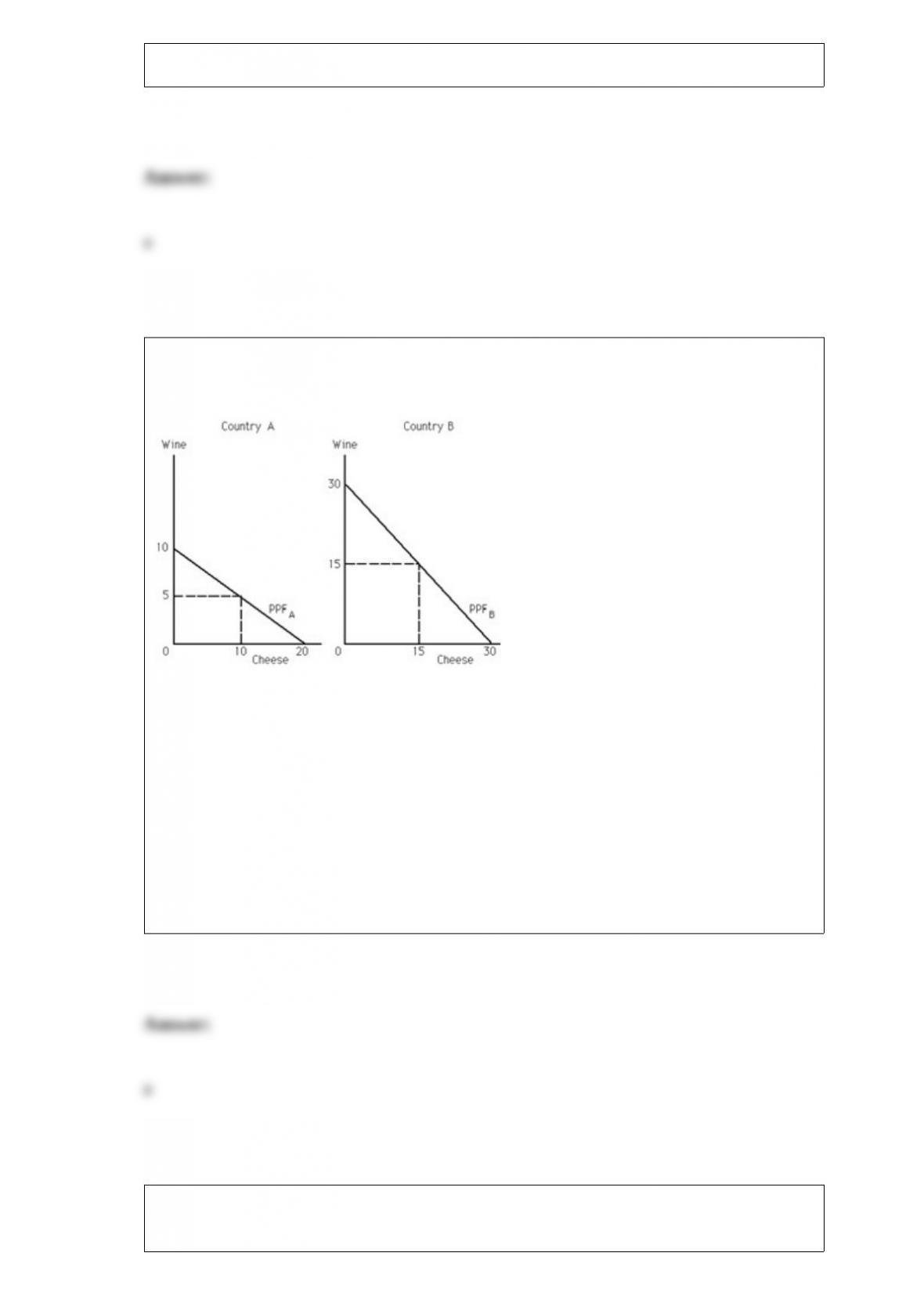
Exhibit 34-6
The opportunity cost of 1 unit of cheese in terms of units of wine is __________ for
country B.
a. 1
b. 5
c. 10
d. 15
A disappearing middle class necessarily connotes a world of only the rich and the poor.

a. True
b. False
A concentration ratio indicates the
a. number of firms in an industry.
b. number of large firms in an industry compared to the number of large firms in
another related industry.
c. percentage of total sales accounted for by the (for example) four largest firms.
d. percentage of sellers in an industry relative to the number of buyers.
e. percentage of sellers in an industry protected by barriers to entry relative to the
number of sellers that wish to enter.
In the U.S., studies have shown that as real incomes have risen, per capita demand for
food has been increasing by a much lower percentage.
a. True
b. False

A politician running for political office does not speak in general terms, does not try to
move to the middle of the political spectrum, and does not take polls, therefore it
follows that
a. the median voter model is wrong.
b. rational ignorance does not exist.
c. the free-rider problem does not exist.
d. voter turnout is likely to rise.
e. none of the above
In relative terms, poverty will always exist
a. regardless of how high the average absolute standard of living is.
b. given an unequal income distribution.
c. unless there is absolute income equality.
d. b and c
e. all of the above

The supply curve for space on a freeway is perfectly vertical at any given point in time.
a. True
b. False
Shirking, being a form of __________, is a good that individuals may consume more of
the __________ its cost.
a. work; higher
b. work; lower
c. leisure; higher
d. leisure; lower
When a perfectly competitive firm incurs losses, it follows that price
a. must be below average total cost.
b. must be below average variable cost.
c. is less than marginal cost.
d. is less than marginal revenue.

In the Texas A & M study of the “buying” behavior of two white rats, as the “relative
price” of one beverage was raised,
a. both white rats began to consume more of the higher-priced beverage.
b. both white rats began to consume less of the higher-priced beverage.
c. one white rat began to consume more of the higher-priced beverage and the other
began to consume less.
d. both white rats continued consuming the same amount of the beverage as before its
price was raised.
e. There was no study done at Texas A & M with white rats.
Consider two straight-line PPFs. They have the same vertical intercept, but curve I is
flatter than curve II. The opportunity cost of producing the good on the horizontal axis
a. is greater along curve I.
b. is greater along curve II.
c. is the same along both curves.
d. cannot be compared for the two curves without more information.

The absolute value of the slope of the budget constraint is also known as the marginal
rate of substitution.
a. True
b. False
The Cellar-Kefauver Antimerger Act of 1950 was designed to
a. prevent one company from acquiring another company’s stock if the acquisition
reduces competition.
b. prevent one company from acquiring another company’s physical assets if the
acquisition reduces competition.
c. require that pending mergers be reported in advance to the Federal Trade
Commission and the Justice Department.
d. prevent price discrimination, exclusive dealing, and tying contracts.
e. prevent interlocking directorates.