
1) It is argued that competitive markets provide a “natural remedy” to discriminatory
wage practices. Which of the following is widely recognized as a potential limit to the
potency of that natural remedy?
a.Governments sometimes mandate discriminatory practices.
b.Some employees have a lot of job experience; others have little job experience.
c.In a discriminatory environment, a competitive firm that takes prices and wages as
given has nothing to gain from any particular choice it makes regarding who to hire or
which customers to serve.
d.Not all firms exhibit social responsibility in sufficient measure to counter
discriminatory wage practices.
2) Refer to Figure 9-18. If Isoland allows international trade, then it will be an exporter
of peaches if and only if the world price of peaches is
a.above $2.
b.below $4.
c.above $4.
d.below $7.
3) For a firm operating in a competitive industry, which of the following statements is
not correct?
a.Price equals average revenue.
b.Price equals marginal revenue.
c.Total revenue is constant.
d.Marginal revenue is constant.
4) The first major piece of antitrust legislation was the
a.Clayton Act.
b.Obama Care Act.
c.Sherman Act.
d.Clinton Act.

5) During the 1990s, the United Kingdom experienced low levels of inflation while
Turkey experienced high levels of inflation. A likely explanation of these facts is that
a.the United Kingdom has a better education system than Turkey.
b.the rate of growth of the quantity of money was slower in the United Kingdom than in
Turkey.
c.workers in Turkey are more productive than workers in the United Kingdom.
d.there are more instances of market power in Turkey than in the United Kingdom.
6) If a country has a lower opportunity cost than its potential trading partner, the
country should decide to be self- sufficient.
a.True
b.False
7) Which of the following is likely to have the most price elastic demand?
a.ice cream
b.frozen yogurt
c.vanilla ice cream
d.H¤agenDazs® vanilla bean ice cream
8) Giffen goods are inferior goods for which the income effect dominates the
substitution effect.
a.True
b.False
9) Consider the labor market for heath care workers. Because of the aging population in
the United States, the output price for health care services has increased. Holding all
else equal, the equilibrium wage of health care employees would
a.increase.
b.decrease.
c.not change.
d.It is not possible to determine what happens to the equilibrium wage.
10) The field of political economy
a.applies the methods of political science to microeconomics.
b.applies the methods of political science to macroeconomics.
c.is relevant to the issue of how active government should be in economic matters.
d.integrates psychological insights to better understand individual choices.
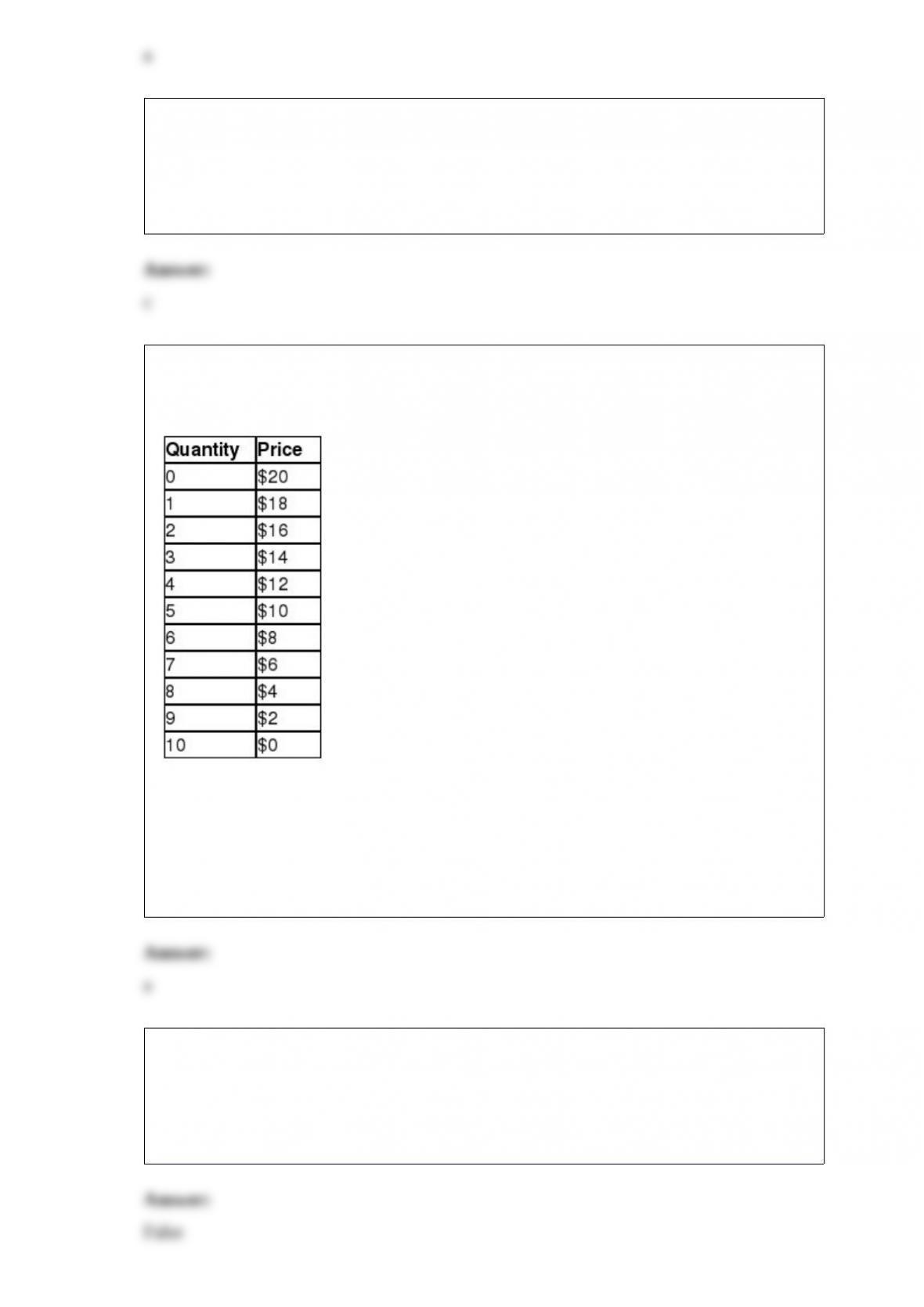
11) Table 15-19
A monopolist faces the following demand curve:
If a monopolist faces a constant marginal cost of $7, how much output should the firm
produce?
a.3 units
b.4 units
c.5 units
d.6 units
12) When a competitive firm hires labor up to the point at which the value of the
marginal product of labor equals the wage, it also produces up to the point at which the
price of output equals average variable cost.
a.True
b.False

13) Harold owns a cranberry bog in which he grows cranberries. Harold’s farm is a
competitive, profitmaximizing firm. As such, Harold much decide
(i)how many cranberries to sell.
(ii)what price to charge for his cranberries.
(iii)what wages to pay his workers.
(iv)how many workers to hire.
a.(i) only
b.(ii) and (iii) only
c.(i) and (iv) only
d.(i), (ii), (iii), and (iv)
14) Scenario 20-4
Suppose the government implemented a negative income tax and used the following
formula to compute a family’s tax liability:
Taxes owed = (1/5 of income) – $15,000
Refer to Scenario 20-4. This negative income tax would guarantee what minimum
level of income to every family?
a.$5,000
b.$10,000
c.$15,000
d.$50,000
15) Production Possibilities for Footville
What is the opportunity cost to Footville of increasing the production of shoes from 400
to 600?
a.400 socks
b.300 socks
c.200 socks
d.100 socks