
Assume that the graph below describes the current labor market for nurses in a
mid-sized city and that the labor market is perfectly competitive.
Suppose that several years ago the supply of nurses in this city was S0. What might
explain the change from S0 to S1?
A. an increase in nurses’ wages
B. a decrease in nurses’ wages
C. increased immigration of people trained as nurses in other countries.
D. increased employment opportunities outside of nursing.
Something that changes incentives so as to make otherwise empty threats or promises
credible is called a:
A. Nash equilibrium.
B. commitment device.
C. strategic device.
D. dominant strategy.

In the long run, in a perfectly competitive industry:
A. economic profit tends to persist.
B. the number of firms in the industry will increase.
C. economic loss tends to persist.
D. economic profit and loss are driven to zero by entry and exit.
The figure below shows a single consumer’s demand for ice cream at the student union.
During a regular semester, there are 500 students on campus. Each student’s weekly
demand for ice cream is shown above. When the price of ice cream is $2.00 per scoop,
those 500 students purchase a total of _____ scoops per week from the student union.
A. 2,000
B. 2,500
C. 3,000
D. 5,000

A labor contract provides for a first-year wage of $10 per hour, and specifies that the
real wage will rise by 3 percent in the second year of the contract. The CPI is 1.00 in
the first year and 1.07 in the second year. What dollar wage must be paid in the second
year?
A. $10.30
B. $10.70
C. $10.90
D. $11.02
The figure below depicts the short-run market equilibrium in a perfectly competitive
market and the cost curves for a representative firm in that market. Assume that all
firms in this market have identical cost curves.
In the long run equilibrium in this market:
A. price will equal $5, and there will be 20 firms in the industry.
B. price will equal $5, and there will be 10 firms in the industry.
C. price will equal $8, and there will be 20 firms in the industry.
D. price will equal $5 and total output will equal 500 units, but there is not enough
information to determine how many firms will be in the industry.

Refer to the figure below. If the Federal Reserve wants to set the nominal interest rate at
1%, it must conduct open market ______ to set the money supply at _____.
A. purchases; 300
B. sales; 100
C. purchases; 900
D. sales; 900
If prices in the current year are higher on average than in the base year, real GDP in the
current year ______ nominal GDP in the current year.
A. is greater than
B. is less than
C. is equal to
D. could be greater than or less than

To produce 150 units of output, a firm must use 3 employee-hours. To produce 300
units of output, the firm must use 8 employee-hours. Apparently, the firm is:
A. producing in the long run.
B. experiencing diminishing returns.
C. not using any fixed factors of production.
D. experiencing negative returns.
Kate and Ali can live together a two-bedroom apartment for $600 per month, or they
can each rent a one-bedroom apartment for $400 per month. Apart from the rent, they
are indifferent between living together and living apart, except for one problem: Kate
hates Ali’s taste in music. Kate would be willing to pay up to $100 a month to avoid
hearing Ali’s music. Ali would give up listening to her music for no less than $300 per
month. Which, if any, of the following ways of splitting the total monthly rent would
induce them to live together?
A. Kate pays $150 per month and Ali pays $450 per month
B. Kate pays $250 per month and Ali pays $350 per month
C. Kate pays $375 per month and Ali pays $125 per month
D. There is no way to split the rent to induce them to live together

The money supply in Macroland is currently 2,500, bank reserves are 200, currency
held by public is 500, and banks’ desired reserve/deposit ratio is 0.10. Assuming the
values of the currency held by the public and the desired reserve/deposit ratio do not
change, if the Central Bank of Macroland wishes to increase the money supply to 3,000,
then it should conduct an open-market ______ government bonds.
A. purchase of 50
B. purchase of 250
C. sale of 500
D. sale of 50
It is spring, and several graduates of State U are seeking employment. State U graduates
have evenly distributed GPAs, from 2.0 to 4.0, with an average GPA of 3.0. The largest
employer in town, Acme Dynamite, is interviewing candidates, hoping to hire a few
hard workers. While Acme does not require students to submit a transcript with their
applications, the hiring officer believes that high GPAs signal a willingness to work
hard. Jordan is a recent graduate and is applying for a job with Acme. Jordan’s GPA is
3.3. Should Jordan include a transcript with her job application?
A. No, because it is not required.
B. Yes, because if she does not, Acme will infer that her GPA is 3.0 or lower.
C. No, because her GPA is not much better than average.
D. No, because it will make Jordan look worse relative to those with higher grades.
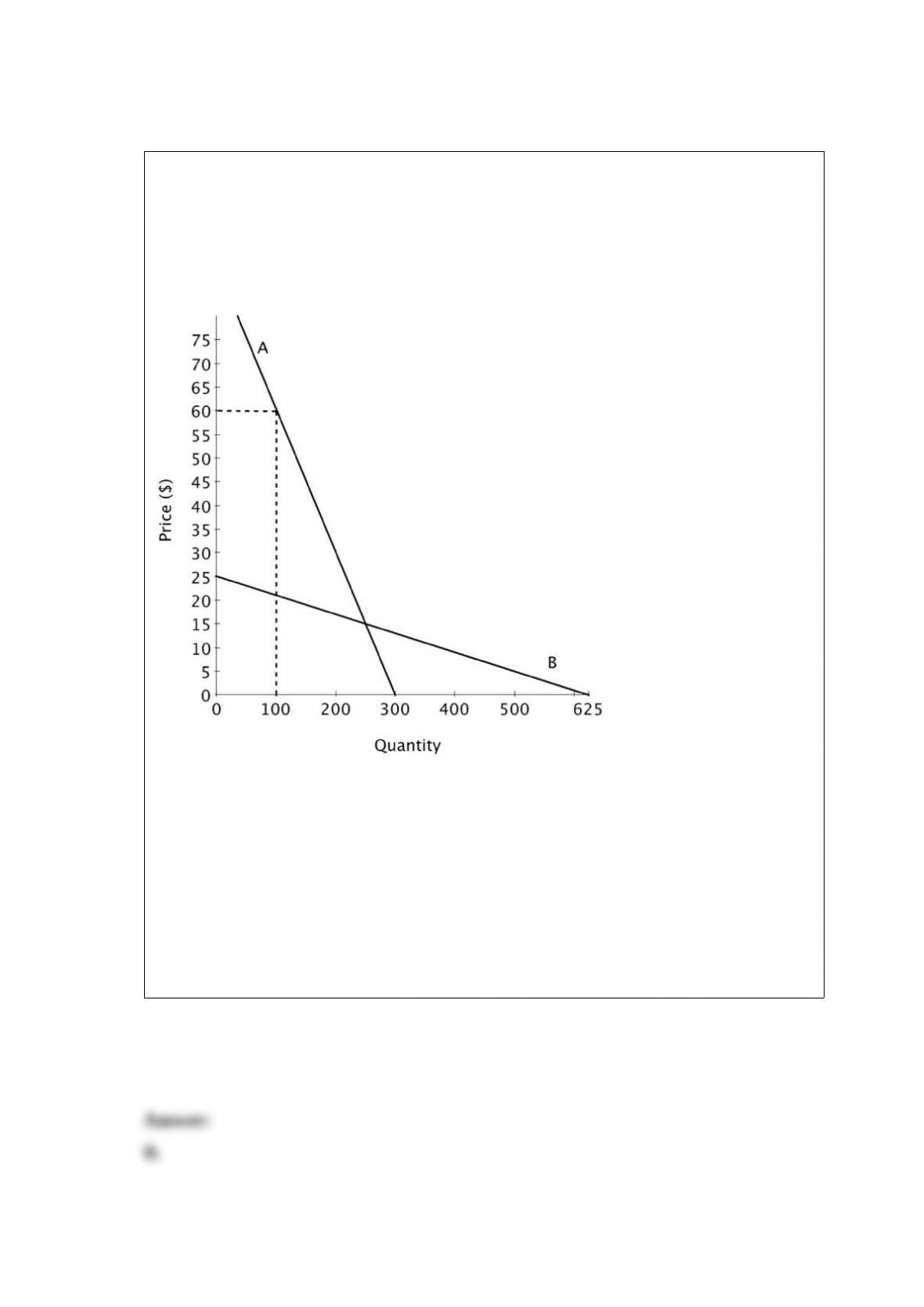
Suppose that a new drug has been approved to treat a life-threatening disease. The
demand for that drug is shown on the graph below. Prior to approval of this drug, the
only treatment for this condition was any one of several non-prescription, or
over-the-counter, pain relievers. The demand for one brand of the several
non-prescription pain relievers is also shown on the graph.
At a price of $15 (the price at which the two demand curves intersect), the price
elasticity of demand for the new drug is ______ the price elasticity of demand for the
over-the-counter pain reliever.
A. greater than
B. less than
C. the same as
D. the reciprocal of
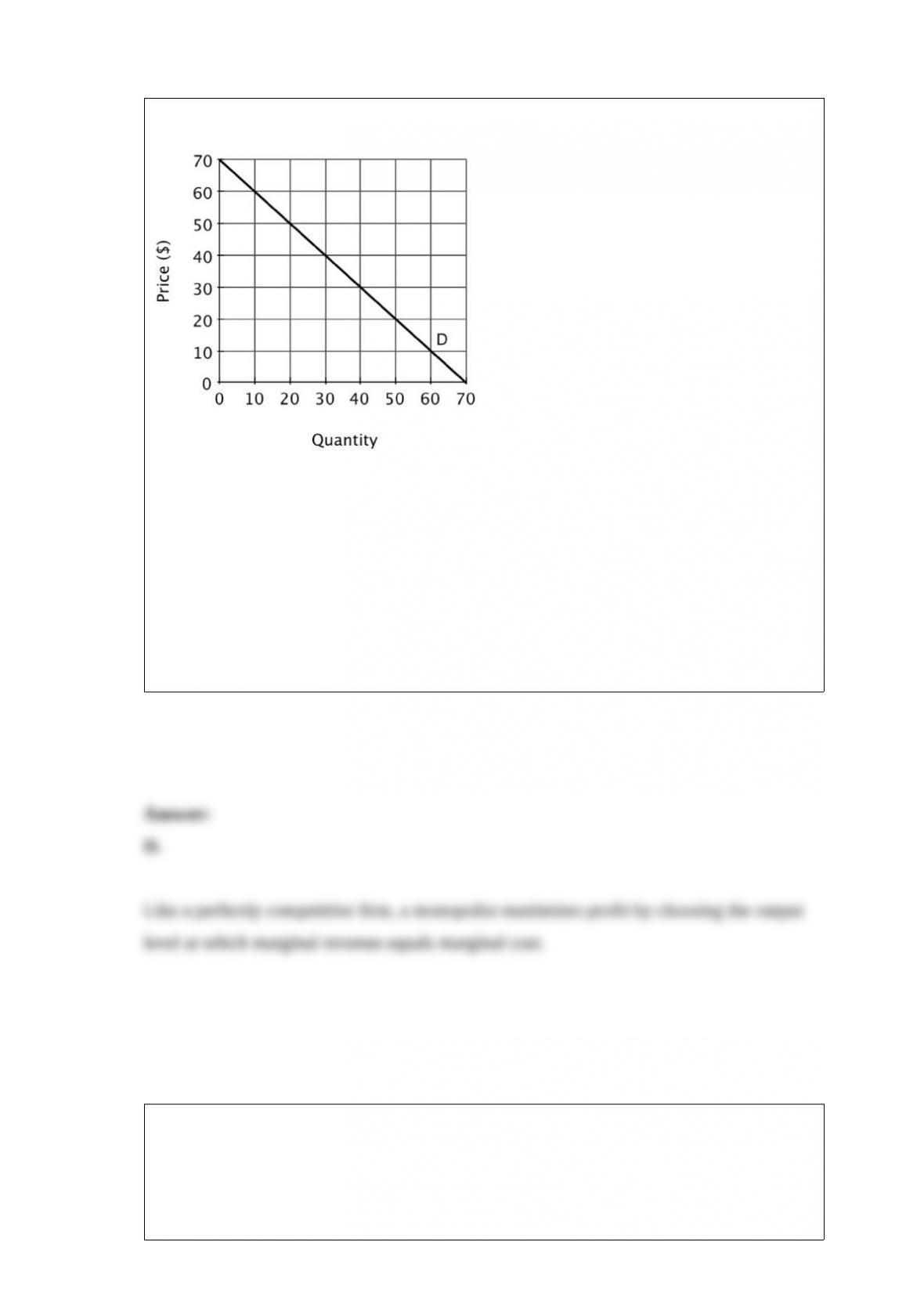
Suppose a monopolist faces the demand curve shown below.
The monopolist maximizes its profits by:
A. charging $70 for each unit.
B. producing 35 units, since this is where total revenue is maximized.
C. producing the level of output at which marginal revenue minus marginal cost is
greatest.
D. producing the level of output at which marginal revenue equals marginal cost.
Assume that the production technology required to produce goods X and Y are very
similar. If a firm that is producing good X notices that the market price of good Y is
rising, it will:
A. intensify its production of good X.

B. shift into producing good Y.
C. anticipate a price increase for good X.
D. charge a higher price for good X.
In the past, some governments’ budget deficits became so large that they could not raise
sufficient taxes to finance the spending, so they ______, which led to ______.
A. reduced the amount of currency held by the public; a smaller money supply
B. increased bank reserves; a larger reserve/deposit ratio
C. printed large quantities of paper money; hyperinflation
D. ordered the central bank to sell government bonds; an increase in the money supply
Extremely rapid rates of money growth are usually the result of:
A. rapid population growth.
B. excessively high interest rates.

C. large government budget deficits.
D. sharp increases in productivity.
If the price elasticity of demand for pineapples is 0.75, then a 4% increase in the price
of pineapples will lead to a:
A. 3% decrease in the quantity of pineapples demanded.
B. 3% increase in the quantity of pineapples demanded.
C. 0.75% decrease in the quantity of pineapples demanded.
D. 0.75% increase in the quantity of pineapples demanded.
In a competitive labor market, if a firm pays a worker less than that worker’s VMP, then
in the long run:
A. the firm will earn positive economic profits.
B. competing firms will hire the worker away.

C. the worker will have no incentive to work hard.
D. the supply of workers will fall.
You read online that, at current rates of production, the yearly world supply of food is
sufficient to feed the projected 2050 population of earth, but that after 2050 there will
be massive starvation. This prediction appears to assume that:
A. the long-run supply of food is perfectly elastic.
B. the long-run supply of food is perfectly inelastic.
C. the short-run supply of food is perfectly elastic.
D. the short-run elasticity of supply of food is greater than long-run elasticity of supply.
The overconsumption of medical care due to first-dollar health insurance coverage is:
A. larger the lower the elasticity of demand for medical care.
B. smaller the higher the elasticity of demand for medical care.

C. larger the higher the elasticity of demand for medical care.
D. small regardless of the elasticity of demand for medical care.
A labor union in alabor market is analogous to a(n) ______ in an output market.
A. monopsony
B. oligopoly
C. cartel
D. perfect competitor
Suppose that the price of doughnuts decreases and that doughnut-holes are a by-product
of producing doughnuts. One would expect:
A. the supply of doughnuts to decrease.
B. the quantity supplied of doughnuts to decrease.
C. the supply of doughnut-holes to increase.
D. the quantity supplied of doughnut-holes to increase.

Entry into a perfectly competitive industry to occurs whenever:
A. accounting profit is equal to zero.
B. accounting profit is greater than zero.
C. economic profit is greater than zero.
D. economic profit is equal to zero.
If a given production combination is known to be attainable, then it:
A. must be on the production possibilities curve.
B. must be an inefficient point.
C. must be an efficient point.
D. could be either an inefficient or efficient point.

Larger increases in the demand for labor than in the supply of labor explain:
A. the substantial increase in real wages.
B. the slowdown in real wage growth.
C. increasing wage inequality.
D. skill-biased technological change.
Which of the following is NOT necessarily true in a market equilibrium?
A. Price represents the value of an extra unit of consumption.
B. Both rich and poor have adequate access to the good.
C. Price represents the cost of an extra unit of production.
D. All mutually beneficial trades have been made.

Diminishing returns to capital is a consequence of firms’ incentives to use each piece of
capital as productively as possible and illustrates the:
A. principle of comparative advantage.
B. principle of increasing opportunity costs.
C. scarcity principle.
D. cost-benefit principle.
In general, individuals and nations should specialize in producing goods ______ other
individuals or nations.
A. that they can produce more quickly than
B. that they can produce less quickly than
C. for which they have a lower opportunity cost compared to
D. for which they have a higher opportunity cost compared to

An expansion is:
A. a period in which the economy is growing at a rate significantly below normal.
B. a period in which the economy is growing at a rate significantly above normal.
C. the high point of economic activity prior to a downturn.
D. the low point of economic activity prior to a recovery.
The rise in average living standards experienced by most industrialized countries:
A. has been continuous over the course of human history.
B. was more rapid before 1870 than after 1870.
C. has been more rapid since 1950 than before 1950.
D. has resulted primarily from an increase in population worldwide.

A decision tree is used when modeling:
A. any type of game.
B. simultaneous decisions.
C. a prisoner’s dilemma.
D. games in which timing matters.
The table below shows a pizzeria’s fixed cost and variable cost at different levels of
output. Pizza’s sell for $20 each.
When the pizzeria makes 100 pizzas a day, its fixed cost is ______ and its total cost is
______.
A. $350; $850
B. $500; $850
C. $500; $1,350
D. $850; $1,650

Fran runs a doughnut shop in a tiny 3-person town. The table below shows the quantity
demand by the three townspeople at various prices.
When the price of a doughnut is 25 cents, what is the market demand for doughnuts?
A. 9 doughnuts
B. 13 doughnuts
C. 16 doughnuts
D. 20 doughnuts