
If the Fed accommodates a leftward shift in the aggregate supply curve
a. real output will fall.
b. the price level will rise considerably.
c. the aggregate demand curve will shift downward to the left.
d. the Phillips curve will shift downward to the left.
e. inflationary pressures will rapidly die out.
In the United States about 90 percent of all goods and services are produced by
a. the government.
b. consumers.
c. unions.
d. firms.
e. nonprofit organizations.
The crude quantity theory is a useful predictor of long-term trends in
a. government spending.

b. taxes.
c. price levels.
d. unemployment.
e. business expectations.
Supply-side measures pushed through Congress by the Reagan administration include
a. proposals to decrease the money supply.
b. changes limiting the protection afforded by our patent laws.
c. a 25 percent cut in the personal income tax and accelerated depreciation of plant and
equipment.
d. “comparable worth” laws to ensure equal pay.
e. laws limiting the rate of interest that may be charged on loans for investment
purposes.
The standard of living in the industrialized nations has improved dramatically over the
past two centuries despite Malthus’s dismal predictions. Malthus’s most important
mistake was to

a. underestimate the extent of technological change.
b. ignore the benefits of free trade between nations, as witnessed by his advocacy of the
Corn Laws.
c. believe that the capital stock would remain at a constant level due to a lack of
incentives for expansion.
d. ignore the potential for expanding actual output to the level of full-employment
output.
e. ignore the effects of population increase.
It is argued that short-run aggregate supply curves slope upward to the right because
a. short-run price levels are inversely related to individual product prices.
b. falling profits force firms to increase prices.
c. in the short run, wages and raw material prices tend to rise less rapidly than product
prices.
d. as price rises, demand falls.
e. increases in aggregate supply cause prices to rise.
Among the reasons cited for the productivity slowdown in our society is the
a. increased rate of incorporating new technology in capital equipment.
b. change in the composition of both the labor force and national output.

c. increased rate of growth of the capital-labor ratio.
d. devotion of too great a share of our resources to research and development.
e. increase of resource mobility and competitiveness in our market economy.
For an employer, profits are maximized when the
a. price of the product exceeds the price of labor.
b. marginal product of labor is greater than its price.
c. price of labor equals the price of all other inputs.
d. value of labor’s marginal product is equal to the price of the product.
e. price of labor equals the value of its marginal product.
Under free trade, as long as there are international differences in the price of a good, the
a. good will be exported by the country where its price is relatively high.
b. price will continue to rise in both the importing and exporting countries.
c. price will fall in the exporting country and rise in the importing country.

d. good will be imported by the country where the price is relatively high.
e. quantities being imported must be greater than the quantities being exported.
Requiring deposits on soft drink containers is an example of using the price system to
eliminate an external diseconomy because
a. consumers prefer throwaway cans.
b. it shifts pollution costs from individuals to society.
c. it makes the drinker pay for the disposal costs of the can.
d. the deposit allows the financing of trash baskets.
e. the private costs exceed the social costs.
The following questions are based on the following diagram:
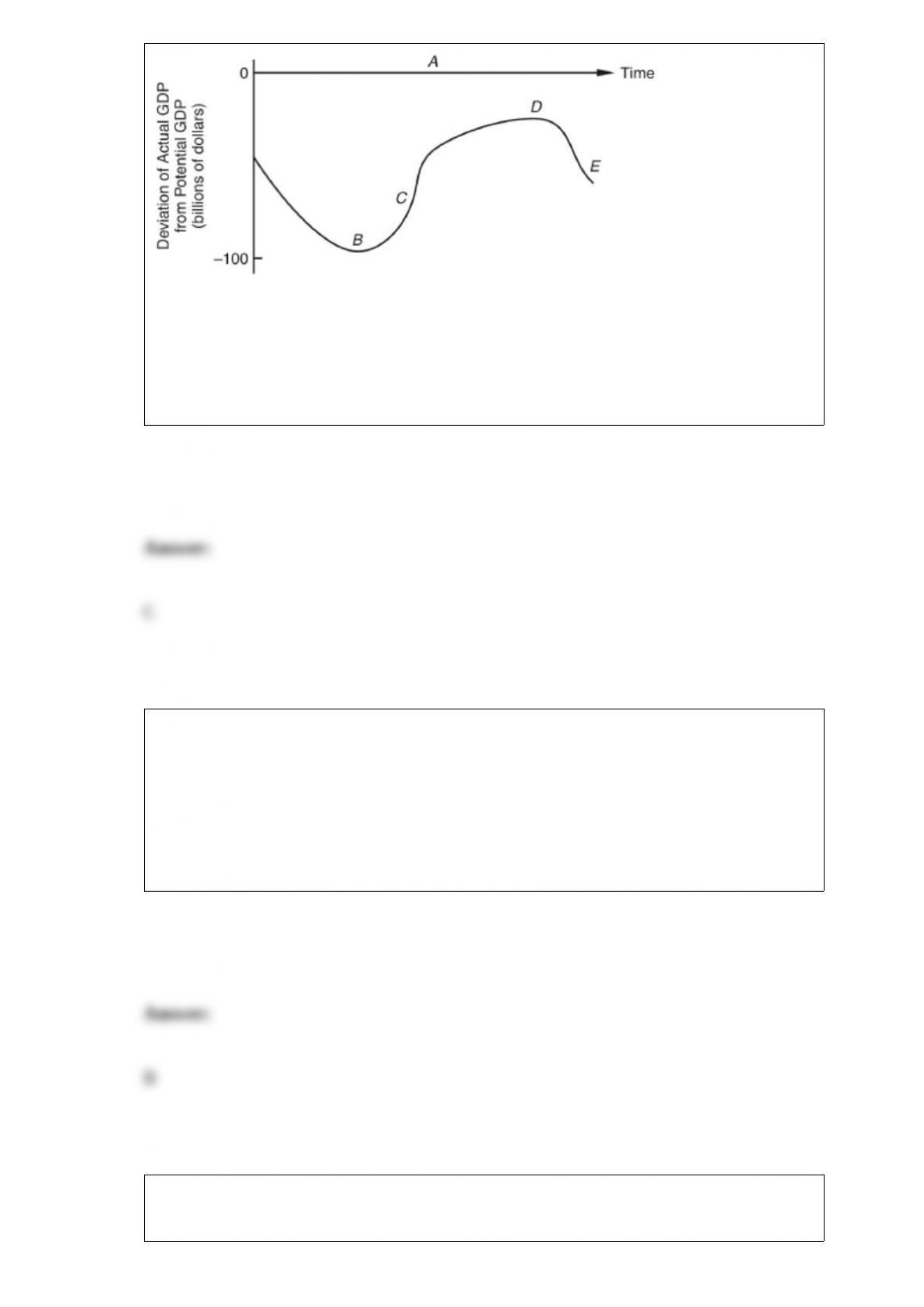
The expansion phase of the cycle is best characterized by letter
a. A.
b. B.
c. C.
d. D.
e. E.
In general, a business cycle goes through its phases in the following sequence:
a. trough, peak, expansion, recession.
b. recession, trough, expansion, peak.
c. trough, recession, expansion, peak.
d. trough, expansion, recession, peak.
e. expansion, recession, trough, peak.
Money is demanded in the form of loanable funds because it

a. possesses intrinsic value.
b. can provide command over resources.
c. is not as liquid as other forms of capital.
d. grows in value as it is held over time.
e. has no opportunity costs associated with holding it.
Printed circuits used in the production of computers are an example of a(n)
a. transfer payment.
b. base transaction.
c. secondhand good.
d. intermediate good.
e. nonmarket transaction.
The business cycle
a. tends to be regular in length and amplitude.
b. has little or no impact on the price level.
c. is in the recession phase when national output is rising to its potential level.

d. has higher rates of unemployment at the trough than at the peak.
e. has been a rare phenomenon since World War II.
Social Security taxes are considered to be regressive because they tax
a. wages up to a cap; thus, those with earnings above the cap pay a smaller proportion
of their incomes than those who earn less.
b. corporate profits more heavily than other forms of income, since firms pay Social
Security payroll taxes.
c. all forms of income, earned and unearned, forcing poor people on welfare to pay
taxes on their welfare income.
d. everyone including the unemployed, and most retired people are considered
unemployed.
e. workers at higher rates than the rates paid out to those who are retired so that
individuals can never get back more than they contributed to the fund.
Approximately what percentage of their income do U.S. households spend on taxes?
a. 8 percent
b. 11 percent
c. 23 percent

d. 32 percent
e. 46 percent
The pollution of streams and the atmosphere indicates
a. artificially low prices for these resources.
b. the quantities supplied exceed the quantities demanded of these resources.
c. the presence of excessive amounts of direct regulation regarding waste disposal.
d. that the private costs of production exceed the social costs of production.
e. the presence of external economies.
On December 5, 1996, Fed chair Alan Greenspan voiced concern over escalating asset
values brought about by what he termed
a. conspicuous consumption.
b. fine tuning.
c. the invisible hand.
d. rational expectations.

e. irrational exuberance.
A production possibilities curve illustrates
a. opportunity costs.
b. a market.
c. principles of taxation.
d. income distribution.
e. the circular flow.
The real wage
a. equals the amount of goods and services that can be bought with the money wage.
b. is the amount of money received per unit of time.
c. unlike the money wage, is unaffected by changes in the price level.
d. rises faster than the money wage as the price level rises.
e. is the money wage adjusted for changes in real output.

A contemporary economist closely associated with the hypothesis of rational
expectations is
a. Milton Friedman.
b. John Muth.
c. John Maynard Keynes.
d. Franco Modigliani.
e. Paul Samuelson.
It is argued that measures taken to reduce inequality may decrease economic efficiency
because
a. poor people are inherently unproductive.
b. it will lead to opportunities for poor people to gain advanced education and training.
c. it is more efficient to produce the goods and services that rich people buy.
d. it will increase saving at the expense of consumption and thereby lower output.
e. people will have less incentive to produce if their incomes are unrelated to their
productivity.

As a result of government borrowing, private sector borrowing is
a. unaffected.
b. reduced by $100 billion.
c. reduced by $200 billion.
d. reduced by $300 billion.
e. reduced by $500 billion.
The law of diminishing marginal utility implies that
a. as people consume more and more goods, their happiness diminishes.
b. a person’s satisfaction declines as more and more of a particular good is consumed.
c. a person’s satisfaction rises indefinitely as additional units of a commodity are
consumed.
d. increases in a person’s satisfaction eventually decline as more and more units of a
commodity are consumed.
e. as a person’s income rises, consumption of all commodities falls.

According to the Markets and Prices video, the 1960s and 1970s development that
enabled the U.S. steel industry to match the price of foreign steel producers for certain
products was the
a. mini-mill.
b. integrated steel mill.
c. blast furnace.
d. use of ingot technology.
e. discovery of new, high-grade ore deposits in the upper Midwest.
If the ratio of the marginal product of labor to the marginal product of land is 1:3, a firm
making an optimal input combination should
a. employ three times as many workers as land units.
b. employ one-third as many workers as land units.
c. pay each worker three times as much as the price of a unit of land.
d. pay each worker one-third as much as the price of a unit of land.
e. use the same number of workers as units of land and pay each worker the same price
as a unit of land.

One notable characteristic of a public good is that
a. its production incurs no economic costs.
b. consumers can easily be denied its benefits.
c. it is automatically produced by the free market price system.
d. it can be consumed collectively.
e. consumers may readily divide it into individual pieces and distribute it among
themselves.
If commercial banks have no excess reserves and the Fed sells government securities
a. the money supply will expand and interest rates will fall.
b. total demand deposits in the banking system will fall by some multiple of the bond
sale.
c. the size of the money supply will not change but its composition will.
d. the required reserve ratio will increase.
e. banks will gain excess reserves equal to the amount of bonds sold.

The following questions are based on the following table:
Technique Number of labor hours Number of machine hours
A 1 6
B 2 4
C 5 2
D 10 1
A firm is able to purchase 1 unit of raw material for $2 and convert that unit into a
finished product that sells for $25. Four production techniques are available, as shown
in the table. If labor costs $1 per hour and machine time costs $3 per hour, the firm
should
a. use technique A.
b. use technique B.
c. use technique C.
d. use technique D.
e. not produce at all.
Economic problems arise because
a. the number of free resources is quite limited.
b. human wants and desires are limited.
c. the world’s population is not growing as fast as output is expanding.
d. there is too much money in the world.

e. too many people are self-sufficient and thus do not produce enough.
The two approaches to antitrust policy are market
a. conduct and market structure.
b. size and market scope.
c. concentration and market disintegration.
d. power and market monopoly.
e. merger and market shares.
Pure oligopoly differs from differentiated oligopoly in that
a. the products of pure oligopolists are identical.
b. the pure oligopolist has greater power over price.
c. pure oligopolists are more likely to advertise.
d. entry into the product group is relatively easy for the pure oligopolist.
e. only the pure oligopolist faces a downward-sloping demand curve.