1) the advantages of the corporate form of business include:
a.the ability to raise financial capital by selling stocks and bonds.
b.the fact that owners are subject to unlimited liability.
c.the elimination of the principal-agent problem.
d.single taxation of corporate earnings.
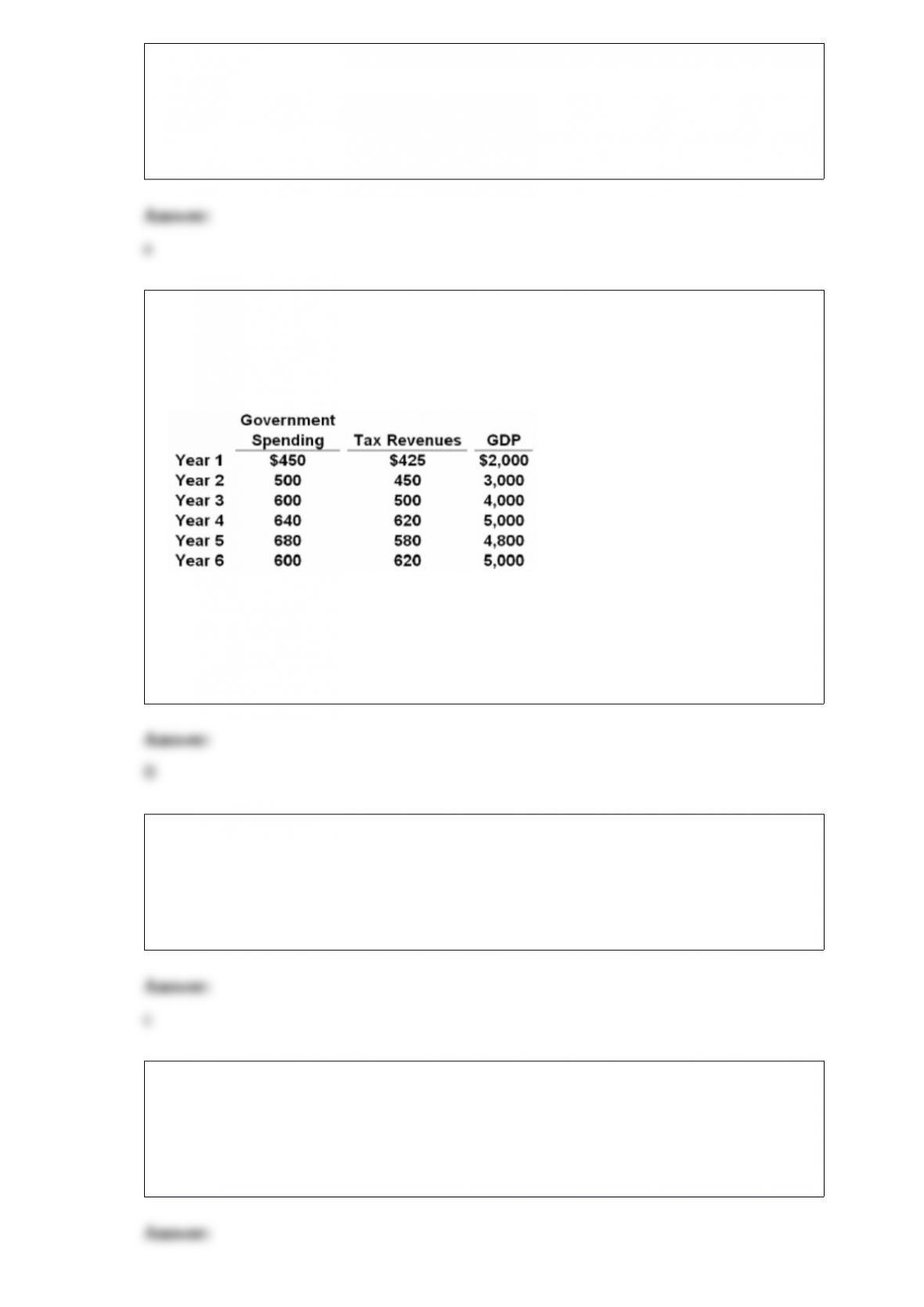
2) Answer the next question(s) using the following budget information for a
hypothetical economy. Assume that all budget surpluses are use to pay down the public
debt.
Refer to the above data. As a percentage of GDP, the:
A.budget deficit was 3.9 percent in year 4.
B.budget surplus was less than 1 percent in year 6.
C.public debt was 3 percent in year 6.
D.public debt was 12.5 percent in year 1.
3) the total-revenue test for elasticity:
a.is equally applicable to both demand and supply.
b.does not apply to demand because price and quantity are inversely related.
c.does not apply to supply because price and quantity are directly related.
d.applies to the short-run supply curve, but not to the long-run supply curve.
4) most economists agree that the immediate cause of most business cycle variation is:
a.an unexpected change in the productivity of workers.
b.an unexpected change in the level of total spending.
c.the invention of new products.
d.the growth and subsequent bursting of financial bubbles.

5) Which of the following is an asset on the consolidated balance sheet of the Federal
Reserve Banks?
A.loans to commercial banks
B.Federal Reserve Notes in circulation
C.Treasury deposits
D.reserves of commercial banks
6) Suppose that a firm introduces a highly profitable new product. If this new product is
priced higher than existing substitute products, then the:
A.new product has greater marginal utility than the existing products.
B.laws of economics have been violated.
C.new product must have increasing, not diminishing, marginal utility.
D.existing products were unprofitable to produce.
7) which of the following best measures improvements in the standard of living of a
nation?
a.growth of nominal gdp
b.growth of real gdp
c.growth of real gdp per capita
d.growth of national income
8) (Advanced analysis) Answer the next question(s) on the basis of the following
information for a private open economy:
Refer to the above information. International trade in this case:
A.has an expansionary effect on GDP.
B.has a contractionary effect on GDP.
C.has no effect on GDP.
D.is causing inflation in this economy.
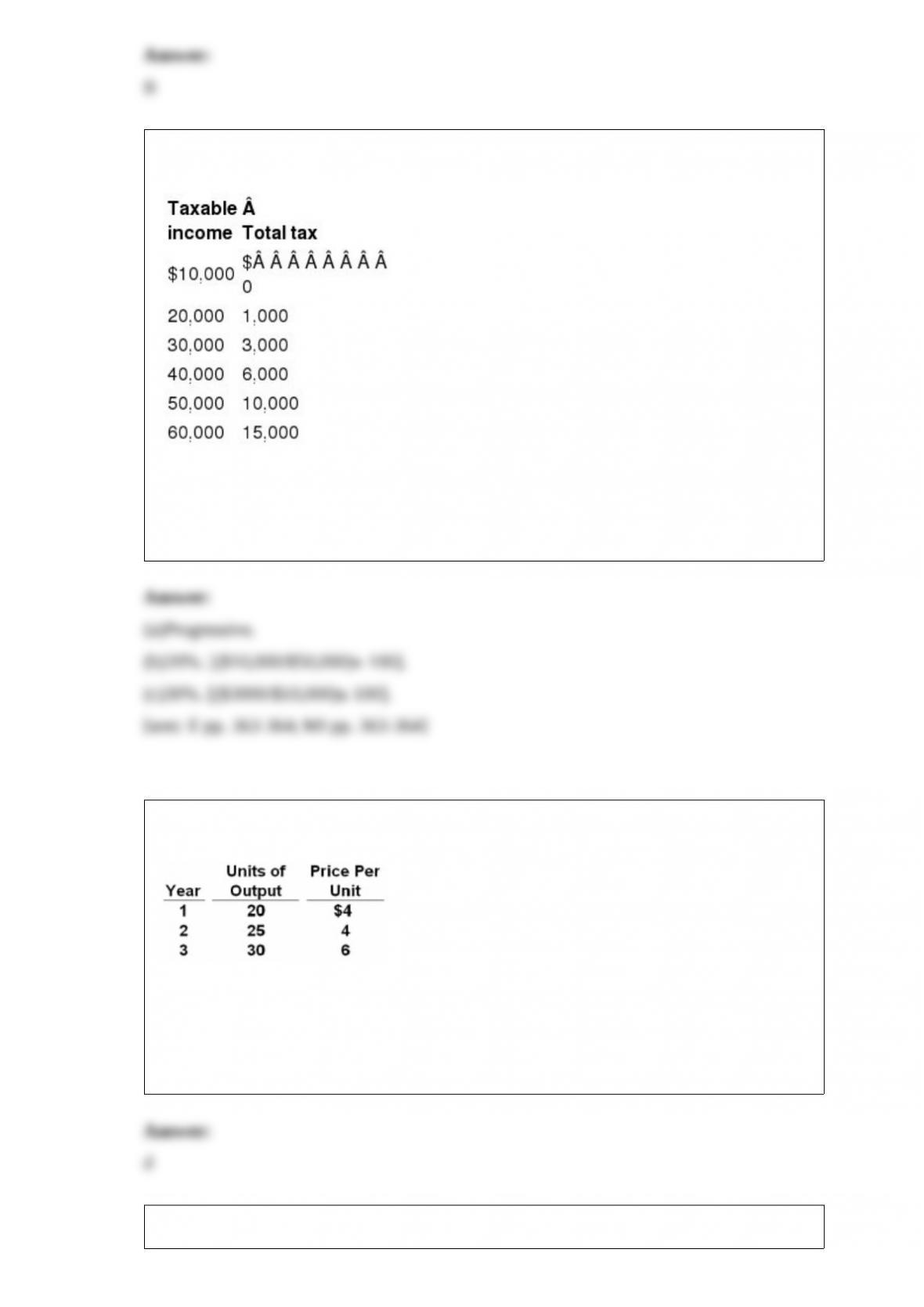
9) Answer the next three questions on the basis of the following data:
(a)What type of tax is represented by the tax schedule?
(b)What will your average tax rate be if your taxable income is $50,000?
(c)If your taxable income increases from $30,000 to $40,000, what will your marginal
tax rate be?
10) assume an economy that is producing only one product. output and price data for a
three-year period are as follows. answer the next question(s) on the basis of these data.
refer to the above data. if year 2 is chosen as the base year, real gdp for year 1 is:
a.$25.
b.$100.
c.$20.
d.$80.
11) Inclusive unionism is practiced mostly by:

A.professional and semiprofessional employees.
B.small unions comprised of skilled workers, such as the bricklayers.
C.industrial unions.
D.craft unions.
12) (consider this) the economic perspective used in customer decision making at
fast-food restaurants is reflected in:
a.customers selecting the shortest line.
b.decisions for which marginal costs exceed marginal benefits.
c.all customer lines tending to be of different length.
d.irrational purchasing of high-fat-content food.