
The demand and supply of movie tickets are given by QD = 30 ” 3P and QS = 4P ” 19,
where P is the price per ticket and Q measures thousands of tickets. If the government
places a $1 tax on each ticket, the prices that consumers pay with and without the tax
are ______ and ______, respectively.
A) $8; $7
B) $7.57; $7
C) $7.50; $6.80
D) $4.30; $3.80
There are 100 consumers in the market for good X, each with a demand curve given by
Q = 2/P. What is the market demand curve for good X?
A) QM = 0.5P
B) QM = 200 ” 200P
C) QM = 1/50P
D) QM = 200/P
Figure 12.10
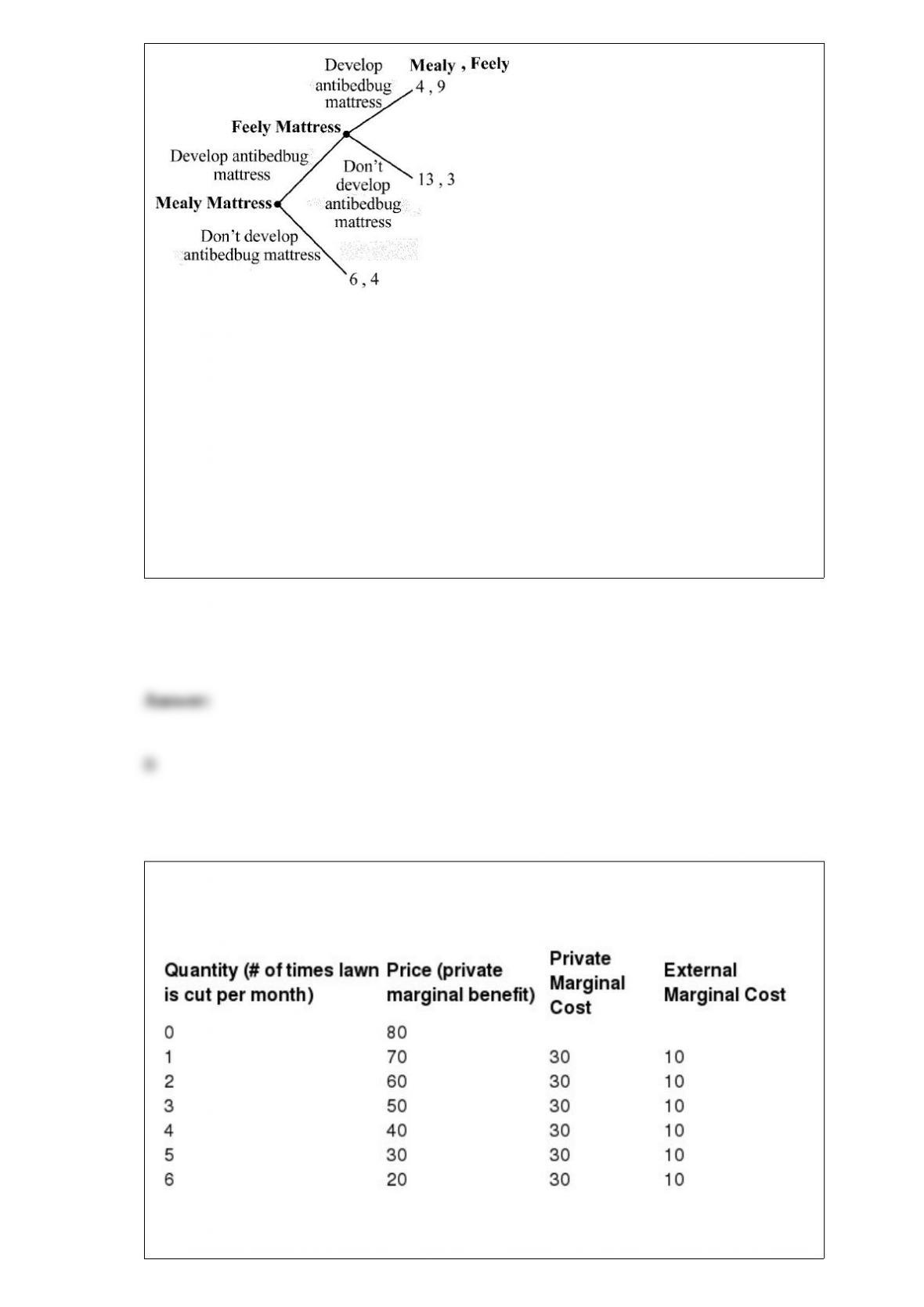
(Figure 12.10) In the figure, payoffs are profits in millions of dollars. Suppose that
Feely cannot develop an antibedbug mattress because of Mealy’s patented technology.
Should Mealy develop and release its antibedbug mattress?
A) Yes, Mealy will earn $4 million and Feely will earn $9 million.
B) Yes, Mealy will earn $13 million and Feely will earn $3 million.
C) Yes, Mealy will earn $6 million and Feely will earn $4 million.
D) No, Mealy will earn larger profits by not releasing the mattress.
Table 16.4
(Table 16.4) Answer the following questions.
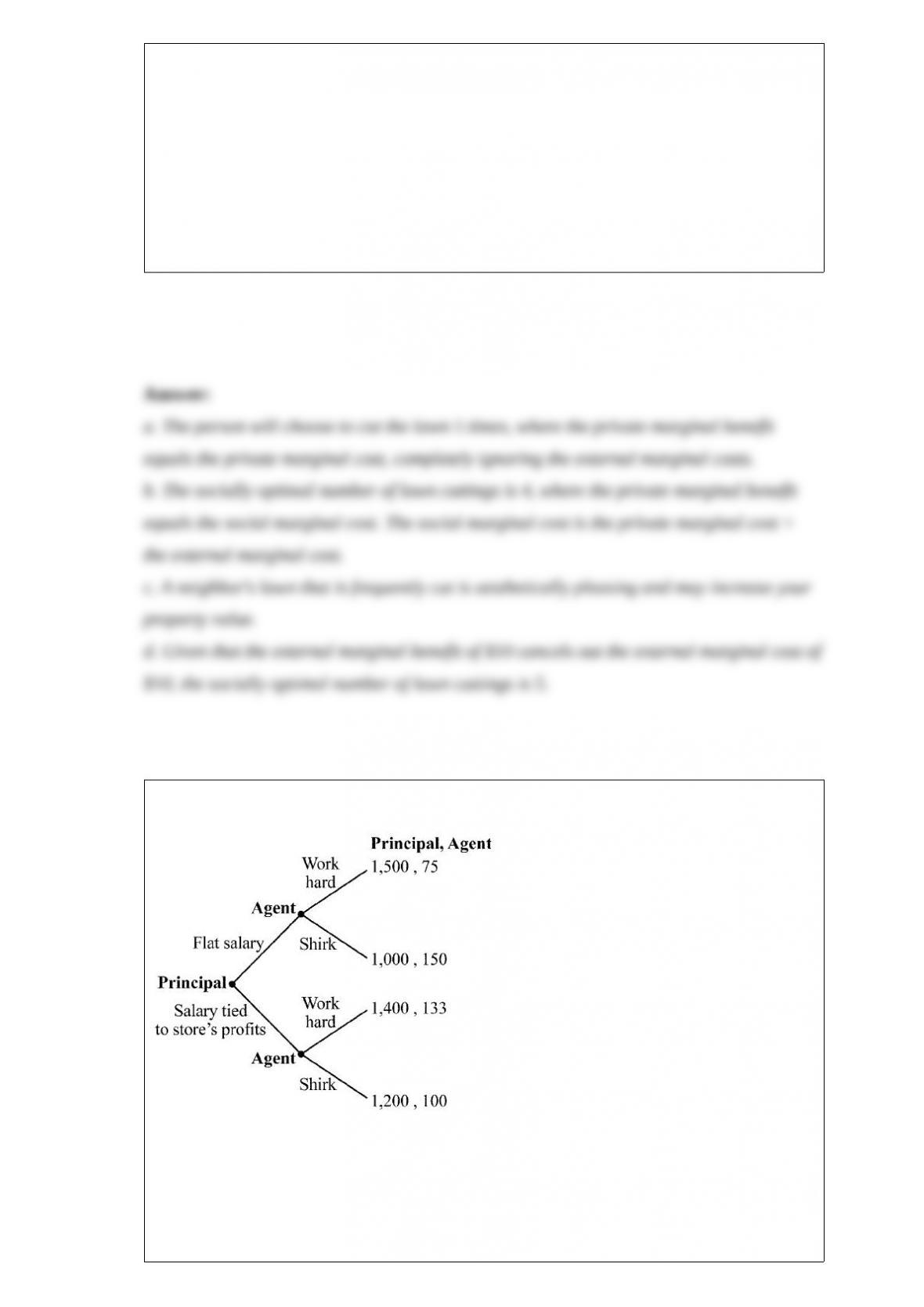
a. How many times will a self-interested person cut her lawn during the month?
b. What is the socially optimal number of times that the lawn should be cut?
c. How might lawn cutting create positive externalities?
d. Besides creating external marginal costs, suppose that lawn cutting also creates an
external marginal benefit of $10. What now is the socially optimal number of times that
a lawn should be cut?
Figure 15.4
(Figure 15.4) If the principal chooses a flat salary, the agent will ______ and earn a
payoff of ______.
A) shirk; 150

B) shirk; 75
C) work hard; 133
D) work hard; 100
The presence of capital rental markets gives firms:
A) the ability hire more labor in periods of high demand by keeping capital costs fixed.
B) reduced flexibility in substituting among various labor and capital inputs.
C) the ability to hire more capital in periods of high demand by keeping capital costs
fixed.
D) the flexibility to adjust their capital usage based on output levels, making capital
costs variable.
Figure 12.4
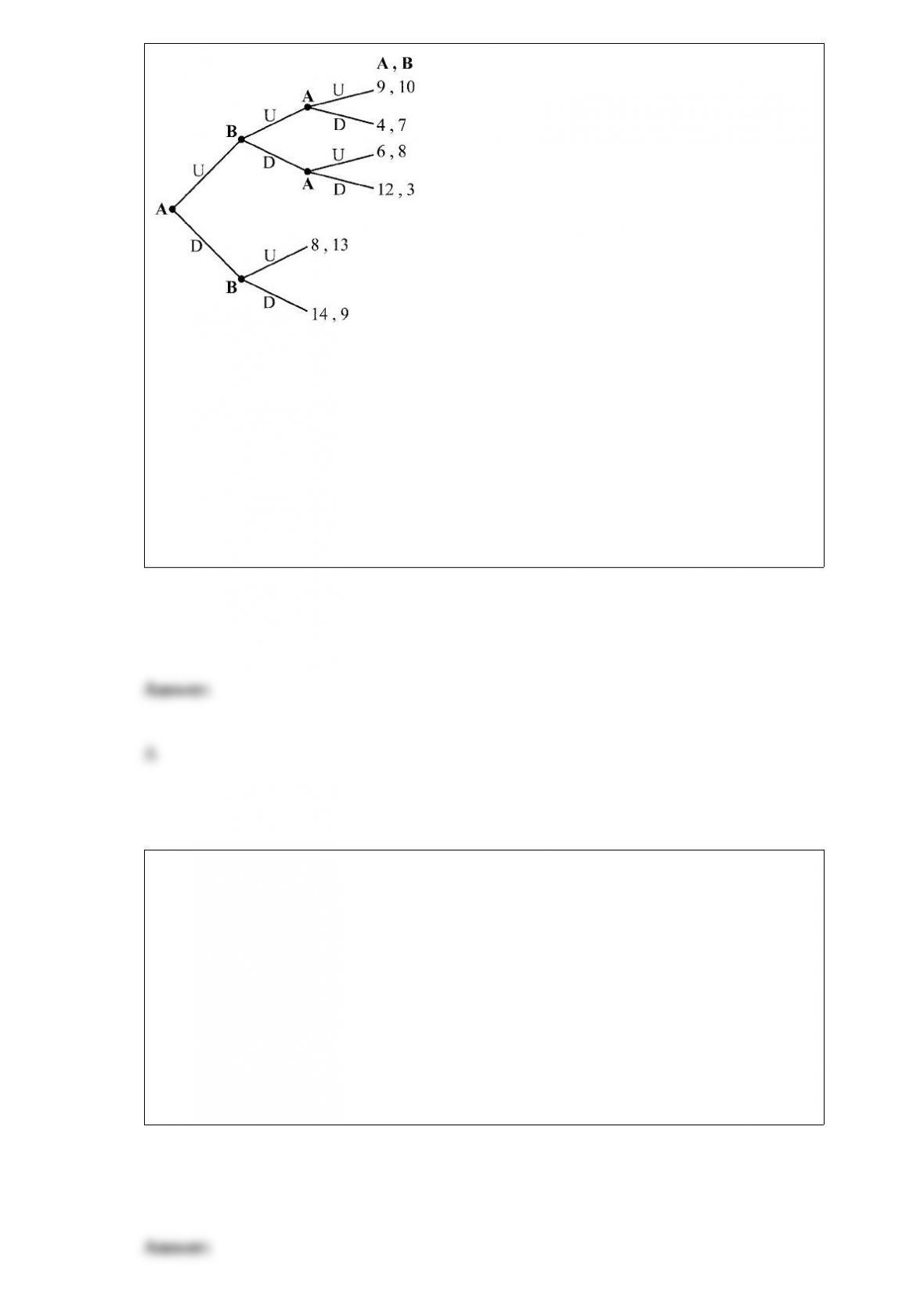
(Figure 12.4) The outcome of this game is:
A) (9, 10).
B) (14, 9).
C) (6, 8).
D) (12, 3).
Suppose that good X and goodY are substitute goods and good X and good Z are
complement goods. When the price of a good Y _____ or the price of good Z _____, the
demand for good X shifts outward.
A) increases; decreases
B) increases; increases
C) decreases; decreases
D) decreases; increases
The market for good X consists of only two consumers; their demand curves are given
by Q = 10 ” 0.10P and Q = 5 ” 0.10P. What is the market demand curve?
A) QM = 15 ” 0.2P if P ³ $50, and QM= 5 “10P if P < $50
B) QM = 15 “2P ifP ³$50, andQM = 10 ” 0.10P if P < $50
C) QM = 15 ” 0.2P if P £ $50, and QM= 10 ” 0.10P if P > $50
D) QM = 15 ” 0.2P
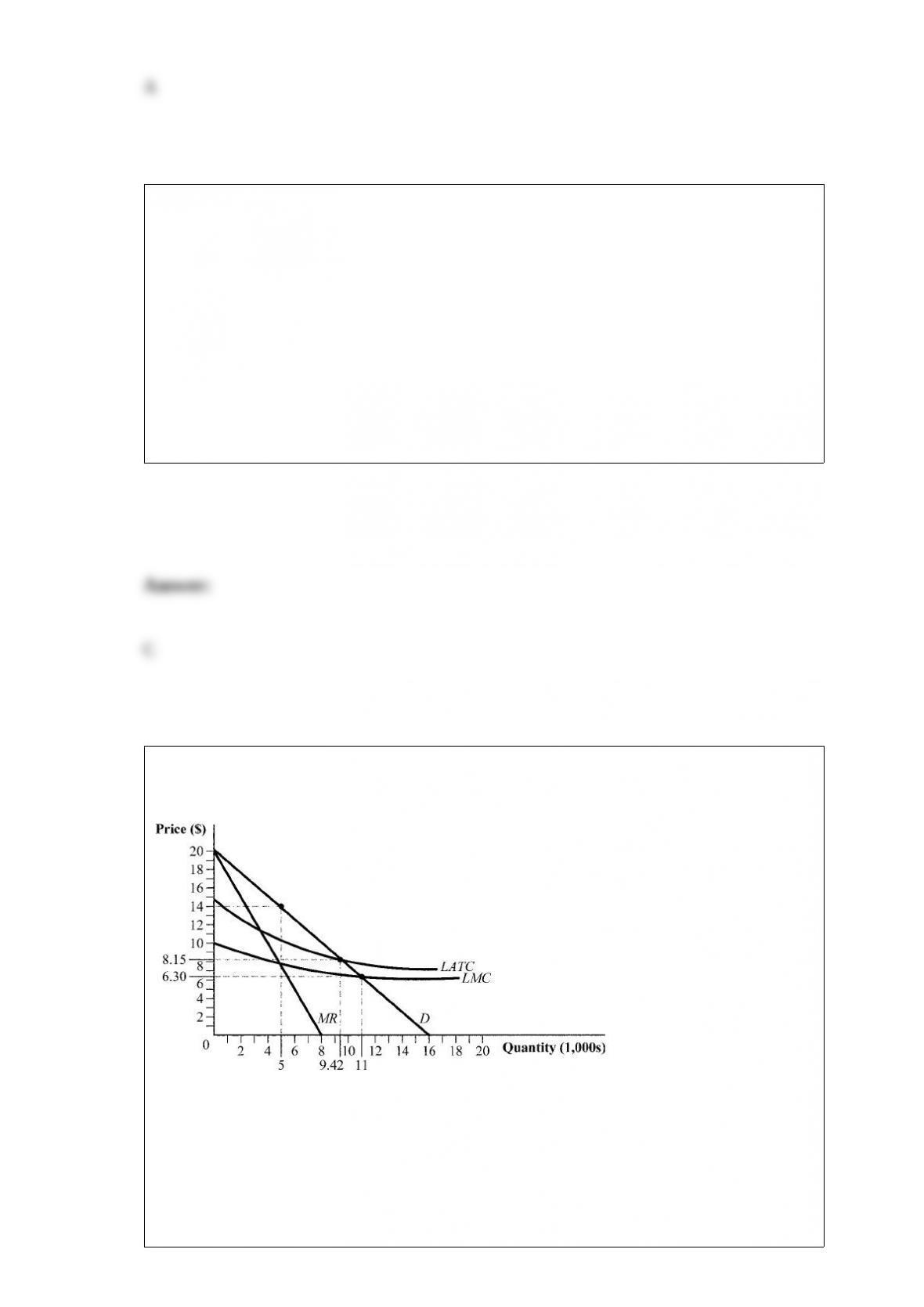
Figure 9.10
(Figure 9.10) If the government regulates the price of this natural monopolist to achieve
a perfectly competitive output level, the regulated price will be:
A) $8.15.
B) $14.

C) $10.
D) $6.30.
Suppose that a night club’s customers all have the same inverse demand curve for
drinks of P = 5″ Q, where P is the price per drink and Q measures the number of drinks.
The marginal cost of a drink is $1.00. With a two-part tariff pricing strategy, how much
do customers pay to get into the nightclub?
A) $5
B) $10
C) $8
D) $6
Table 10.7

(Table 10.7) Assume that the marginal cost of coffee is $0.50 and the marginal cost of
cake is $0.50. Which pricing scheme leads to the highest producer surplus?
A) a pure bundling strategy that charges $3.25 for a coffee and cake
B) charging a price of $1.50 per cake and $2.00 per coffee
C) a mixed bundling strategy that charges $3.75 for both a coffee and cake or charges a
price of $2.50 per cake and $2.50 per coffee
D) a mixed bundling strategy that charges $5.00 for both a coffee and cake or charges a
price of $2.75 per cake and $2.75 per coffee
Tavist allergy pills sell for $25 a box. Steve, Brian, and Toby are willing to pay $33,
$27, and $19, respectively, for a box of Tavist. What is the total consumer surplus for
Steve, Brian, and Toby?
A) $16
B) $10
C) $4
D) $60
Figure 5.19
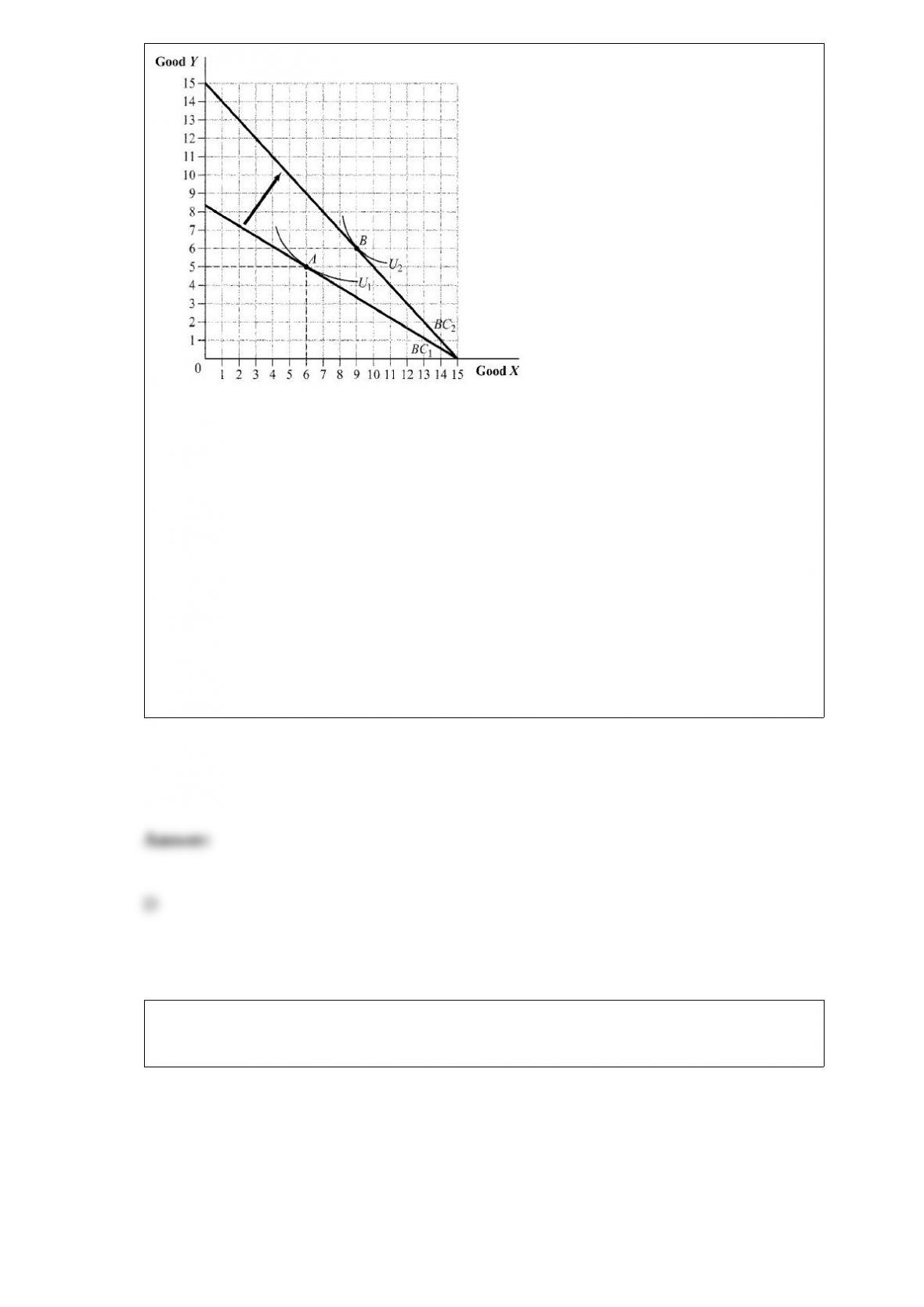
(Figure 5.19) Which of the following statements is TRUE?
A) The price of good Y increased, increasing the consumption of both good Y and good
X, which are complement goods.
B) The price of good Y decreased, increasing the consumption of both good Y and good
X, which are substitute goods.
C) The price of good Y increased, increasing the consumption of both good Y and good
X, which are substitute goods.
D) The price of good Y decreased, increasing the consumption of both good Y and good
X, which are complement goods.
Figure 14.2
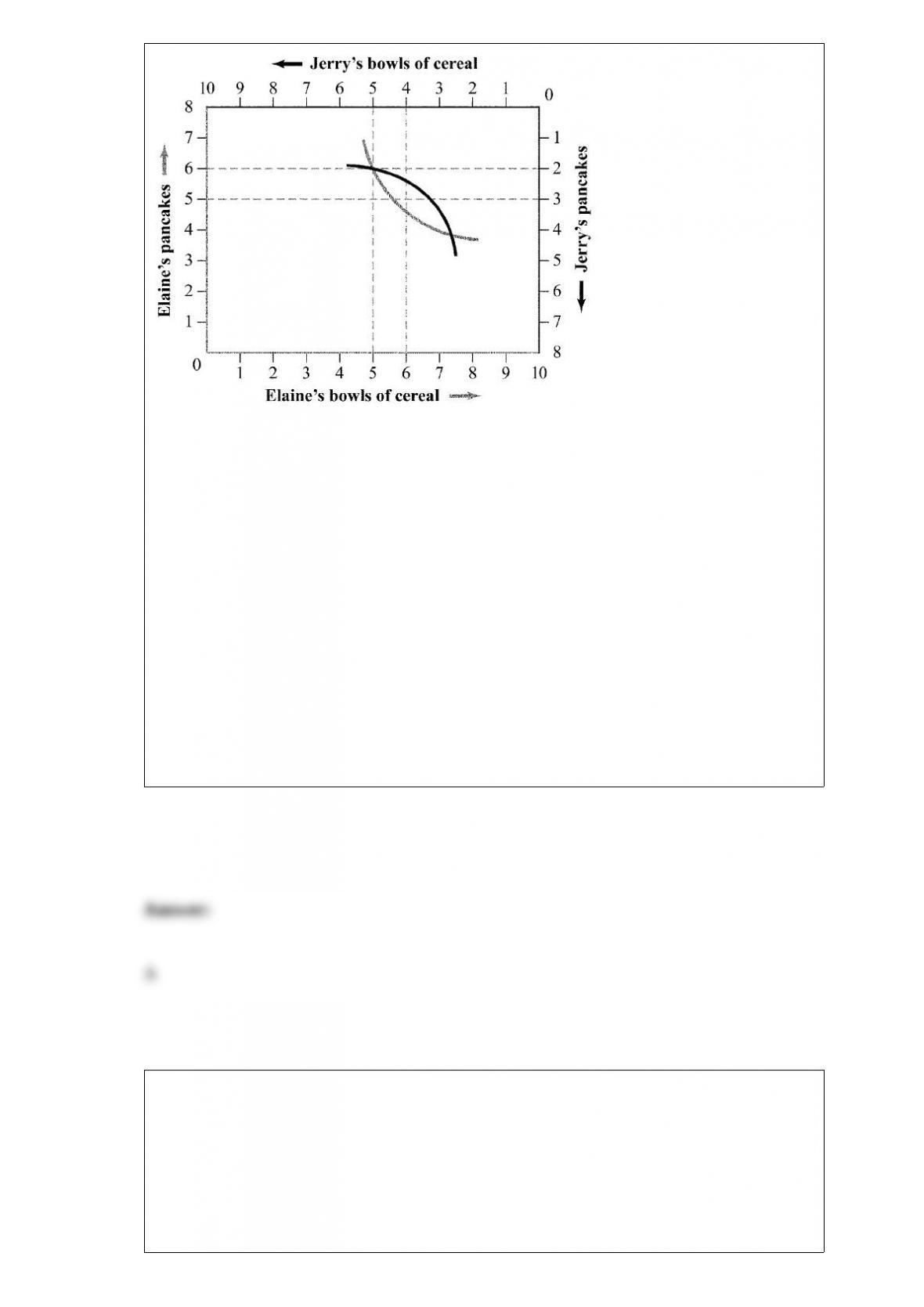
(Figure 14.2) Suppose that Elaine has 6 pancakes and 5 bowls of cereal, and Jerry has 2
pancakes and 5 bowls of cereal. Which of the following allocations would be a Pareto
improvement?
A) Elaine has 5 pancakes and 6 bowls of cereal, and Jerry has 3 pancakes and 4 bowls
of cereal.
B) Elaine has 5 pancakes and 5 bowls of cereal, and Jerry has 3 pancakes and 5 bowls
of cereal.
C) Elaine has 6 pancakes and 6 bowls of cereal, and Jerry has 2 pancakes and 4 bowls
of cereal.
D) Elaine has 7 pancakes and 5 bowls of cereal, and Jerry has 1 pancake and 5 bowls of
cereal.
Amazon.com changed its prices based on customers’ geographic location to examine
how price changes affect sales. This is an example of a:
A) field experiment.
B) permit study.
C) natural experiment.
D) Coase experiment.
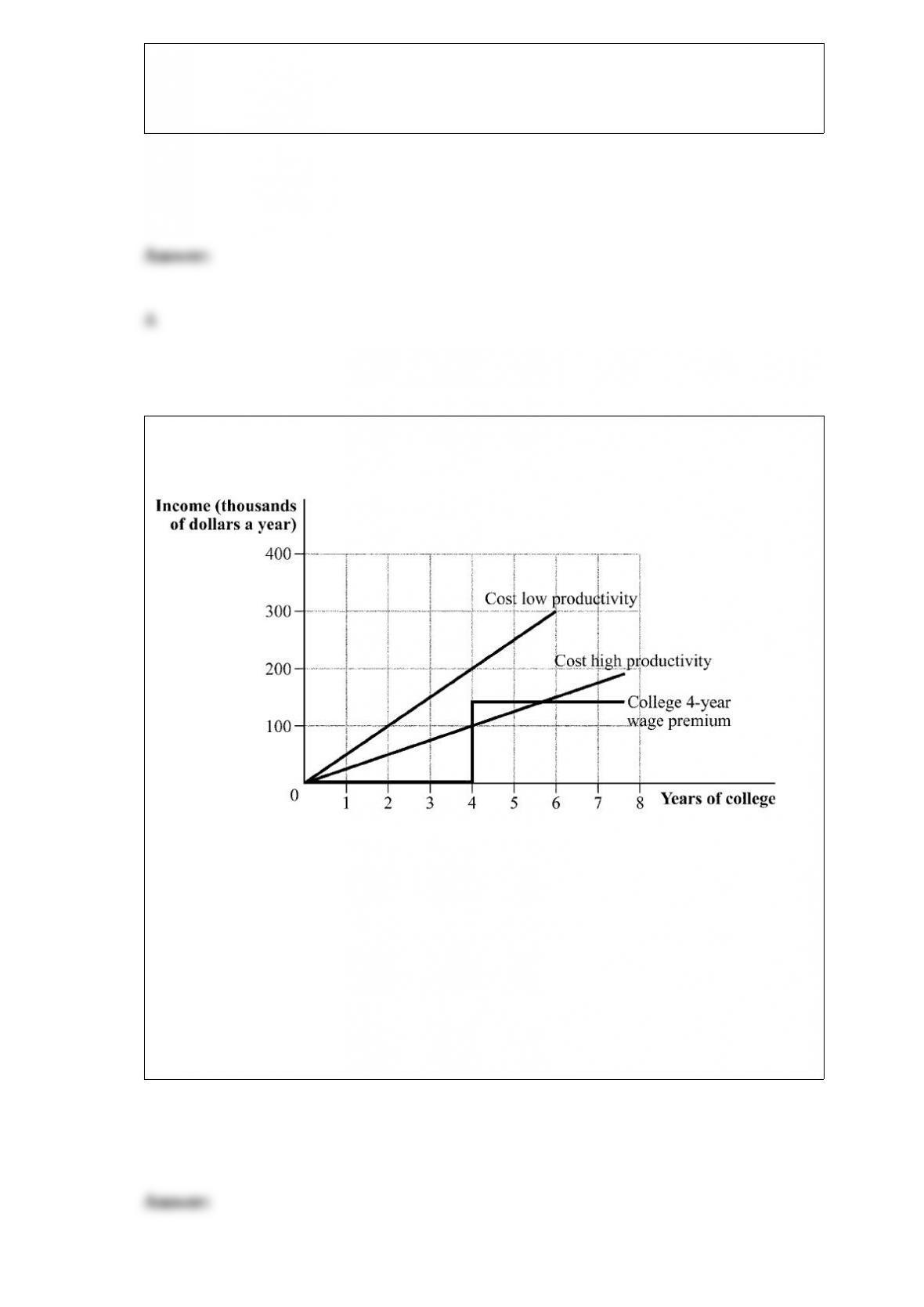
Figure 15.6
(Figure 15.6) The figure shows the cost of college for high- and low-productivity
workers. Based on the college wage premium:
A) high-productivity workers will get a 4-year degree.
B) low- and high-productivity workers will get a 4-year degree.
C) high-productivity workers will choose 6 years of college.
D) neither type of workers will get a 4-year degree.

Producing 200 units of good Y and 100 units of good X in the same factory costs the
firm $50,000. In contrast, producing 200 units of good Y in one factory and 100 units of
good X in another factory costs the firm $75,000. So if the firm produces the two goods
together, it experiences:
A) quadratic returns to scale.
B) diseconomies of scope.
C) economies of scope.
D) diseconomies of scale and diseconomies of scope.
Suppose that the demand and supply curve for green peas are given by QD = 10 ” 8P
and QS = 2P, where P is price per pound and Q is measured in thousands of pounds. If
the current price per pound of peas is $0.50, what do you expect will happen to the
price?
A) At a price of $0.50, there is excess demand in the market of 3,000 pounds, so the
price will rise.
B) At a price of $0.50, there is excess supply in the market of 1,000 pounds, so the price
will fall.
C) At a price of $0.50, the market is in equilibrium, so the price will remain unchanged.
D) At a price of $0.50, there is excess demand in the market of 5,000 pounds, so the
price will rise.
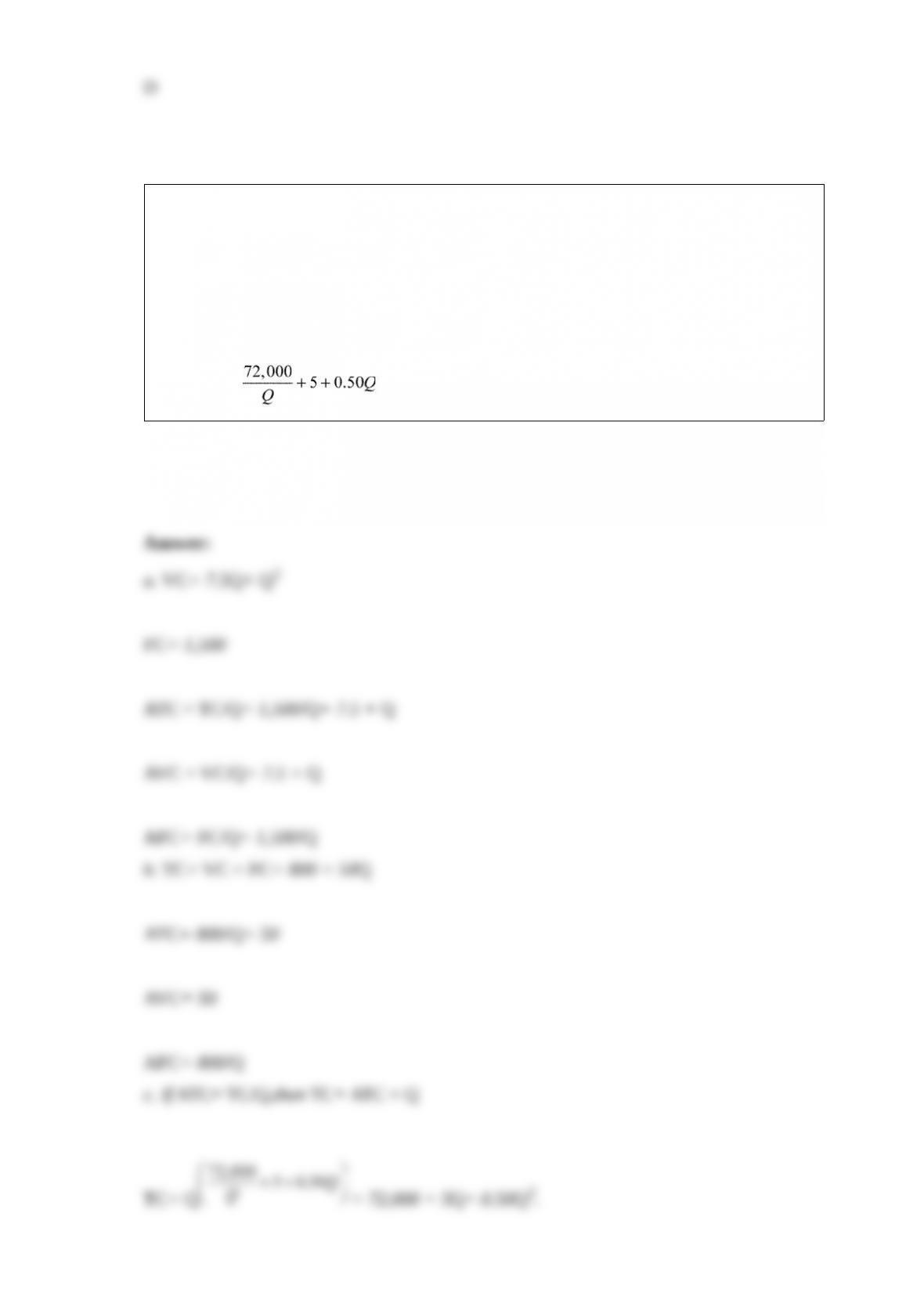
Answer the following questions.
a. If TC = 1,500 + 7.5Q + Q2, derive the cost functions for VC, FC, ATC, AVC, and
AFC.
b. If VC = 50Q and FC = 800, derive the cost functions for TC, ATC, AVC, and AFC.
c. If ATC = derive the cost functions for TC, FC, VC, AVC, and AFC.

Bubba Golf, a manufacturer of golf clubs, can sell 3 drivers at $600 each. To sell 4
drivers, Bubba Golf must lower the price to $580 each. The marginal revenue of the
fourth club is:
A) $20.
B) $60.
C) $580.
D) $520.
Table 12.3
(Table 12.3) In the table, the payoffs represent profits. What happens if Cape North and
Imperial both choose their dominated strategy?
A) Each company will earn a profit of $154.
B) Each company will earn a profit of $120.

C) Cape North will earn a profit of $75 and Imperial will earn profit of $180.
D) Each company will earn a profit of $75.
Consider 200 people with a disease. Which of the following treatment options are
identical?
I. Of the 200 people, 160 will be cured and the rest will die.
II. There is a 40% probability of death and 60% probability of cure.
III. There is a 20% probability of cure and 80% probability of death.
IV. Of the 200 people, 1 in 5 will die and the rest will be cured.
A) II and III
B) I and II
C) I and IV
D) III and IV
Which of the following requirements is necessary to practice price discrimination?
I. The firm must have market power.

II. The firm can prevent arbitrage of its product.
III. The firm faces a perfectly elastic demand curve.
IV. The firm operates in a perfectly competitive industry.
A) II, III, and IV
B) I, II, and III
C) I and II
D) III and IV
Answer the following questions.
a. Graph the inverse demand curve P = 12 ” Q. On your graph, identify the area of total
revenue associated with 2 and then 3 units of output. Is marginal revenue of the third
unit positive or negative?
b. Graph the inverse demand curve P = 12 ” Q. On your graph, identify the area of total
revenue associated with 9 and 10 units of output. Is marginal revenue of the tenth unit
positive or negative?
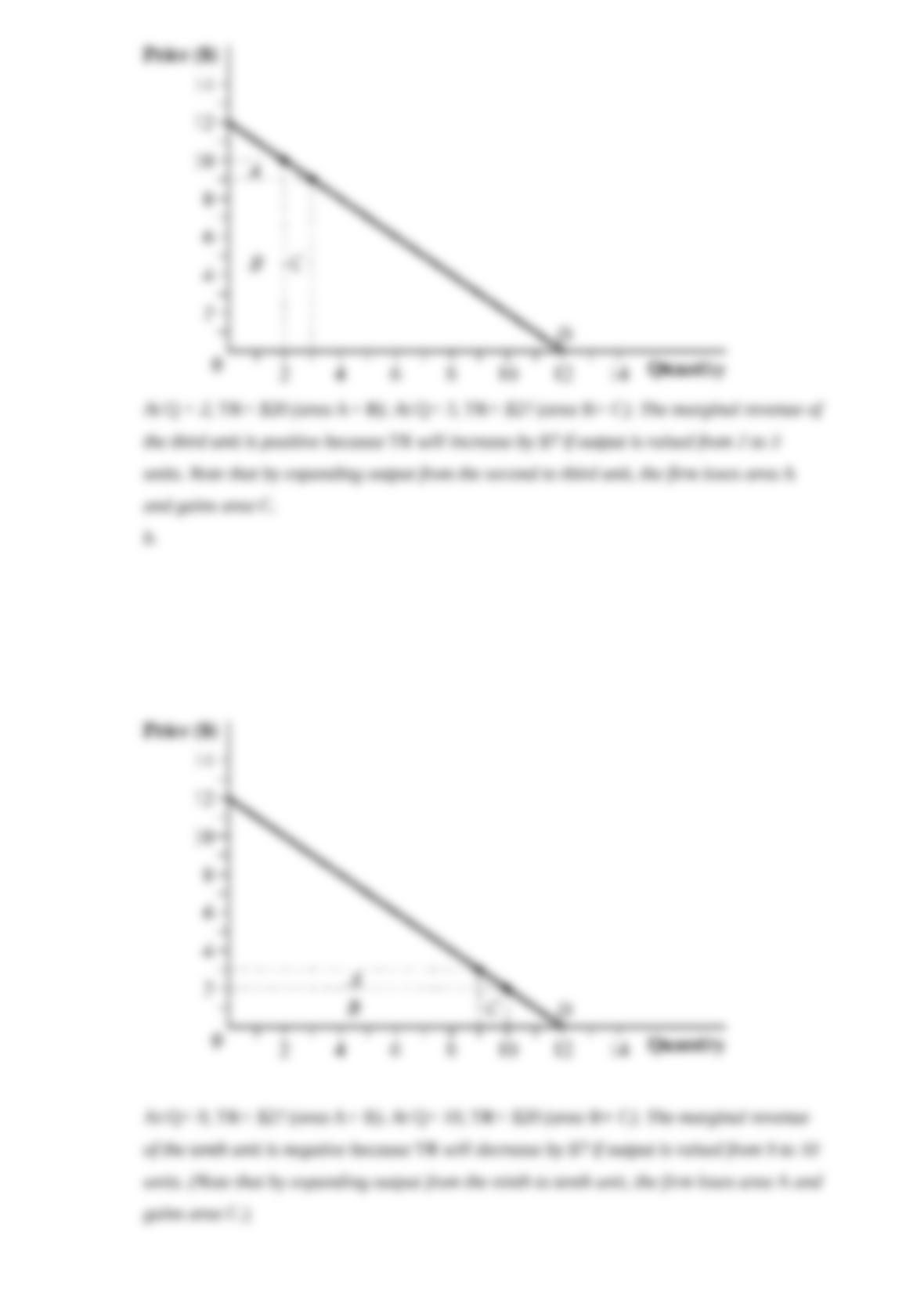
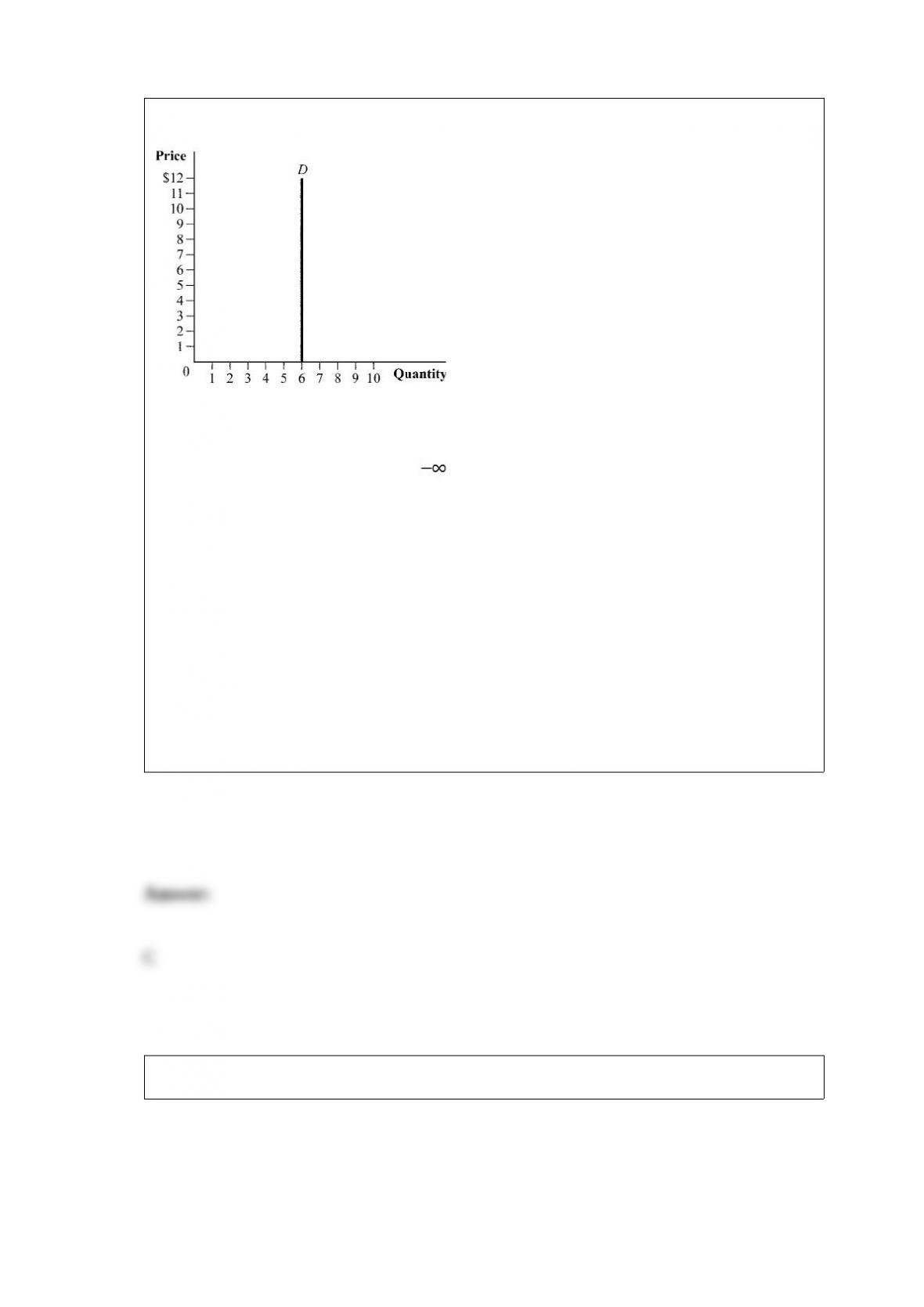
Figure 2.11
(Figure 2.11) Which of the following statements is TRUE regarding the figure?
I. The price elasticity of demand is .
II. The demand curve is perfectly inelastic.
III. An increase in price has no effect on quantity demanded.
A) I and III
B) I, II, and III
C) II and III
D) II only
Figure 6.16
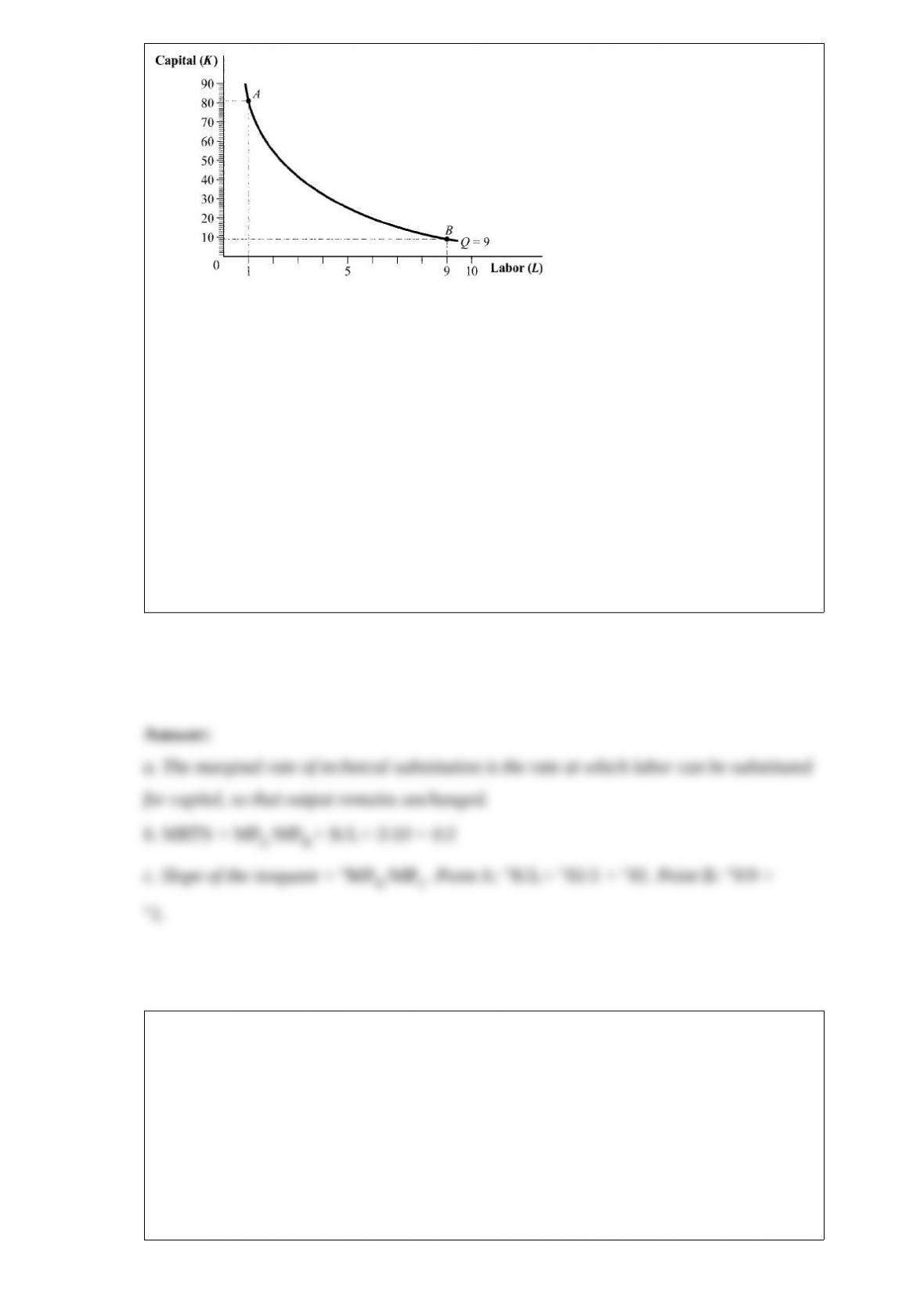
(Figure 6.16) Consider the production function Q = L0.5K0.5, with MPK = L0.5/K0.5 and
MPL = K0.5/L0.5. a. Define the marginal rate of technical substitution. b. Calculate the
marginal rate of technical substitution for K = 5 and L = 10. c. Figure 6.16 shows an
isoquant based on the production function referred to in the question. Calculate the
slope of the isoquant at point A and point B.
a. Define the marginal rate of technical substitution.
b. Calculate the marginal rate of technical substitution for K = 5 and L = 10.
c. Figure 6.16 shows an isoquant based on the production function referred to in the
question. Calculate the slope of the isoquant at point A and point B.
A two-firm cartel, which produces a product at a constant marginal cost of $20, faces a
market inverse demand curve of P = 100 ” 0.50Q. Initially, both firms agree to act like a
monopolist, each producing 40 units of output. If one of the firms cheats on the
agreement (assuming the other firm abides by the agreement and continues to produce
40 units), how much output should the cheating firm produce to maximize profits?
A) The firm should produce 41 units.
B) The firm should produce 60 units.

C) The firm should produce 80 units.
D) The firm should produce 44 units.
In 2007, Hawaii began providing universal health care coverage to all children, but the
Hawaiian government ended the program in just 7 months. Government officials
claimed that most of the children who received government coverage dropped their
private insurance to become eligible for the program. As a government official stated,
“People who were already able to afford health care began to stop paying for it so they
could get it for free.” In this example, Hawaii’s universal health care coverage caused:
A) crowding out.
B) expansion drift.
C) impure prevalence.
D) supplier-induced demand.
On Monday, you want to start your exercise program on Saturday. When Saturday
arrives, you spend your time watching college football and don’t exercise. This behavior
is an example of:
A) negative discounting.
B) egocentrism.

C) time inconsistency.
D) neo-foresight.
What would happen if the government quit subsidizing a product?
A) Consumer surplus would increase and producer surplus would decrease.
B) Consumer and producer surplus would decrease.
C) Consumer and producer surplus would increase.
D) Consumer surplus would decrease and producer surplus would increase.
Give an example of the following systematic biases.
a. being overconfident
b. having self-control problems and using hyperbolic discounting
c. falling prey to framing due to anchoring
d. paying attention to sunk costs
e. relying on generosity and selflessness