
If the consumer price index is 120 in 2009 and 139.2 in 2010, then the rate of inflation
for 2010 is 39.2 percent.
a. True
b. False
Which of the following is an example of a normative, as opposed to positive,
statement?
a. Following the most recent recession, the economy is recovering at a slower than
usual pace.
b. To stimulate the economy during the most recent recession, the federal government
increased spending.
c. In response to the most recent recession, the federal government extended the
duration of unemployment benefits.
d. The federal government’s responses to the most recent recession were insufficient.
Figure30-2. On the graph, MS represents the money supply and MD represents money
demand. The usual quantities are measured along the axes.
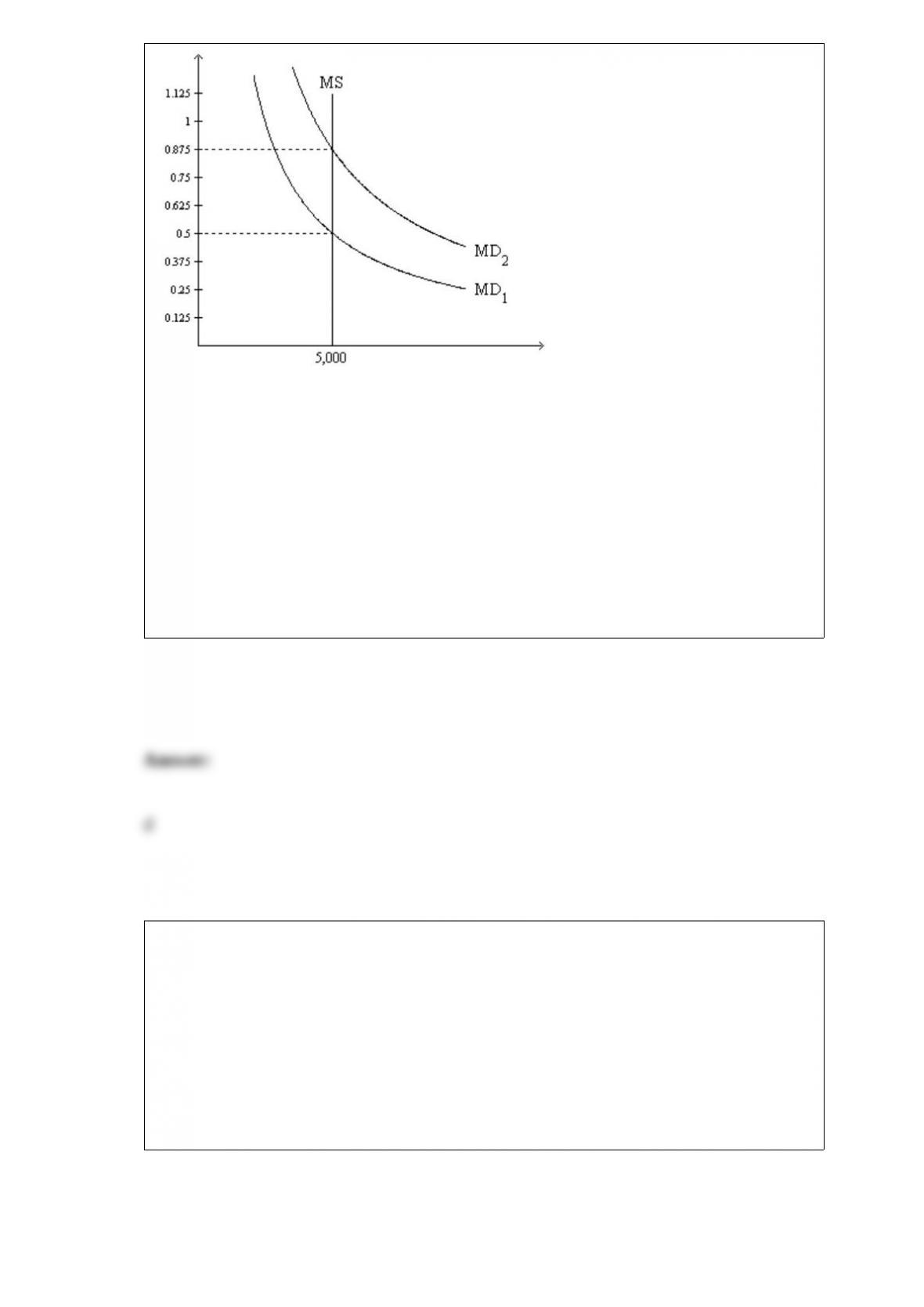
RefetoFigure30-2. Which of the following events could explain a shift of the
money-demand curve from MD1 to MD2?
a. an increase in the value of money
b. a decrease in the price level
c. an open-market purchase of bonds by the Federal Reserve
d. None of the above is correct.
If people decide to hold less currency relative to deposits, the money supply
a. falls. The Fed could lessen the impact of this by buying Treasury bonds.
b. falls. The Fed could lessen the impact of this by selling Treasury bonds.
c. rises. The Fed could lessen the impact of this by buying Treasury bonds.
d. rises. The Fed could lessen the impact of this by selling Treasury bonds.

Most goods whose purchases are included in the investment component of GDP are
used to produce other goods in future periods.
a. True
b. False
The opportunity cost of obtaining more of one good is shown on the production
possibilities frontier as the
a. amount of the other good that must be given up.
b. market price of the additional amount produced.
c. amount of resources that must be devoted to its production.
d. number of dollars that must be spent to produce it.
According to purchasing power parity, the nominal exchange rate between the U.S. and
another country should equal the price level of foreign goods divided by the price level

of U.S. goods.
a. True
b. False
An increase in real interest rates in the United States
a. discourages both U.S. and foreign residents from buying U.S. assets.
b. encourages both U.S. and foreign residents to buy U.S. assets.
c. encourages U.S. residents to buy U.S. assets, but discourages foreign residents from
buying U.S. assets.
d. encourages foreign residents to buy U.S. assets, but discourages U.S. residents from
buying U.S. assets.
According to liquidity preference theory, equilibrium in the money market is achieved
by adjustments in
a. the price level.
b. the interest rate.
c. the exchange rate.

d. real wealth.
Suppose that a small economy that produces mostly agricultural goods experiences a
year with exceptionally good conditions for growing crops. The good weather would
a. shift both the short-run aggregate supply and the short-run Phillips curve right.
b. shift both the short-run aggregate supply and the short-run Phillips curve left.
c. shift the short-run aggregate supply curve to the right, and the short-run Phillips
curve to the left.
d. shift the short-run aggregate supply curve to the left, and the short-run Phillips curve
to the right.
Gwen is an unpaid worker in her family’s restaurant. The Bureau of Labor Statistics
counts Gwen as
a. unemployed and in the labor force.
b. unemployed and not in the labor force.
c. employed and in the labor force.
d. employed and not in the labor force.

If the MPC is 4/5, the multiplier is 5/4.
a. True
b. False
Economics is the study of how society manages its
a. limited wants and unlimited resources.
b. unlimited wants and unlimited resources.
c. limited wants and limited resources.
d. unlimited wants and limited resources.
If a country’s trade surplus falls, its net capital outflow rises.

a. True
b. False
If you go to the bank and notice that a dollar buys more Japanese yen than it used to,
then the dollar has
a. appreciated. Other things the same, the appreciation would make Americans less
likely to travel to Japan.
b. appreciated. Other things the same, the appreciation would make Americans more
likely to travel to Japan.
c. depreciated. Other things the same, the depreciation would make Americans less
likely to travel to Japan.
d. depreciated. Other things the same, the depreciation would make Americans more
likely to travel to Japan.
Suppose the U.S. supply of loanable funds shifts left. This will
a. increase U.S. net capital outflow and increase the quantity of loanable funds
demanded.
b. increase U.S. net capital outflow and decrease the quantity of loanable funds
demanded.

c. decrease U.S. net capital outflow and increase the quantity of loanable funds
demanded.
d. decrease U.S. net capital outflow and decrease the quantity of loanable funds
demanded.
When the price of a good is lower than the equilibrium price,
a. a surplus will exist.
b. buyers desire to purchase more than is produced.
c. sellers desire to produce and sell more than buyers wish to purchase.
d. quantity supplied exceeds quantity demanded.
Figure 4-26
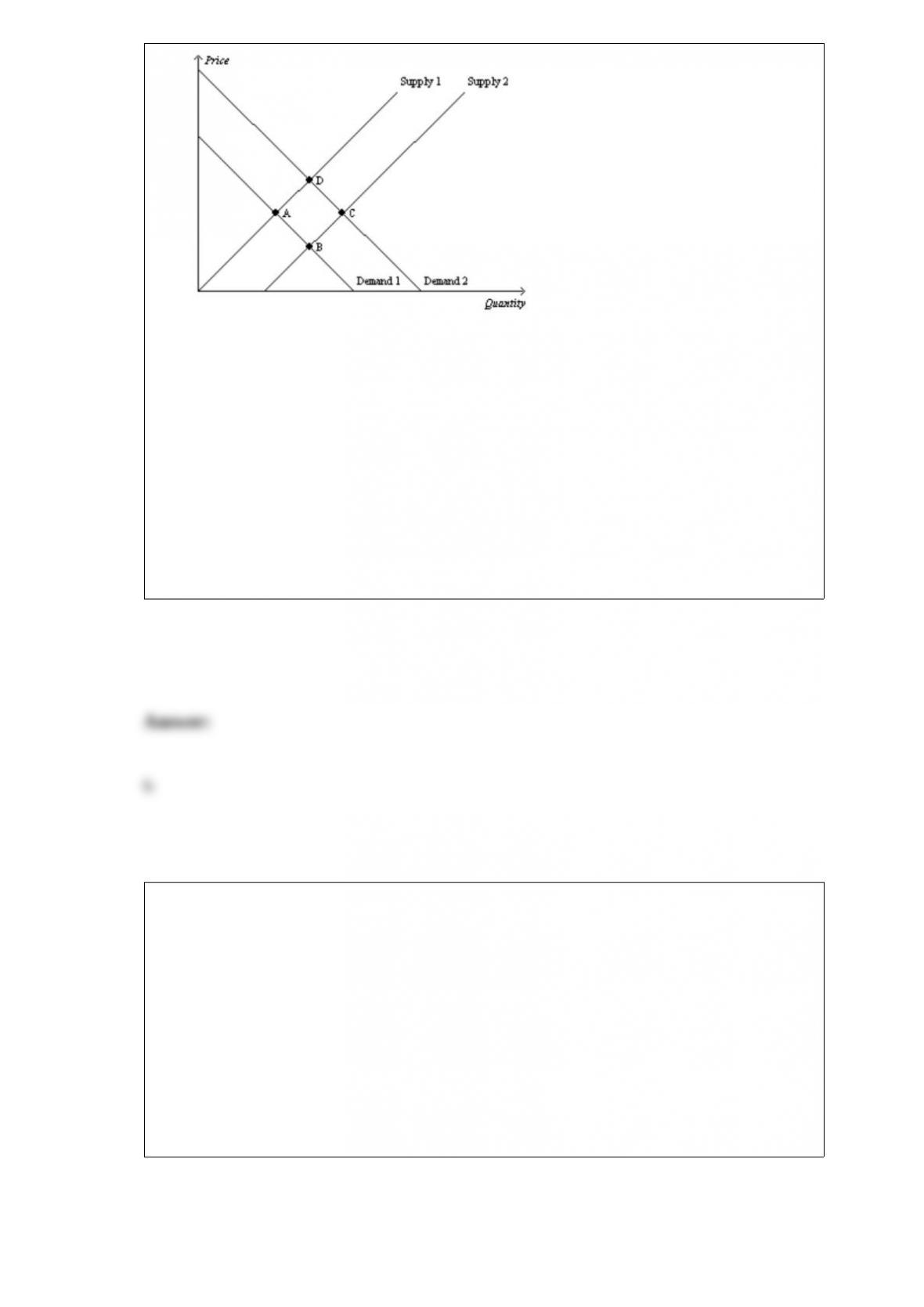
RefertoFigure4-26.Which of the following movements would illustrate the effect in the
market for paper napkins as a result of a “Go Green” advertising campaign encouraging
people to use cloth napkins?
a. Point A to Point B
b. Point C to Point B
c. Point C to Point D
d. Point A to Point D
Which of the following restrictions implies that investment exceeds private saving for a
closed economy?
a. The economy has no government.
b. The economy’s government is running a budget deficit.
c. The economy’s government is running a budget surplus.
d. No restriction is necessary; investment and private saving are equal for all closed
economies.

One determinant of the long-run average unemployment rate is the
a. market power of unions, while the inflation rate depends primarily upon government
spending.
b. minimum wage, while the inflation rate depends primarily upon the money supply
growth rate.
c. rate of growth of the money supply, while the inflation rate depends primarily upon
the market power of unions.
d. existence of efficiency wages, while the inflation rate depends primarily upon the
extent to which firms are competitive.
A circular-flow diagram is a visual model of the economy.
a. True
b. False

An increase in nominal U.S. GDP necessarily implies that the United States is
producing a larger output of goods and services.
a. True
b. False
Suppose a closed economy had public saving of -$1 trillion and private saving of $3
trillion. What are national saving and investment for this country?
a. $2 trillion, $2 trillion
b. $2 trillion, $3 trillion
c. $3 trillion, $3 trillion
d. $4 trillion, $2 trillion
Other things equal, relatively poor countries tend to grow
a. slower than relatively rich countries; this is called the poverty trap.
b. slower than relatively rich countries; this is called the fall-behind effect.
c. faster than relatively rich countries; this is called the catch-up effect.
d. faster than relatively rich countries; this is called the constant-returns-to-scale effect.

Which of the following is an example of a nonrenewable natural resource?
a. tin
b. petroleum
c. gold
d. All of the above are correct.
If an increase in inflation permanently reduced unemployment, then
a. money would not be neutral and the long-run Phillips curve would slope upward.
b. money would not be neutral and the long-run Phillips curve would slope downward.
c. money would be neutral and the long-run Phillips curve would slope upward.
d. money would be neutral and the long-run Phillips curve would slope downward.

To which of the problems in the construction of the CPI is the creation of the mobile
phone most relevant?
a. substitution bias
b. introduction of new goods
c. unmeasured quality change
d. income bias
In the economy of Talikastan in 2015, consumption was $4000, exports were $800,
GDP was $7500, imports were $200, and investment was $1000. What were
Talikastan’s government purchases in 2015?
a. $1200
b. $1900
c. $2500
d. $4500
Other things the same, which of the following responses would we expect from an
increase in U.S. interest rates?

a. Your aunt puts more money in her savings account.
b. Foreign citizens decide to buy fewer U.S. bonds.
c. You decide to purchase a new oven for your cookie factory.
d. All of the above are correct.
You have some estimates of national accounts numbers for a closed economy for the
coming year. Under one set of expectations, government purchases will be $30 billion,
transfer payments will be $10 billion, and taxes will be $45 billion. Under another set of
expectations, GDP will be $200 billion, taxes will be $50 billion, transfer payments will
be $20 billion, consumption will be $120 million, and investment will be $40 billion.
Based on these numbers in the first case there should be a
a. $15 billion surplus, and in the second case a $10 billion surplus.
b. $15 billion surplus, and in the second case a $30 billion deficit.
c. $5 billion surplus, and in the second case a $10 billion deficit.
d. $5 billion surplus, and in the second case a $30 billion deficit.
Colonial America had little industry and so had mostly raw materials to export. At the
same time, there were many opportunities to purchase capital goods and earn a high rate
of return because there was little existing capital so that the marginal product of capital

was relatively high. What does this suggest about net exports and net capital outflow in
colonial America?
What assumptions are necessary to argue that the quantity equation implies that
increases in the money supply lead to proportional changes in the price level?
GDP is defined as the market value of all final goods and services produced within a
country in a given period of time. In spite of this definition, some production is left out
of GDP. Explain why some final goods and services are not included.

John and Miguel are fishermen. When they go fishing, John consistently catches 2 or 3
fish per hour, while Miguel consistently catches 5 or 6 fish per hour. Miguel’sexceeds
that of John.
Which part of the Federal Reserve determines monetary policy? How often does it
meet? What does it set a target for?
Carefully explain how monetary policy can be used to counter a recession. Explain
what the central bank does as well as how its actions affect the economy. Under what
circumstances is fiscal policy especially useful?
A company has an investment project that will cost $2 million today and yield a payoff
of $3 million in 5 years. What interest rate represents the cutoff between profitability
and nonprofitability for this project?
The level of real GDP is a good measure of economic prosperity, and the growth of real
GDP is a good measure of__________.
During 2011 the inflation rate in Brazil was about 6.6% while in the U.S. it was about
3.3%. At the start of 2011 the nominal exchange rate was about 1.7 Brazilian real per
U.S. dollar.
If purchasing-power parity holds, about what should the nominal exchange rate have
been at the end of 2011? Show your work.
Use sticky-wage theory to explain why an increase in the expected price level shifts the
aggregate supply curve.
Compare changes in the price level for a recession resulting from a shift in aggregate
demand to that of a recession resulting from a shift in short run aggregate supply.
Shoe Quota
Concerns raised about the declining U.S. shoe industry and unfair labor practices in
foreign shoe factories lead the Congress and President to impose a quota on shoe
imports.
RefertoShoeQuota. What is a quota? What is a tariff?
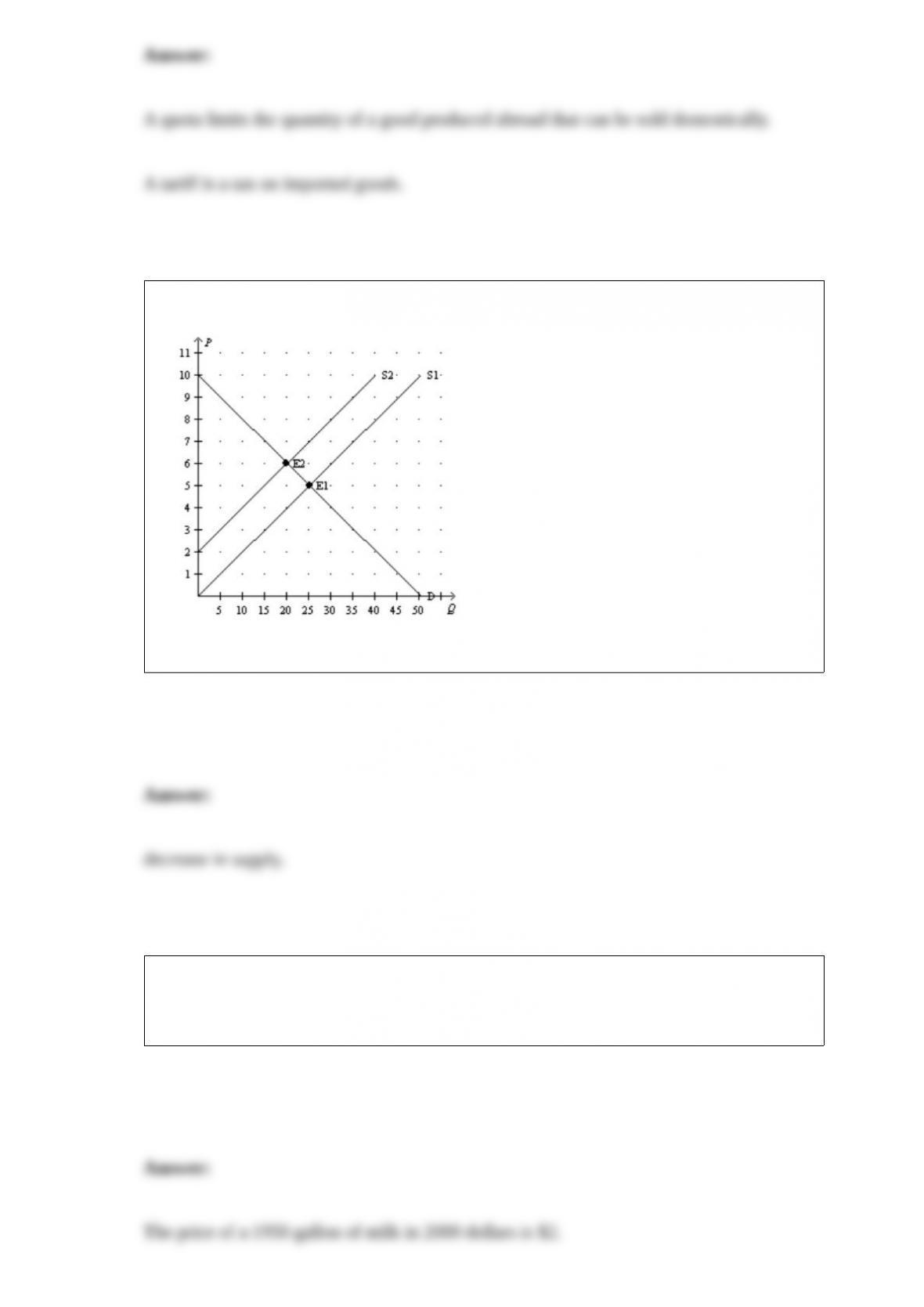
Figure 4-29
RefertoFigure4-29.The movement from S1 to S2 is a
Suppose that the price of one gallon of milk was $0.25 in 1950, that the CPI in 1950
was 25, and that in 2000 the CPI was 200.What is the price of a 1950 gallon of milk in
2000 dollars?
Brazil gives cash payments to its poor citizens on the condition that those citizens’
children stay in school. In terms of the determinants of productivity, how might this
public policy contribute to higher productivity in Brazil?
If you withdraw $500 from your savings account and deposit it in your checking
account, then M1 will change byand M2 will change by.
Consider the nations of Canada, the United Kingdom, and the United States. Since
1870, which of these nations has progressed, in an economic sense, more slowly than
the other two nations?

A country recently had 500 billion euros of national saving and -200 billion euros of net
capital outflow. What was its domestic investment? What was its quantity of loanable
funds supplied?
When the Federal Reserve conducts an open-market purchase, the money supply and
aggregate demand _____.