
For a price taker, market equilibrium price is $100. At 50 units, MR = MC, ATC = $80,
and AVC = $70. This price taker will
a. earn $100 profits if it produces 50 units of the good.
b. earn $1,000 profits if it produces 50 units.
c. shut down its operation and by doing this minimize its losses.
d. maximize its profits if it produces fewer than 50 units.
e. maximize its profits if it produces more than 50 units.
A positive externality exists when
a. marginal social costs are less than marginal private costs.
b. marginal social costs are greater than marginal private costs.
c. marginal social benefits are less than marginal private benefits.
d. marginal social benefits are greater than marginal private benefits.
e. a and d
The endowment effect
a. states that we value an item more highly if we own it than if we do not own it.
b. is the same as compartmentalizing.

c. states that people are often willing to make themselves worse off in order to make
someone else worse off.
d. states that people are often willing to make themselves worse off in order to make
someone else better off.
e. a and d
The market supply curve of labor
a. slopes downward, indicating that as the wage rate falls, the quantity supplied of labor
rises.
b. slopes upward, indicating that as the wage rate rises, the quantity supplied of labor
rises.
c. is vertical, indicating that the quantity supplied of labor is independent of the wage
rate.
d. slopes upward, indicating that as the wage rate falls, the quantity supplied of labor
rises.
Productive efficiency implies
a. the possibility of gains in one area without losses in another.
b. that more output has been produced.
c. the impossibility of gains in one area without losses in another.

d. that prices are stable.
e. c and d
Which of the following statements is true?
a. To an economist, demand is different from quantity demanded.
b. A demand schedule is the numerical tabulation of the law of demand.
c. A demand curve is the graphical representation of the direct relationship between
price and quantity demanded.
d. a and b
e. a, b, and c
There is no market failure if
a. the marginal private cost curve is upward sloping.
b. the demand curve (for a good or service) is downward sloping.
c. the demand curve lies about the marginal private cost curve.
d. marginal private costs are greater than the external costs associated with a negative
externality.
e. none of the above
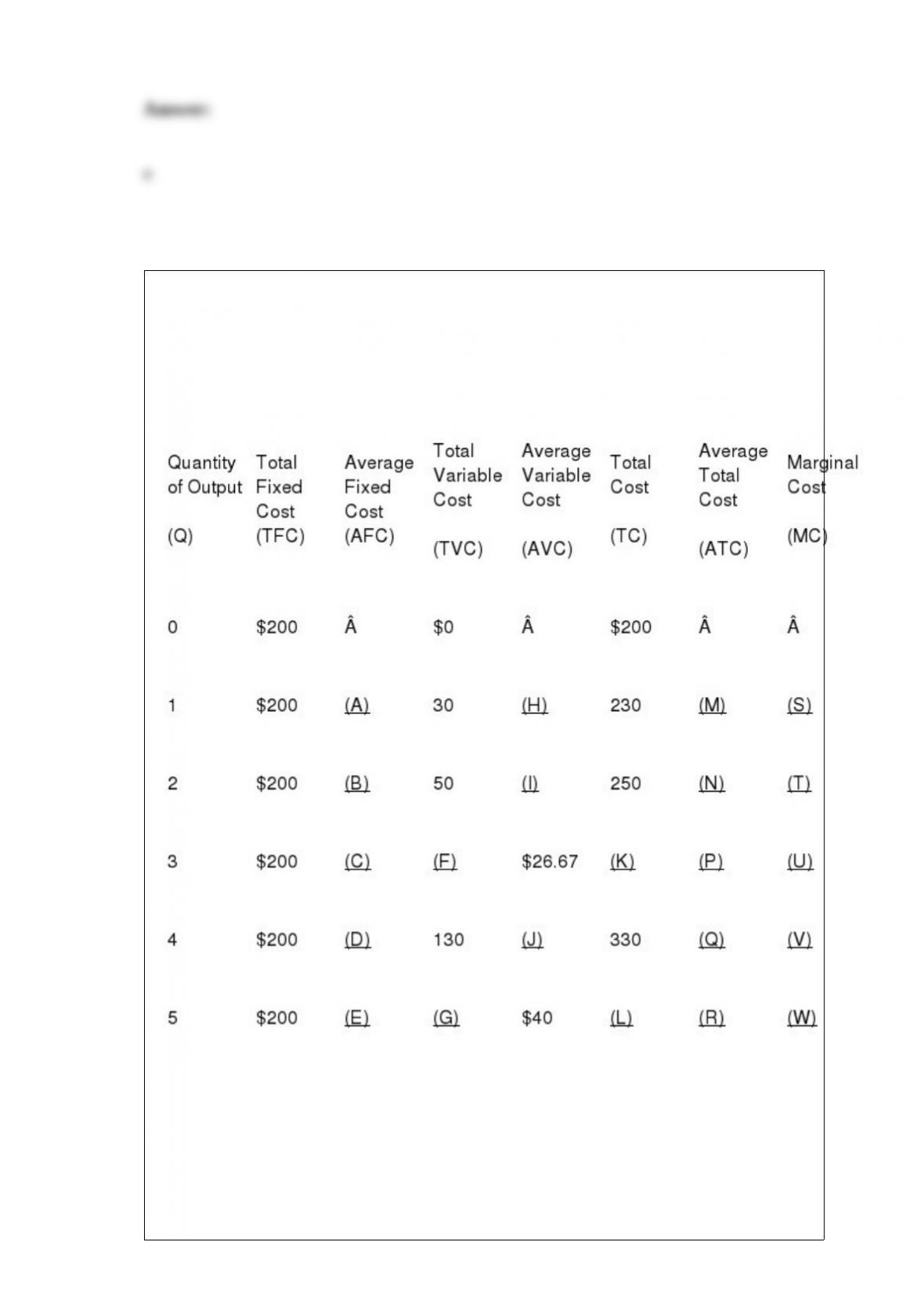
Exhibit 22-13
What dollar amounts go in blanks (V) and (W), respectively?
a. $50; $70
b. $12.50; $14
c. $140; $150

d. $82.50; $80
e. There is not enough information to answer this question.
The monopolistic competitive firm will most likely earn a normal profit in the long run
because of
a. product differentiation.
b. many buyers and sellers.
c. easy entry and exit.
d. b and c
At the optimal or efficient level of an activity, the activity€s marginal benefit must
a. be zero.
b. be greater than zero.
c. equal the marginal cost of the activity.

d. exceed the marginal cost of the activity.
In general, in a given rich country the ______________ the opportunity cost for a
woman of having and raising a child, the _____________ children she will have.
a. higher; fewer
b. higher; more
c. lower; fewer
d. lower; more
e. a and d