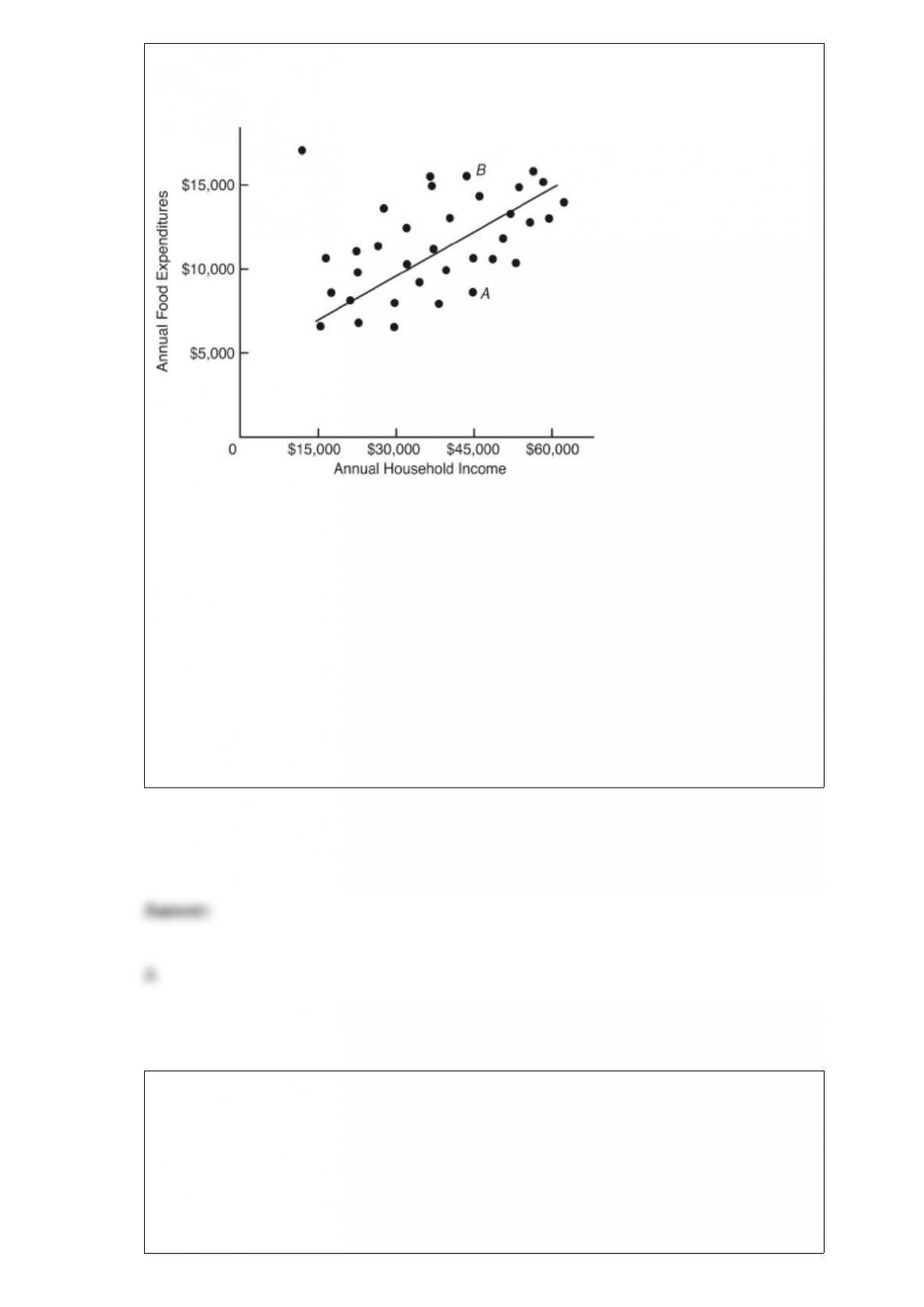
The following questions are based on the following diagram illustrating the results of a
study of food expenditures and income for a group of families:
If a graph of two variables shows a downward-sloping relationship, that relationship is
considered to be
a. inverse.
b. positive.
c. normative.
d. variable.
e. independent.
Government anti-inflationary fiscal policy
a. is intended to shift the short-run aggregate supply curve to the left.
b. typically leads to an increase in total real output and a rise in the price level.
c. leads to a reduction in total real output when the short-run aggregate supply curve is

positively sloped.
d. shifts the aggregate demand curve to the right.
e. is undertaken when the economy is in the horizontal range of the short-run aggregate
supply curve.
If the desire for present consumption by individuals and households increases, the
supply of loanable funds will
a. shift to the right, causing the interest rate to rise.
b. shift to the right, causing the interest rate to fall.
c. shift to the left, causing the interest rate to fall.
d. shift to the left, causing the interest rate to rise.
e. be unaffected, but the demand for loanable funds will fall.
According to U.S. government figures, an unemployed person is one who
a. has given up looking for a job.
b. only works part-time.
c. is actively seeking a job.
d. cannot be a member of the labor force.
e. works at jobs below his or her skills or abilities.

Those who exchange their labor resources for money to buy goods and services to
satisfy their wants and desires are called
a. capitalists.
b. firms.
c. corporations.
d. rentiers.
e. consumers.
The expression “the farmer is a price taker, not a price maker,” refers to the fact that
a. the market demand curve for food is perfectly elastic.
b. demand for agricultural products has declined steadily throughout the twentieth
century.
c. prices of farm goods are generally set by government.
d. in perfect competition, no one producer can control prices.
e. shifts in the demand and supply for farm products have little impact on farm prices.

Among the factors giving rise to profits are
a. innovation, uncertainty, and monopoly power.
b. perfect competition and perfect knowledge of the future.
c. the absence of risk and uncertainty.
d. the need to reward labor in excess of its contribution to production.
e. business efforts to avoid forms of income that can be taxed fully.
The phrase “You can”t push on a string” is
a. a line from a 1930s song.
b. used to suggest that monetary policy can make money available but cannot ensure it
will be spent.
c. an analogy used by monetarists to describe the ineffectiveness of fiscal policy.
d. used by rational expectations theorists in their criticisms of supply-side economics.
e. a reference to the fact that Congress is in control of the government’s purse strings
and determines spending without regard to economic impact.

The income velocity of circulation refers to the
a. turnover of money.
b. current interest rate.
c. rate of inflation.
d. speed with which economic recovery is realized.
e. nominal GDP divided by real GDP.
Both the new Keynesians and the new classical economists have
a. agreed that changes in the price level are unrelated to changes in the money supply.
b. concluded that the U.S. business cycle is dead.
c. advocated the elimination of the Federal Reserve System.
d. adopted the theory of rational expectations.
e. seen their theories become so divergent since the 1960s that they are useless to policy
makers.

One notable characteristic of a public good is that
a. its production incurs no economic costs.
b. consumers can easily be denied the benefits of the good.
c. it will automatically be produced by the free market price system.
d. its consumption by one person does not reduce the amount available to others.
e. consumers may readily divide it into individual pieces and distribute it among
themselves.
When monetary authorities accommodate or validate supply-side inflation, they
a. increase the money supply sufficiently to prevent significant increases in
unemployment.
b. pursue tight money policies to ensure matching increases in interest rates.
c. ensure that aggregate demand shifts to the left.
d. reduce the price level by an amount equal to the rate of inflation.
e. rely on large budget surpluses to offset their open market purchases.

In the long run, in a perfectly competitive industry, ________ are zero.
a. economic profits
b. costs of production
c. average total costs
d. prices
e. variable costs
Supply-siders typically advocate
a. tax increases to balance the federal budget.
b. tax reductions for households and tax increases for businesses to stimulate national
output.
c. a steeply progressive personal income tax structure.
d. tax reductions to increase both the labor force participation and investment.
e. tax reductions for low-income workers, to stimulate consumption.
The Kennedy-Johnson guidelines specified that the rate of increase of wage rates,
including fringe benefits, for a particular industry should equal the

a. rate of productivity increase in that industry.
b. rate of increase in the general price level.
c. trend rate of overall productivity increase.
d. rate of wage increase in the countries that are our major trading partners.
e. increase in steel and auto industries’ wages.
Which of the following would be the most effective public policy for encouraging
research and development?
a. subsidizing industries that are at a competitive disadvantage
b. maintaining price stability and encouraging saving and investment
c. increasing interest rates to make investment more profitable
d. reducing resource mobility to ensure an adequate labor supply
e. increasing the scope and extent of industrial regulation
The following questions are based on the following information regarding the gross
monthly receipts of a miniature golf course in a resort community at the shore.

When the price per game is decreased from $4.50 to $4.00
a. the number of games played remains the same.
b. demand becomes price elastic.
c. the number of games played must have fallen, but there is not enough information to
tell by how much.
d. the percentage increase in the number of games is equal to the percentage decrease in
price.
e. the profits of the golf course rise significantly.
The term of office for a member of the Federal Reserve Board is
a. two years.
b. four years.
c. seven years.
d. 14 years.
e. life.

If the quantity demanded is relatively sensitive to changes in price and the quantity
supplied is relatively insensitive to changes in price, the imposition of a sales tax will
a. shift entirely to the buyer.
b. fall more heavily on the buyer.
c. be equally shared by the buyer and seller.
d. fall more heavily on the seller.
e. shift entirely to the seller.
The following questions are based on the following perfectly competitive firm’s demand
curve for labor:
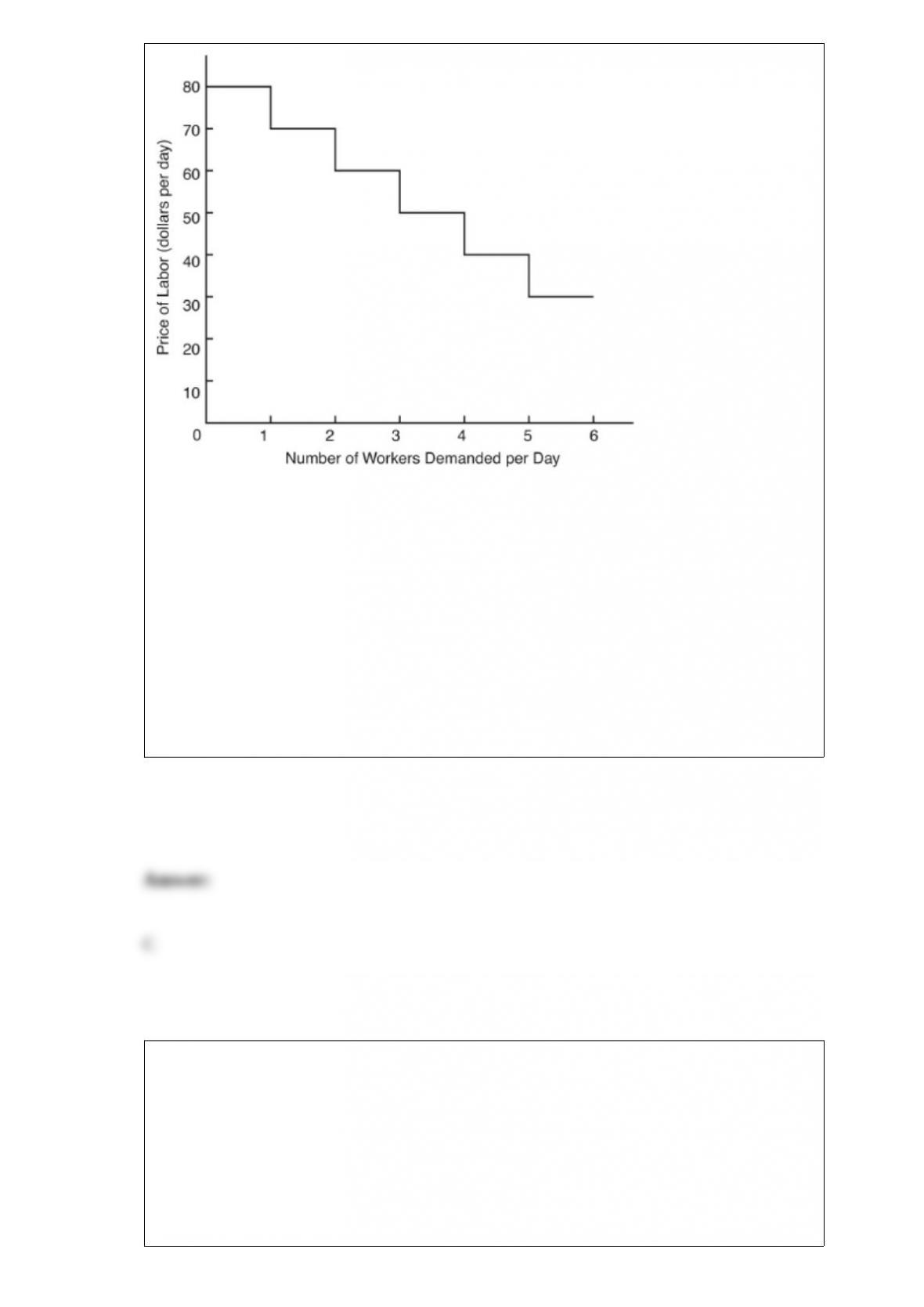
The firm would hire three workers if the wage of a worker were between
a. $31 and $40.
b. $41 and $50.
c. $51 and $60.
d. $61 and $70.
e. $71 and $80.
If a family’s disposable income is $100,000 and the amount it saves is $35,000, its
a. average propensity to consume is 0.65.
b. marginal propensity to save is 0.53.
c. marginal propensity to consume is 0.65.

d. marginal plus average propensities to consume equal 1.
e. average propensity to consume is 1.53.
When market prices fall short of the true social costs of an activity
a. there are significant benefits to the public at large.
b. resources are underused.
c. society is properly compensated for its losses.
d. there is no economic growth.
e. external diseconomies exist.
Suppose the short-run price elasticity of demand for gasoline is 0.4. Acting on this
information, one gasoline station at an intersection where there are three additional
gasoline stations raises its price by 10 percent. If the other three stations keep their
original prices, the first gasoline station will probably see its gasoline sales
a. increase by 0.4 percent.
b. remain unchanged.
c. fall by 0.4 percent.

d. fall by 4 percent.
e. fall by more than 4 percent.
A basic characteristic of an equitable tax system is that
a. it promotes a perfectly equal distribution of income.
b. only the highest income families pay taxes.
c. people in essentially the same circumstances pay the same taxes.
d. marginal and average tax rates fall as incomes rise.
e. it places the tax burden primarily on businesses, rather than on households.
Most available evidence suggests that the U.S. technological lead over other countries
is
a. widening.
b. narrowing.
c. the same as it has been since 1900.
d. negative (below other countries).

e. nonexistent; Japan and West Germany have caught up with it.
This table shows the hypothetical effect of a redeployment of resources within the
United States and the Arab countries for the production of oil and wheat.
A country that is able to produce many goods should specialize in those products
a. in which it has a comparative advantage.
b. in which it has an absolute advantage.
c. it needs most.
d. its citizens are most willing to pay for.
e. that command the highest price on the world market.

The percentage change in the quantity demanded of one commodity resulting from a 1
percent change in the price of a substitute commodity is called the ________ elasticity
of demand.
a. income
b. price
c. cross
d. equilibrium
e. arc
In a simple Keynesian model, when net exports increase, the
a. C + I + G + (X ” MI) line shifts downward.
b. 45-degree line becomes flatter.
c. multiplier falls to zero.
d. aggregate demand curve shifts to the left.
e. equilibrium level of GDP increases by an amount greater than the increase in net
exports.

Successful innovations are generally imitated by others, causing the
a. production possibilities curve to shift to the left.
b. marginal product of capital curve to shift to the left.
c. profits of the innovator to decline.
d. output rate per worker to fall.
e. quality of output to fall.
In commenting on the problems of implementing the provisions of the Clean Air Act for
Los Angeles, EPA director William Ruckelshaus noted that
a. Los Angeles really did not have a pollution problem and that implementing the act
would be burdensome.
b. under provisions of the act, the EPA was not allowed to take the economic costs
imposed by the act into consideration.
c. it would require taking only 10 percent of the cars in the region off the highway and
that people were unwilling to make even this small sacrifice.
d. the Los Angeles pollution was created by activities taking place outside the region
and thus not covered by the provisions of the law.
e. the Clean Air Act dealt only with industrial pollution and that the problem in Los
Angeles was caused by automobiles.

The initial success of the Kennedy-Johnson wage and price guidelines was diminished
considerably during the late 1960s mainly because
a. labor markets tightened in response to the Vietnam buildup.
b. the Council of Economic Advisers was opposed to them.
c. the guidelines had no real administrative backing.
d. they had fulfilled their purpose and were no longer needed.
e. they were favored only by labor unions.
A labor organization set up in a specific geographic area or plant is called a
a. national union.
b. closed shop.
c. cartel.
d. company union.
e. local union.

Human wants and desires
a. are rarely influenced by advertising or cultural factors.
b. can be classified into the categories of land, labor, and capital.
c. are more readily satisfied when labor productivity declines.
d. appear to be insatiable in the aggregate.
e. fall dramatically as incomes rise in the economy.