Gross domestic product is the money value of manufacturing production in a year.
a. True
b. False
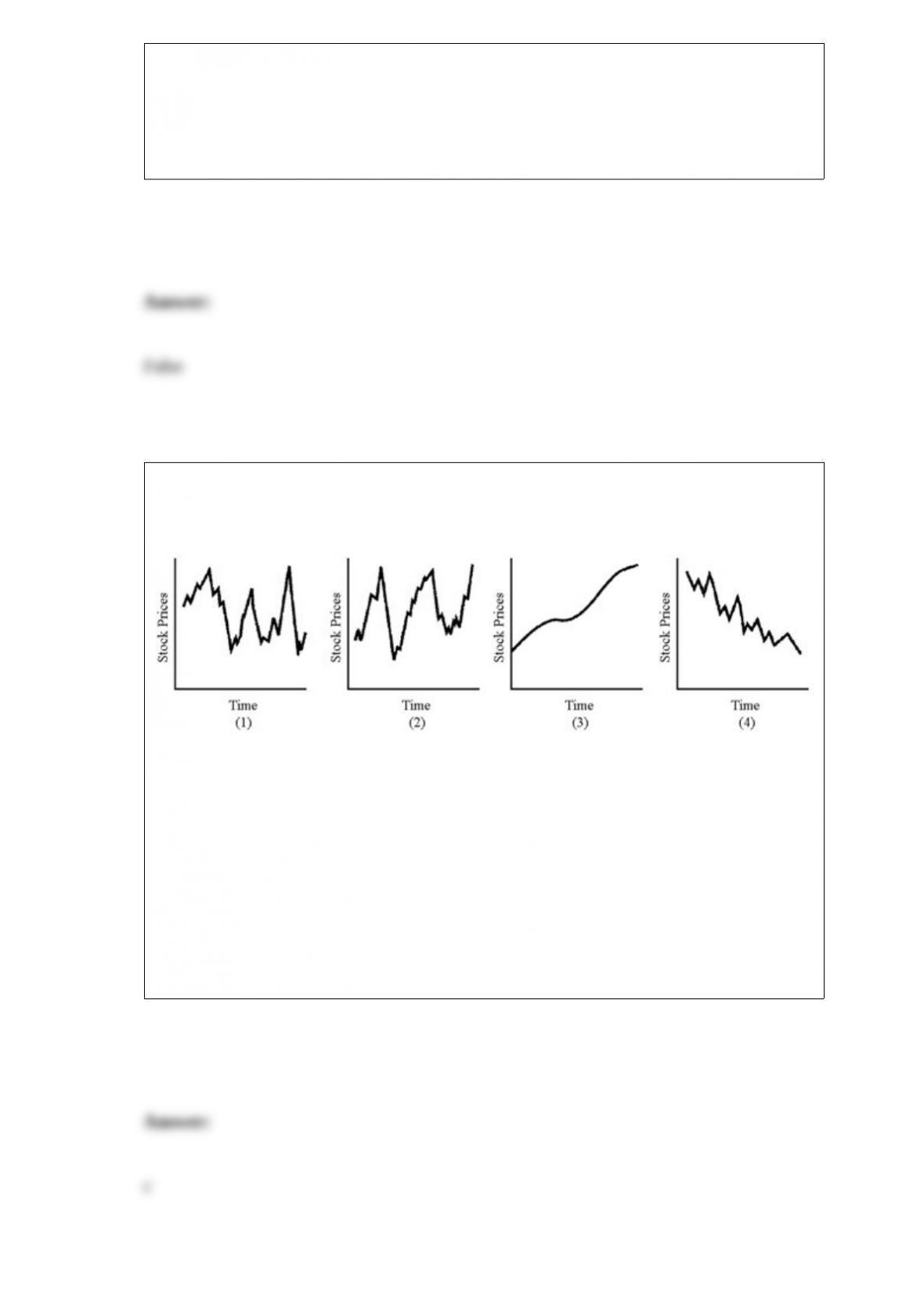
Figure 9-1
Which of the graphs in Figure 9-1 best illustrates the path of a composite of common
stock prices over the long term?
a. (1)
b. (2)
c. (3)
d. (4)

A decrease in the price of resources will cause the aggregate supply curve to
a. shift outward.
b. shift inward.
c. become flatter.
d. become steeper.
As Americans have become more health conscious, rules about food labels have
become more complex and stringent. This is an example of government acting as
a. regulator.
b. redistributor.
c. taxer.
d. defender.
e. referee.
Which of the following activities is most likely to be considered rent seeking?
a. buying an apartment building

b. hiring a lobbyist
c. voting for a politician who supports government spending
d. buying common stock
If MU = MC = P, an economist can judge with certainty that the distribution of output is
a. fair.
b. equal.
c. unbiased.
d. efficient.
A nation can gain from imposing a tariff on imports if it forces exporting countries
a. to raise their prices to pay the tariff.
b. to lower their prices to avoid stocks of unsold goods.
c. to produce at diseconomies of scale.
d. to accept some imports from the tariff-imposing nation.

Slope will vary along a curve (as opposed to a straight line).
a. True
b. False
If the nominal interest rate was 12 percent and the inflation rate was 10 percent in 1980,
while the nominal interest rate was 7 percent and the inflation rate was 2 percent in
2001, then
a. real rates were higher in 2001.
b. real rates were higher in 1980.
c. credit was more expensive in 1980.
d. credit was cheaper in 2001 because the nominal rate was lower.
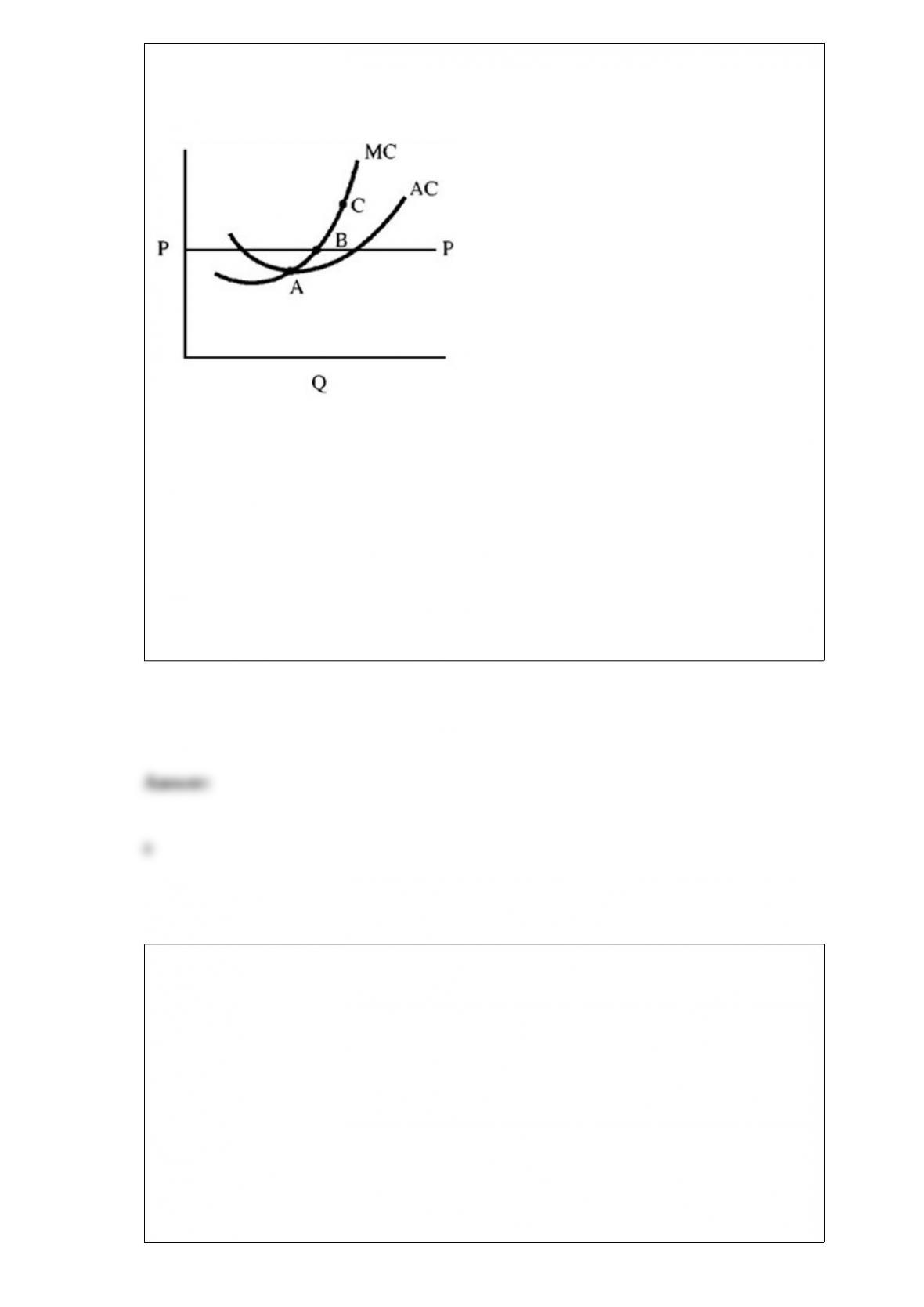
Figure 10-7
In Figure 10-7, through which point must a horizontal demand curve pass to yield a
long-run equilibrium?
a. A
b. B
c. C
d. All of the above is correct.
By tradition, Japanese employers cannot “lay off” workers. As a result they have goods
that they cannot sell on the domestic market without driving down prices. To minimize
losses, they sell goods such as steel and televisions in foreign markets at prices well
below those in Japan. This is called
a. beggar my neighbor.
b. helpfulism.
c. strategic trade policy.
d. dumping.

A demand curve is described as perfectly elastic if
a. any quantity can be sold at a given price.
b. the same quantity is sold regardless of price.
c. neither price nor quantity demanded ever change.
d. only price can change.
Most American firms are corporations.
a. True
b. False

Identify the market structure characterized by many small firms selling somewhat
different products.
a. Monopoly
b. Monopolistic competition
c. Perfect competition
d. Duopoly
A run on a bank may occur if
a. depositors withdraw some funds to invest in the stock market.
b. required reserves are increased.
c. interest rates are raised.
d. depositors lose confidence in the bank and attempt to withdraw all their funds.
e. All of the above are correct.
The expansion path of product indifference curves shows the cost-minimizing
combination of inputs.
a. True

b. False
Monopolistic competition has at least one similarity to perfect competition: firms are
free to enter and leave the industry.
a. True
b. False
There are at least three exchange rates between every pair of national currencies.
a. True
b. False

A scatter diagram could help a policy maker decide on the size of a tax cut necessary to
increase consumer expenditures by a certain amount.
a. True
b. False
The invisible hand enforces the tendency toward
a. MR = MU.
b. MC = P = MU.
c. MC = MPP = P.
d. MRP = MPP = P.
An export subsidy is a payment by the government to exporters to permit them to
charge lower prices.
a. True
b. False

Wages in American industry are very high because of wage laws.
a. True
b. False
Crowding out occurs when
a. increased taxes force higher levels of national saving.
b. deficit spending by the government forces private investment spending to contract.
c. local businesses cannot get government contracts because of the higher bids of large
corporations.
d. foreign investors are willing to pay higher prices for U.S. bonds than American
citizens will pay.
Fixed cost increases when output rises.

a. True
b. False
Suppose that many corporations begin issuing new bonds. Everything else being equal,
what is most likely to happen to the interest rate?
a. It will increase.
b. It will decrease.
c. It will not change.
d. It will vary according to a random walk.
The perfect competition price system is the most efficient because it equates MC = P =
MU.
a. True
b. False
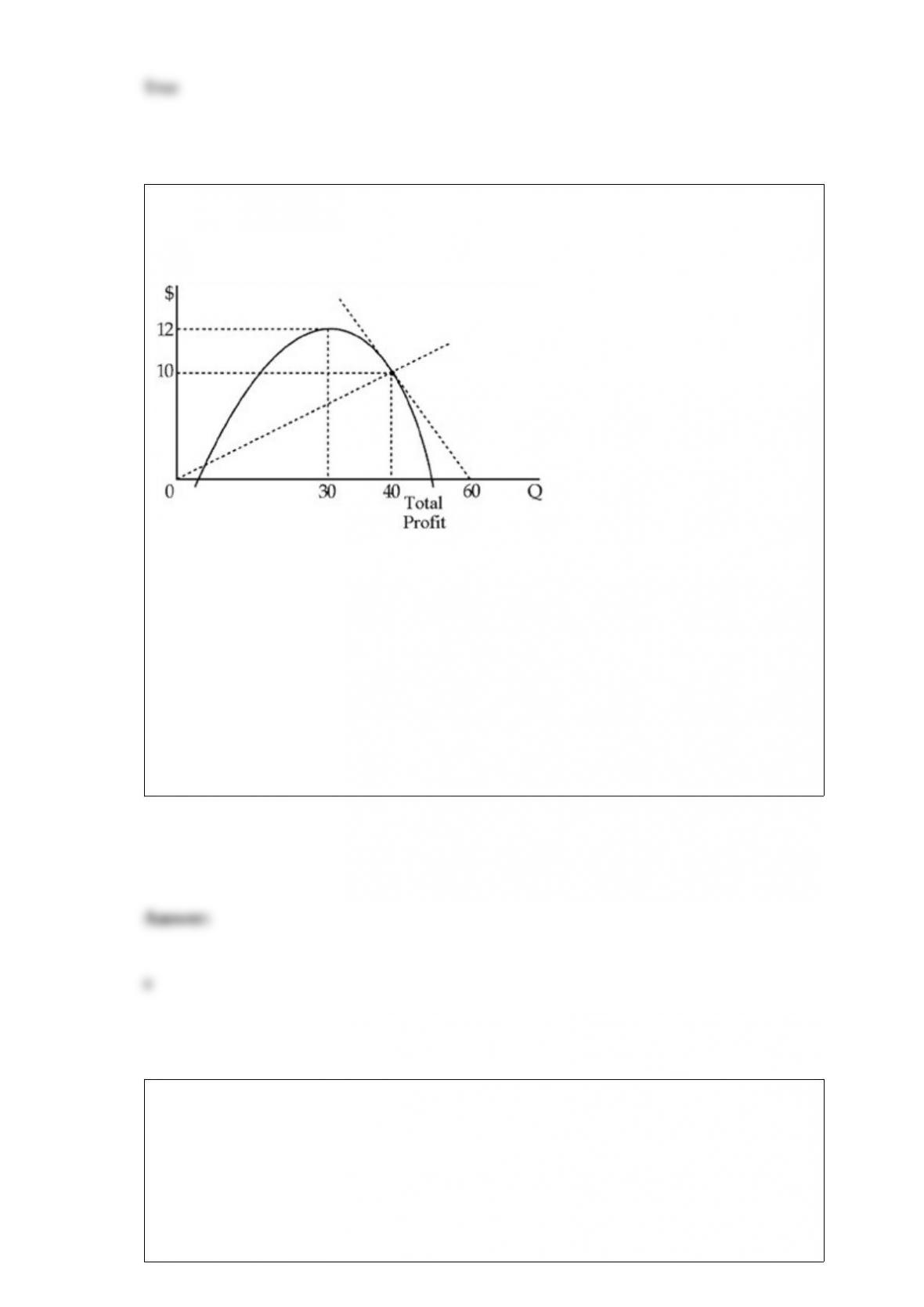
Figure 8-3
Figure 8-3 shows a firm’s total profit function. At an output of 40, the firm’s total profit
equals ____.
a. 10
b. 40
c. 200
d. 400
In the United States, the fact that the gap between the rich and the poor has been
increasing is often justified by economists on the grounds that greater
a. efficiency can never be achieved without greater inequality.
b. inequality does not create any problems.

c. inequality is a desirable end in itself.
d. inequality is an undesirable consequence of greater efficiency.
e. efficiency should be achieved at any cost.
A common misconception about supply is that
a. supply depends on many other variables.
b. price is a major determinant of quantity.
c. it is a fixed amount.
d. quantity cannot be determined in advance.
e. All of the above are correct.
Globalization was much more pervasive in the 1800s than it is today.
a. True
b. False

With a monopsony in the labor market, a union can often raise wages and the number of
workers hired.
a. True
b. False
Economic theory posits that a resource which is finite and being depleted will rise in
price continuously, and demand will be reduced. In fact, a recent study, graphing the
price behavior of lead, zinc and copper found that until about 2007,
a. prices rose steadily, as predicted.
b. prices dropped precipitously.
c. prices remained remarkably stable.
d. prices were up and down with no discernible pattern.
The emigration of some of Whoville’s workers reduces the quantity of thingamabobs

supplied at every price by 50. The new supply curve will ____ the old supply curve.
a. be steeper and less elastic at every price than
b. have the same slope and the same elasticity at every price as
c. have the same slope and be more elastic at every price than
d. More information is needed to predict the relationship between the elasticities of the
two supply curves.