
Rational ignorance refers to voter-citizens choosing to be uninformed about politics
and government on an individual basis because
a. of apathy.
b. of ignorance.
c. of laziness.
d. they believe the benefits of becoming informed are greater than the costs.
e. they believe the benefits of becoming informed are less than the costs.
Supply-restricting policies are intended to shift the
a. supply curve to the left.
b. supply curve to the right.
c. demand curve to the left.
d. demand curve to the right.
e. b and d
Government can overcome the free rider problem by collecting taxes and using the
funds to provide individuals with nonexcludable public goods that they want to buy but
the market cannot provide.
a. True

b. False
“Rent seeking” is socially wasteful because
a. resources devoted to transferring rents are not used to produce goods.
b. wage income is converted into profit income.
c. it results in higher prices than would exist without monopoly.
d. it discourages innovation and risk taking.
Which of the following will cause a firm’s factor demand curve to shift to the left?
a. a decrease in factor costs
b. an increase in factor costs
c. a decrease in marginal physical product
d. an increase in marginal physical product

When a firm earns zero economic profit, it has
a. not covered all its explicit costs.
b. not covered all its implicit costs.
c. not earned enough to stay in business.
d. definitely earned an accounting profit if implicit costs are positive.
e. none of the above
One of the assumptions upon which the theory of perfect competition is built is that
each firm produces and sells a heterogeneous product.
a. True
b. False
Refer to Exhibit 39-7. Let E1 represent the initial equilibrium in the market for X. A
combination of population growth and an increase in agricultural productivity will
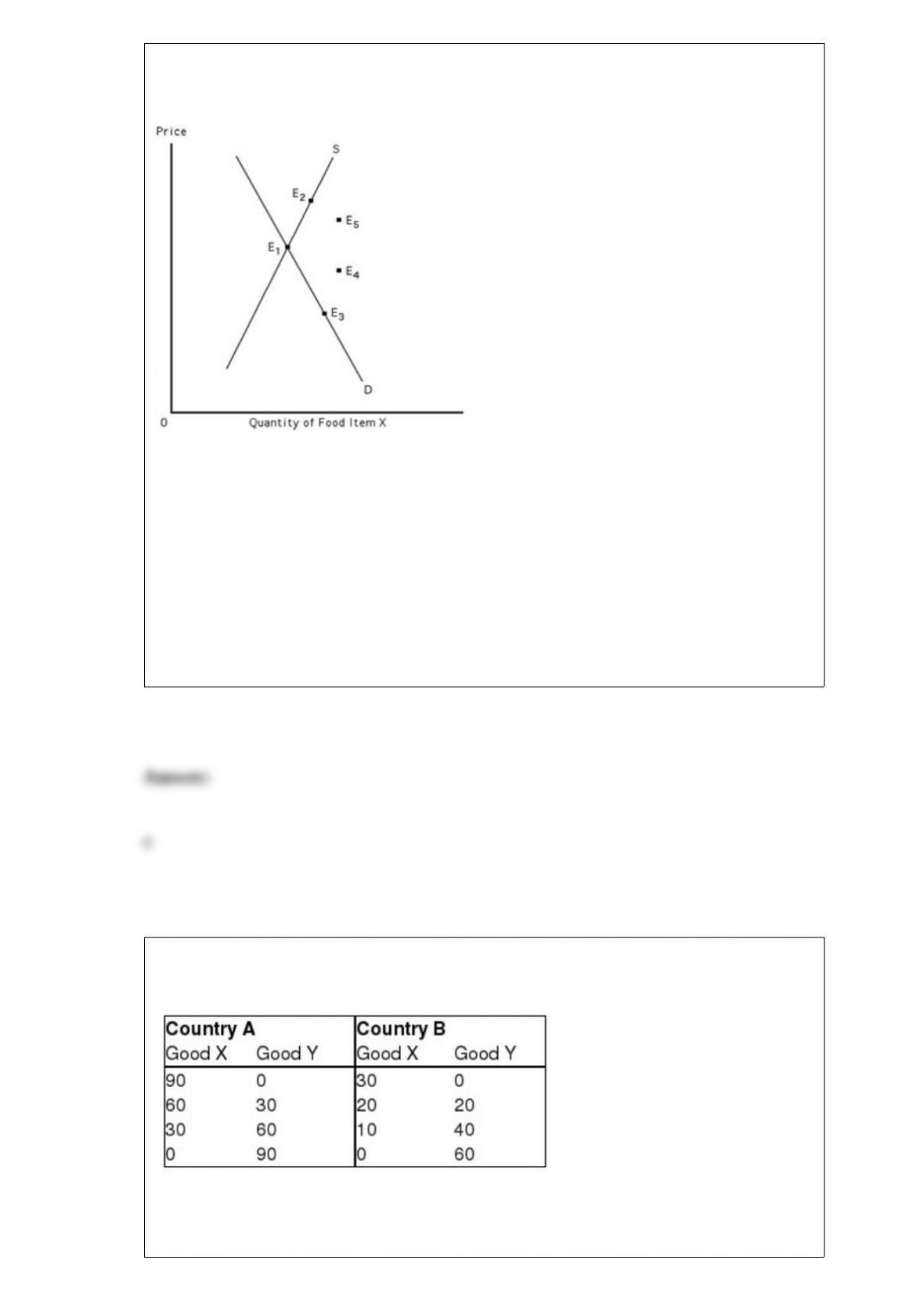
likely result in a new equilibrium at
Exhibit 39-7
a. E2.
b. E3.
c. E4.
d. E5.
e. E4 or E5, depending on the extent of income elasticity of demand.
Refer to Exhibit 34-1. Country B is the lower opportunity cost producer of
Exhibit 34-1
a. good Y.

b. both goods.
c. neither good.
d. good X.
Variables A and B are directly related. If we plot A on the horizontal axis and B on the
vertical axis, the line that connects combinations of A and B in a two-variable diagram
is
a. parallel to the horizontal axis.
b. downward-sloping (left to right).
c. parallel to the vertical axis.
d. upward-sloping (left to right).
e. a or c
Refer to Exhibit 4-4. Which of the following is false?
Exhibit 4-4
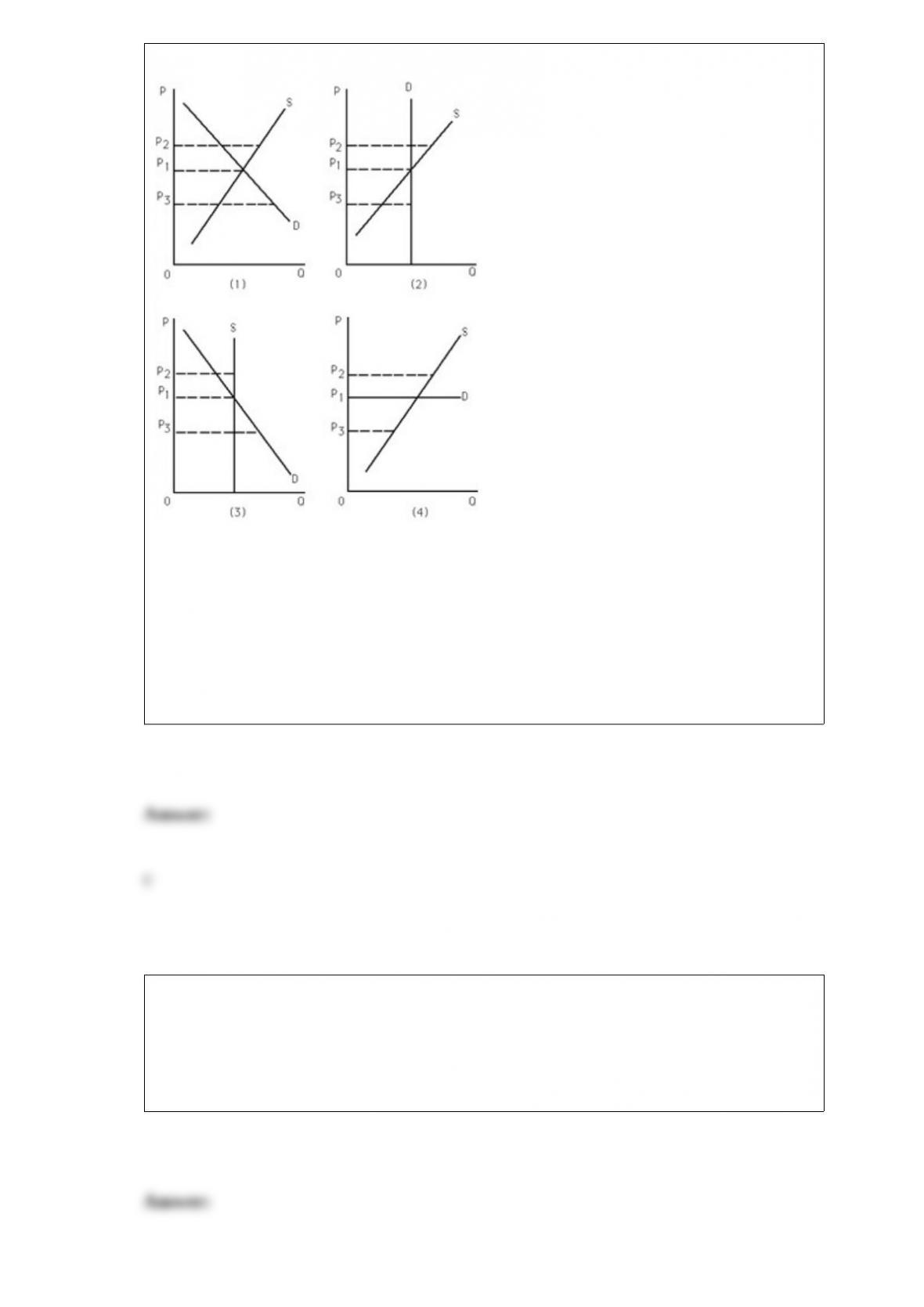
a. Graph (1): There is a shortage when price is P3.
b. Graph (2): As supply increases, equilibrium quantity remains constant.
c. Graph (3): As demand increases, equilibrium price remains constant.
d. Graph (4): As supply changes, equilibrium price stays the same.
Natural monopolies arise because of economies of scale.
a. True
b. False

The long-run industry supply curve is the graphic representation of the quantity of
output that the industry is prepared to
a. supply at different prices after the entry and exit of firms is completed.
b. supply at a single price after the entry and exit of firms is completed.
c. purchase at different prices after the entry and exit of firms is completed.
d. purchase at different prices after the entry of firms is completed.
e. supply at different prices after the exit of firms is completed.
Constant returns to scale are said to exist when inputs are increased by some percentage
and output increases by a(n) __________ percentage, causing unit costs to __________.
a. greater; fall
b. smaller; fall
c. greater; rise
d. smaller; rise
e. equal; remain constant
A potato farmer who signs a futures contract is
a. speculating on the future price of potatoes, hoping it will be higher.
b. speculating on the future price of potatoes, hoping it will be lower.
c. eliminating his exposure to risk from a falling potato price.
d. trying to influence the price of potatoes to rise.
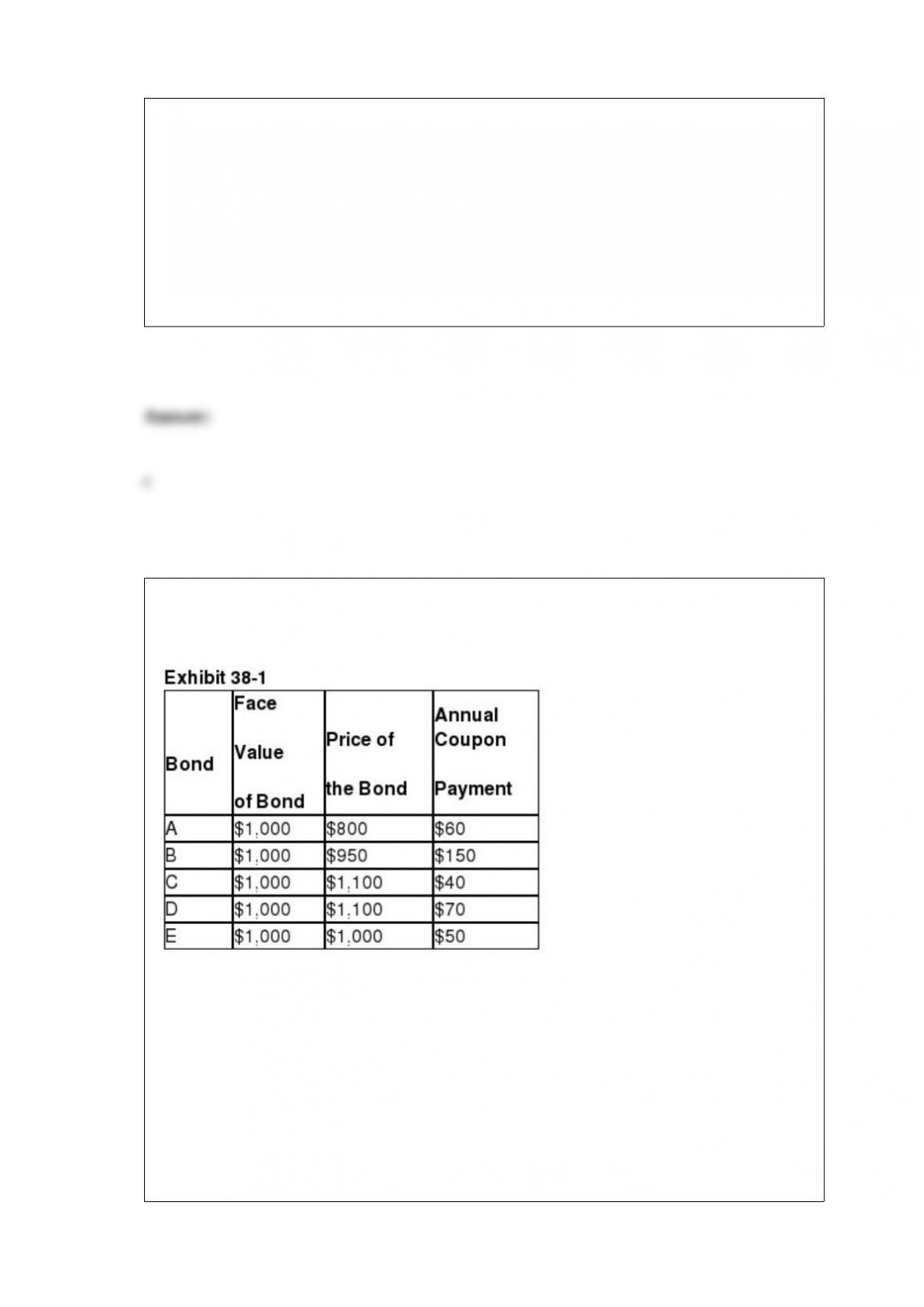
Refer to Exhibit 38-1. For which bond is the yield and the coupon rate the same?
a. Bond A
b. Bond B
c. Bond C
d. Bond D
e. Bond E

If a monopolist practices perfect price discrimination, then it will have
a. a greater total revenue and sell a greater output than if it were not practicing price
discrimination.
b. a smaller total revenue and sell a smaller output than if it were not practicing price
discrimination.
c. the same total revenue but sell a larger output than if it were not practicing price
discrimination.
d. the same total revenue but sell a smaller output than if it were not practicing price
discrimination.
The formula for determining the production flexibility contract payment is:
a. contract acreage x 0.75 x yield per acre x crop payment rate.
b. contract acreage x 0.85 x yield per acre x $1.
c. contract acreage x 0.85 x yield per acre x crop payment rate.
d. contract acreage – (0.85 x contract acreage) x yield per acre x crop payment rate.
e. There is no formula for the production flexibility contract payment. There is only a
flat fee that changes annually.

Which of the following statements is not an example of the use of persuasion to correct
(or adjust for) an externality?
a. Maggie asks her neighbor to keep his dog quiet at night.
b. An environmental group conducts a sit-in at a chemical factory to demand that the
firm stop polluting rivers.
c. A judicial court imposes a fine on a reckless driver.
d. All of the above are examples of the use of persuasion to correct (or adjust for) an
externality.
If, at the world price, domestic producers are producing and selling 100 units of a good,
then at the world price plus tariff it follows that
a. they will be producing and selling more than 100 units of the good.
b. they will be producing and selling fewer than 100 units of the good.
c. producers’ surplus will be less than what it is when domestic producers produce and
sell 100 units.
d. consumers’ surplus will be greater than what it is when domestic producers produce
and sell 100 units.
e. c and d

Suppose the price elasticity of demand of for soy beans is 0.85.When the price of
soybeans rises by 20 percent, the quantity demanded of soybeans falls by approximately
_____________ percent.
a. 0.024
b. 26.67
c. 23.53
d. 17.00
A decreasing-cost industry has a long-run supply curve that is upward sloping.
a. True
b. False
The government can _______________ change an inefficient market outcome (in the
case where there is a negative externality) into an efficient outcome by imposing a tax
on the activity that generates the negative externality.
a. in almost all situations
b. possibly

c. not
d. in all situations
e. a or d
Cartels are easy to form and to maintain.
a. True
b. False