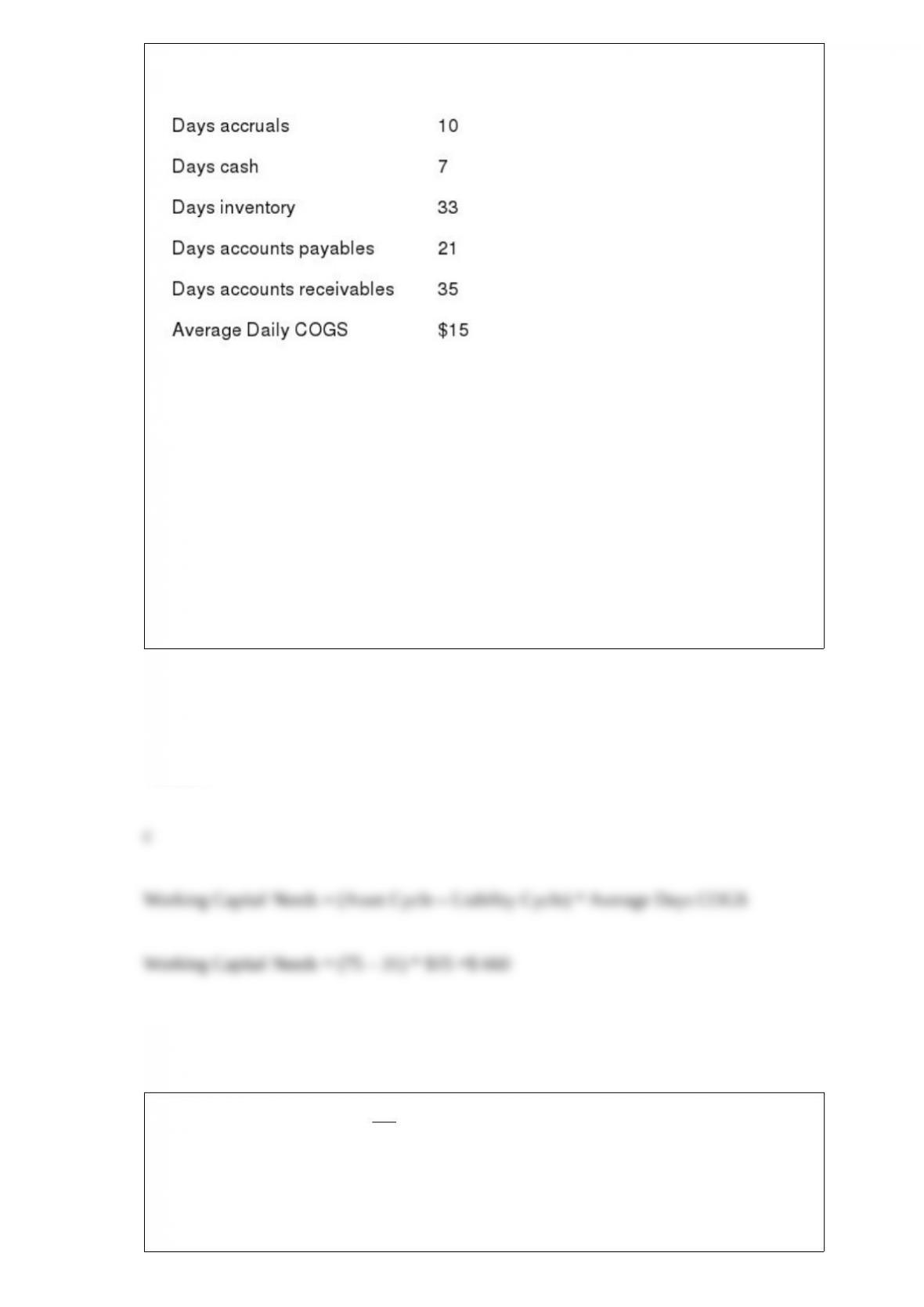
Use the following firm working capital cycle information.
What are the firm’s estimated working capital needs?
a. $90
b. $315
c. $660
d. $1,125
e. $2,250
Answer:
Why is liquidating collateral not a preferred means of loan repayment?
a. It deprives the borrower of the opportunity to salvage the company.
b. Transaction costs on liquidating collateral are often quite high.

c. Bankruptcy laws may prevent liquidation to occur in a timely manner.
d. All of the above.
e. b. and c. only
Answer:
A financial holding company cannot own which of the following?
a. A bank.
b. A bank holding company.
c. A thrift.
d. A thrift holding company.
e. A financial holding company may own all of the above.
Answer:
Use the following information.
How much Tier 2 capital does the bank have?

a. $200
b. $450
c. $550
d. $800
e. $1100
Answer:
Tier 2 capital consists of all of the following except:
a. 30-year subordinated debt.
b. cumulative perpetual preferred stock.
c. mandatory convertible preferred stock.
d. preferred stock with a maturity of 7 years.
e. equity in subsidiaries.
Answer:

Which of the following is not a cost management strategy?
a. Investing in resources to improve long-term profitability
b. Changing pricing such that total revenues increase
c. Identify operating efficiencies
d. Burden identification
e. Expense reduction
Answer:
If rate-sensitive assets equal $500 million and rate-sensitive liabilities equals $400
million, what is the expected change in net interest income if rates increase by 1%?
a. Net interest income will increase by $1 million.
b. Net interest income will fall by $1 million.
c. Net interest income will increase by $10 million.
d. Net interest income will fall by $10 million.
e. Net interest income will be unchanged.
Answer:

Under FASB 157, the valuation of Level 3 assets is labeled:
a. marking to market.
b. marking to matrix.
c. marking to myth.
d. marking to major.
e. marking to minor.
Answer:
Under FASB 157, Level _______ assets valuation are based on management’s best
judgment of what the underlying asset is worth.
a. 1
b. 2
c. 3
d. 4
e. 5
Answer:

What is the effective annual rate of an investment that offers 8%, compounded
quarterly?
a. 8.00%
b. 8.16%
c. 8.24%
d. 8.32%
e. 8.64%
Answer:
A three-year 9% bond is trading at par of $5,000. If you buy the bond expecting to hold
it to maturity and believe you can reinvest the $225 semi-annual coupon payments at a
3.5% semi-annual rate through maturity. The total return on this investment is _____
annually.
a. 3.50%
b. 4.50%
c. 7.00%
d. 8.80%
e. 9.00%

Answer:
On Goldman Groups’ 2012 balance sheet, ___________ consist of securities that
Goldman Sachs has loaned under an agreement to repurchase at a later date.
a. collateralized agreements
b. financial instruments
c. collateralized financings
d. receivables
e. payables
Answer:
If you invest $2,000 today at 9% compounded interest for two years, the value of the
investment to the nearest dollar at the end of the two years will be:
a. $2,376
b. $2,360
c. $2,180.

d. $1,640.
e. $1,624.
Answer:
Net income is defined as:
a. Net interest income – burden + provision for loan loss + securities gains or losses –
taxes.
b. Net interest income + burden + provision for loan loss + securities gains or losses –
taxes.
c. Net interest income – burden – provision for loan loss + securities gains or losses –
taxes.
d. Net interest income – burden – provision for loan loss + securities gains or losses +
taxes.
e. Net interest income + burden – provision for loan loss + securities gains or losses –
taxes.
Answer:
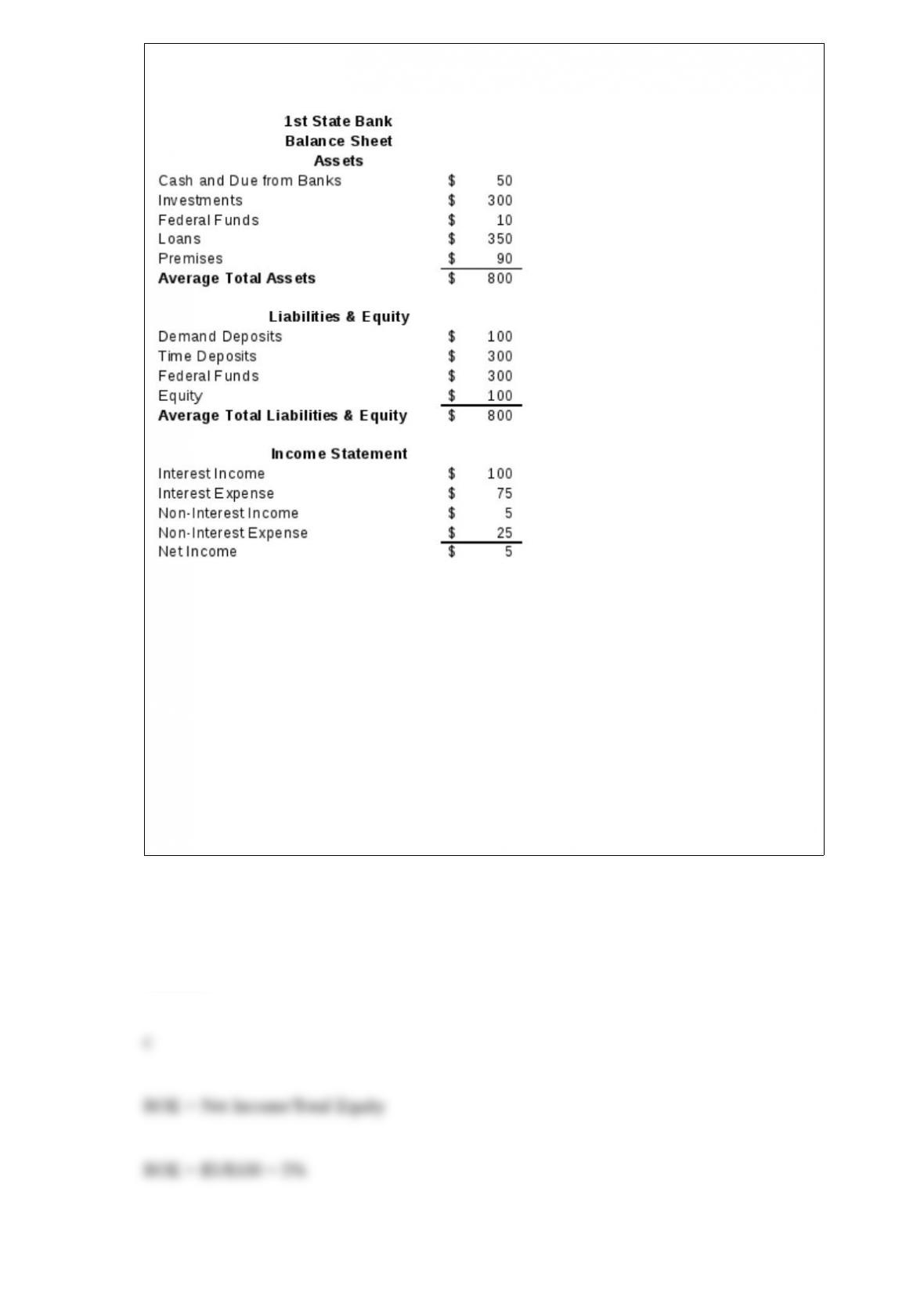
Use the following information.
What is 1st State’s return on equity?
a. 0.6%
b. 3.8%
c. 5.0%
d. 8.2%
e. 9.8%
Answer:

To buy a futures contract, one must post a(n):
a. maintenance margin.
b. variation margin.
c. market margin.
d. initial margin.
e. marked margin.
Answer:
If a bank has a negative GAP, an increase in interest rates will cause interest income to
__________, interest expense to__________, and net interest income to __________.
a. increase, increase, increase
b. increase, decrease, increase
c. increase, increase, decrease
d. decrease, decrease, decrease
e. decrease, increase, increase
Answer:

Use the following information.
A London based firm has a subsidiary located in New York. The subsidiary has $1,000
in assets and $750 in liabilities. The current spot rate is $1.60/£.
What is the U.S. firm’s net exposure?
a. $250
b. $750
c. $1,000
d. $1,750
e. Cannot be determined.
Answer:
Under current bankruptcy law, which of the following debts are not dischargeable under
Chapter 7?
a. Past due child support
b. Past due mortgage payments
c. Past due credit card payments
d. Past due auto loan payments
e. All of the above are dischargeable under Chapter 7 bankruptcy law

Answer:
What is the Macaulay’s duration of a 10 year zero-coupon bond with a face value of
$1,000 and a market rate of 8%, compounded annually is:
a. 10 years
b. 11 years
c. 12 years
d. 13 years
e. None of the above
Answer:
A loan to an individual to purchase a home would be considered a:
a. consumer loan.
b. commercial loan.
c. agricultural loan.
d. construction loan.
e. real estate loan.

Answer:
What is the return on equity for a bank that has an equity multiplier of 12, an interest
expense ratio of 5%, and a return on assets of 1.1%?
a. 5.0%
b. 13.2%
c. 8.2%
d. 26.4%
e. 0.66%
Answer:
The ease of converting an asset to cash with a minimum of loss is known as:
a. asset liquidity.
b. volatile liquidity.
c. core liquidity.
d. liability liquidity.
e. non-core liquidity.

Answer:
The goal of a bank manager should be:
a. to maximize earnings.
b. to minimize taxes.
c. to minimize risk.
d. to maximize shareholder wealth.
e. to maximize net interest income.
Answer:
Return on equity can be decomposed into:
a. the sum of return on assets and the equity multiplier.
b. the product of return on assets and the equity multiplier.
c. the product of the profit margin and the equity multiplier.
d. the sum of the profit margin and the equity multiplier.
e. the sum of the profit margin, equity multiplier, and the interest ratio.

Answer:
Loan covenants:
a. protect the borrower from lender interference in management.
b. are limited to “negative” provisions.
c. may limit discretionary cash outlays by firms.
d. are seldom enforced.
e. often result in the lender’s bankruptcy.
Answer:
The _________ requires disclosure of a bank’s privacy policy.
a. Riegle-Neal Interstate Banking and Branching Efficiency Act
b. Gramm-Leach-Bliley Act
c. Financial Institutions Reform, Recovery and Enforcement Act
d. Federal Deposit Insurance Corporation Improvement Act
e. Depository Institutions Deregulation and Monetary Control Act

Answer:
Consumer loans differ from commercial loans in all of the following ways except:
a. consumer loans are generally smaller than commercial loans.
b. consumer loans are generally for longer terms than commercial loans.
c. consumer loans are generally less expensive to administer on a unit basis than
commercial loans.
d. individuals are more likely to default than businesses.
e. consumer loans in some states are still covered by usury laws.
Answer:
______________ is/are the primary revenue source for a majority of banks.
a. Check-processing fees
b. Investment income from deposit balances
c. Loan interest
d. Earnings credits
e. Swaps

Answer:
On Goldman Groups’ 2012 balance sheet, Financial Instruments Owned consists of:
a. cash.
b. collateralized agreements.
c. derivative securities.
d. a. and b.
e. a. and c.
Answer: