1) The average tax rate measures the
a.fraction of spending paid in taxes.
b.fraction of income paid in taxes.
c.incremental rate of tax on income.
d.average deadweight loss from all taxes.
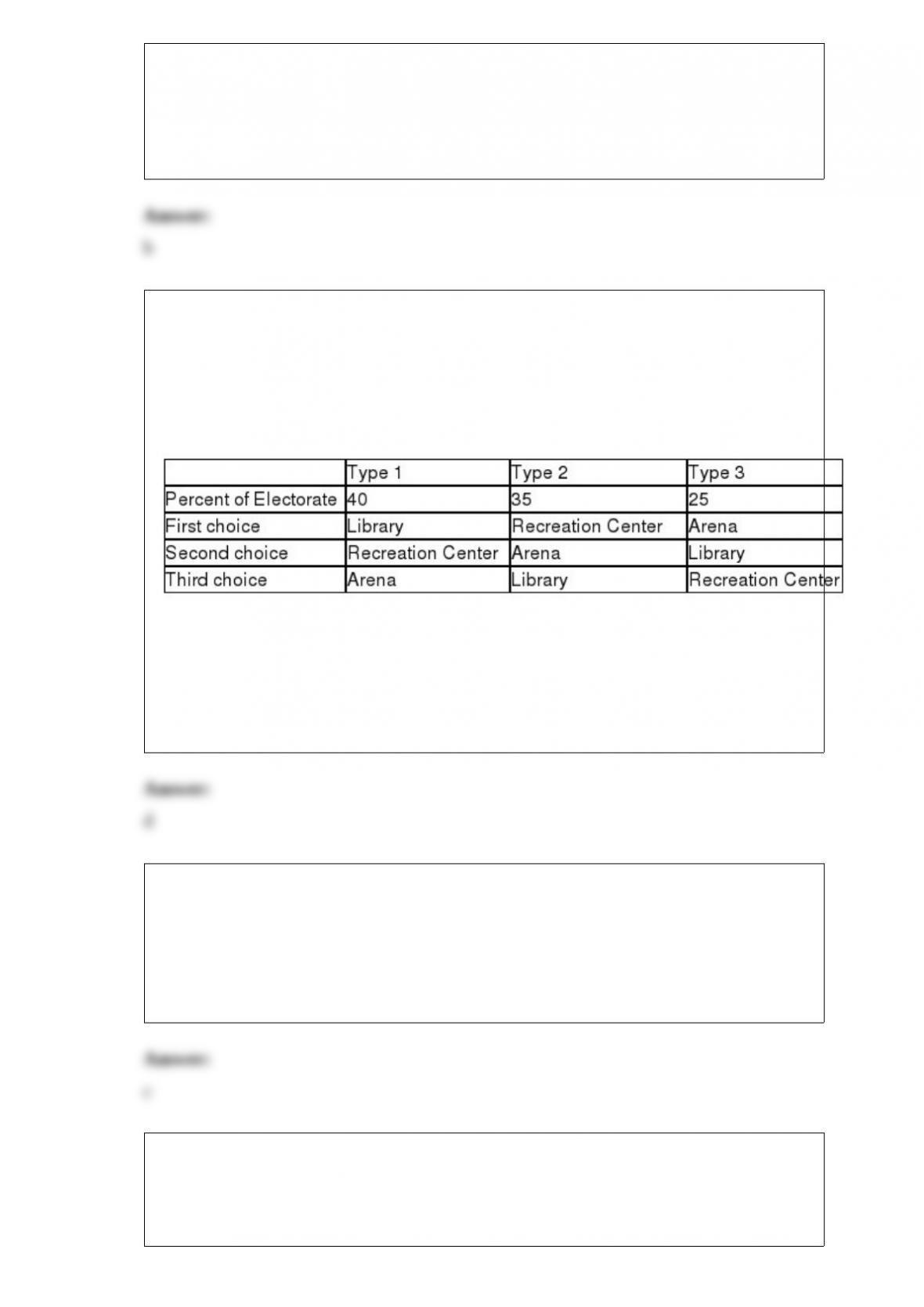
2) Table 22-5
The citizens of Anytown will decide whether to build a new library, a recreation center,
or an arena. Exactly one of the three choices will prevail, and the choice will be made
by way of pairwise voting, with the majority determining the outcome on each vote.
The preferences of the voters are summarized in the table below.
Voter Type
Refer to Table 22-5. If the citizens of Anytown use a Borda count, rather than pairwise
majority voting, to decide what to build, then they will build a new
a.library.
b.recreation center.
c.arena.
d.None of the above is correct; a Borda count fails to produce a winner in this instance.
3) Which of the following is not an expression for the sum of all the individual demand
curves for a product?
a.total demand
b.market demand
c.equilibrium demand
d.aggregate demand
4) According to the ability-to-pay principle, it is fair for people to pay taxes based on
their ability to handle the financial burden.
a.True
b.False
5) If a tax takes a constant fraction of income as income rises, it is
a.regressive.
b.proportional.
c.progressive.
d.based on the ability-to-pay principle.
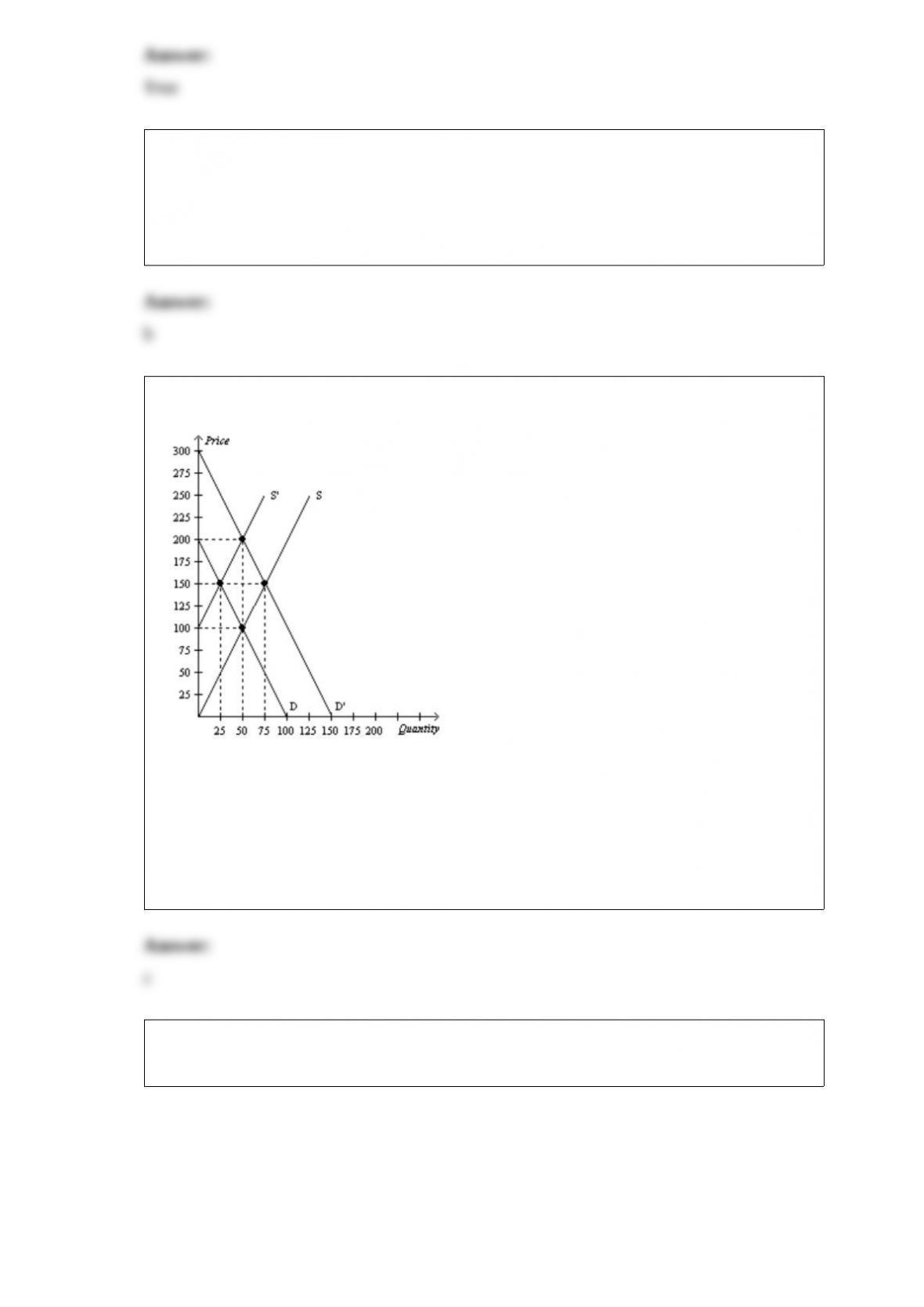
6) Figure 7-11
If the supply curve is S, the demand curve is D, and the equilibrium price is $100, what
is the producer surplus?
a.$625
b.$1,250
c.$2,500
d.$5,000
7) Figure 9-14. On the diagram below, Q represents the quantity of crude oil and P
represents the price of crude oil.
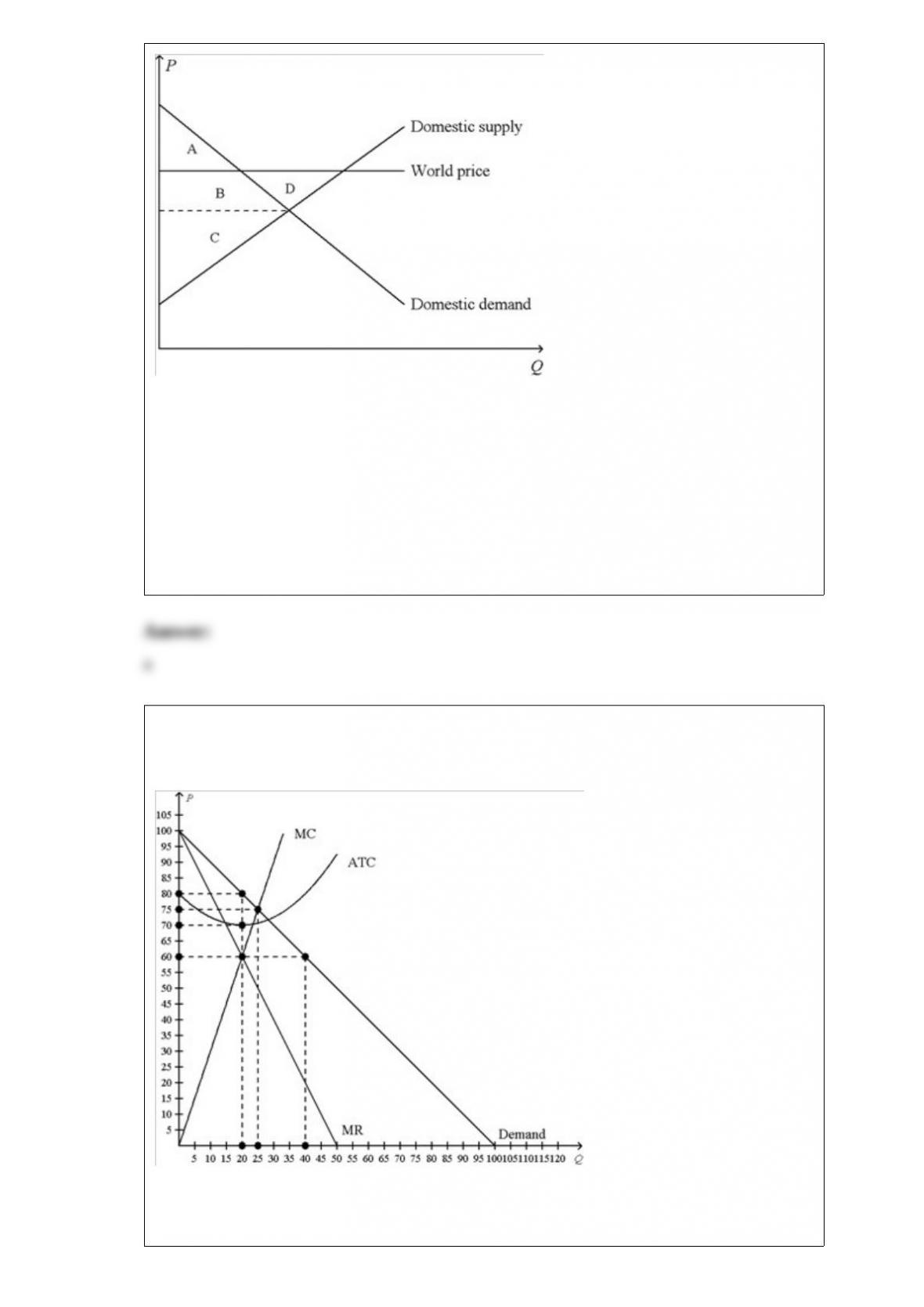
The country for which the figure is drawn
a.has a comparative advantage relative to other countries in the production of crude oil
and it will export crude oil.
b.has a comparative advantage relative to other countries in the production of crude oil
and it will import crude oil.
c.has a comparative disadvantage relative to other countries in the production of crude
oil and it will export crude oil.
d.has a comparative disadvantage relative to other countries in the production of crude
oil and it will import crude oil.
8) Figure 16-3
This figure depicts a situation in a monopolistically competitive market.
How much profit will the monopolistically competitive firm earn in this situation?
a.$0
b.$80
c. $200
d. $400
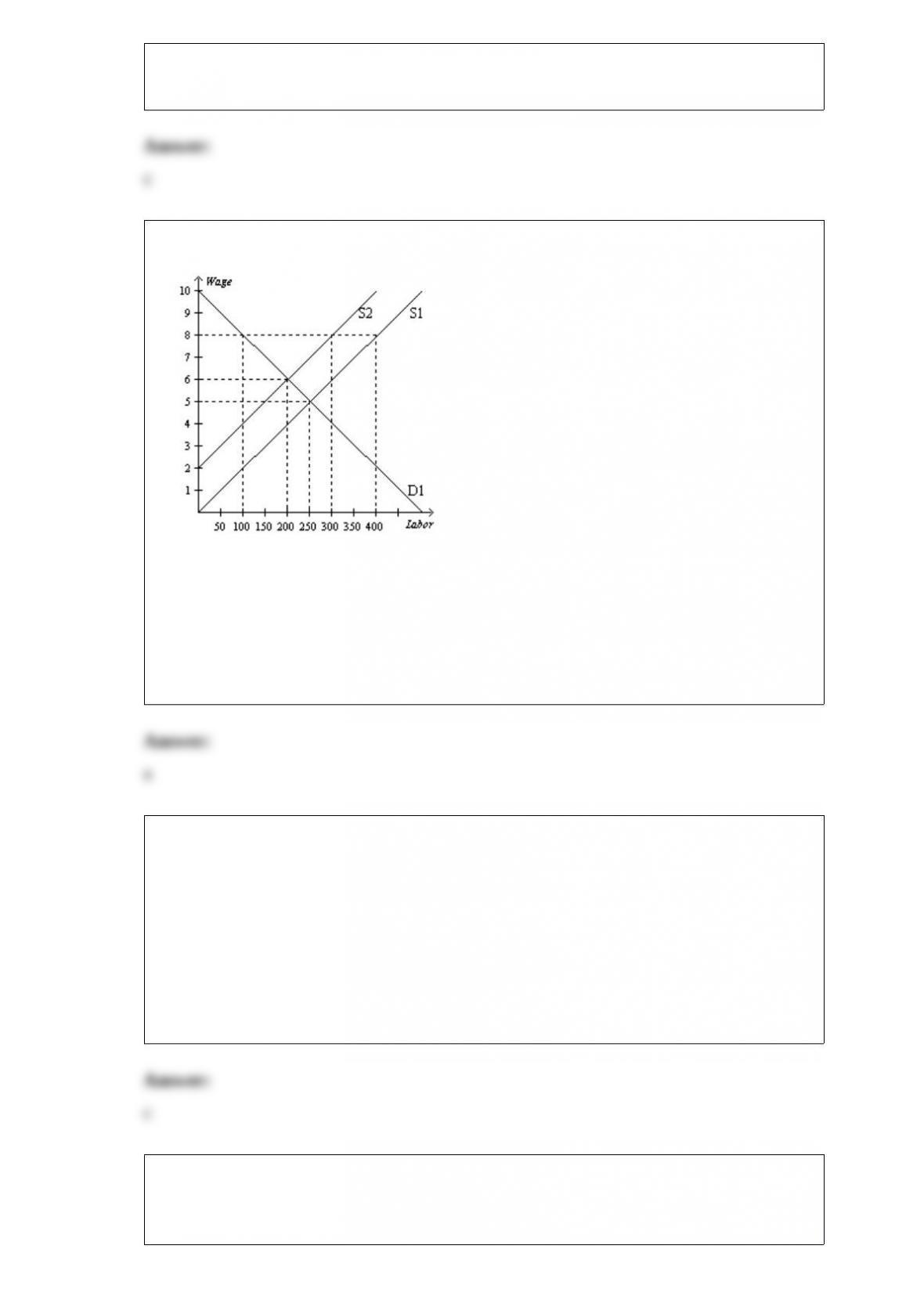
9) Figure 19-5
Refer to Figure 19-5. Given demand for labor, D1, and supply of labor, S1, what are
the equilibrium wage and quantity of labor?
a.$5 and 250
b.$6 and 200
c.$8 and 100
d.$8 and 400
10) Scenario 14-2
Assume a certain firm is producing Q = 1,000 units of output. At Q = 1,000, the firm‘s
marginal cost equals $20 and its average total cost equals $25. The firm sells its output
for $30 per unit.
At Q = 999, the firm‘s total costs equal
a. $24,970.
b. $24,975.
c. $24,980.
d. $25,025.
11) When a production possibilities frontier is bowed outward, the opportunity cost of
producing an additional unit of a good
a.increases as more of the good is produced.
b.decreases as more of the good is produced.
c.does not change as more of the good is produced.
d.may increase, decrease, or not change as more of the good is produced.
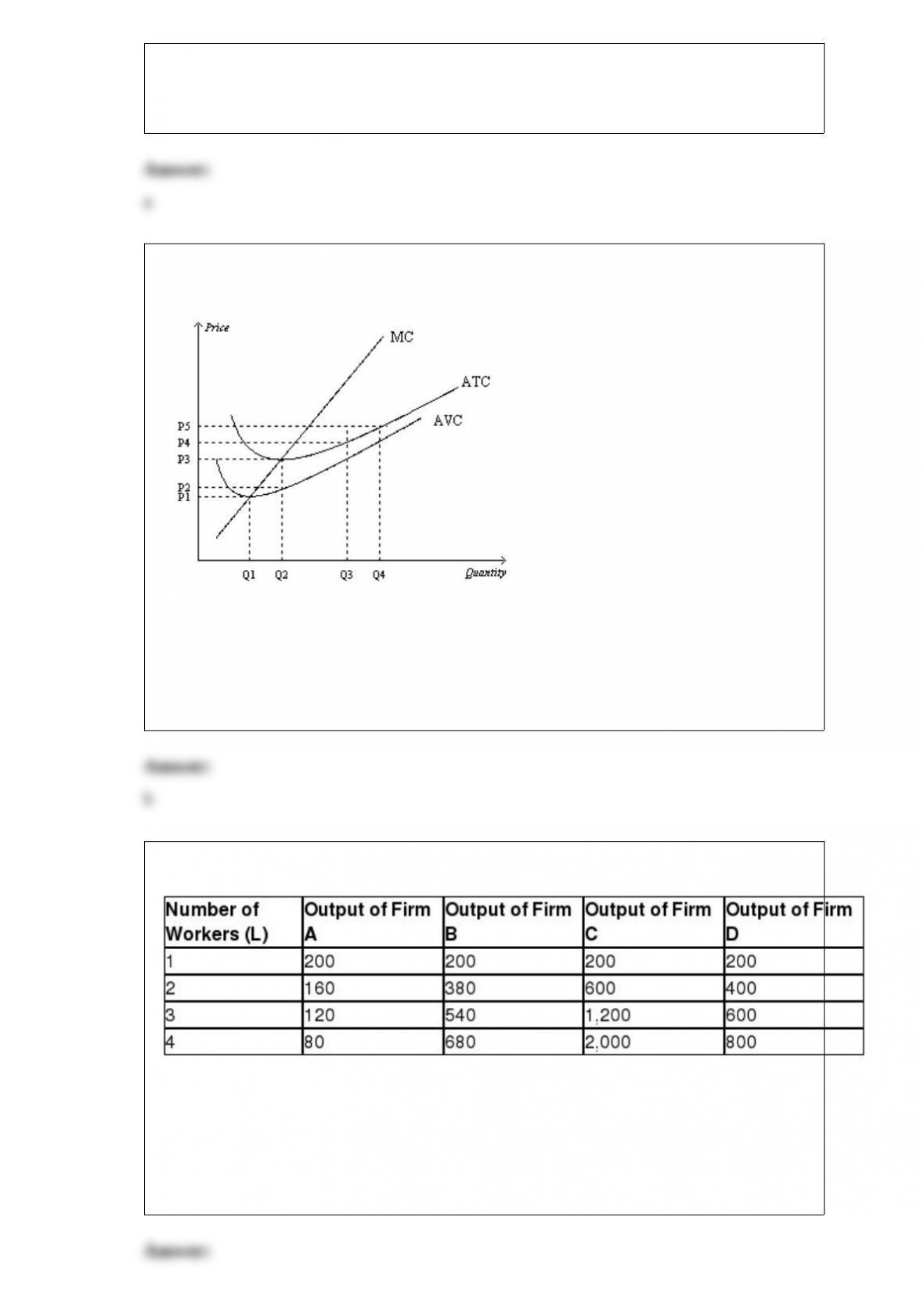
12) Figure 14-6
Suppose a firm operating in a competitive market has the following cost curves:
When market price is P3, a profit-maximizing firm‘s total revenue
a.can be represented by the area P3 x Q3.
b.can be represented by the area P3 x Q2.
c.can be represented by the area (P3-P2) x Q3.
d.is zero.
13) Table 18-3
Refer to Table 18-3. Which firm’s production function exhibits constant marginal
product?
a.Firm A
b.Firm B
c.Firm C
d.Firm D

14) Costas faces a progressive federal income tax structure that has the following
marginal tax rates: 0 percent on the first $10,000, 10 percent on the next $10,000, 15
percent on the next $10,000, 25 percent on the next $10,000, and 50 percent on all
additional income. In addition, he must pay 5 percent of his income in state income tax
and 15.3 percent of his labor income in federal payroll taxes. Costas earns $70,000 per
year in salary and another $20,000 per year in non-labor income. What is his average
tax rate, and what is his marginal tax rate on his salary?
a.His average tax rate is 17.19 percent, and the marginal tax rate on his salary is 55
percent.
b.His average tax rate is 50.23 percent, and the marginal tax rate on his salary is 70.3
percent.
c.His average tax rate is 53.63 percent, and the marginal tax rate on his salary is 70.3
percent.
d.His average tax rate is 55.79 percent, and the marginal tax rate on his salary is 70.3
percent.
15) Which of the following goods is the best example of a public good?
a.garbage-collection services that are provided by a municipal government
b.music that is broadcast over the airwaves by a privately-owned FM radio station
c.electricity that is provided to farmhouses by a rural electric cooperative
d.cable TV services that are provided by a privately-owned firm that is regulated by the
government of the city in which it operates
16) Since the early 1970s, average incomes have
a.increased, which has reduced the poverty rate.
b.increased, while the poverty rate increased slightly.
c.decreased, while the poverty rate has remained unchanged.
d.remained unchanged, while the poverty rate has decreased.
17) Which of the following would most likely serve as an example of a monopoly?
a.a bakery in a large city
b.a bank in a large city
c.a local cable television company
d.a small group of corn farmers
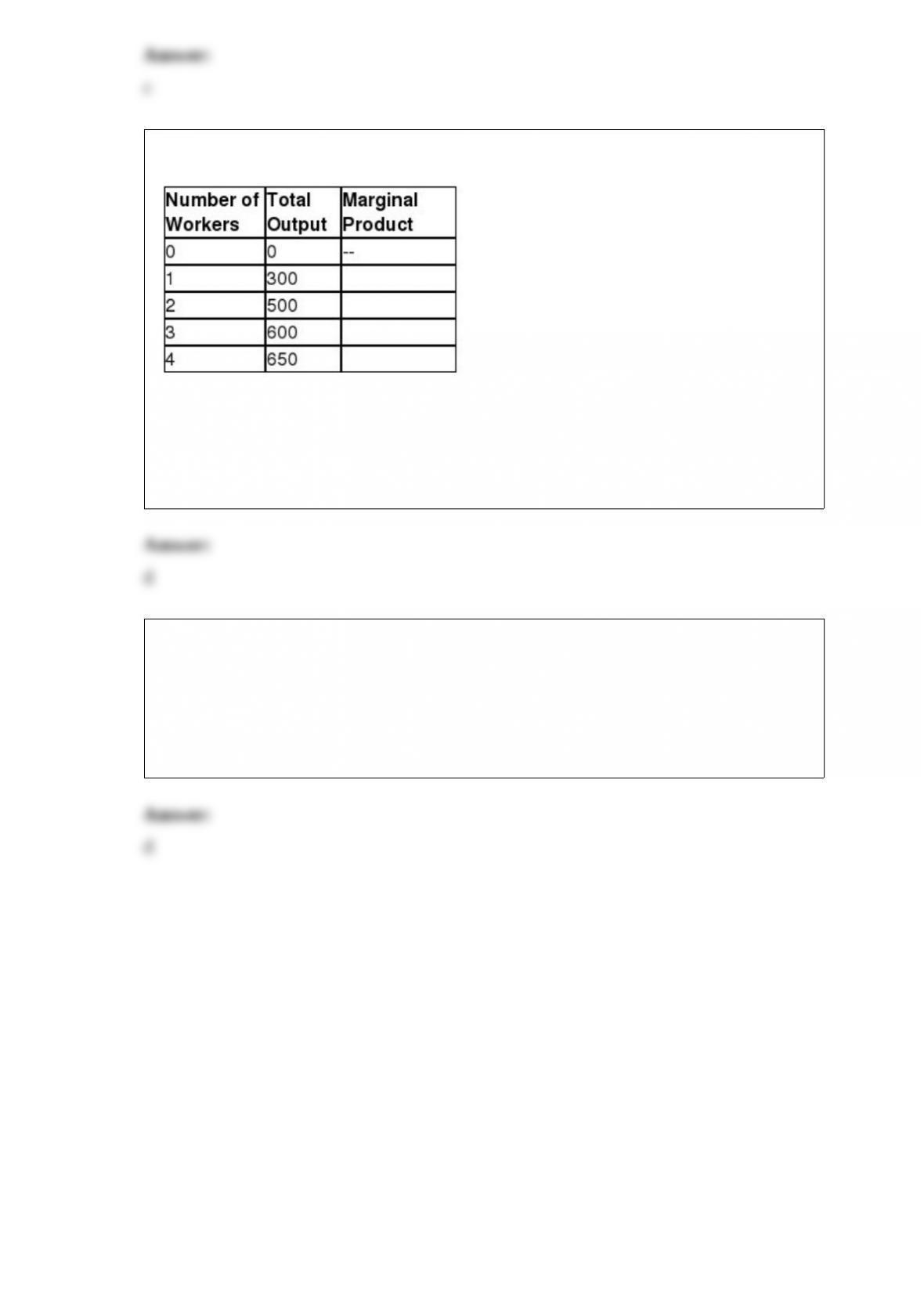
18) Table 13-2
What is the marginal product of the fourth worker?
a.300 units
b.200 units
c.100 units
d.50 units
19) Which of the following is not an example of price discrimination?
a.A movie theater charges a lower price for a child’s ticket than for an adult’s ticket.
b.A university rebates part of the cost of tuition in the form of financial aid for needy
students.
c.A local pizza chain offers a “buy three get one free” deal.
d.An ice cream parlor charges a higher price for ice cream than for sherbet.