
1) because the equilibrium position of a purely competitive seller entails an equality of
price and marginal costs, competition produces an efficient allocation of economic
resources.
2) U.S. exports of farm products have generally declined as a percentage of U.S. farm
output over the past half-century.
3) Efficiency wage theory says that an above-market wage can reduce labor costs per
unit of output by eliciting greater work effort, lowering supervision costs, and reducing
job turnover.
4) The more elastic the demand for a product the less elastic will be the demand for the
resources employed in producing it.
5) A demand curve for a public good is determined by summing horizontally the
individual demand curves for the public good.
6) price discrimination occurs whenever a firm sells a good for two different prices.
7) improvements in technology are considered a demand factor in economic growth.

8) all expenditures on new construction are included as investment in calculating gdp.
9) The demand for a resource depends on its productivity and the market value of the
product it is producing.
10) if an economy is currently producing on its production possibilities curve, a
rightward shift of the curve is a necessary but not sufficient condition for economic
growth.
11) a cross elasticity of demand coefficient of +2.5 indicates that the two products are
substitutes.
12) The United States has had significant trade and current account surpluses in recent
years.
13) Most nations of the world are now IACs, not middle- and low-income DVCs.
14) a change in the slope of a budget line is solely the result of a change in:
a.consumer preferences.
b.the price of one good relative to the other.
c.money income.
d.the slope of the indifference curve that is tangent to the budget line.

15) In which of the following U.S. industries is the rate of unionization the lowest?
A.transportation
B.mining
C.manufacturing
D.finance
16) A bank’s actual reserves can be found by:
A.adding its required and excess reserves.
B.subtracting its required reserves from its excess reserves.
C.multiplying its excess reserves by the reserve ratio.
D.multiplying its checkable deposits by the reserve ratio.
17) Economist Arthur Laffer equated Robin Hood to:
A.government and equated the people passing through Sherwood Forest to taxpayers.
B.charitable organizations and equated the people passing through Sherwood Forest to
poor people.
C.businesses and equated the people passing through Sherwood Forest to consumers.
D.government and equated the people passing through Sherwood Forest to importers of
goods and services.
18) a cost that cannot be partly or fully recovered through any subsequent action is
known as a:
a.variable cost.
b.fixed cost.
c.marginal cost.
d.sunk cost.
19) Describe each of the following outcomes in terms of shifts in aggregate demand or
aggregate supply curves.
(a)A recession deepens while the rate of inflation increases
(b)The price level rises sharply while real output and employment increase
(c)The price level falls, but the unemployment rate rises
(d)Real output rises, unemployment rate falls, and the price level rises
20)
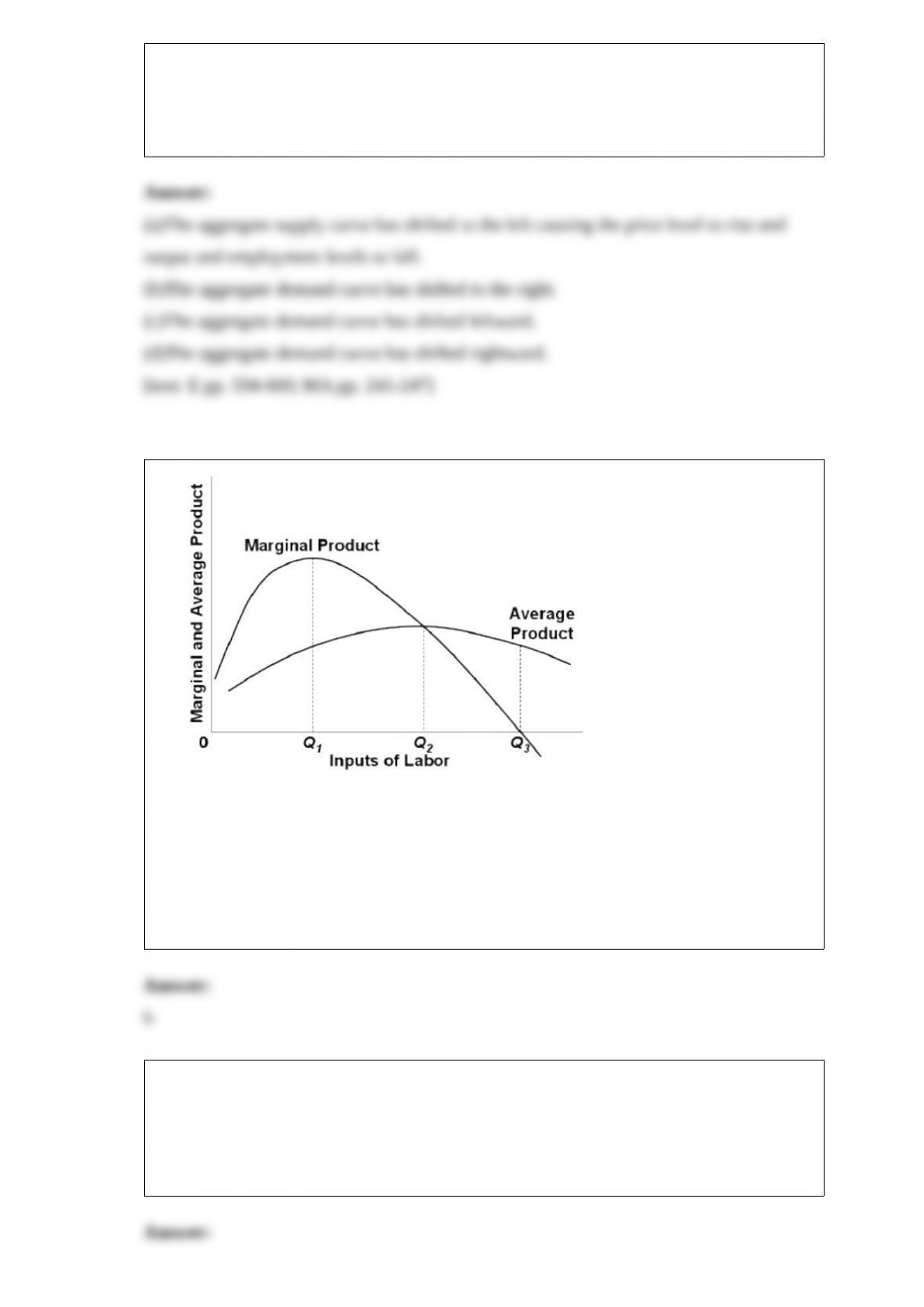
refer to the above diagram, where variable inputs of labor are being added to a constant
amount of property resources. average variable cost will be at a minimum when the
firm is hiring:
a.q3 workers.
b.q2 workers.
c.q1 workers.
d.more than q3 workers.
21) The demand for most agricultural products is:
A.elastic with respect to price, but inelastic with respect to income.
B.inelastic with respect to price, but elastic with respect to income.
C.elastic with respect to both price and income.
D.inelastic with respect to both price and income.
22) An expansionary monetary policy may be frustrated if the:
A.demand-for-money curve shifts to the left.
B.investment-demand curve shifts to the left.
C.saving schedule shifts downward.
D investment-demand curve shifts to the right.
23) Which of the following provides retirement income to qualified retirees?
A.Medicare
B.Supplemental Security Income (SSI)
C.Social Security
D.TANF
24)
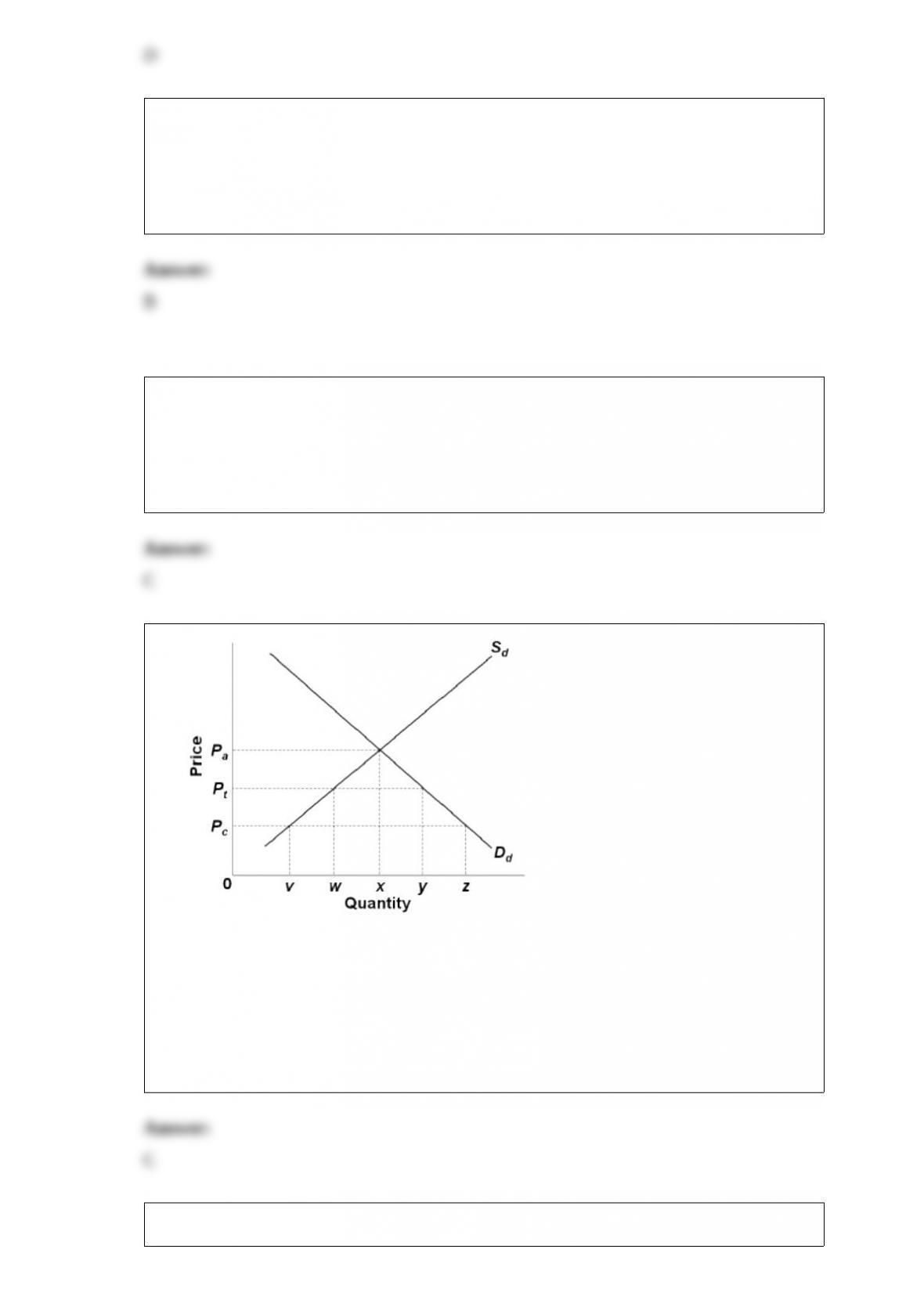
Refer to the above diagram, where Sd and Dd are the domestic supply and demand for a
product and Pc is the world price of that product. With a per unit tariff of PcPt, the total
amount of tariff revenue collected on this product will be:
A.PaPt times wy
B.PcPa times x
C.PcPt times wy
D.PcPt times z
25) which of the following is a correct statement?
a.economic concepts or laws that are valid during depression are necessarily valid
during prosperity.
b.though not quantitatively exact, economic laws are useful because they allow us to
predict and therefore control or adjust to events.
c.economics is as scientific as are physics and chemistry because economic laws are as
quantitatively precise as the laws of physics or chemistry.
d.because economics is concerned with questions of “ought,” it is a branch of applied
ethics and not scientific.
26)
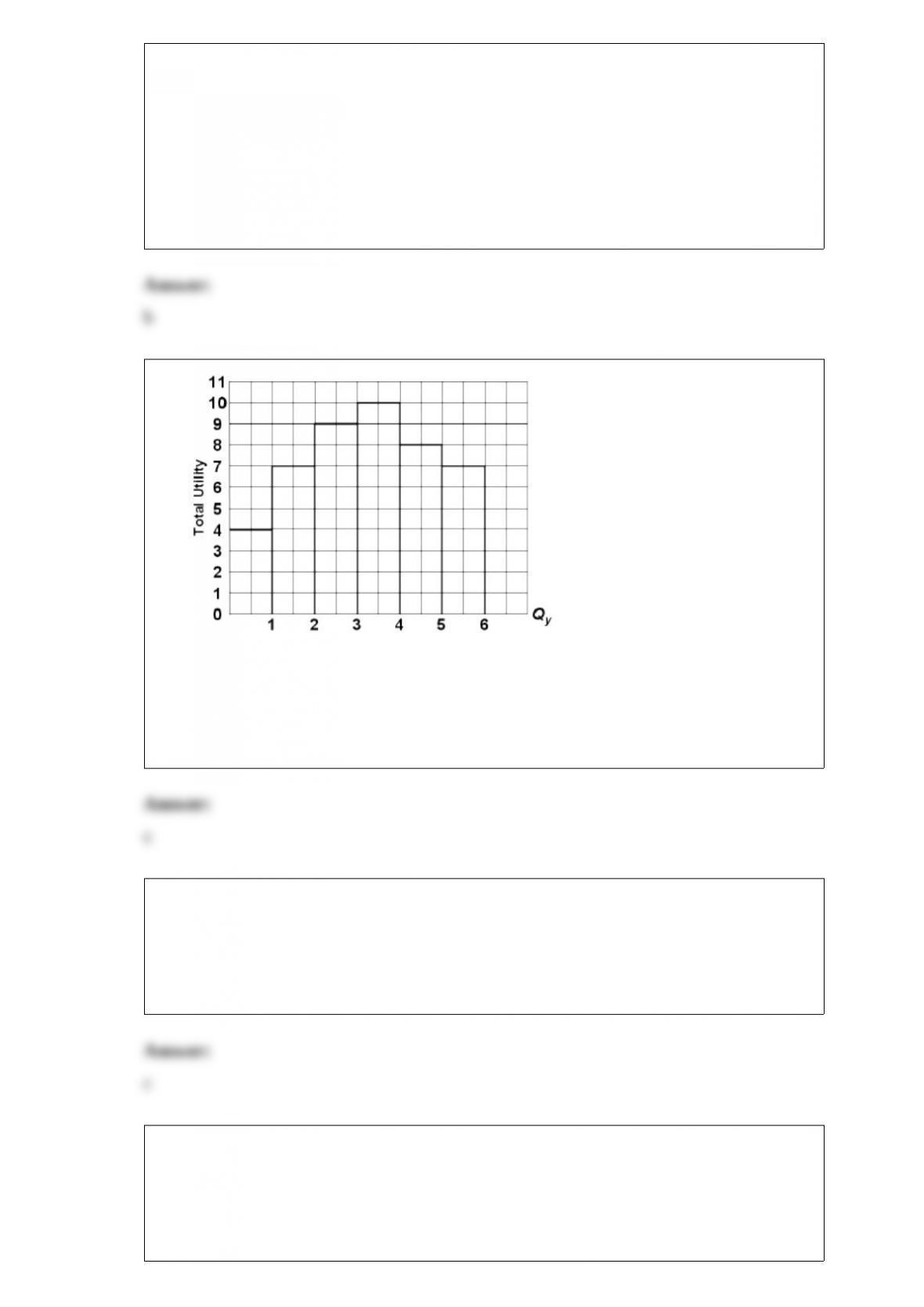
refer to the above diagram. total utility:
a.increases so long as additional units of y are purchased.
b.becomes negative at 4 units.
c.increases at a diminishing rate, reaches a maximum, and then declines.
d.is maximized at 2 units.
27) the loss of a purely competitive firm which shuts down in the short run:
a.is equal to its total variable costs.
b.is zero.
c.is equal to its total fixed costs.
d.cannot be determined.
28) Wage differentials can arise from:
A.both the demand-side and supply-side of labor markets.
B.the demand-side of labor markets only.
C.the supply-side of labor markets only.
D.neither the demand-side or supply-side of labor markets.
29) In the table below are statistics showing the civilian non-institutional population,
the civilian labor force and total employment in year 1 and year 2. Make the
computations necessary to complete the table. (Number of persons is in thousands.)
30) What economic functions do rent, interest, and profit payments perform? How
effective are they in performing these functions?
31) Describe bank runs. How can bank runs be avoided?
32) Discuss three major points about what gives money its value.
33) The economic cost of unemployment is measured by the GDP gap. Explain this
statement.
34) Suppose an economys real GDP is $100,000 in year 1 and $110,000 in year 2. What
is the growth rate of its GDP? Assume that population was 200 in year 1 and 205 in
year 2. What is the growth rate in GDP per capita?
35) What is a Lorenz curve? How is it constructed?
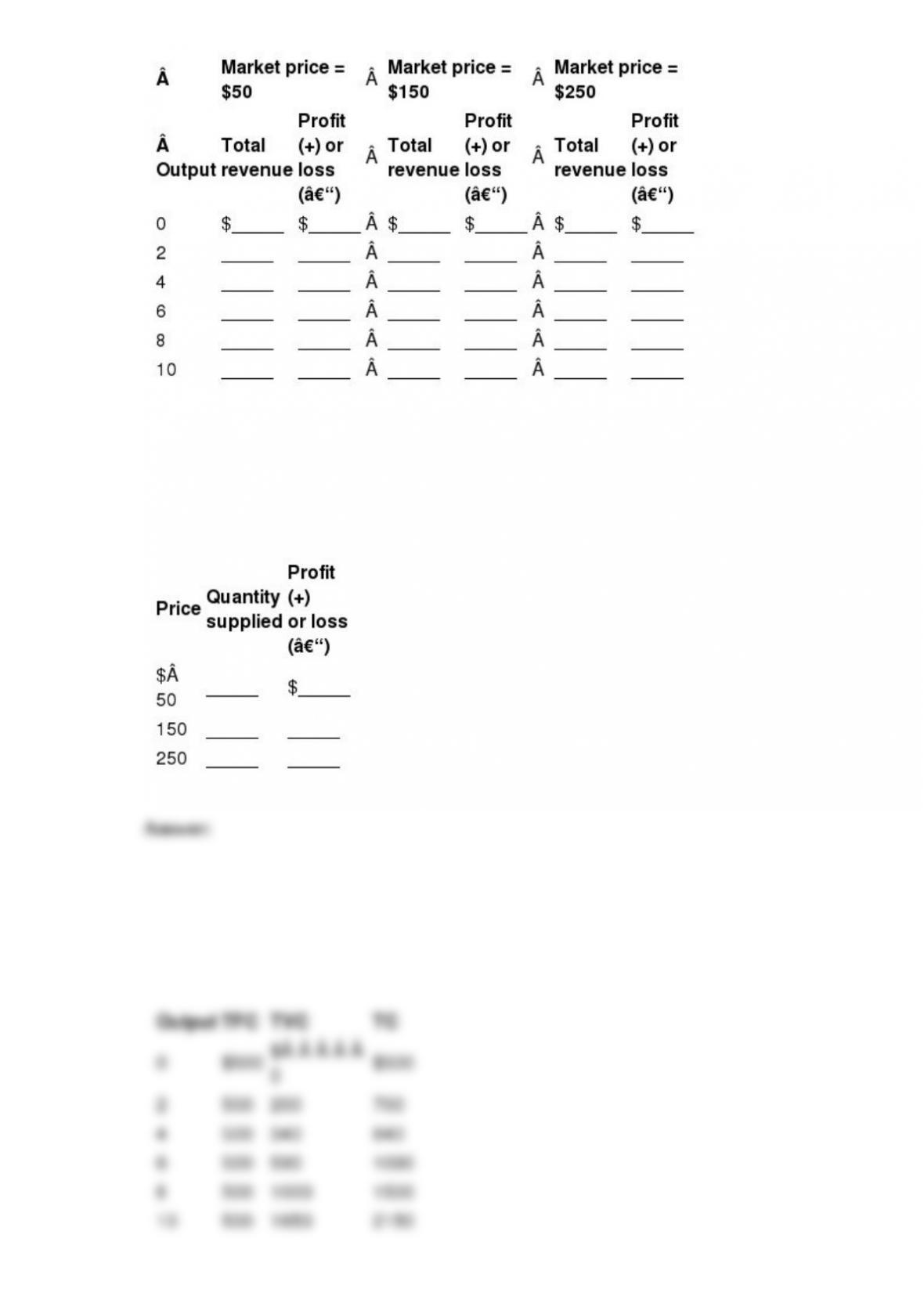
36) Assume that a purely competitive firm has the schedule of total fixed and total
variable costs given in the table below. Fill in the total cost column.
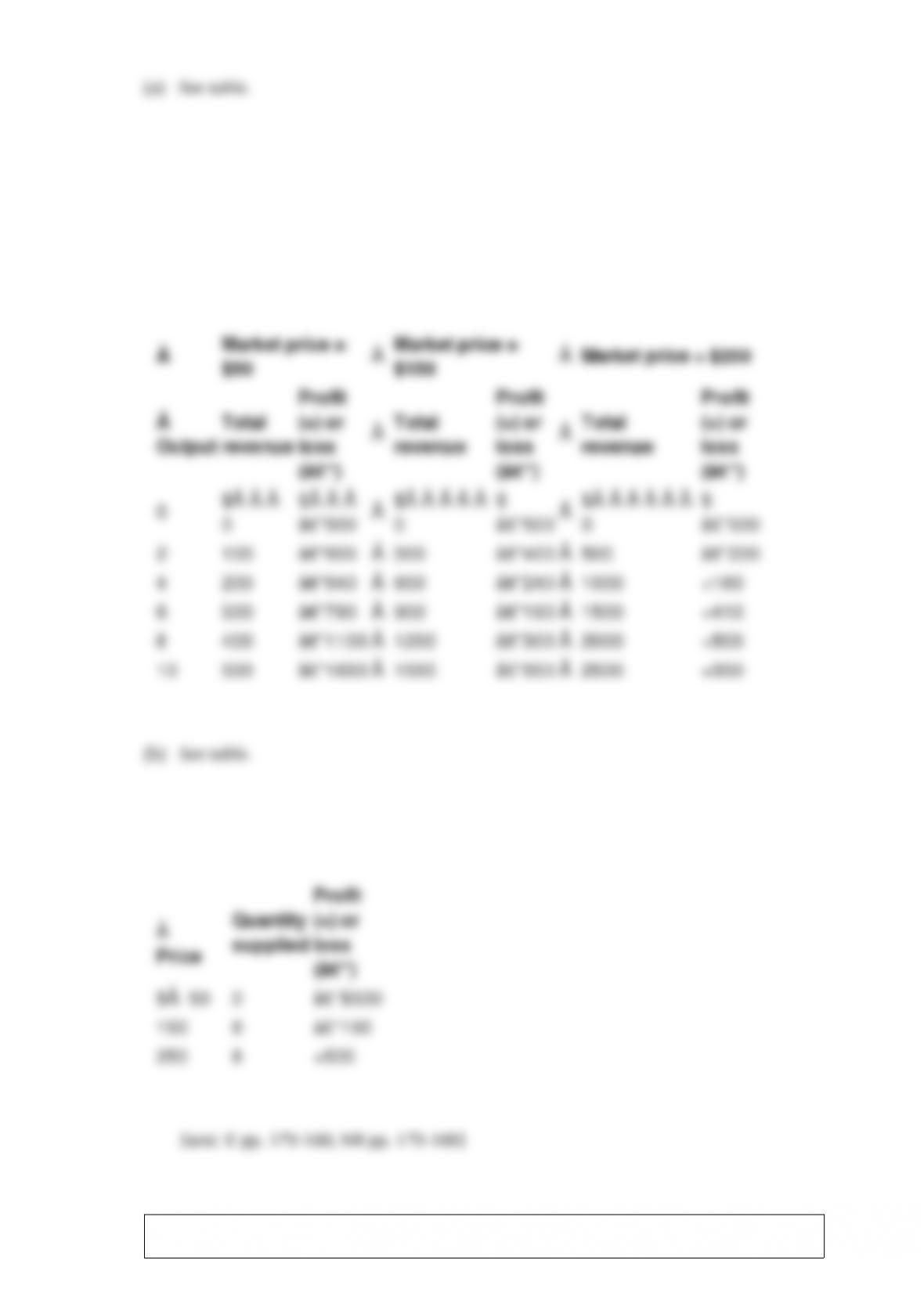
•Complete the table below to show the total revenue and total profit of the firm at
each level of output the firm might produce. Assume market prices of $50, $150,
and $250.
37) (Consider This) What are the benefits and costs to Indian citizens of allowing

Indian companies to copy and sell patent-protected drugs developed by U.S.
companies?