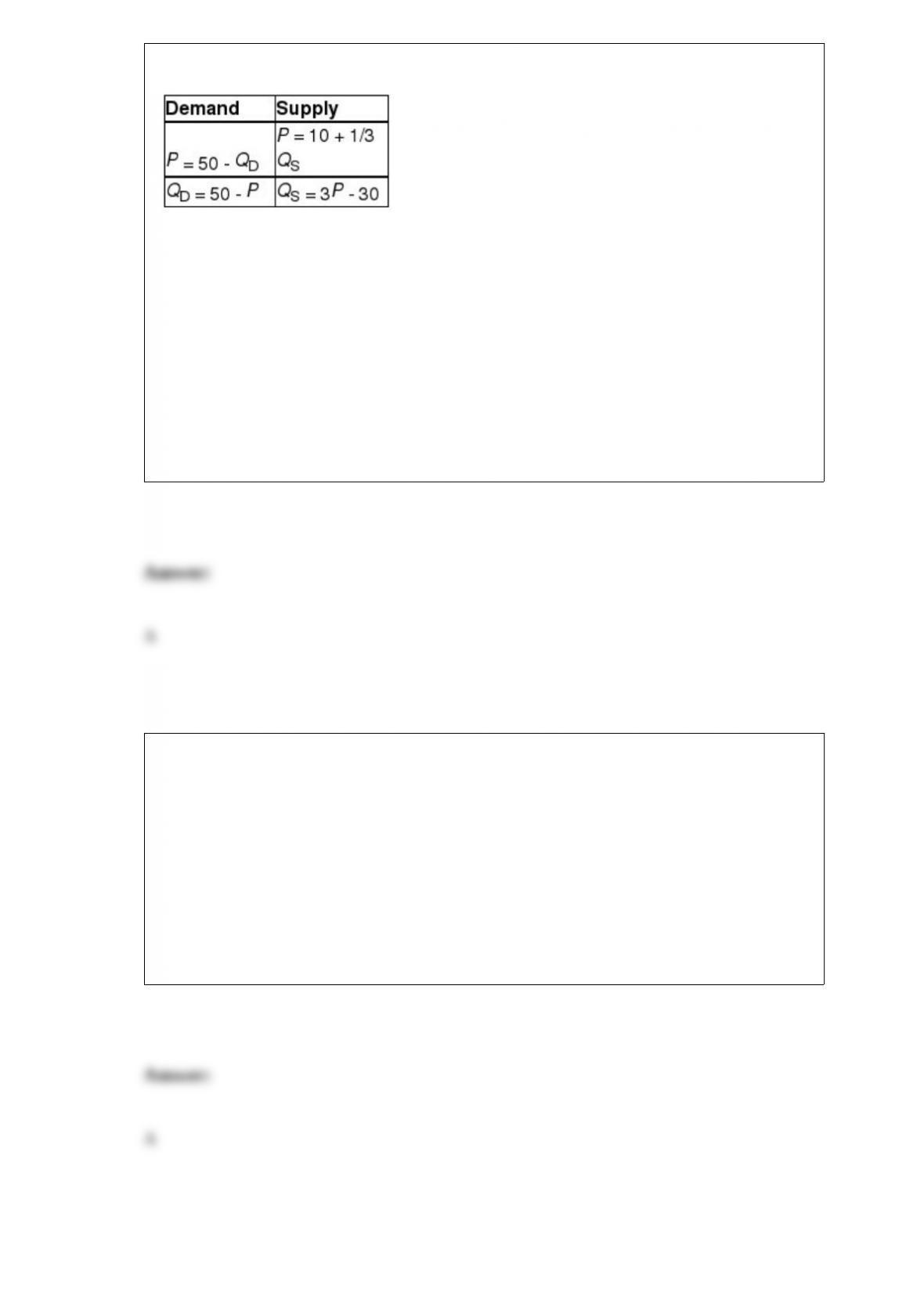
Table 4-13
The equations above describe the demand and supply for Aunt Maud’s Premium Hand
Lotion. What are the equilibrium price and quantity (in thousands) for Aunt Maud’s
Lotion?
A) $20 and 30 thousand
B) $30 and 20 thousand
C) $60 and 30 thousand
D) $20 and 60 thousand
The intention of the U.S. tariff on Chinese tires was to
A) protect jobs in the U. S. tire industry.
B) protect infant industries in tire U.S. tire market.
C) insure that Chinese tires meet U.S. quality and safety standards.
D) save the government money by restricting the sale of more expensive Chinese-made
tires.

In the circular flow model, producers
A) sell goods and services in the input market.
B) and households spend earnings from resource sales on goods and services in the
factor market.
C) hire resources sold by households in the factor market.
D) spend earnings from resource sales on goods and services in the product market.
There is much evidence to suggest that airlines are more likely to match price cuts than
price increases. Which of the following best explains this evidence?
A) The law of demand which states that an increase in price leads to a decrease in
quantity demanded.
B) No one airline wants to be the first to renege on a tacit collusive agreement in which
all airlines implicitly agree to match price cuts but not price increases.
C) An airline fears that if it does not match a price cut, its sales may fall considerably
but if it does not match a price increase, it will be able to attract customers away from
its rivals.
D) Airlines have different costs of production and therefore it is more difficult to agree
on a price increase than on a price decrease.
Table 9-6
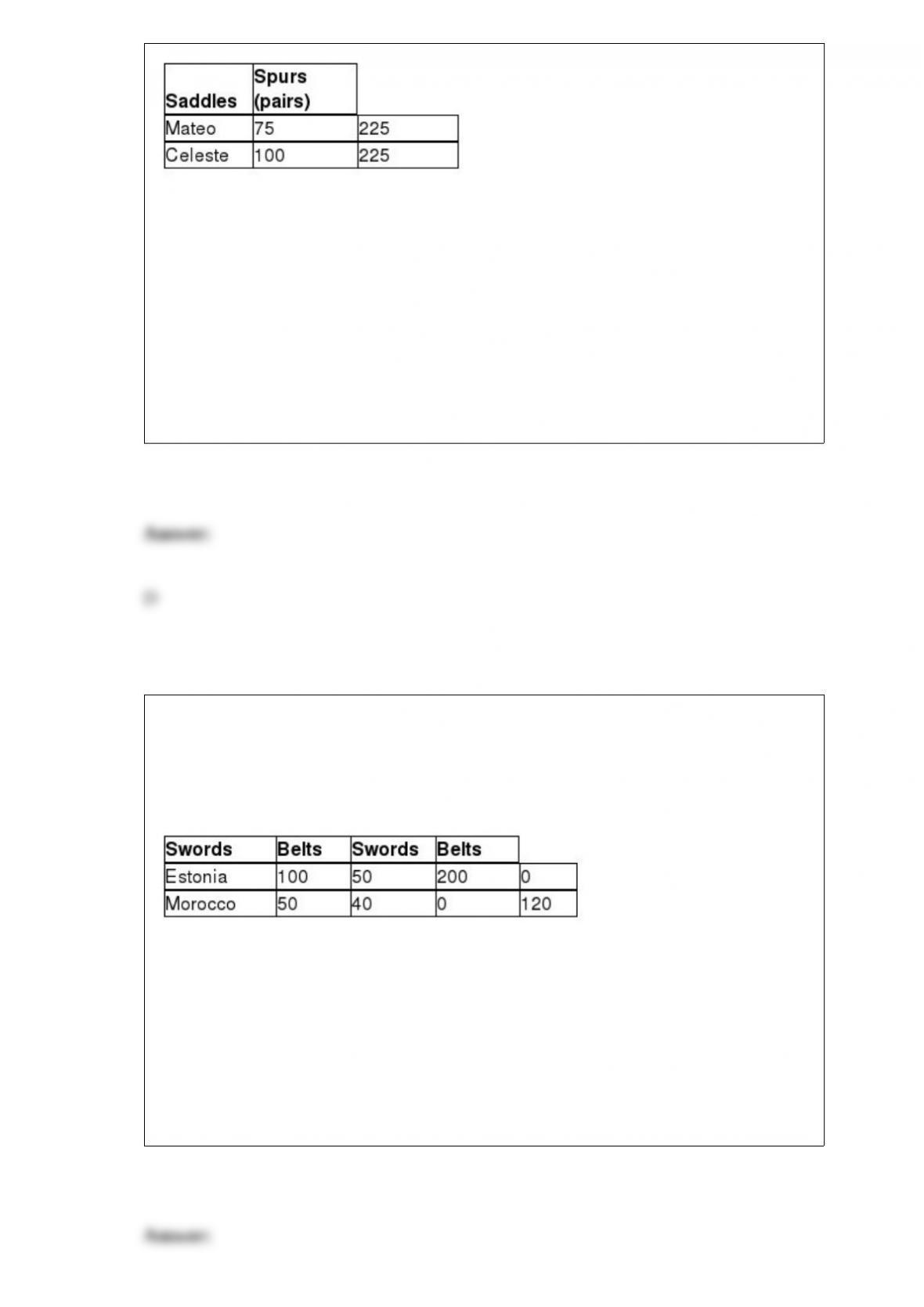
Mateo and Celeste produce custom saddles and spurs. Table 9-6 lists the number of
saddles and pairs of spurs Mateo and Celeste can each produce in one month. Select the
statement that accurately interprets the data in the table.
A) Mateo has an absolute advantage in making saddles and spurs.
B) Celeste has an absolute advantage in making saddles and spurs.
C) Neither Mateo nor Celeste has an absolute advantage in making saddles.
D) Neither Mateo nor Celeste has an absolute advantage in making spurs.
Table 9-12Production and
Consumption Production
Without Trade With Trade
Prior to trade, what was the opportunity cost to produce 1 belt in Estonia?
A) 1/2 of a sword
B) 4/5 of a sword
C) 1.25 swords
D) 2 swords
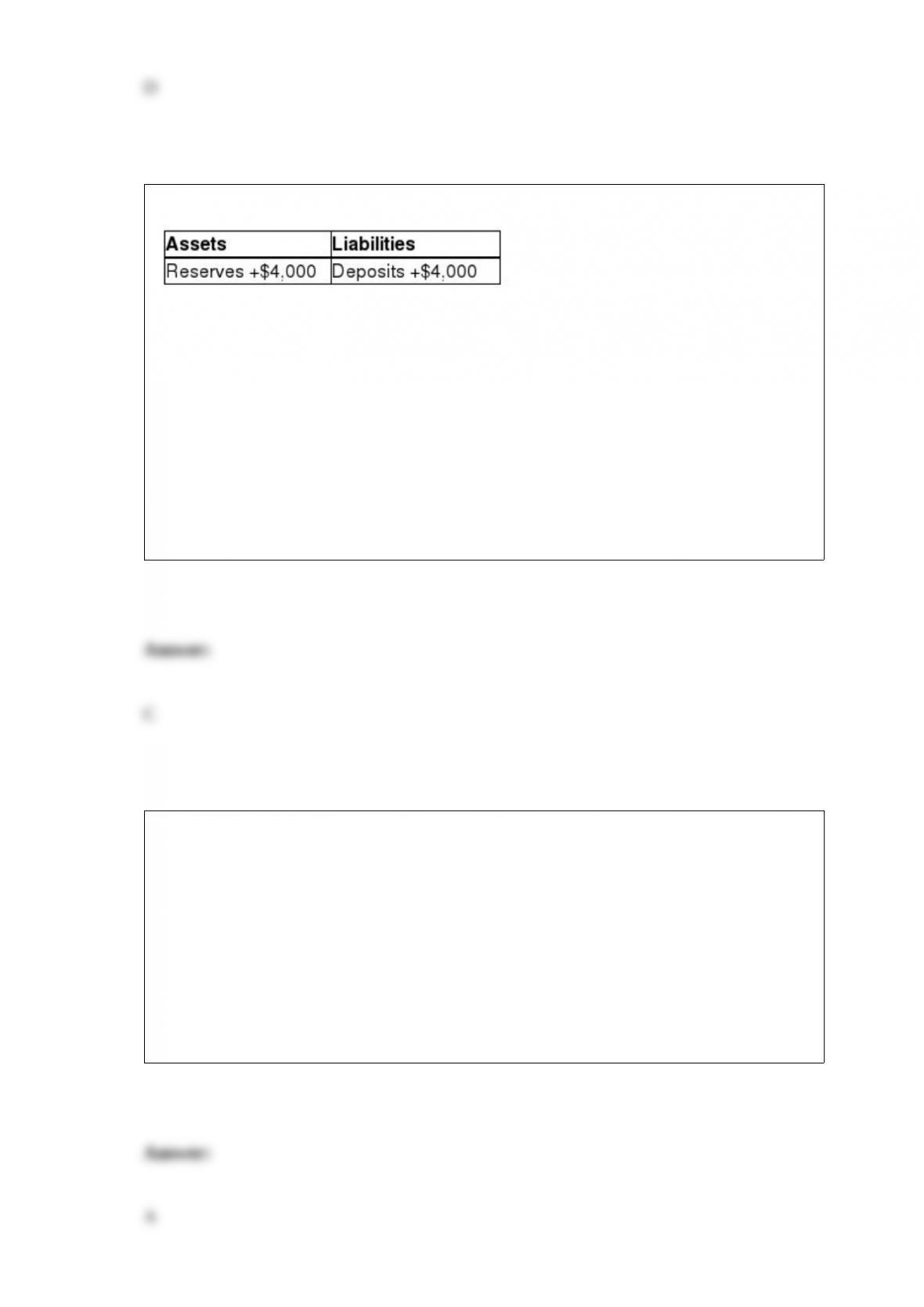
Table 25-1
Suppose a transaction changes a bank’s balance sheet as indicated in the T-account, and
the required reserve ratio is 10 percent. As a result of the transaction, the bank has
excess reserves of
A) $0.
B) $400.
C) $3,600.
D) $4,000.
In 2012, over 75 percent of the revenue of the U.S. federal government was raised
through
A) individual income and social insurance taxes.
B) property and social insurance taxes.
C) sales and corporate income taxes.
D) individual income and property taxes.

If Valerie purchases ankle socks at $5 and gets 25 units of marginal utility from the last
unit, and bandanas at $3 and gets 12 units of marginal utility from the last bandana
purchased, she
A) is maximizing total utility and does not want to change their consumption of ankle
socks or bandanas.
B) wants to consume more ankle socks and fewer bandanas.
C) wants to consume more of bandanas and fewer ankle socks.
D) wants to consume less of both ankle sock and bandanas.
About ________ of research on new medicines is carried out in the United States.
A) 10 percent
B) one-half
C) two-thirds
D) 90 percent
Table 15-4
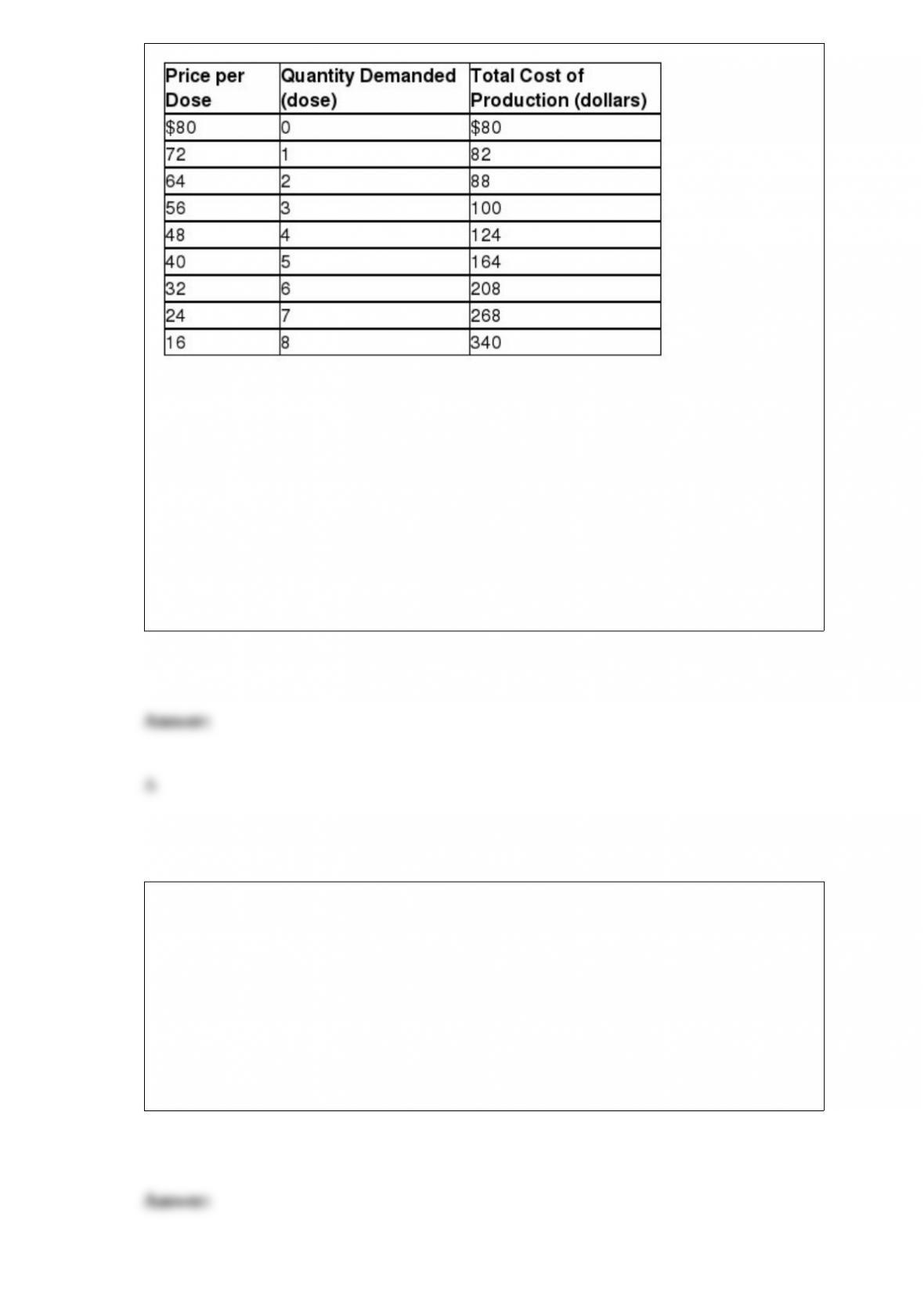
Shakti Inc. has been granted a patent for its Arnica toothache balm. Table 15-4 shows
the demand and the total cost schedule for the firm. What is Shakti’s profit-maximizing
output?
A) 4 units
B) 5 units
C) 6 units
D) 7 units
Who won a Nobel Prize in economics for his work in the development of game theory?
A) John von Neuman
B) Oskar Morgenstern
C) John Nash
D) Howard Schultz

“A competitive market achieves economic efficiency by maximizing the sum of
consumer surplus and producer surplus.” This statement
A) is true only if there are positive externalities in production in the market.
B) is true only if there are no negative externalities in the market.
C) is true only if there are no positive or negative externalities in the market.
D) is true in theory, but economic efficiency cannot be achieved in a real market.