
1) If a particular R&D expenditure is expected to be worthwhile, the firm should
undertake it because the project will definitely increase the firm’s future profits.
2) The ‘stimulus package” that the government implemented in response to the Great
Recession of 2007-09 made the cyclically-adjusted budget of the U.S. have a very large
positive balance in that time period.
3) The slope of the consumption schedule is measured by the MPC.
4) Fiscal policy is more susceptible to politicization than monetary policy.
5) Most industrialized countries emphasize private health insurance paid by employers,
to provide coverage for most workers in each nation.
6) The Social Security program is financed with funds from general tax revenues of the
Federal government.
7) If a purely competitive firm is producing a level of output greater than its
profit-maximizing output, then its profits must be negative.

8) The fact that people prefer to consume in the present rather than the future is referred
to as time preference.
9) In repeated games, credible threats are necessary for the players to reach a Nash
equilibrium.
10) Quantitative measures of managerial success, such as production targets or quotas,
are highly foolproof and are thus ideal to use in raising economic efficiency.
11) If you pay $1,980 annually on an $18,000 loan and the rate of inflation is 3 percent,
then the:
A.Real rate of interest is 8 percent
B.Nominal rate of interest is 8 percent
C.Real rate of interest is 11 percent
D.Nominal rate of interest is 14 percent
12) If the purchasing power of the dollar is falling, then it follows that:
A.The price index is falling
B.The price index is rising
C.Nominal incomes are falling
D.Interest rates are rising
13)

Refer to the above graphs. Which graph shows the immediate market period for supply?
A.Graph A
B.Graph B
C.Graph C
D.Graph D
14) A factor that limits the amount of saving in developing countries is the fact that:
A.The banking system does not encourage saving
B.There is too much foreign aid so savings is not needed
C.The level of aggregate domestic output is low
D.The government controls financial institutions and makes it difficult for people to
save
15)
Refer to the data in the table above. The direction of fiscal policy became more
expansionary from:
A.1999 to 2000
B.2004 to 2005
C.2002 to 2003
D.2003 to 2004
16) Answer the question based on the following list of factors that are related to the
aggregate demand curve.
Which of the above factors best explain the downward slope of aggregate demand
curve?
A.2, 4, and 6
B.7, 9, and 10
C.1, 3, and 8
D.4, 6, and 7

17) Any activity designed to transfer income or wealth to a particular individual or firm
at society’s expense is called:
A.Patent protection
B.X-inefficiency
C.Price discrimination
D.Rent-seeking
18) Prospect theory is based on behavioral economists understanding of how people:
A.React to good things (or gains) and bad (or losses)
B.Make predictions about their future income
C.Search for job-prospects or business prospects
D.Behave under stressful conditions
19) The Security Market Line (SML) is upward-sloping, indicating that the:
A.Beta of an investment increases as its risk level increases
B.Average expected return on investments decreases as their risk level decreases
C.Average expected return on the risk-free asset increases as its beta increases
D.Average expected return of the market portfolio increases as its beta increases
20) Why do skilled workers generally earn more than unskilled workers?
A.The demand for unskilled labor is more inelastic than the demand for skilled labor
B.Skilled labor has higher marginal revenue products than unskilled labor
C.The demand for unskilled labor is greater than the demand for skilled labor
D.The supply of skilled labor is greater than the supply of unskilled labor
21)
Refer to the diagram. At disposable income level D, consumption is equal to:
A.CD.

B.D minus CD.
C.CD/D.
D.CD plus BD
22) All of the following are economic implications of the 1995-2012 rise in the average
rate of productivity growth except:
A.a lower natural rate of unemployment.
B.larger outward shifts of the economy’s production possibilities curve.
C.an end to the business cycle.
D.a greater rate of economic growth.
23)
24) What can IACs do to expand trade with DVCs?
25) What are the major economic effects on output, prices, and farmers€ income from
government price supports that set minimum prices for farm products?
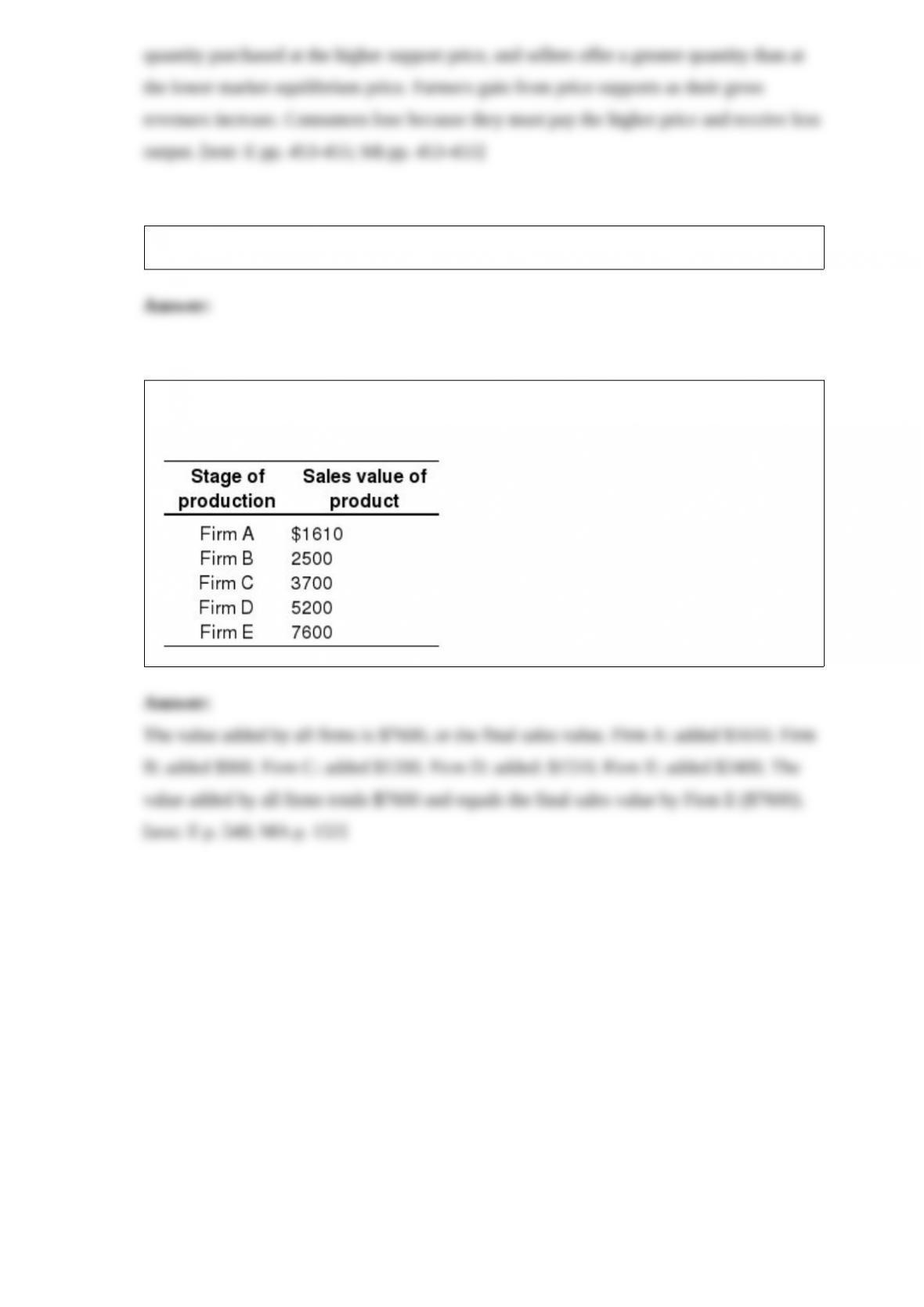
26)
27) What is the value added by all the firms A€E from the production of a product as
described below? What did each firm add separately in value and what does it total?