
1) Marginal revenue product measures the:
A.amount by which the extra production of one more worker increases a firm’s total
revenue.
B.decline in product price that a firm must accept to sell the extra output of one more
worker.
C.increase in total resource cost resulting from the hire of one extra unit of a resource.
D.increase in total revenue resulting from the production of one more unit of a product.
2) If the multiplier in an economy is 5, a $20 billion increase in net exports will:
A.increase GDP by $100 billion.
B.reduce GDP by $4 billion.
C.decrease GDP by $100 billion.
D.increase GDP by $20 billion.
3) to maximize profit a pure monopolist must:
a.maximize its total revenue.
b.maximize the difference between marginal revenue and marginal cost.
c.maximize the difference between total revenue and total cost.
d.produce where average total cost is at a minimum.
4) The following information for the Moolah Bank.
Assume that the listed amounts constitute this bank’s complete set of accounts.
Moolah’s:
A.assets are $1000.
B.liabilities are $1000.
C.net worth is zero.
D.profit is $1000.
5) most demand curves are relatively elastic in the upper-left portion because the
original price:
a.and quantity from which the percentage changes in price and quantity are calculated
are both large.
b.and quantity from which the percentage changes in price and quantity are calculated
are both small.
c.from which the percentage price change is calculated is small and the original
quantity from which the percentage change in quantity is calculated is large.
d.from which the percentage price change is calculated is large and the original quantity
from which the percentage change in quantity is calculated is small.
6)
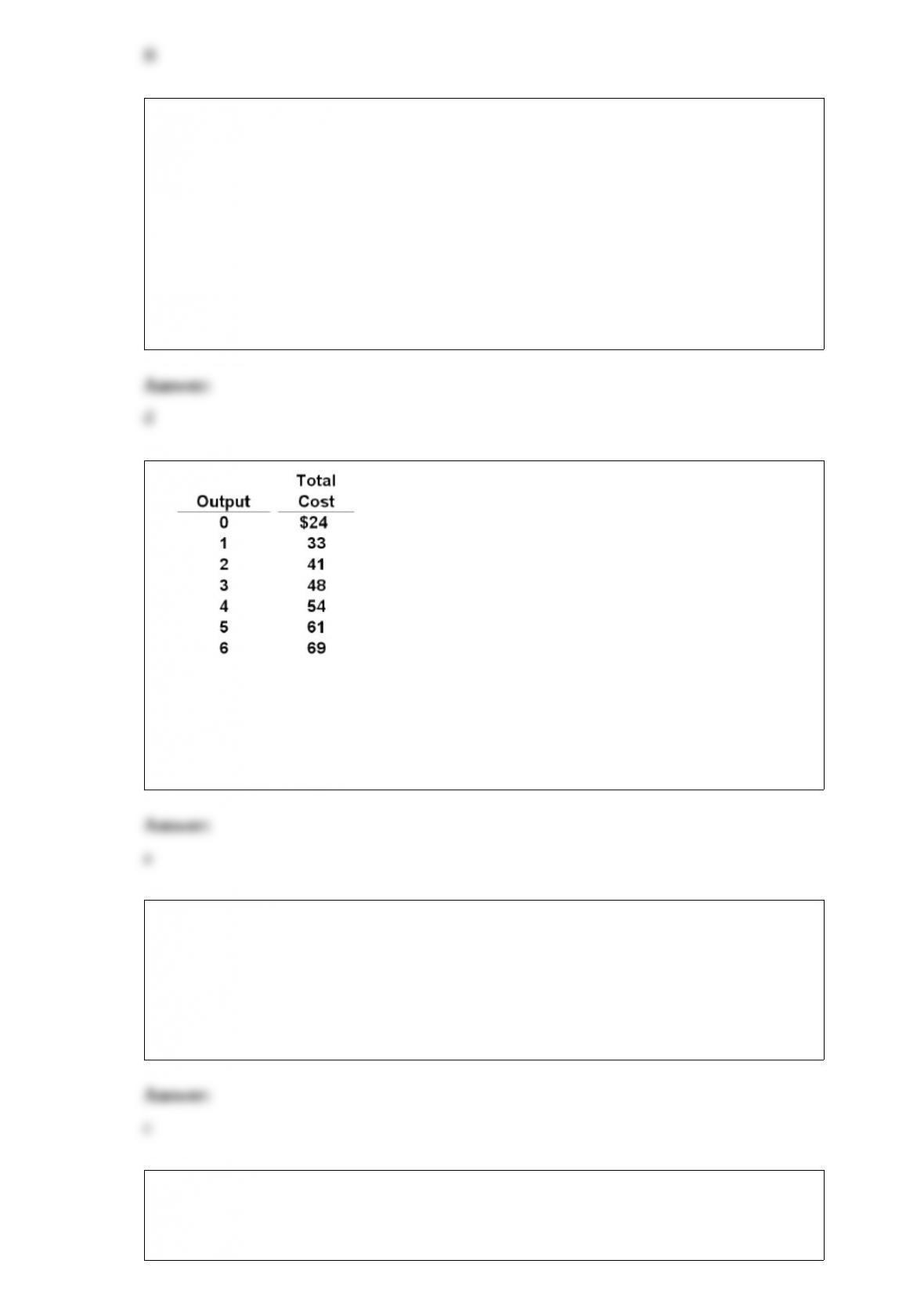
refer to the above data. the average fixed cost of producing 3 units of output is:
a.$8.
b.$7.40.
c.$5.50.
d.$6.
7) if an industry’s long-run average total cost curve has an extended range of constant
returns to scale, this implies that:
a.technology precludes both economies and diseconomies of scale.
b.the industry will be a natural monopoly.
c.both relatively small and relatively large firms can be viable in the industry.
d.the industry will be comprised of a very large number of small firms.
8) According to the Taylor rule:
A.if real GDP rises by 2 percent above potential GDP, the Fed should raise the Federal
funds rate by 1 percentage point.

B.when real GDP is equal to potential GDP and inflation is equal to its target of 4
percent, the Federal funds rate should be kept at 2 percent.
C.if inflation falls by 1 percentage point below its target of 2 percent, then the Fed
should raise the Federal funds rate by one-half a percentage point.
D.all of these are appropriate Fed actions.
9) In 1994, the world’s trading nations agreed to:
A.increase export subsidies to reduce world surpluses of farm products.
B.reduce agricultural subsidies and tariffs on agricultural imports.
C.eliminate all price supports for farm products.
D.create an international farm price support system to replace the price support systems
of individual countries.
10) Graphically, demand-pull inflation is shown as a:
A.rightward shift of the AD curve along an upsloping AS curve.
B.leftward shift of the AS curve along a downsloping AD curve.
C.leftward shift of AS curve along an upsloping AD curve.
D.rightward shift of the AD curve along a downsloping AS curve.