Producer surplus is the difference between the highest price someone is willing to pay
and the price he actually pays.
Ceteris paribus, an increase in the government’s budget deficit will increase the current
account deficit.
Foreign portfolio investment occurs when an individual or firm buys stock or bonds
issued in another country.
The full-employment rate of unemployment is zero.
The “rational expectations” school of economists, including Robert Lucas and Thomas
Sargent, argue that changes in monetary policy cannot affect unemployment rates in the
short run or long run.
One factor which brought on the recession of 2007-2009 was the end of the housing
bubble.
Among countries that purchased U.S. stocks and bonds in 2012, China was the biggest
customer, accounting for over 50 percent of all purchases.
Disposable income is defined as
A) national income – transfers + taxes.
B) national income + transfers + taxes.
C) national income – transfers – taxes.
D) national income + transfers – taxes.

In the market for insurance,
A) buyers often have more information than sellers.
B) sellers often have better information than buyers.
C) sellers are protected from lawsuits brought by buyers.
D) demand is perfectly inelastic because, by law, home owners and automobile drivers
must have insurance.
The five most important variables that determine the level of ________ are disposable
income, wealth, expected future income, price level, and interest rate.
A) consumption
B) government purchases
C) planned investment
D) net exports

How can the influence of a third variable be shown on a two-dimensional graph?
A) by allowing the relationship to be nonlinear
B) by allowing the position of the relationship line or curve to shift on the graph
C) by drawing a third axis coming out of the two axes
D) by super-imposing the third variable on the two-dimensional graph
Liquidity refers to
A) the ease with a stock can be traded for a bond.
B) the ease with which a financial security can be traded for cash.
C) the number of times a dollar changes hands in the creation of GDP in an economy.
D) the number of shares of stock a corporation issues.
Figure 4-1
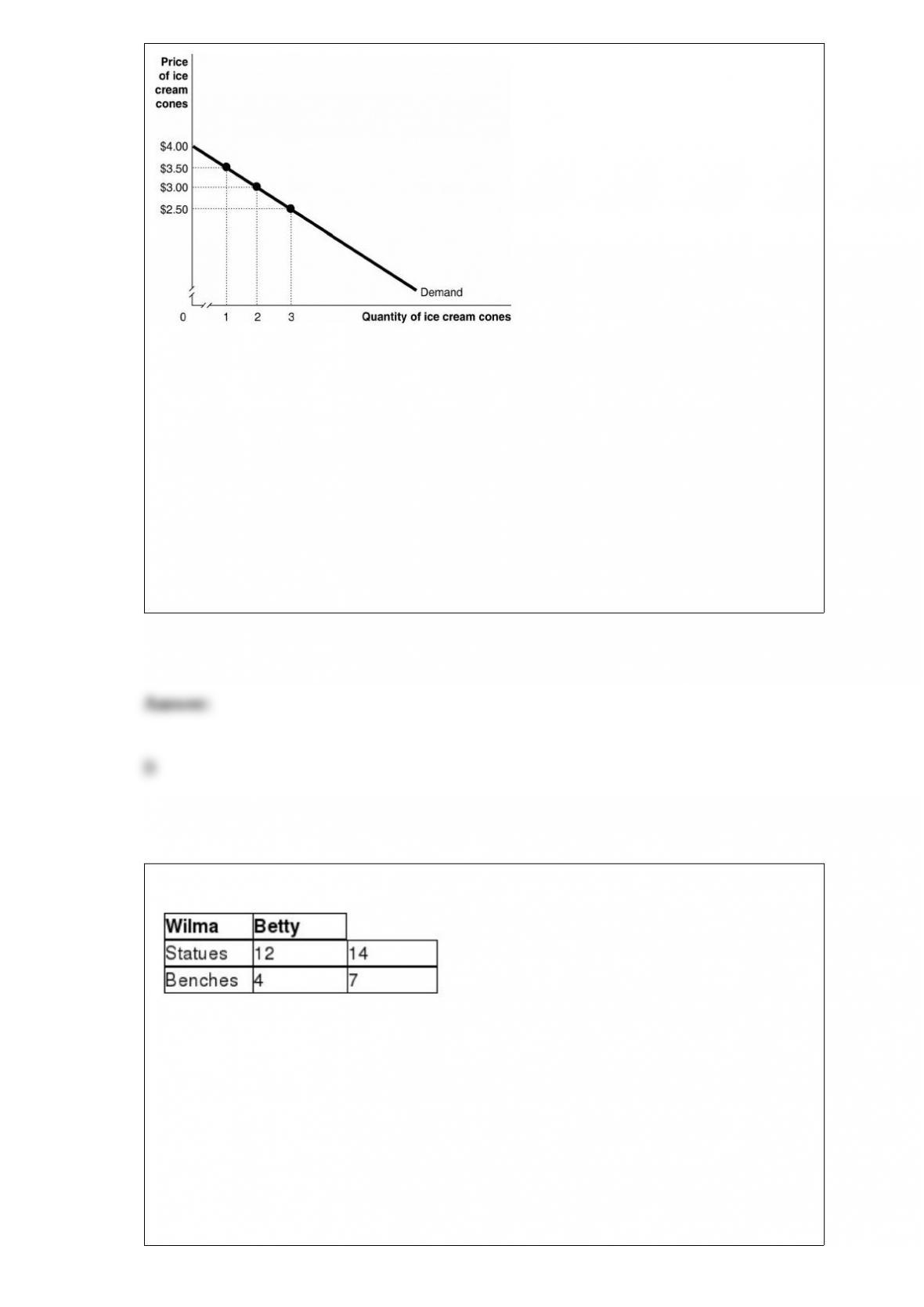
Figure 4-1 shows Kendra’s demand curve for ice-cream cones.
Refer to Figure 4-1. What is the total amount that Kendra is willing to pay for 1 ice
cream cone?
A) $0.50
B) $3.50
C) $9.00
D) $13.50
Table 2-8
Table 2-8 shows the output per month of two people, Wilma and Betty. They can either
devote their time to making marble statues or making marble benches.
Refer to Table 2-8. What is Betty’s opportunity cost of making a bench?
A) 1/2 statue
B) 2 statues
C) 1.75 benches

D) 2.8 statues
When actual inflation is less than expected inflation,
A) borrowers lose and lenders gain.
B) borrowers gain and lenders lose.
C) borrowers and lenders both gain.
D) borrowers and lenders both lose.
According to the short-run Phillips curve, which of the following would result in high
rates of unemployment?
A) strong increases in aggregate supply
B) a lower inflation rate
C) strong increases in aggregate demand
D) a higher inflation rate

Dr. Goldfinger decides to invest in companies which he believes can “improve the
productivity and efficiency” of health care services. How can Dr. Goldfinger strive to
achieve this productive efficiency?
A) by investing in companies that produce goods and services based on consumer
preferences
B) by investing in companies that produce goods and services at the lowest possible
cost
C) by investing in companies that fairly distribute their products and services
D) by investing in companies that produce up to the point where the marginal benefit of
the last unit produced is equal to the marginal cost of producing it
Expansionary monetary policy to prevent real GDP from falling below potential real
GDP would cause the inflation rate to be relatively ________ and real GDP to be
relatively ________.
A) higher; higher
B) higher; lower
C) lower; higher
D) lower; lower

The producer price index measures the prices that firms
A) pay for imported natural resources that go into the production process.
B) receive for the goods and services they export.
C) receive for the goods and services they use at all stages of production.
D) pay for labor, whether or not the labor is foreign or domestic.
The government budget for the country of Economia is in surplus in 2011, and in deficit
in the following year, 2012. We can conclude the
A) government must have raised tax rates or cut spending.
B) government must have cut tax rates or increased spending.
C) government fiscal policy did not change between 2011 and 2012.
D) none of the above
How is a stock’s price-earnings ratio found?
A) by dividing the dividend by the closing price of the stock
B) by dividing the dividend by the firm’s earnings per share
C) by dividing current market price of the stock by the firm’s earnings per share
D) by subtracting the firm’s earnings per share from the closing price of the stock
Because of the productivity slowdown in the United States from the mid-1970s through
the mid-1990s,
A) real GDP per capita grew more rapidly.
B) real GDP per capita grew more slowly.
C) the standard of living did not change.
D) the standard of living increased in the United States.
Every society faces trade-offs. Explain the concept of trade-offs.
If workers accurately predict the rate of inflation, is there a short-run trade-off between
inflation and unemployment, as predicted by the Phillips curve? Why or why not?
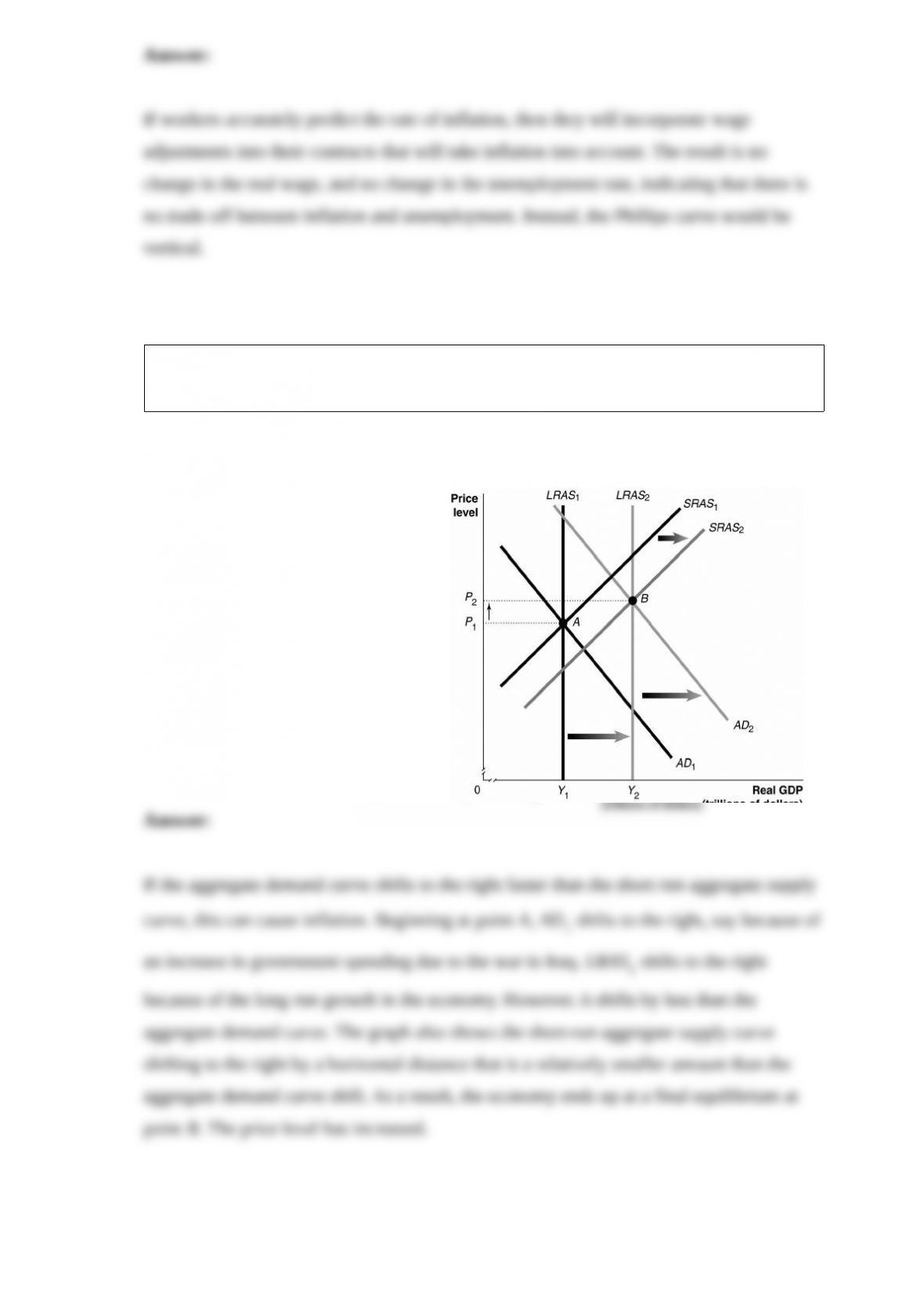
Use the dynamic model of aggregate demand and supply to illustrate a situation where
the economy is growing but experiencing inflation in the long run.
What impact does a higher price level have on interest rates, wealth, and investment
spending?
How does a firm raise external funds through direct finance?
How might a company that offers to handle all paperwork involved with a health
insurance claim for a flat fee face the problem of adverse selection?