1) according to the office of immigration statistics, approximately what percentage of
legal immigrants in 2007 were parents, children, siblings, or other qualified relatives of
legal permanent u.s. residents?
a.13 percent
b.50 percent
c.66 percent
d.81 percent
2)
Refer to the above graphs, where the subscripts on the labels denote years 1 and 2.
From the graphs we can clearly conclude that from year 1 to year 2:
A.the economy recovered from a recession.
B.the economy experienced economic growth and mild inflation.
C.output grew and the unemployment rate fell.
D.the government engaged in expansionary fiscal and monetary policies.
3) Other things equal, trademarks and brand names:
A.increase the interest-rate cost of funds used to finance R&D expenditures.
B.decrease the interest-rate cost of funds used to finance R&D expenditures.
C.decrease the expected rate of return on R&D expenditures.
D.increase the expected rate of return on R&D expenditures.
4)
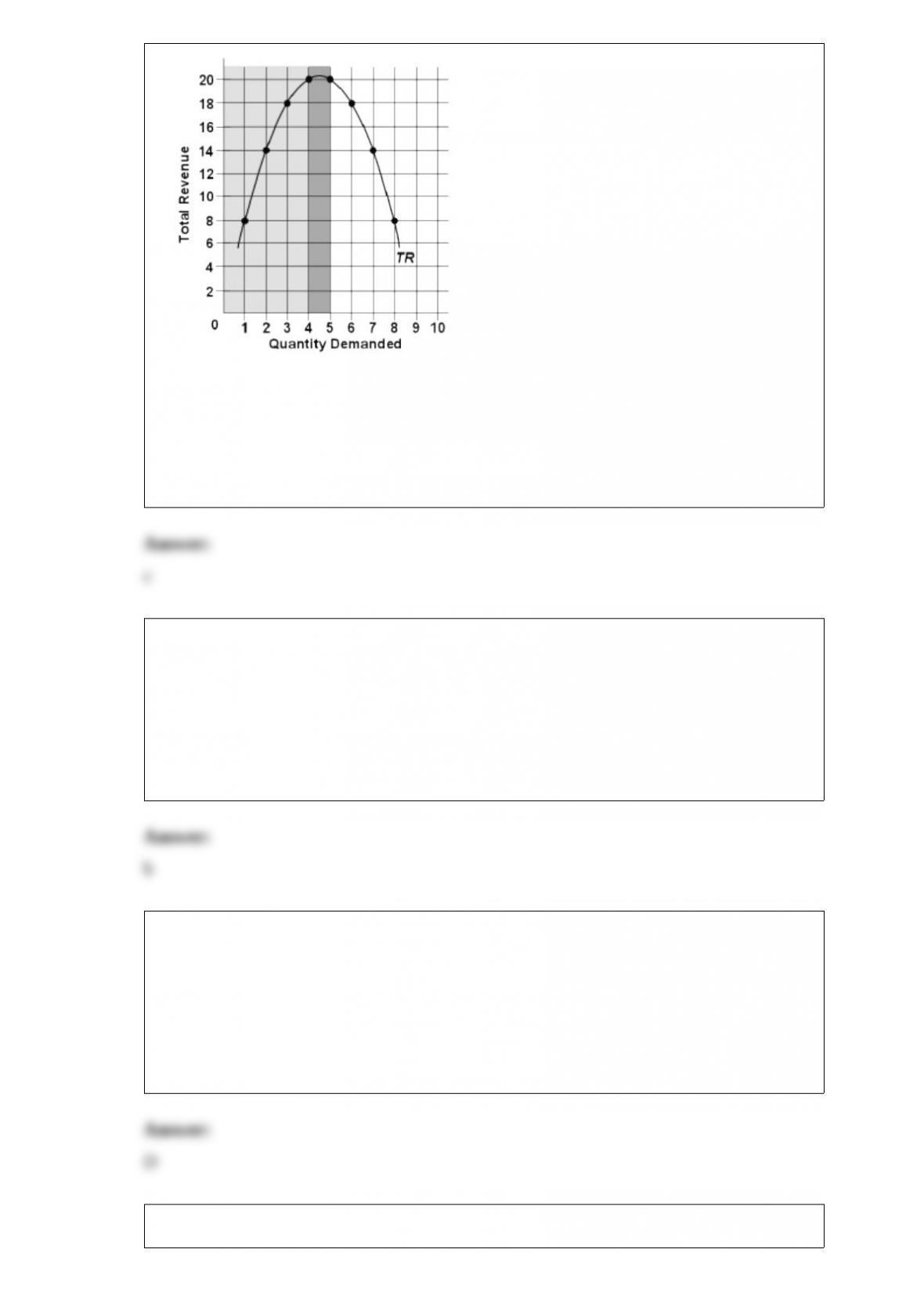
suppose that the above total revenue curve is derived from a particular linear demand
curve. that demand curve must be:
a.inelastic for price declines that increase quantity demanded from 2 units to 3 units.
b.elastic for price declines that increase quantity demanded from 5 units to 6 units.
c.unit elastic for price increases that reduce quantity demanded from 5 units to 4 units.
d.inelastic for price increases that reduce quantity demanded from 4 units to 3 units.
5) suppose that a business incurred implicit costs of $200,000 and explicit costs of $1
million in a specific year. if the firm sold 4,000 units of its output at $300 per unit, its
accounting profits were:
a.$100,000 and its economic profits were zero.
b.$200,000 and its economic profits were zero.
c.$100,000 and its economic profits were $100,000.
d.zero and its economic loss was $200,000.
6) Excess reserves refer to the:
A.difference between a bank’s vault cash and its reserves deposited at the Federal
Reserve Bank.
B.minimum amount of actual reserves a bank must keep on hand to back up its
customers deposits.
C.difference between actual reserves and loans.
D.difference between actual reserves and required reserves.
7) Consumer’s income = $12
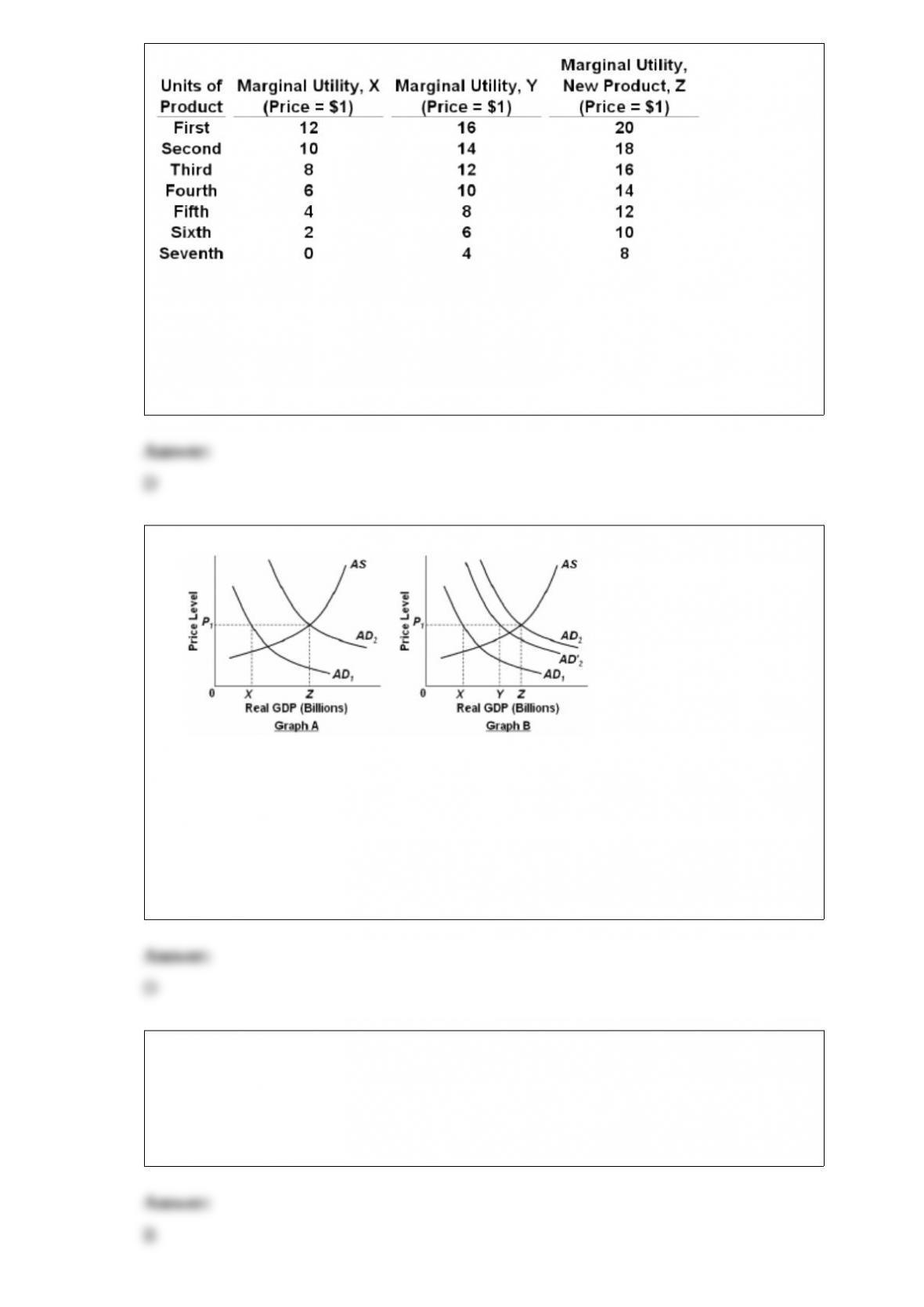
Refer to the above data. Assume new product Z is introduced. How many units of Z
will this consumer buy, given his or her $12 budget?
A.zero units
B.2 units
C.4 units
D.6 units
8)
Suppose real GDP is X, as shown in graph A. If the economy’s MPC is .75, X is $100
billion and full-employment real GDP Y is $140 billion, an appropriate fiscal policy
would be to:
A.reduce taxes by $100 billion.
B.increase government expenditures by $100 billion.
C.reduce taxes by $10 billion.
D.increase government expenditures by $10 billion.
9) The determinants of aggregate demand:
A.explain why the aggregate demand curve is downsloping.
B.explain shifts in the aggregate demand curve.
C.demonstrate why real output and the price level are inversely related.
D. include input prices and resource productivity.
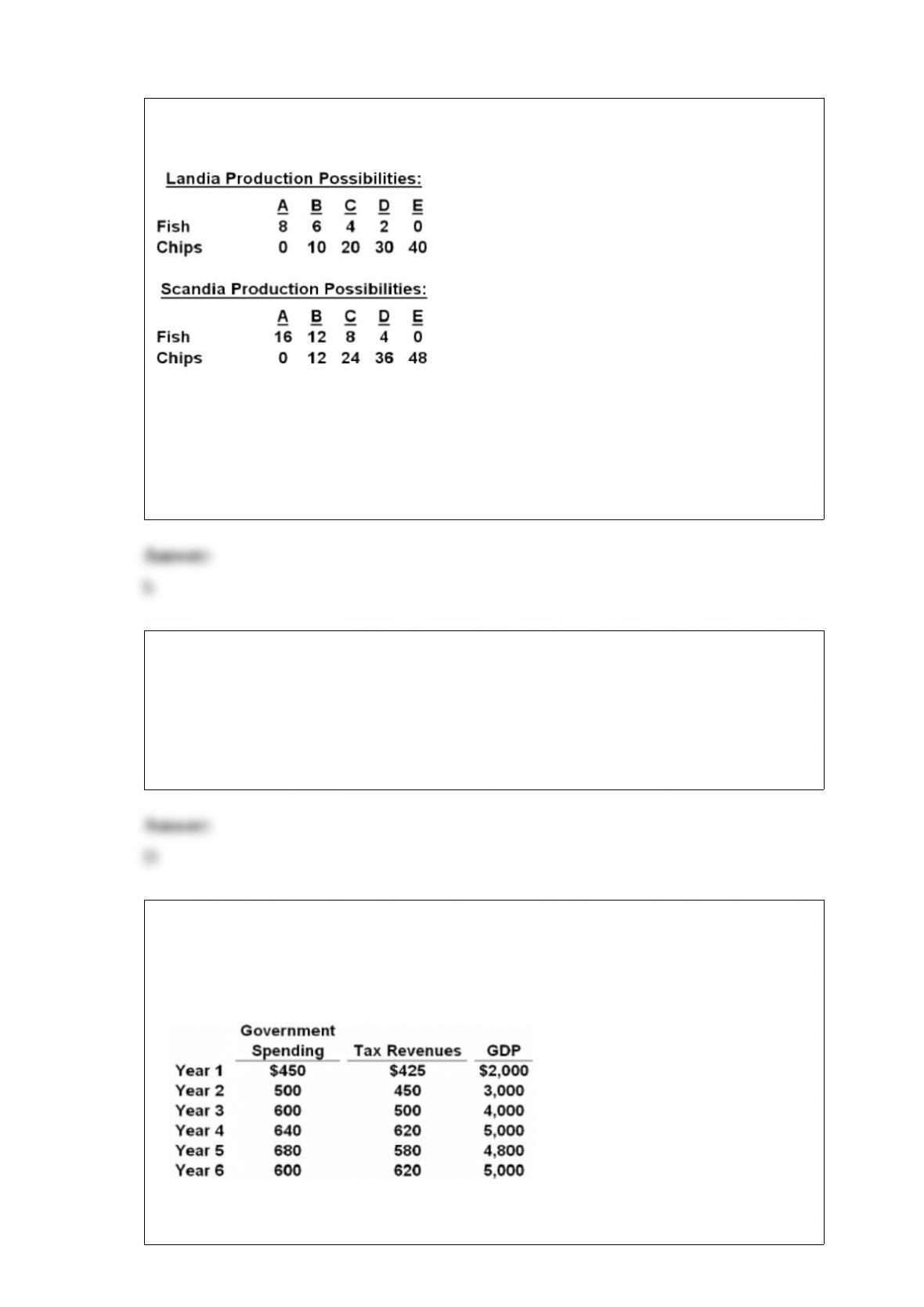
10) the following production possibilities data for landia and scandia:
refer to the above data. if landia and scandia fully specialize based on comparative
advantage, their aggregate output will be:
a.48 chips and 8 fish.
b.40 chips and 16 fish.
c.36 chips and 10 fish.
d.42 chips and 12 fish.
11) Which of the following statements is correct?
A.The parity ratio has not exceeded 100 in the 20th or 21st century.
B.An increase in prices paid by farmers relative to prices received by farmers will
increase the parity ratio.
C.The parity ratio has generally been greater than 100 in the past four decades.
D.The parity ratio has generally declined over the past five decades.
12) Answer the next question(s) using the following budget information for a
hypothetical economy. Assume that all budget surpluses are use to pay down the public
debt.
Refer to the above data. The public debt declined in year:
A.6.

B.5.
C.4.
D.3.
13) How does technological advance enhance economic efficiency? Distinguish
between its effects on productive efficiency and allocative efficiency.
14) Draw and explain a diagram that illustrates the vicious circle of poverty in DVCs.
15) Do changes in relative price-levels affect the value of a nations currency?
16) What is the difference between economic profit and normal profit?
17) Explain how the GDP and the interest rate are related to the transactions and asset
demands for money.
18) Define savings.
19) What resource problem is created by negative externalities and what methods are
suggested for dealing with this problem?

20) What does it mean that innovators try to anticipate the future? What are the
economics consequences of this effort?
21) What is the difference between nominal and real wages?
22) How are monopolistically competitive industries identified with concentration
ratios?