
Normative analysis is concerned with “what ought to be,” while positive analysis is
concerned with “what is.”
Answer:
One desirable outcome of a market economy is that it leads to a more equitable
distribution of income.
Answer:
Each year, the U.S. exports about 50 percent of its wheat crop.
Answer:
The term “market” refers to trading arrangements by which buyers and sellers come
together.
Answer:

Vaccinations tend to result in a negative externality.
Answer:
An increase in government spending lowers interest rates and increases the rate of
investment in new capital.
Answer:
When Javier’s income increases by $5,000, he spends an additional $3,750 dollars. This
implies that his marginal propensity to consume is 0.75.
Answer:
An equilibrium in which each player chooses its best strategy given the strategies
chosen by the other players is called a Nash equilibrium.
Answer:

The purchase of foreign stocks and bonds by a U.S. brokerage firm is an example of
capital inflows to the United States.
Answer:
An increase in exports decreases aggregate demand.
Answer:
Counting part-time workers who are looking for full-time work as employed overstates
the degree of joblessness in the economy.
Answer:
An optimal two-part tariff pricing schedule maximizes consumer surplus.
Answer:

The four-firm concentration ratio of the aircraft industry is over 80 percent. Most
economists would consider this industry an oligopoly.
Answer:
Table 2-16
Table 2-16 shows the number of labor hours required to produce a cell phone and a
board foot of lumber in Estonia and Finland. Does either Estonia or Finland have an
absolute advantage and if so, in what product?
A) Finland has an absolute advantage in lumber.
B) Estonia has an absolute advantage in lumber.
C) Finland has an absolute advantage in both products.
D) Estonia has an absolute advantage in cell phones.
Answer:
How would the equilibrium quantity of loanable funds respond to a change from an
income tax to a consumption tax?
A) The equilibrium quantity of loanable funds would rise.
B) The equilibrium quantity of loanable funds would fall.
C) The equilibrium quantity of loanable funds would be unaffected.

D) The equilibrium quantity of loanable funds may rise or fall based on whether
household saving increases or decreases as a result of the change from an income tax to
a consumption tax.
Answer:
Foreign direct investment in the United States declined 42 percent in the first quarter of
2009. This means that
A) people or firms in other countries reduced their purchases of stocks and bonds in the
United States by 42 percent in the first quarter of 2009.
B) people or firms in the United States reduced their purchases of stocks and bonds in
foreign countries by 42 percent in the first quarter of 2009.
C) people or firms in other countries reduced their building of facilities of purchases of
facilities in the United States by 42 percent in the first quarter of 2009.
D) people or firms in the United States reduced their building of facilities or purchases
of facilities in foreign countries by 42 percent in the first quarter of 2009.
Answer:
Which of the following is the best example of a quota?
A) a limit imposed on the number of sport utility vehicles that the United States can
import from Japan
B) a subsidy granted by the U.S. government to domestic garment manufacturers so
they can compete more effectively with foreign garment manufacturers
C) a tax placed on all sport utility vehicles sold in the domestic market

D) a $5,000 per-car fee imposed on all sport utility vehicles imported into the United
States
Answer:
Select the phrase that correctly completes the following statement. “A positive change
in technology caused an increase in the supply of flat-screen televisions. As a result
________.”
A) the price of flat-screen televisions decreased and the demand for flat-screen
televisions increased
B) the equilibrium quantity of flat-screen televisions decreased
C) the price of flat-screen televisions decreased and the quantity demanded of
flat-screen televisions increased
D) the price of flat-screen televisions decreased. The lower price caused the supply of
flat-screen televisions to decrease
Answer:
Figure 2-2 Figure 2-2 above shows the production
possibilities frontier for Vidalia, a nation that produces two goods, roses and orchids.
Suppose Vidalia is currently producing 20 dozen orchids per period. How many roses is
it also producing, assuming that resources are fully utilized?
A) 30 dozen roses
B) 50 dozen roses
C) 100 dozen roses
D) 150 dozen roses
Answer:
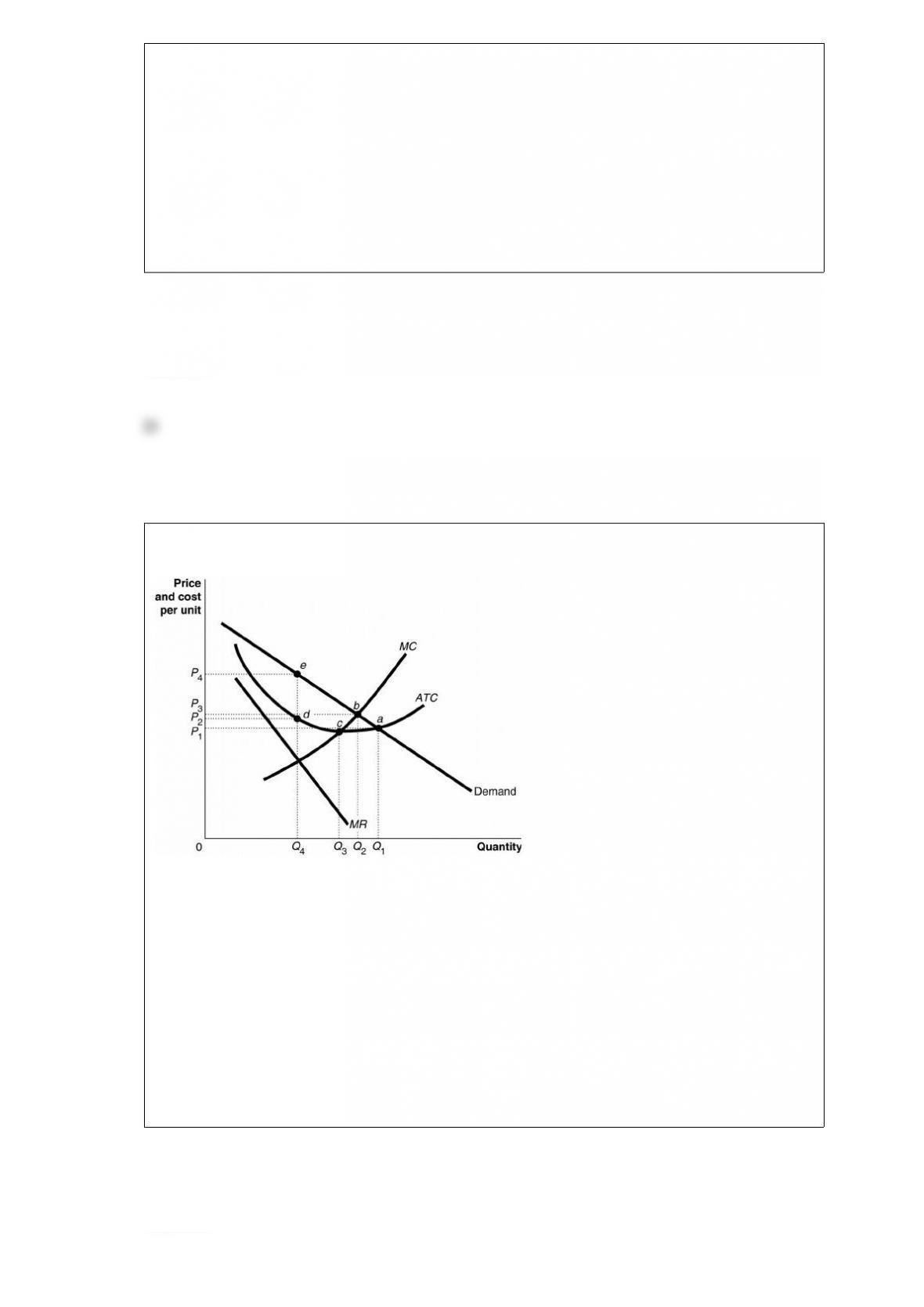
Figure 13-13
What is the output price?
A) P4
B) P3
C) P2
D) P1
Answer:

In the circular flow model, producers
A) sell goods and services in the input market.
B) and households spend earnings from resource sales on goods and services in the
factor market.
C) hire resources sold by households in the factor market.
D) spend earnings from resource sales on goods and services in the product market.
Answer:
If the price level in the United States is 110, the price level is 120 in Mexico, and the
nominal exchange rate is 140 pesos per dollar, what is the real exchange rate from the
U.S. perspective?
A) 94
B) 115
C) 128
D) 153
Answer:
Which of the following is a true statement about the length of recessions and
expansions in the United States economy?

A) Prior to 1900, the length of expansions equaled the length of recessions.
B) Prior to 1900, the length of expansions were much less than the length of recessions.
C) Prior to 1900, the length of expansions were much longer than the length of
recessions.
D) Prior to 1900, the length of recessions were brief and almost nonexistent.
Answer:
If the balance of the current account in the United States is -$900 billion, which of the
following is most likely to be true?
A) The balance on the financial account is positive.
B) The trade balance is positive.
C) Net foreign investment is positive.
D) The balance on the capital account is negative.
Answer:

Figure 11-7 Figure 11-7 shows the cost
structure for a firm.
When the output level is 100 units, average fixed cost is
A) $10.
B) $8.
C) $5.
D) This cannot be determined from the diagram.
Answer:
A decrease in cyclical unemployment will
A) shift the long-run Phillips curve to the left.
B) decrease the natural rate of unemployment.
C) shift the short-run Phillips curve to the left.
D) All of the above are correct.
E) None of the above is correct.
Answer:
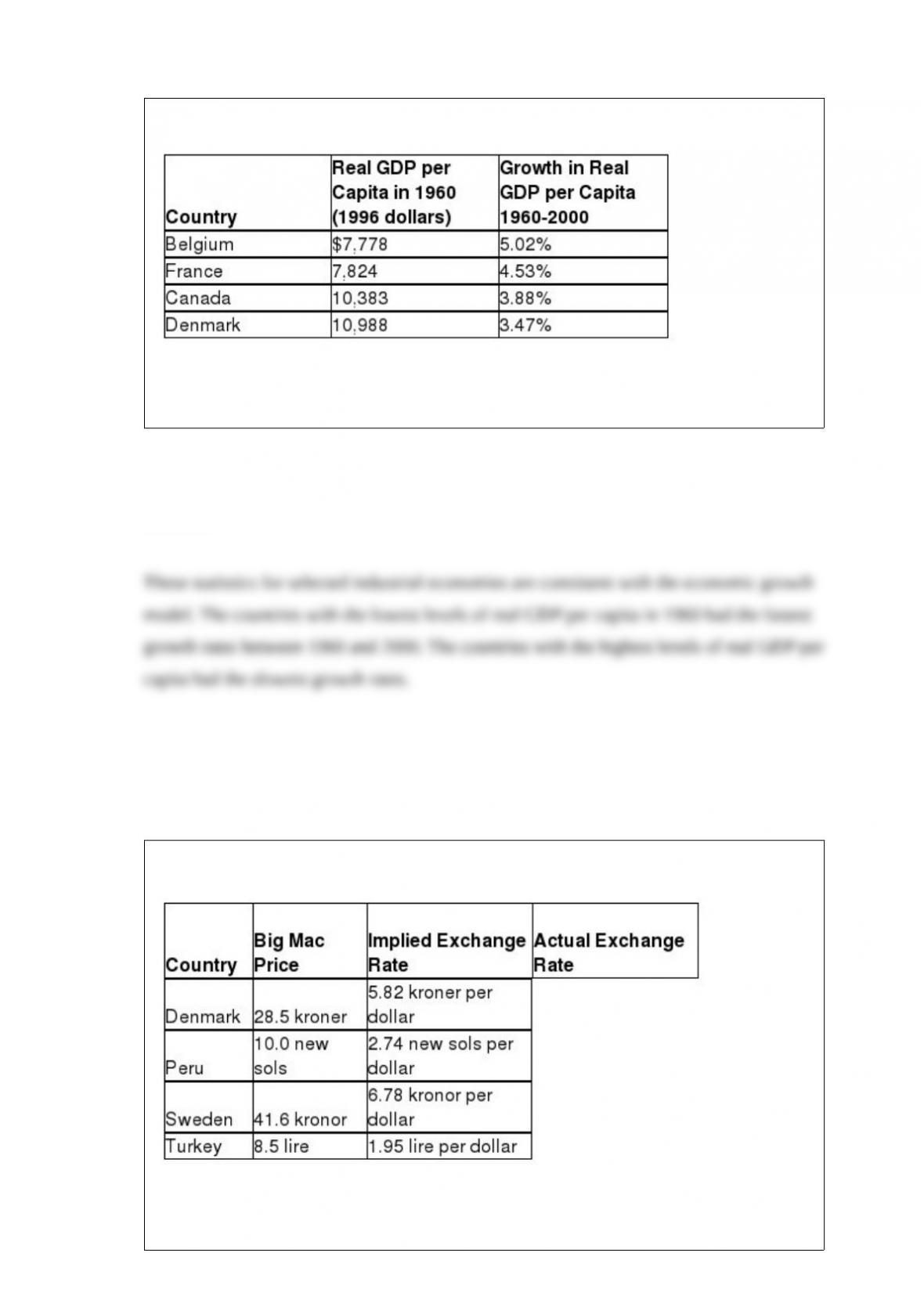
Table 11-5
Consider the statistics in the table above in describing the industrialized countries.Are
these consistent with the economic growth model? Briefly explain.
Answer:
Table 19-1
Source: “The Big Mac Index,” Economist, July 11, 2013.
Fill in the missing values in the above table. Assume the Big Mac is selling for $4.56 in

the United States. Explain whether the U.S. dollar is overvalued or undervalued relative
to each of the other currencies and predict what will happen in the future to each
exchange rate.
Answer:
C = 2,550 + (MPC)Y
I = 800
G = 1,100
NX = 50 If the equilibrium level of GDP is $11,250, using the equations for C, I, G, and
NX shown above, find the value of the marginal propensity to consume.
Answer:

Use the following information to draw a graph showing the short-run and long-run
Phillips curves, and be sure your graph shows the point where the short-run and
long-run Phillips curves intersect. Natural rate of unemployment = 4 percent
Current rate of unemployment = 5 percent
Expected inflation rate = 3 percent
Current inflation rate = 2 percent
Answer:

List three different price indices and explain how they differ in terms of the market
basket on which they are based.
Answer:
Explain why the marginal cost of production must increase if the marginal product of a
variable resource is decreasing.
Answer: