A transfer payment is
a. a payment for moving expenses a worker receives when he or she is transferred by an
employer to a new location.
b. a payment that is automatically transferred from your bank account to pay a bill or
some other obligation.
c. a form of government spending that is not made in exchange for a currently produced
good or service.
d. the benefit that a person receives from an expenditure by government minus the taxes
that were collected by government to fund that expenditure.
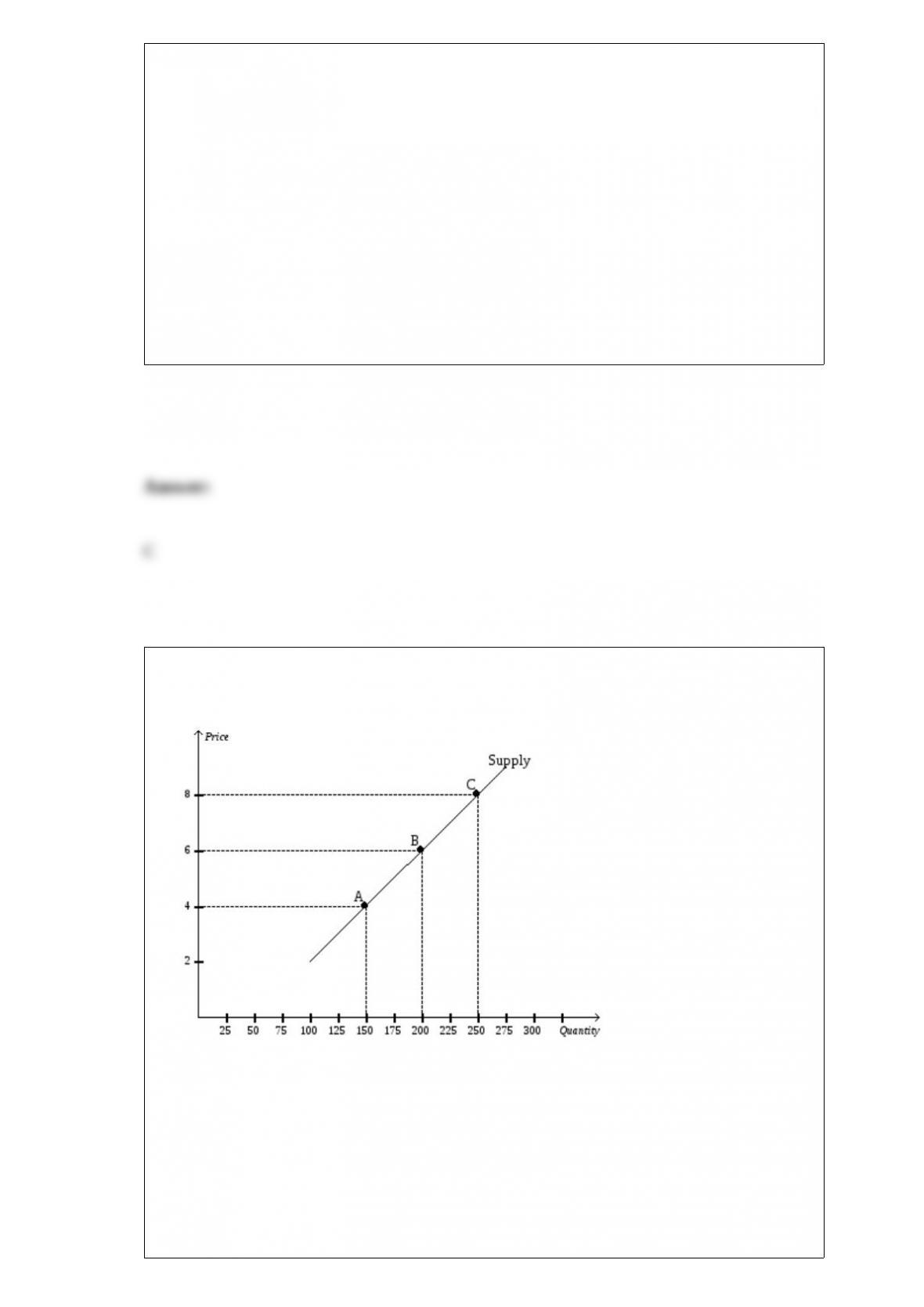
Figure 5-16
Refer to Figure 5-16. If, holding the supply curve fixed, there were an increase in
demand that caused the equilibrium price to increase from $6 to $8, then sellers’ total
revenue would
a. increase.
b. decrease.

c. remain unchanged.
d. The effect on total revenue cannot be determined from the given information.
If unions were formed in more industries, the supply of labor in other industries would
a. increase, causing employment in other industries to rise.
b. increase, causing employment in other industries to fall.
c. decrease, causing employment in other industries to rise.
d. decrease, causing employment in other industries to fall.
Which of the following would raise the price level in both the short and long run?
a. an increase in taxes
b. an increase in government expenditures
c. a decrease in the minimum wage
d. an increase in the capital stock
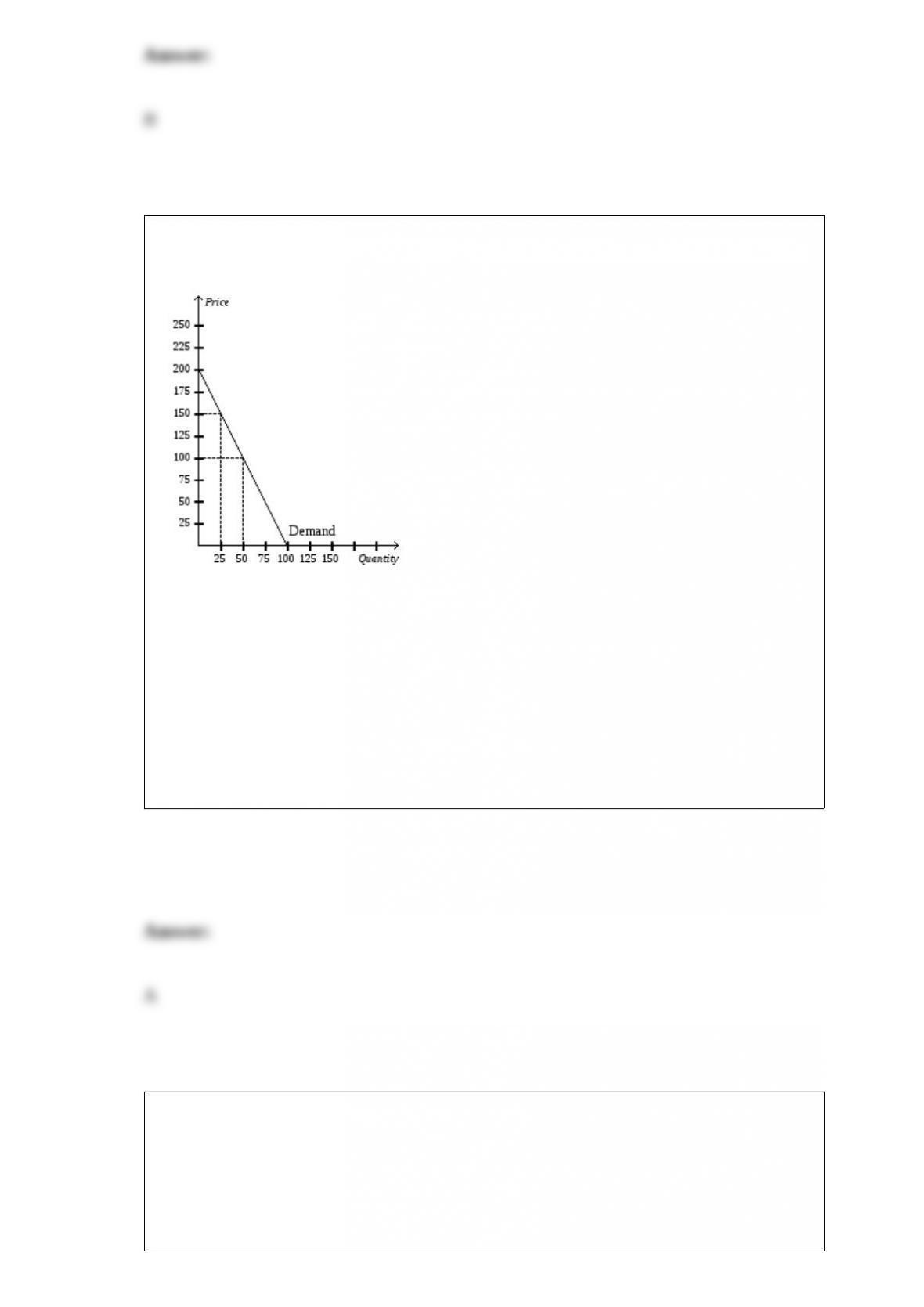
Figure 7-6
Refer to Figure 7-6. What is the consumer surplus if the price is $100?
a. $2,500
b. $5,000
c. $10,000
d. $20,000
Consumer surplus is a good measure of economic welfare if policymakers want to
a. maximize total benefit.
b. minimize deadweight loss.

c. respect the preferences of sellers.
d. respect the preferences of buyers.
The demand for salt is inelastic, and the supply of salt is elastic. The demand for caviar
is elastic, and the supply of caviar is inelastic. Suppose that a tax of $1 per pound is
levied on the sellers of salt, and a tax of $1 per pound is levied on the buyers of caviar.
We would expect that most of the burden of these taxes will fall on
a. sellers of salt and the buyers of caviar.
b. sellers of salt and the sellers of caviar.
c. buyers of salt and the sellers of caviar.
d. buyers of salt and the buyers of caviar.
A demand curve reflects each of the following except the
a. willingness to pay of all buyers in the market.
b. value each buyer in the market places on the good.
c. highest price buyers are willing to pay for each quantity.
d. ability of buyers to obtain the quantity they desire.
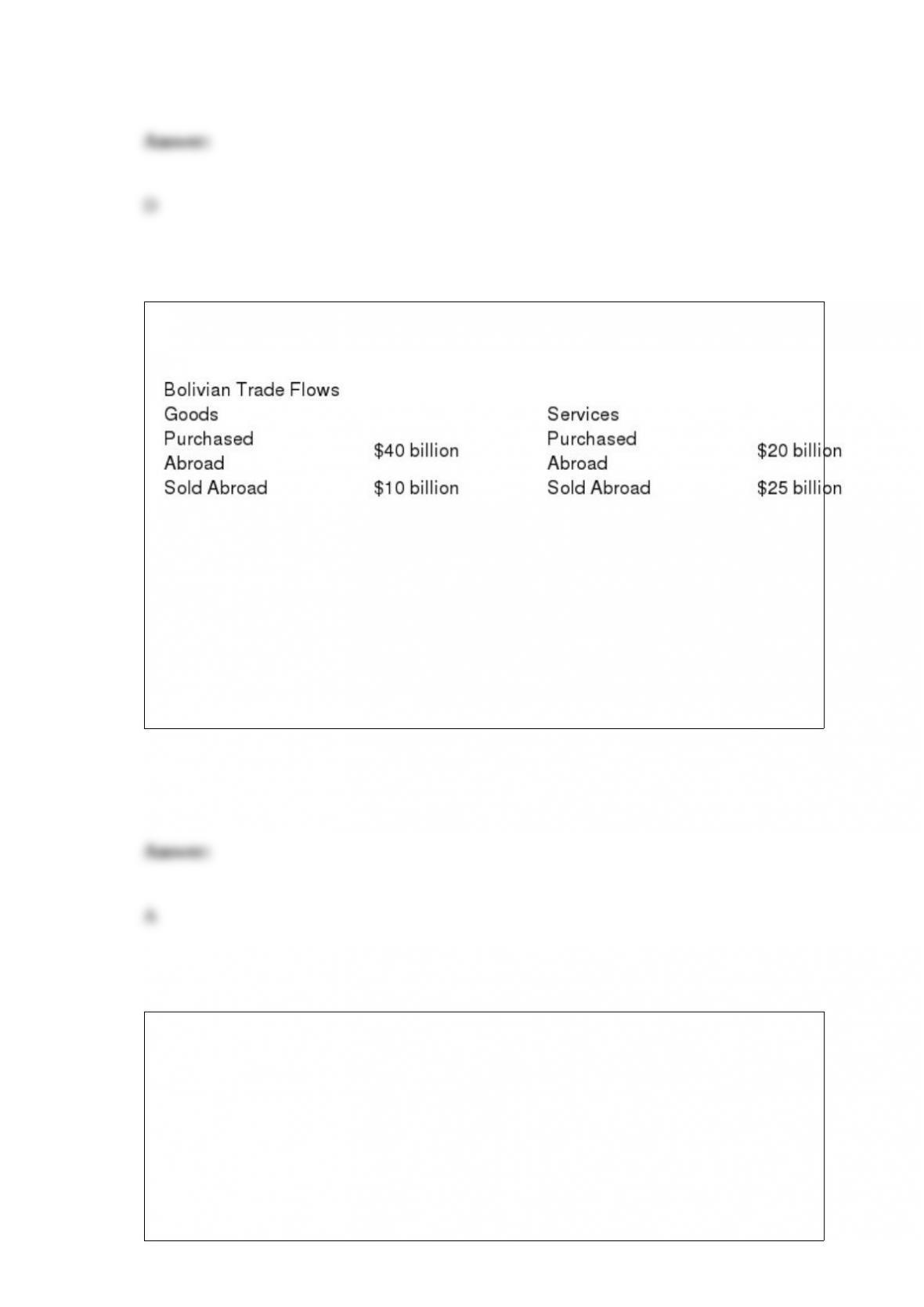
Table 18-1
Refer to Table 18-1. What are Bolivia’s imports?
a. $60 billion
b. $35 billion
c. $40 billion
d. None of the above are correct.
For teenagers, a 10 percent increase in the price of cigarettes leads to a
a. 1 percent reduction in the quantity demanded of cigarettes.
b. 4 percent reduction in the quantity demanded of cigarettes.
c. 10 percent reduction in the quantity demanded of cigarettes.
d. 12 percent reduction in the quantity demanded of cigarettes.

Economists have developed models of risk aversion using the concept of
a. utility and the associated assumption of diminishing marginal utility.
b. utility and the associated assumption of increasing marginal utility.
c. income and the associated assumption of diminishing marginal wealth.
d. income and the associated assumption of increasing marginal wealth.
Which of the following events could cause an increase in the supply of ceiling fans?
a. The number of sellers of ceiling fans increases.
b. There is an increase in the price of air conditioners, and consumers regard air
conditioners and ceiling fans as substitutes.
c. There is an increase in the price of the motor that powers ceiling fans.
d. All of the above are correct.

Recent changes in methods used to compute the CPI have made the
a. upward bias in the CPI inflation rate more severe than it used to be.
b. upward bias in the CPI inflation rate less severe than it used to be.
c. downward bias in the CPI inflation rate more severe than it used to be.
d. downward bias in the CPI inflation rate less severe than it used to be.
The future value of a deposit in a savings account will be larger
a. the longer a person waits to withdraw the funds.
b. the higher the interest rate is.
c. the larger the initial deposit is.
d. All of the above are correct.
People hold money primarily because it
a. has a guaranteed nominal return.
b. serves as a store of value.
c. can directly be used to buy goods and services.
d. functions as a unit of account.
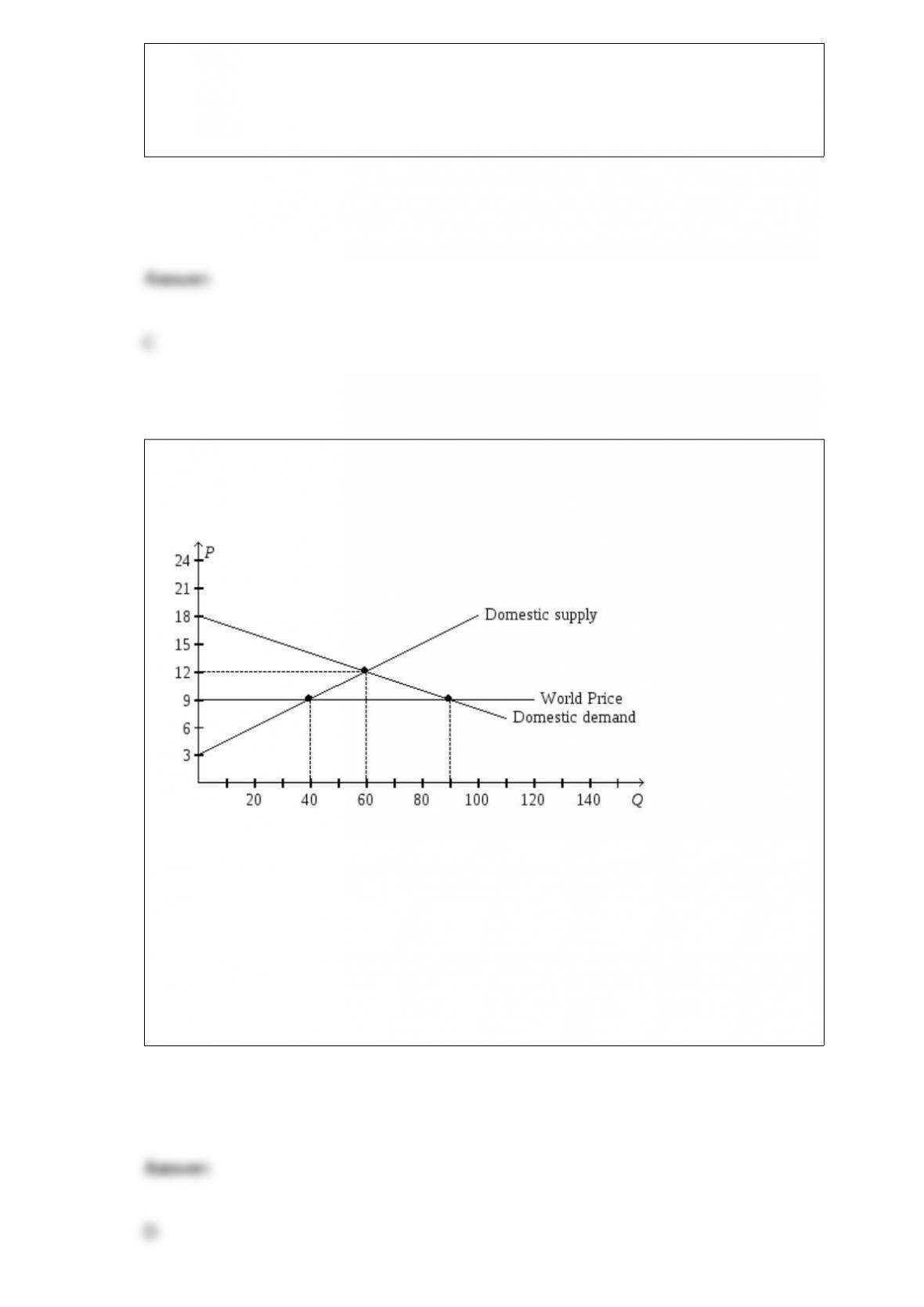
Figure 9-19. On the diagram below, Q represents the quantity of textiles and P
represents the price of textiles.
Refer to Figure 9-19. With free trade, the country for which the figure is drawn will
a. export 30 units of textiles.
b. export 50 units of textiles.
c. import 30 units of textiles.
d. import 50 units of textiles.

A $0.10 tax levied on the sellers of chocolate bars will cause the
a. supply curve for chocolate bars to shift down by $0.10.
b. supply curve for chocolate bars to shift up by $0.10.
c. demand curve for chocolate bars to shift down by $0.10.
d. demand curve for chocolate bars to shift up by $0.10.
Y = C + I + G + NX is an identity because
a. each symbol identifies a macroeconomic variable.
b. the right-hand and left-hand sides are equal when an equilibrium is reached.
c. the equality holds due to the way the variables are defined.
d. None of the above is correct.
Other things the same,the aggregate quantity of goods demanded in the U.S. increases if
a. real wealth falls.
b. the interest rate rises.
c. the dollar depreciates.
d. None of the above is correct.
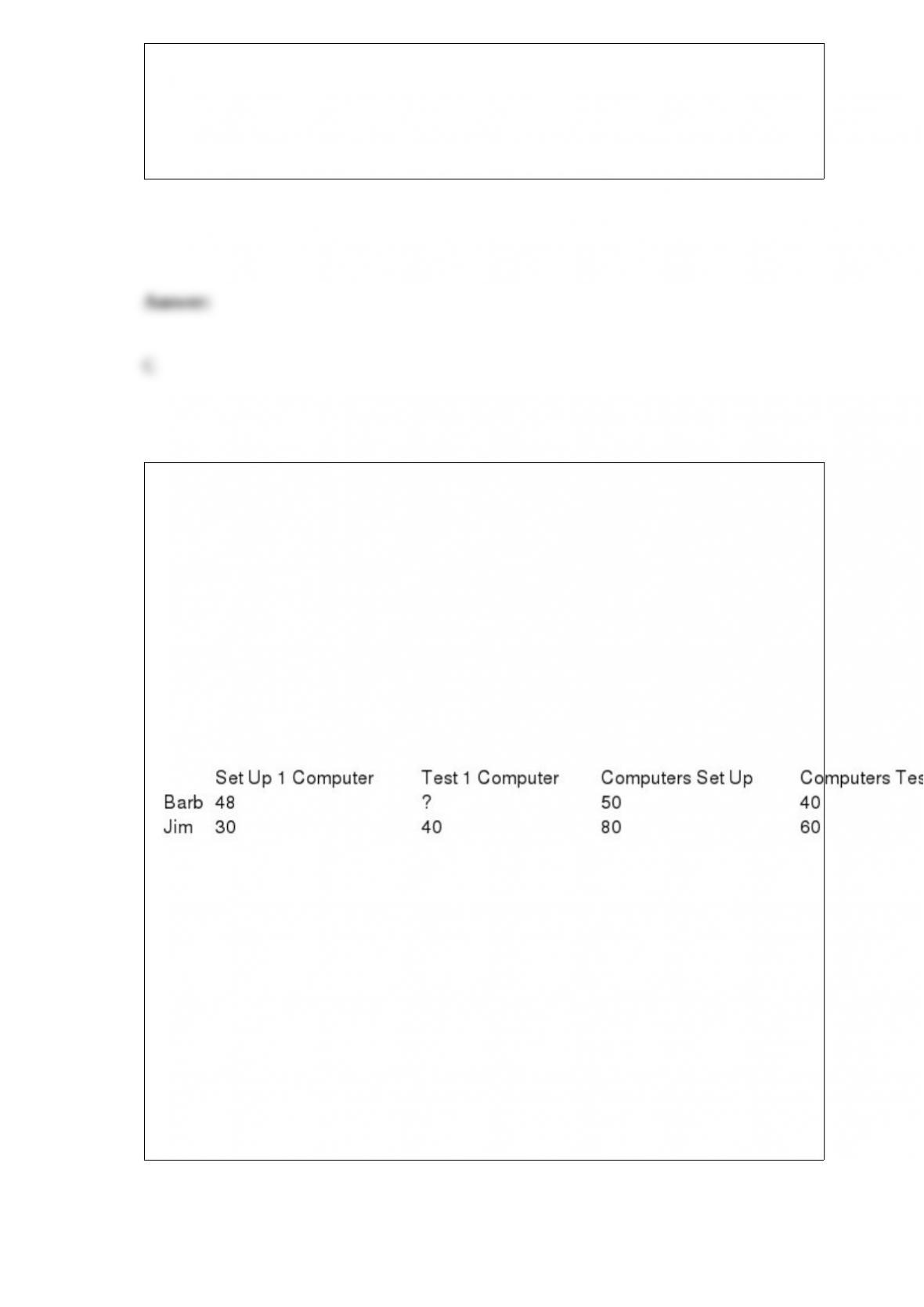
Table 3-9
Barb and Jim run a business that sets up and tests computers. Assume that Barb and Jim
can switch between setting up and testing computers at a constant rate. The following
table applies.
Minutes Needed to Number of Computers
Set Up or Tested in a
40-Hour Week
Refer to Table 3-9. Jim has an absolute advantage in
a. both setting up and testing computers and a comparative advantage in setting up
computers.
b. both setting up and testing computers and a comparative advantage in testing
computers.
c. neither setting up nor testing computers and a comparative advantage in setting up
computers.
d. neither setting up nor testing computers and a comparative advantage in testing
computers.

In 2007 and 2008 households and firms reduced desired expenditures. During the same
period inflation fell and unemployment rose.
a. The change in inflation, but not the change in unemployment is consistent with what
a given short-run Phillips curve implies.
b. The change in unemployment, but not the change in inflation is consistent with what
a given short-run Phillips curve implies.
c. Both the change in inflation and the change in unemployment are consistent with
what a given short-run Phillips curve implies.
d. Neither the change in inflation nor the change in unemployment are consistent with
what a given short-run Phillips curve implies.
Table 3-17
US and French Production Opportunities
Refer to Table 3-17 The US has a comparative advantage in the production of
a. wine.
b. cheese.
c. both wine and cheese.
d. neither wine nor cheese.
In 2002 it looked like the Argentinean government might default on its debt (which
eventually it did). The open-economy macroeconomic model predicts that this should
have
a. raised Argentinean interest rates and caused the Argentinean currency to appreciate.
b. raised Argentinean interest rates and caused the Argentinean currency to depreciate.
c. lowered Argentinean interest rates and caused the Argentinean currency to appreciate.
d. lowered Argentinean interest rates and caused the Argentinean currency to depreciate.
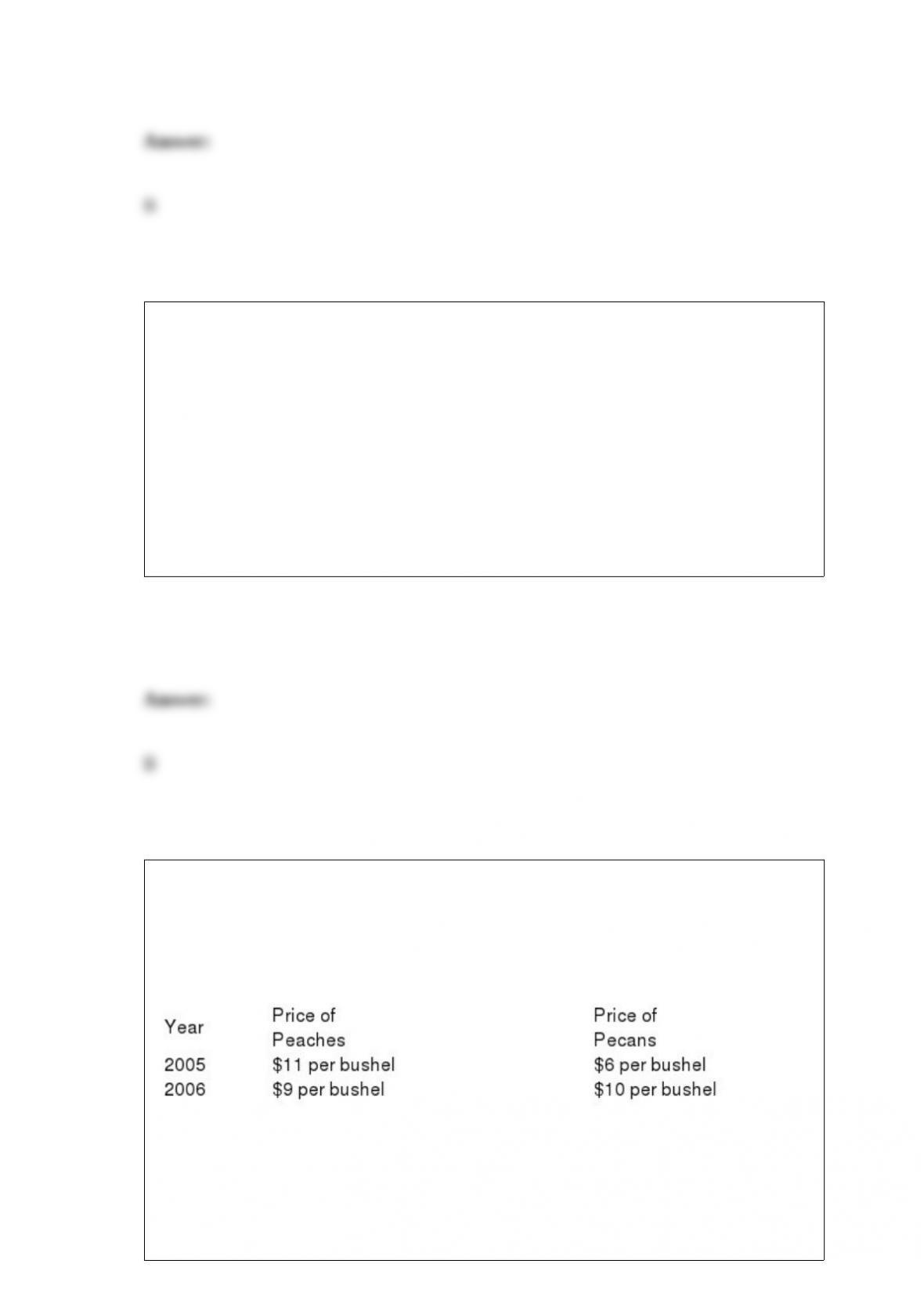
Table 11-1
The table below pertains to Pieway, an economy in which the typical consumer’s basket
consists of 10 bushels of peaches and 15 bushels of pecans.
Refer to Table 11-1. If 2005 is the base year, then the CPI for 2006 was
a. 83.3.
b. 100.

c. 120.
d. 240.
Price controls
a. always produce a fair outcome.
b. always produce an efficient outcome.
c. can generate inequities of their own.
d. All of the above are correct.
Which of the following is a part of your economics professor’s human capital?
a. the things she learned at some prestigious university
b. her copy of Mankiw’s text
c. her chalk holder
d. All of the above are correct.

Twenty years ago, Dr. Montgomery borrowed money from her parents to pay her tuition
at graduate school. Now she wants to pay them back. She gives them double what they
gave her. According to the rule of 70, what interest rate would have given her parents
the same amount of money if they had put it in the bank rather than lending it to their
daughter?
a. 3.5 percent
b. 4.5 percent
c. 5 percent
d. 7 percent
A reduction in the tax rate on interest income
a. raises the amount earned on savings. Saving will rise if the income effect of the
reduction in the tax rate is larger than the substitution effect.
b. raises the amount earned on savings. Saving will rise if the income effect of the
reduction in the tax rate is smaller than the substitution effect.
c. reduces the amount earned on savings. Saving will rise if the income effect of the
reduction in the tax rate is larger than the substitution effect.
d. reduces the amount earned on savings. Saving will rise if the income effect of the
reduction in the tax rate is smaller than the substitution effect.

Cameron visits a sporting goods store to buy a new set of golf clubs. He is willing to
pay $750 for the clubs but buys them on sale for $575. Cameron’s consumer surplus
from the purchase is
a. $175.
b. $575.
c. $750.
d. $1,325.
An increase in the price of bread produced domestically will be reflected in
a. both the GDP deflator and the consumer price index.
b. neither the GDP deflator nor the consumer price index.
c. the GDP deflator but not in the consumer price index.
d. the consumer price index but not in the GDP deflator.