The term “present value” refers to
a. how much something costs today relative to what it could be sold for in the future
after it depreciates in value.
b. how much you would be willing to pay for a good today if you are not sure that the
good will be available in the future.
c. the current worth of some future dollar amount of income.
d. how much your savings are worth today after having been invested for a certain
number of years.
e. the difference between the price you pay for a good and the costs of producing that
good.
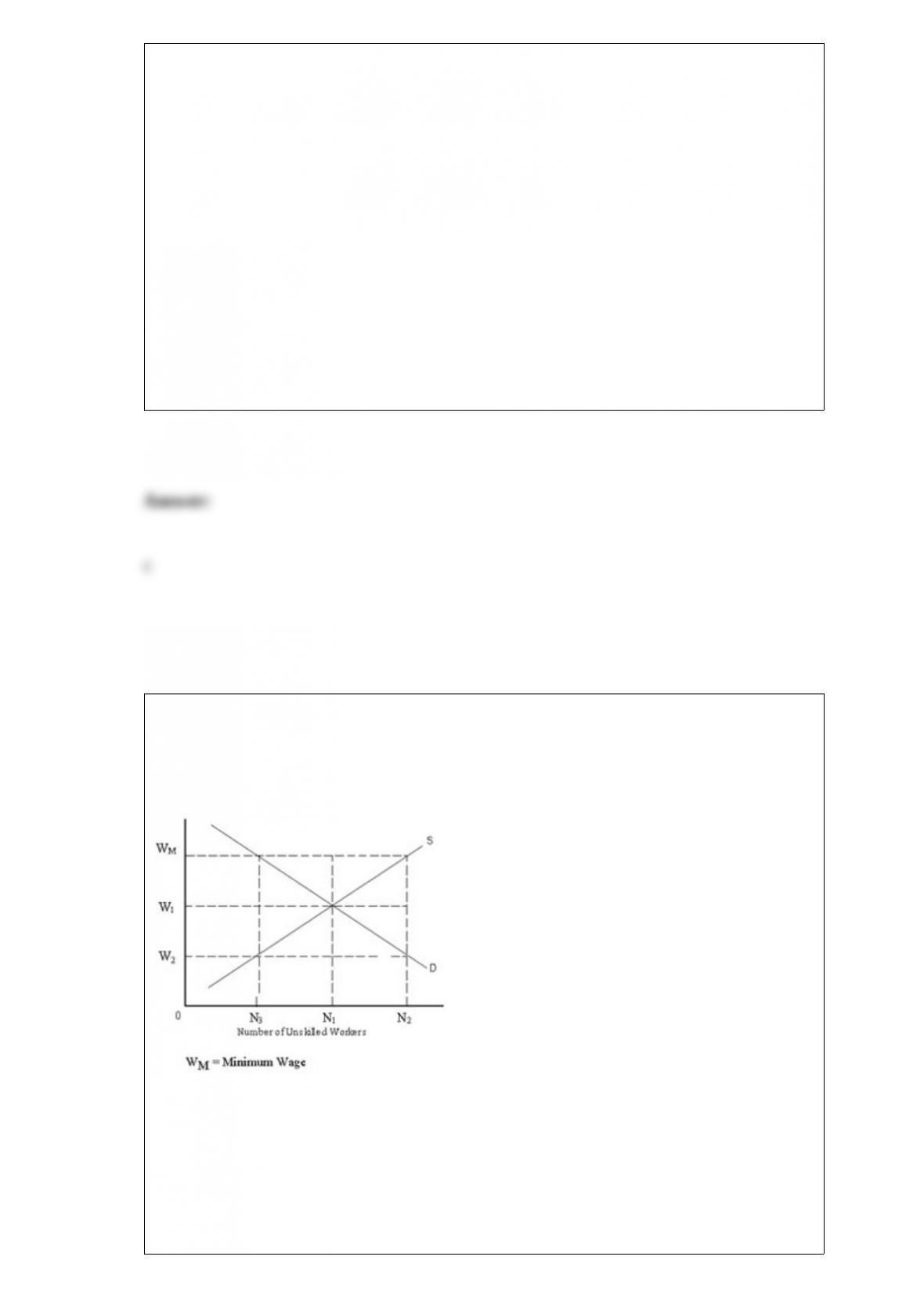
Refer to Exhibit 4-7. The number of unskilled workers who want to work at the
minimum wage is
Exhibit 4-7
a. N3.
b. N1.
c. N2.
d. N2 – N1.

Since price __________ for a monopoly firm, the profit-maximizing monopoly firm
does not produce the quantity of output for which price equals marginal cost.
a. does not equal marginal revenue
b. does equal marginal revenue
c. is higher for a perfectly competitive firm than
d. is lower for a perfectly competitive firm than
e. a and d
This is the solution to the diamond-water paradox: Those things that have high value in
use sometimes have low prices because they are consumed at low __________ utility;
those things that have low value in use sometimes have high prices because they are
consumed at high __________utility.
a. marginal; total
b. total; total
c. total; marginal
d. marginal; marginal
e. none of the above
A Gini coefficient of zero means there is
a. perfect income equality.
b. perfect income inequality.
c. a more equal distribution of income than before.
d. a less equal distribution of income than before.
e. the same distribution of income as before.
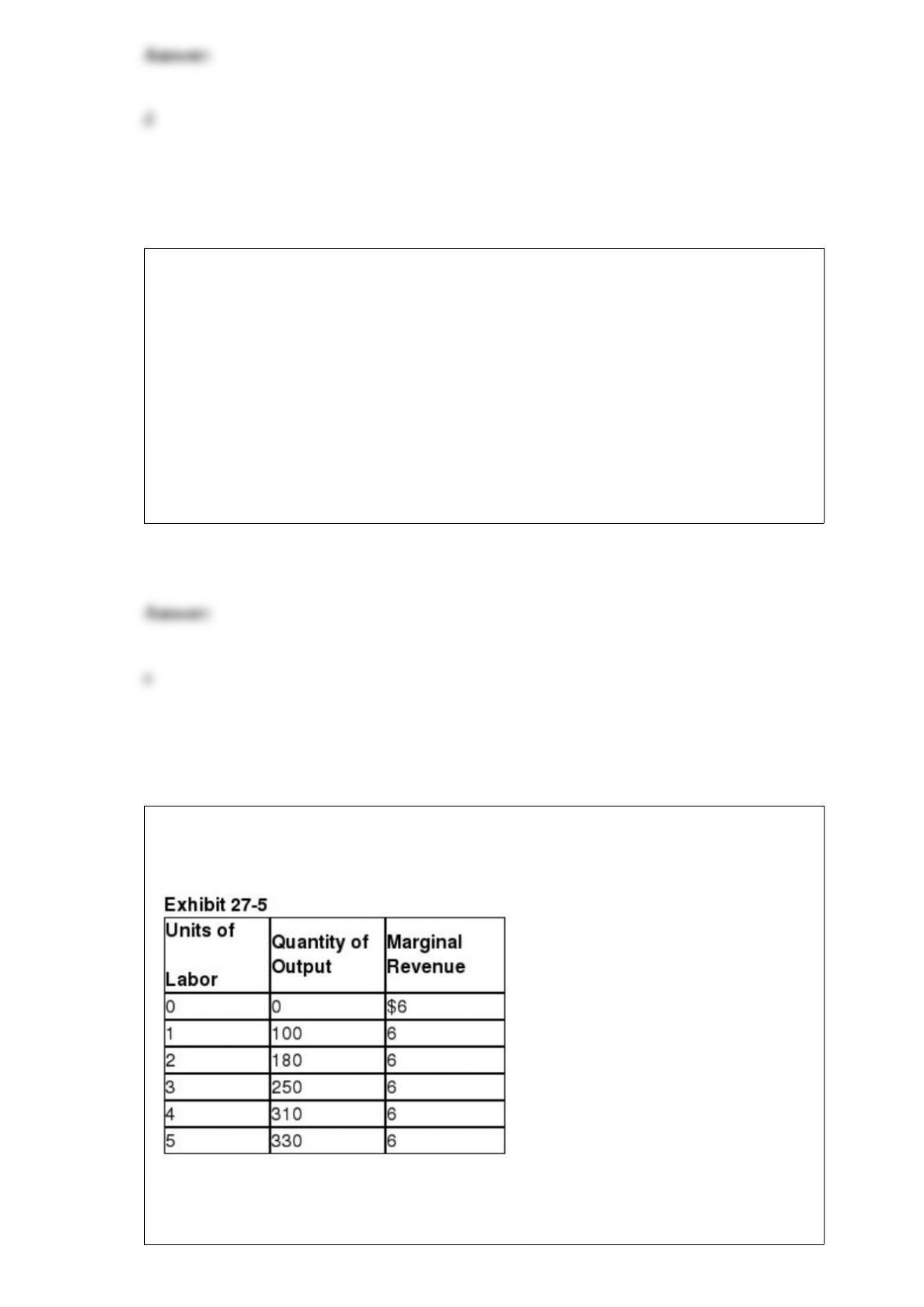
Refer to Exhibit 27-5. The marginal revenue product of the fifth unit of labor is
a. $270.

b. $20.
c. $330.
d. $120.
Consider the following information about a business Diane opened last year: price =
$15, quantity sold = 25,000; implicit cost = $155,000; explicit cost = $260,000. What
was Diane’s accounting profit?
a. $40,000
b. $115,000
c. -$40,000
d. $220,000
e. There is not enough information provided to answer this question.
Smith sends her children to a private school on the other side of town.Tuition per
student per year is $15,000.Jones sends her children to a public school on her side of
town.Tuition per student per year is $0.Most people seem to think that the private
school and public school are equivalent when it comes to educating students. According
to a theory discussed in the textbook,
a. Smith lives in a more expensive home than Jones.

b. Jones lives in a more expensive home than Smith.
c. Smith and Jones live in homes that are priced the same.
d. Smith lives in a larger home than Jones.
e. none of the above
In the theory of perfect competition, the assumption of easy entry into and exit from the
market implies
a. positive economic profits in the long run.
b. losses in the long-run equilibrium.
c. zero economic profits in the long run.
d. zero economic profits in both the short run and the long run.
e. positive economic profits in both the short run and the long run.
An economist might say, “The market guides and coordinates individuals’ actions.”
Which of the following is an example of this happening?
a. An employer tells an employee to get to work early.
b. As the price of oranges rises, more individuals begin to produce oranges.

c. The manager of a plant issues a directive that there will be no more smoking in the
cafeteria.
d. a and c
e. a, b, and c
A deadweight loss is the loss to society of not producing the supply-and-demand
determined level of output.
a. True
b. False
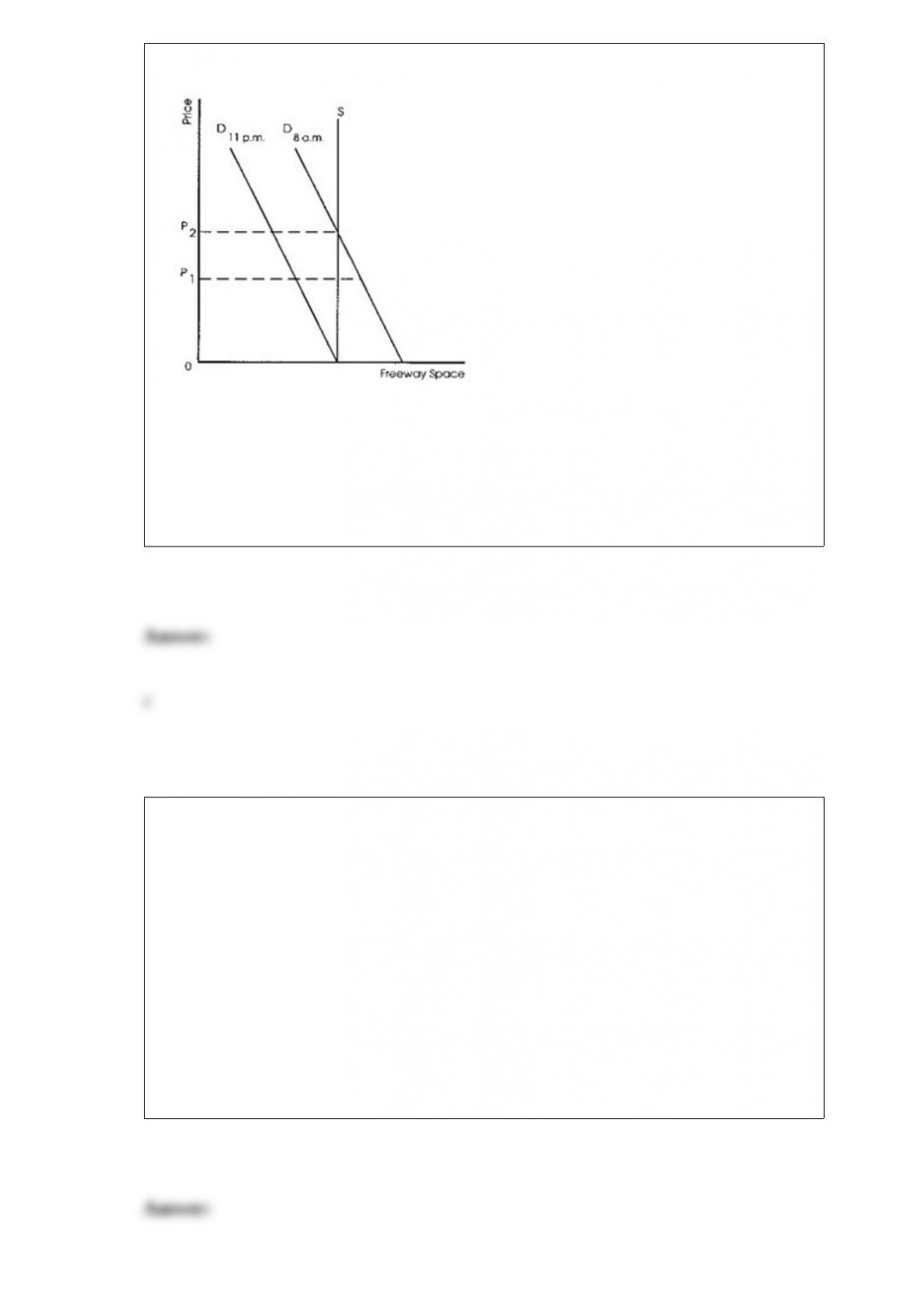
Refer to Exhibit 5-1, which shows supply and demand for freeway space at both 8 a.m.
and 11 p.m. A toll of P2 creates __________ at 8 a.m. and __________ at 11 p.m.
Exhibit 5-1
a. a shortage; a surplus
b. a surplus; a shortage
c. equilibrium; a surplus
d. a shortage; equilibrium
The market shares (in percentage terms) for the 12 firms that comprise an industry are
15, 12, 11, 10, 8, 7, 7, 6, 6, 6, 6, and 6. The Herfindahl index will rise by __________
points if the firms with the two largest market shares merge.
a. 400
b. 360
c. 100
d. 220
e. 140

Roundabout methods of production are said to be productive. What does this mean?
a. Goods are best produced by many people working together-as in a circle.
b. If you go round and round thinking about something, you will usually come up with
the right way to do it-so you minimize on mistakes.
c. If you take the most direct route to producing a good, you will save time, and time is
something that producers want to save since “time is money.”
d. If you take time out to produce a capital good, with that capital good you can produce
more than you could produce without it.
Bond prices and bond yields have a(n) ______________ relationship.
a. direct
b. inverse
c. independent
d. positive

You turn to the Treasury bond market page of a newspaper and look under the column
headed “Bid” and see that it says, “125:8” this indicates that
a. the price that the buyer is willing to pay for this bond is $125.08.
b. the price that the buyer is willing to pay for this bond is $1,252.50.
c. the price that the seller is willing to sell this bond for is $125.80.
d. the price that the seller is willing to sell this bond for is $125.08.
At the optimal or efficient level of an activity, the activity’s marginal benefit must
a. be zero.
b. be greater than zero.
c. equal the marginal cost of the activity.
d. exceed the marginal cost of the activity.
Which of the following statements is true?
a. Price ceilings set below the equilibrium price cause shortages.
b. Surpluses result when a price floor is set above the equilibrium price.
c. Price ceililngs set above the equilibrium price cause surpluses.
d. Price ceilings are set by the market and price floors are set by the government.

e. a and b
Refer to Exhibit 24-1. If the product is produced under single-price monopoly, what
does total revenue equal at the profit maximizing level of output?
a. area 0P2CQ1
b. area BCA
c. area P1P2CB
d. area P2CAP1
e. none of the above
The higher the opportunity cost of doing something, the more likely it will be done.
a. True
b. False

Which of the following statements is false?
a. An upward-sloping supply curve graphically represents the law of supply.
b. A vertical supply curve graphically represents the law of supply.
c. If income rises and good X is a normal good, then the demand for good X will rise.
d. If income falls and good Y is an inferior good, then the demand for good Y will rise.
One of the consequences of an agricultural price support program is
a. a surplus.
b. more exchanges made at the price support.
c. lower prices paid by consumers.
d. lower taxes for taxpayers.
e. a and c
Evidence indicates that tariffs and quotas are
a. beneficial for producers in a protected industry, but not beneficial for the workers in

the industry.
b. beneficial for producers in a protected industry, but not beneficial for consumers.
c. beneficial for workers in a protected industry, but not beneficial for consumers.
d. not beneficial for the workers in a protected industry or for consumers.
e. b and c
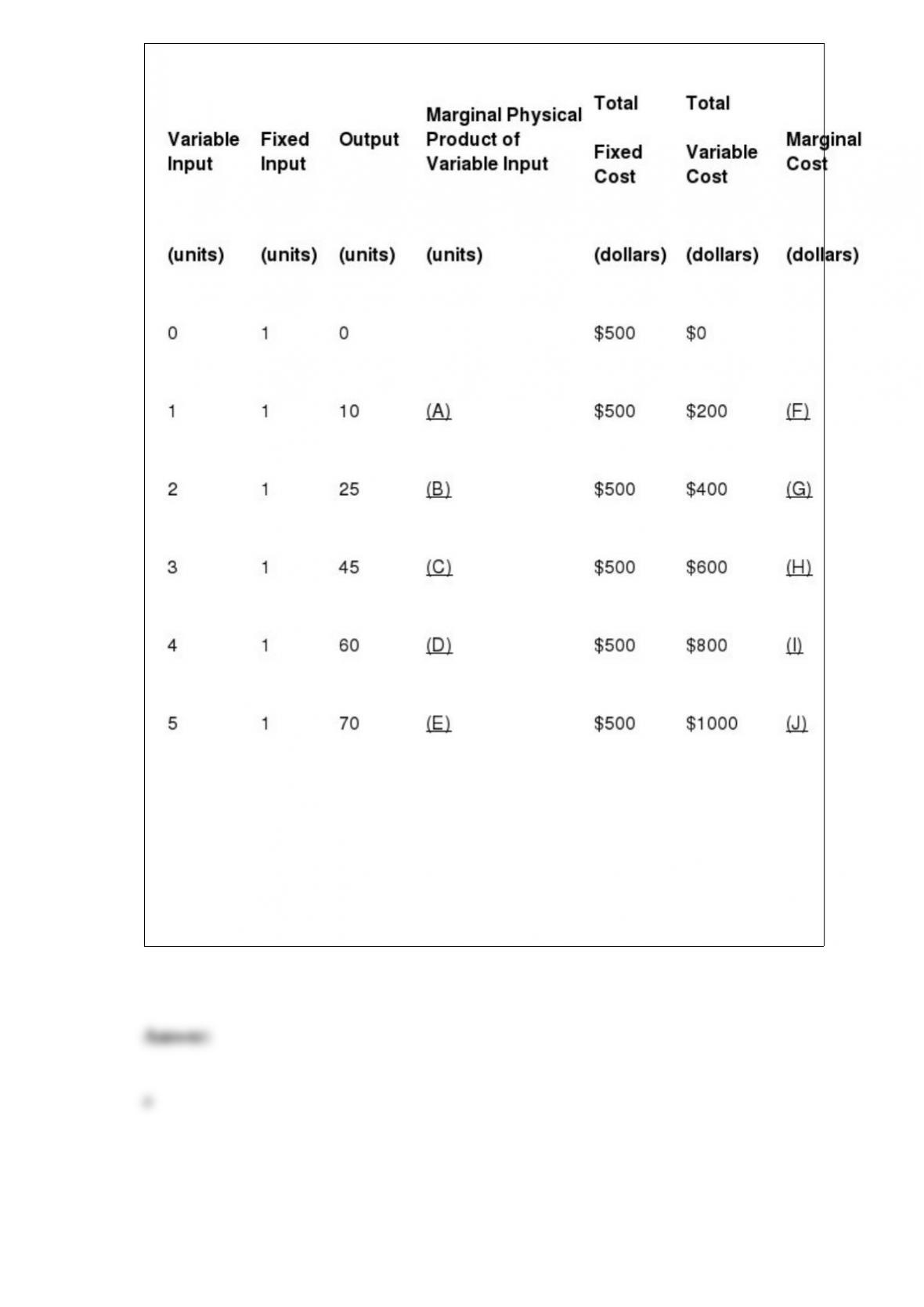
Refer to Exhibit 22-3. What is the average total cost of producing 60 units of output?
Exhibit 22-3
a. $21.67
b. $1.33
c. $24.17
d. $12.50