Sparkle, one of many firms in the market for toothpaste, is in long-run equilibrium.
Sparkle has a small market share and has been in business for a long time. a. Identify
the market structure in which Sparkle operates. Explain your answer.
b. What is Sparkle’s profit or loss? Explain your answer. If you cannot determine the
profit or loss, explain what information is missing.
c. Draw a diagram showing Sparkle’s demand curve, marginal revenue curve, average
total cost curve and marginal cost curve. Label your diagram.
According to a study of the U.S. demand for alcoholic beverages, the price elasticity of
demand for beer is -0.30. Which of the following could explain why the price elasticity
of demand for beer is low?
A) Beer is an inferior alcoholic beverage.
B) More and more people are switching to wine and cocktails rather than beer.
C) The price of beer is relatively low and for many people it is a habit forming product.
D) There are only a few major suppliers of beer.
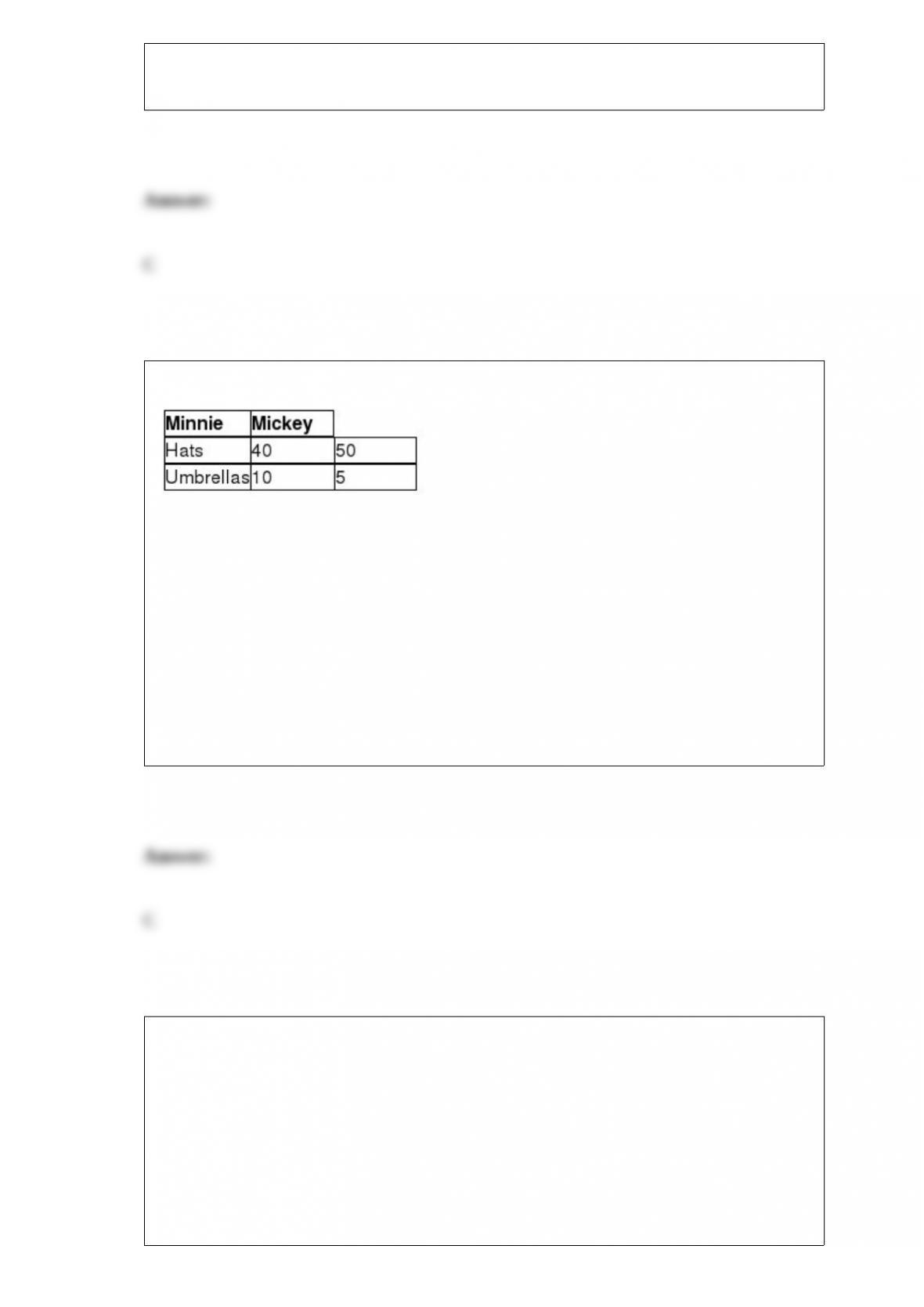
Table 2-7
Table 2-7 shows the output per week of two people, Minnie and Mickey. They can
either devote their time to making hats or making umbrellas. What is Minnie’s
opportunity cost of making an umbrella?
A) 1/10 of a hat
B) 1/4 of a hat
C) 4 hats
D) 40 hats
Investment spending includes spending on
A) stocks.
B) food.
C) changes in business inventories.
D) transfer payments.
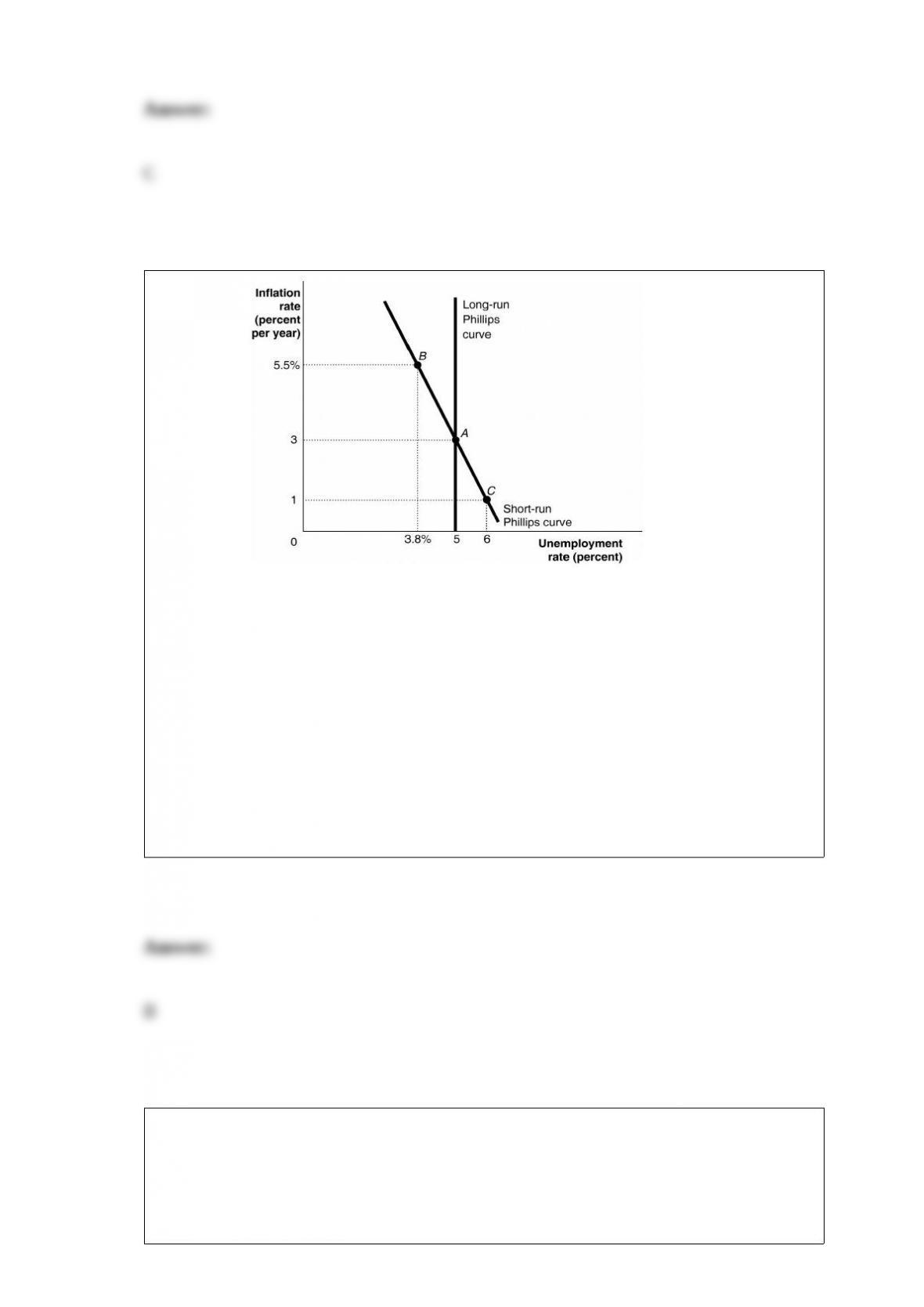
Figure 17-2
Suppose the economy is at point A in the figure above. Which of the following is true?
A) The expected rate of inflation is 5.5%.
B) The current unemployment rate is equal to the natural rate of unemployment.
C) The current unemployment rate is 3.8%.
D) Actual inflation is 1%.
E) The economy will move from A to B.
A perfectly competitive firm in a constant-cost industry produces 3,000 units of a good
at a total cost of $36,000. The prevailing market price is $15. What will happen to the
number of firms in the industry and to the industry’s output in the long run?
A) The number of firms and the industry’s output increase.

B) The number of firms and the industry’s output decrease.
C) The number of firms remains constant and the industry’s output increases.
D) The number of firms remains constant and the industry’s output decreases.
Because firms can free ride on the research and development of other firms,
A) firms choose a level of research and development where the marginal cost of
research is equal to the economy’s marginal return of research.
B) firms choose a level of research and development where the marginal cost of
research is above the economy’s marginal return of research.
C) firms choose a level of research and development where the marginal cost of
research is below the economy’s marginal return of research.
D) firms choose a level of research and development where the marginal cost of
research is below the individual firm’s marginal return of research.
The change in a firm’s revenue as a result of hiring one more worker
A) is the definition of the marginal product of labor.
B) is equal to the firm’s marginal cost.
C) is the definition of the marginal revenue product of labor.
D) will be negative if the demand for the firm’s output is inelastic.
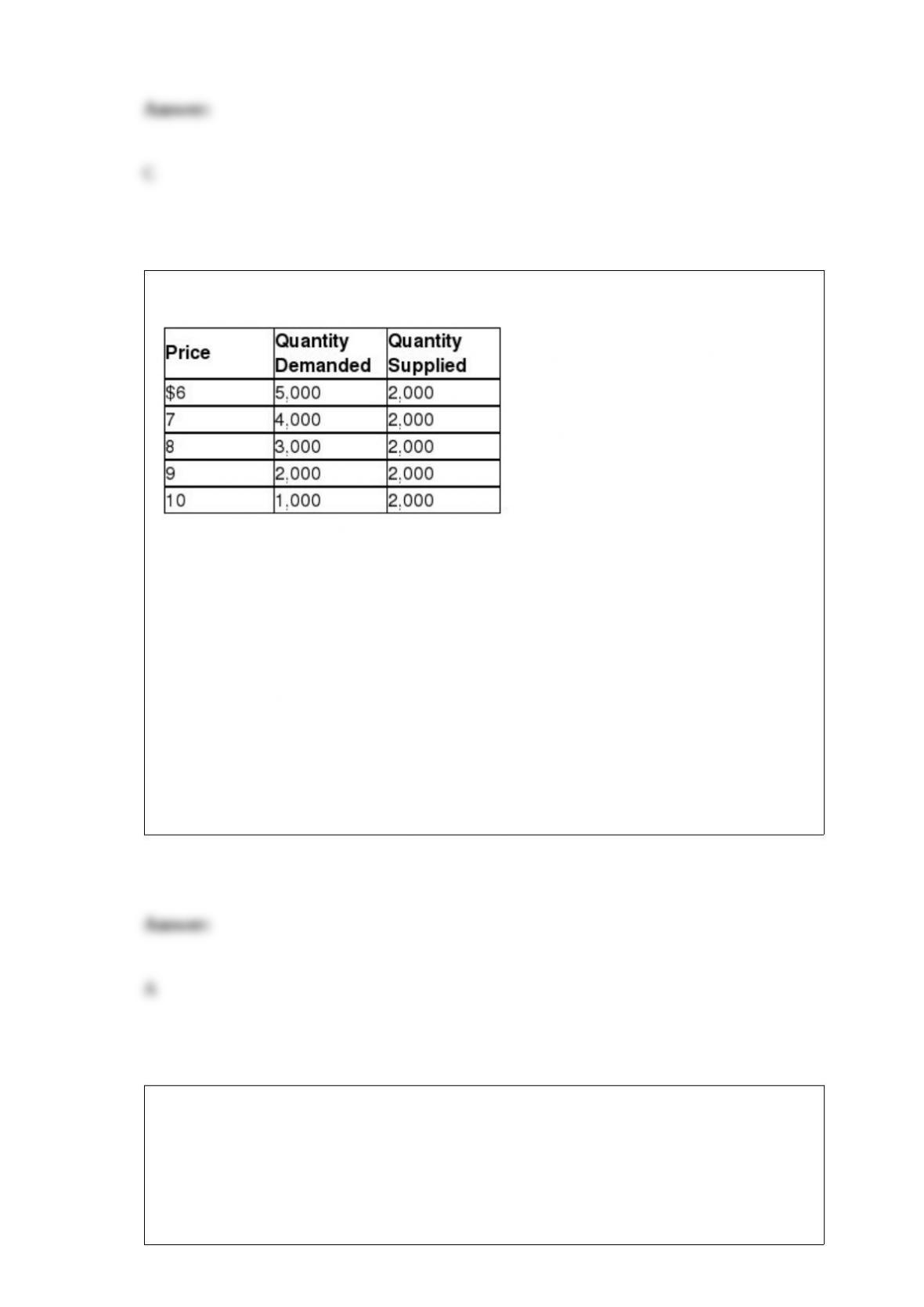
Table 6-7
The town of Bloomfield is well known for its basketball team. The price of basketball
game tickets is determined by market forces. Table 6-7 above shows the demand and
supply schedules for basketball games tickets. What is the most distinctive feature of
the supply curve?
A) The supply curve is perfectly inelastic.
B) The supply curve is horizontal.
C) The supply curve is upward sloping.
D) The supply curve is perfectly elastic.
The quantity theory of money predicts that, in the long run, inflation results from the
A) velocity of money growing at a faster rate than real GDP.
B) velocity of money growing at a lower rate than real GDP.

C) money supply growing at a lower rate than real GDP.
D) money supply growing at a faster rate than real GDP.
If planned aggregate expenditure is less than total production,
A) actual inventories will equal planned inventories.
B) firms will experience an unplanned decrease in inventories.
C) GDP will decrease.
D) the economy is in equilibrium.