
The Fed relies on open market operations, which work
a. with the Treasury in creating money to finance bonds.
b. through major stock exchanges to influence bond prices.
c. directly through the nonbank public to change their assets.
d. through the banking system by affecting their reserves.
The factor that leads to underpricing and overuse of an economic resource is
a. human greed and selfishness.
b. capital markets.
c. the lack of an enforceable property right.
d. the lack of understanding of pollution and its effects.
Firms will continue to enter a perfectly competitive industry until
a. the supply curve is vertical.
b. the supply curve is meaningless.
c. any excess returns have been competed away.

d. all resources are fully employed.
Thomas Edison once complained that he was not making a profit selling light bulbs
because his plants were operating 25 percent below capacity. He estimated that he could
increase output 25 percent with a 2 percent increase in the cost of production. He sold
the 25 percent on the foreign market at a price below what he called the “cost of
production.” We can deduce that Edison really meant
a. Marginal cost was below average cost but less than marginal revenue.
b. Average cost exceeded variable cost, which exceeded marginal revenue.
c. Variable cost exceeded fixed cost but was less than marginal revenue.
d. Marginal cost was above average cost but greater than marginal revenue.
The production possibilities frontier illustrates
a. the fundamental fact of scarcity.
b. the opportunity cost of acquiring more of one good.
c. maximum output utilizing all resources efficiently.
d. All of the above are correct.

Before the Industrial Revolution, per capita income in the U.S. was about:
a. $4,000
b. $2,000
c. $1,000
d. $0
Most economists agree that exclusive reliance on direct controls
a. is a sound approach.
b. has worked well for us in the past.
c. is cheaper than any other enforcement mechanism.
d. is a mistake.

Many economists maintain that
a. the aggregate supply curve is nearly horizontal at low levels of real GDP.
b. the aggregate supply curve is nearly vertical at very high levels of real GDP.
c. any change in aggregate demand will have most of its effect on output when
economic activity is low but on prices when the economy is near full employment.
d. All of the above are correct.
The book that is the basis for modern macroeconomic theory is
a. The Wealth of Nations.
b. Principles of Political Economy.
c. The General History of Money and Banking.
d. The General Theory of Employment, Interest, and Money.
Policy-oriented economists seek to develop theories to
a. explain how things work so policies can be formulated.

b. describe what happened in a particular time period in history.
c. describe current economic events.
d. find correlations between events.
e. change people’s values and ethics.
European governments accepted prolonged periods of unemployment in the 1990s in
order to reduce inflation.
a. True
b. False
When you use the word income, you mean a value that must be qualified by a length of
time.
a. True
b. False
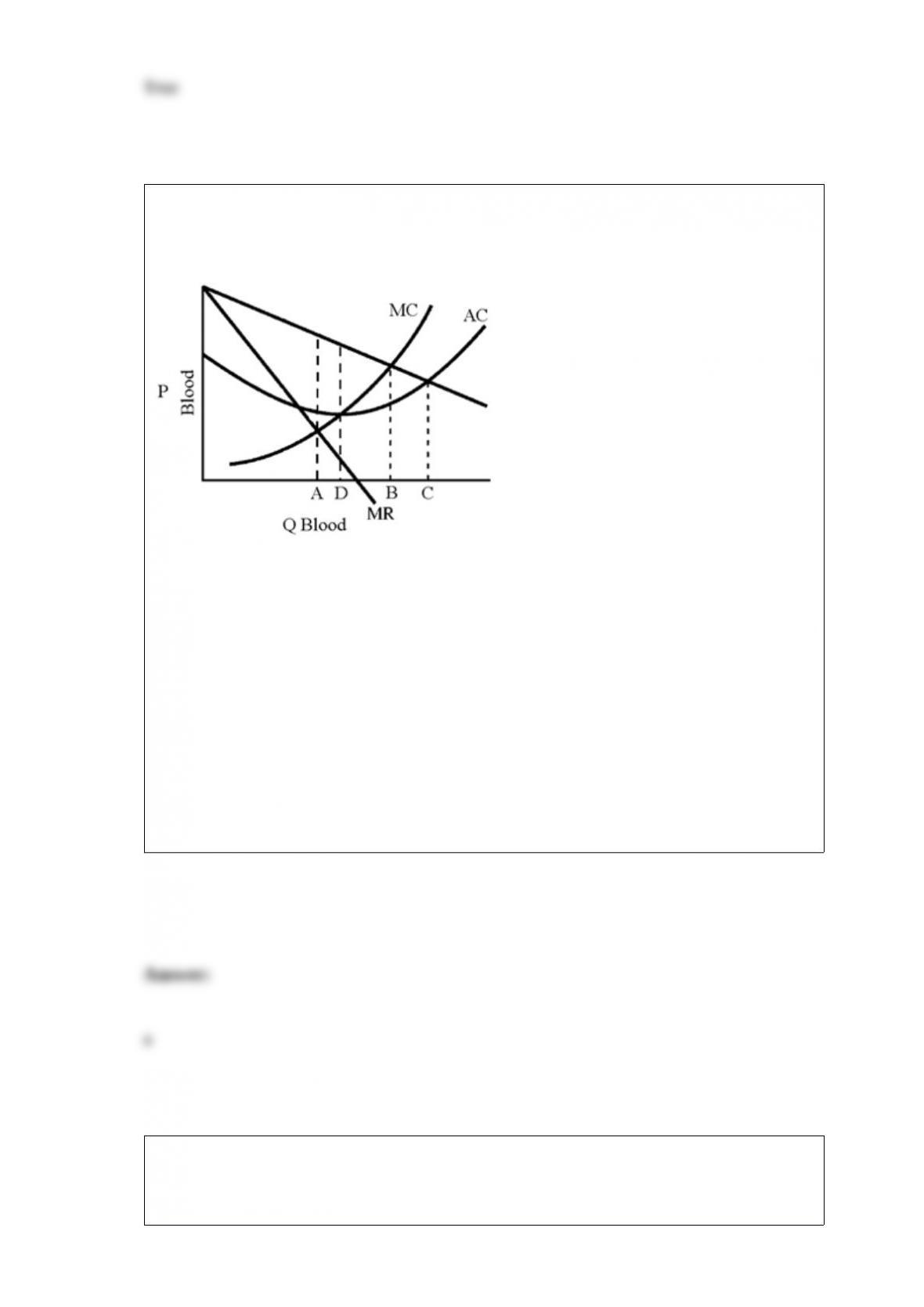
Figure 11-1
The Red Cross is virtually the only operator of blood banks in the United States. In
Figure 11-1 are the demand and supply curves facing the Red Cross blood bank. If it
were to operate like a profit-maximizing business, how many units of blood would it
sell?
a. OA
b. OB
c. OC
d. OD
Table 8-1
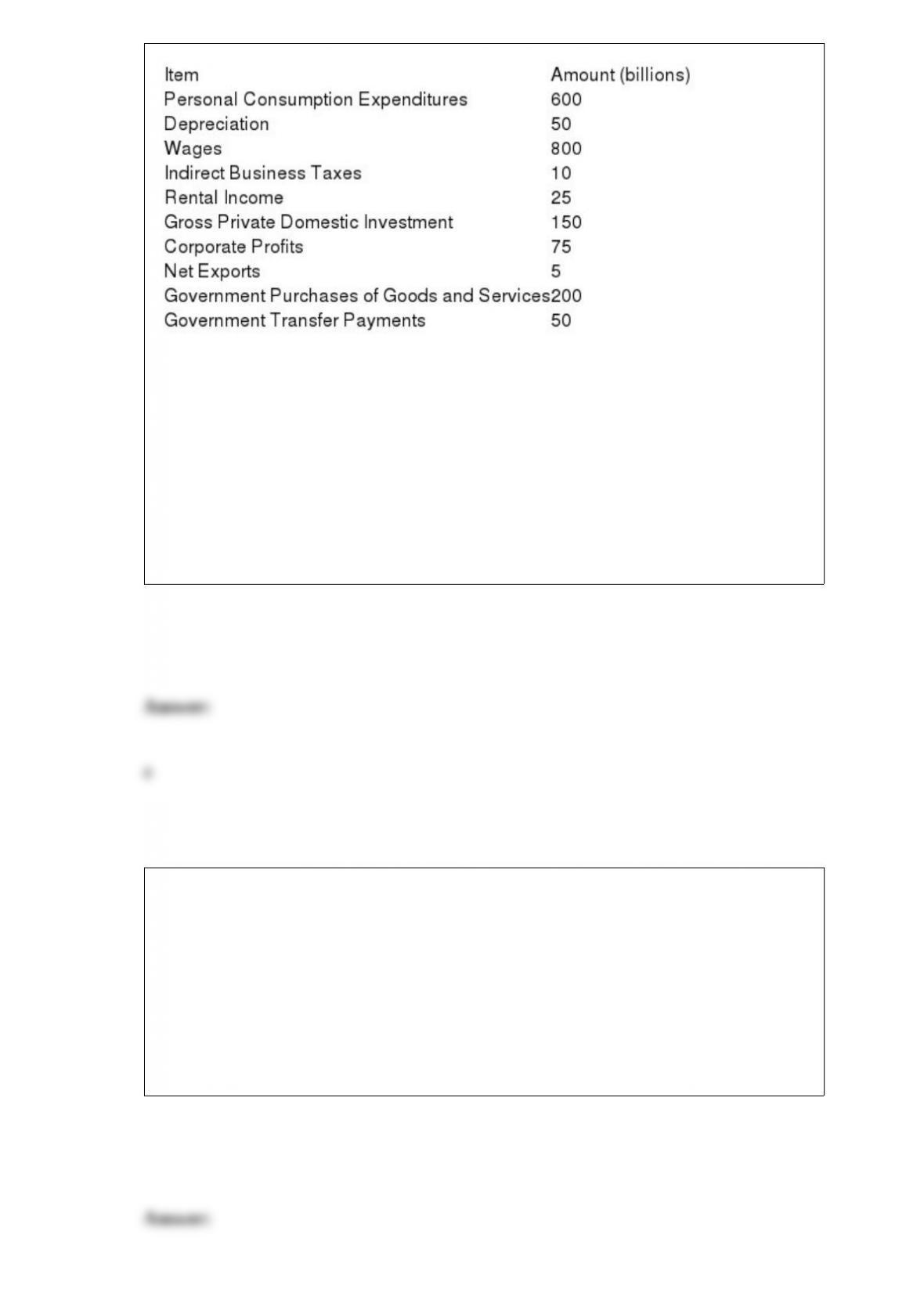
According to the data in Table 8-1, the value of NNP is
a. 900.
b. 805.
c. 750.
d. 705.
An advertising race among oligopolists may be rational if it
a. is defense advertising.
b. raises entry barriers.
c. increases cost per unit of sales.
d. encourages new entrants.

Direct controls often require long legal proceedings before they can be effective.
a. True
b. False
Monopolistic competition is different from perfect competition in that every
manufacturer
a. has a small monopoly, and differentiates the product.
b. takes the product quality as given, and chooses price.
c. takes output level as given, but must choose price.
d. differentiates product, but cannot advertise successfully.
If Honda (a Japan-based firm) produces a car in Ohio and exports it to Japan, in which
country’s GDP will the car be counted?
a. Japan’s, because Honda is a Japanese company

b. Japan’s because that is where the car is purchased
c. The GDP of the United States because that is where it was built
d. Both Japan and the United States
Higher prices may serve the public interest when:
a. there is a shortage of goods or services available
b. there is an uneven distribution of traffic on alternate routes
c. higher prices never serve the public interest
d. both a and b
Depreciation of the Japanese Yen would lead to
a. outward shift in the aggregate supply curve for Japan.
b. upward shift in the aggregate demand curve for Japan.
c. downward shift in the aggregate supply curve for Japan.
d. inward shift in the aggregate demand curve for Japan.

In which zone does the total physical product reach it maximum value?
a. Increasing marginal return
b. Negative marginal return
c. Diminishing marginal return
d. Decreasing total physical product
The quantity of labor supplied is dependent on the size of the working population and
the wage rate.
a. True
b. False
Investment goods are counted in GDP because they are

a. intermediate goods.
b. purchased in their final form.
c. usually exported as foreign investment.
d. deductible business expenses.
If you divide the amount of nominal GDP by the stock of money, you have computed
the
a. multiplier.
b. price level.
c. velocity of circulation.
d. inflation rate.
A demand curve with an elasticity of 1.0 is said to be an elastic demand curve.
a. True
b. False

If an airline company has several empty seats on a flight and the full price of an air
ticket is $500 and the marginal cost per passenger is $100, then it will be profitable for
the airline to
a. charge a stand-by passenger no less than the full fare of $500.
b. charge a stand-by passenger less than $100.
c. charge a stand-by passenger more than $500.
d. charge a stand-by passenger more than $100.
e. fill the seats at the last minute for any price.
The multiplier can be expressed as the ratio of the change in Y over the change in I.
a. True
b. False

Which of the following quotations best captures the idea of opportunity cost?
a. “Opportunity knocks but once.”
b. “Every choice involves a sacrifice.”
c. “Let’s not ask for the moon; we have the stars.”
d. “Fools rush in where wise men fear to tread.”
e. “All that glitters is not gold.”
Actual experiments show that negative income taxes destroy work incentives.
a. True
b. False
Education is subsidized because it generates beneficial externalities.
a. True
b. False

The law of demand ensures that a demand curve has a positive slope.
a. True
b. False
The one category of goods that are not sold but are, nevertheless, included in GDP is
a. inventories.
b. imports.
c. consumer services.
d. exports.
A lottery promises a $250,000 prize. But the prize money is paid out in $50,000 annual
installments with the first installment received today.. The winner is offered the option
of an immediate lump-sum payment. If the interest rate remains at 10 percent for the
entire period, what is the smallest amount the winner should accept?

a. $189,540
b. $192,970
c. $208,494
d. $225,000