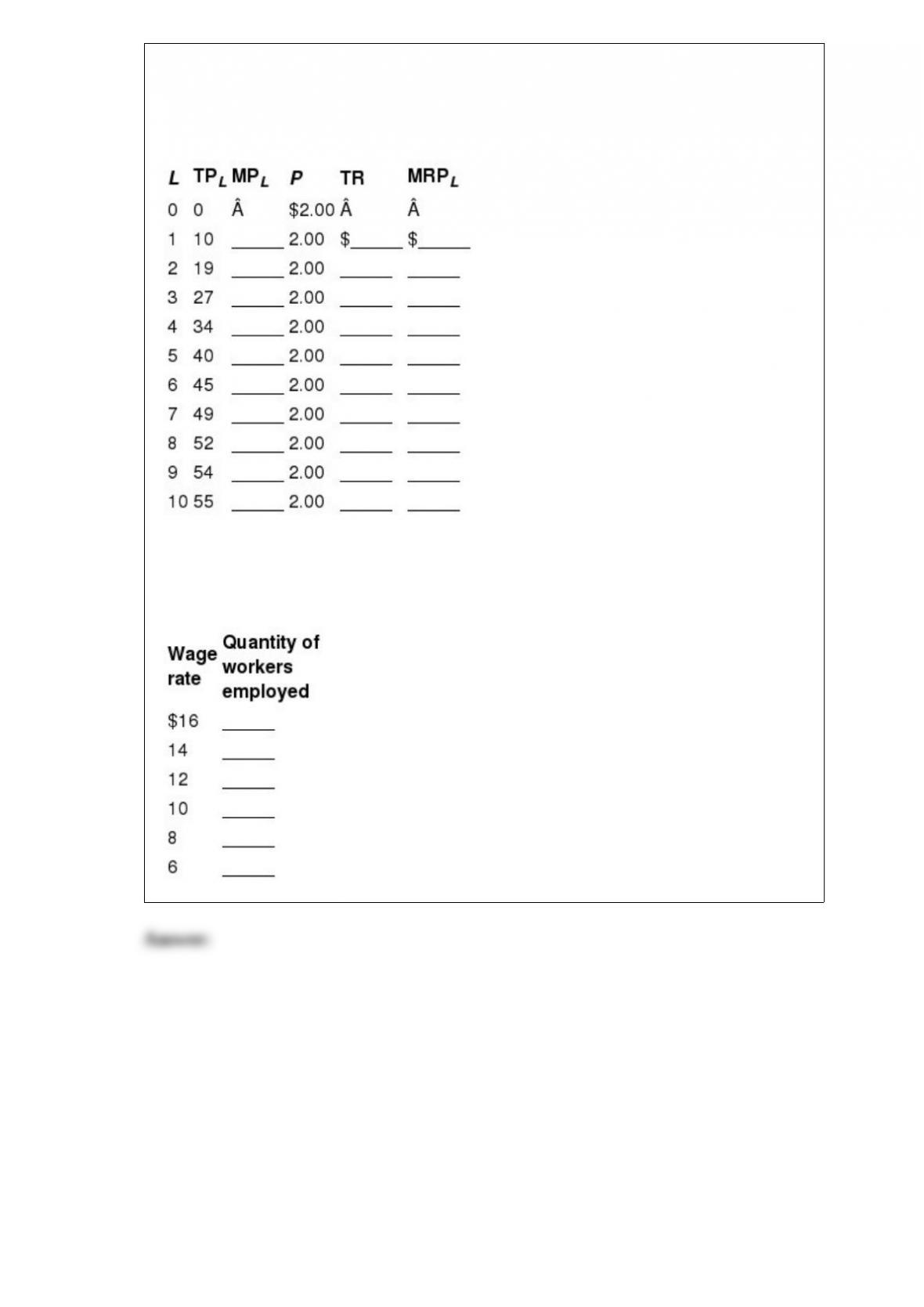
1) Complete the following table, where L is the units of labor, TPL is the total product
of labor, MPL is the marginal product of labor, P is product price, TR is total revenue,
and MRPL is the marginal revenue product of labor.
(a)In what type of market is the firm selling its product? How do you know?
(b)Why does the MRP schedule decrease as labor increases?
(c)Complete the following table.
2)
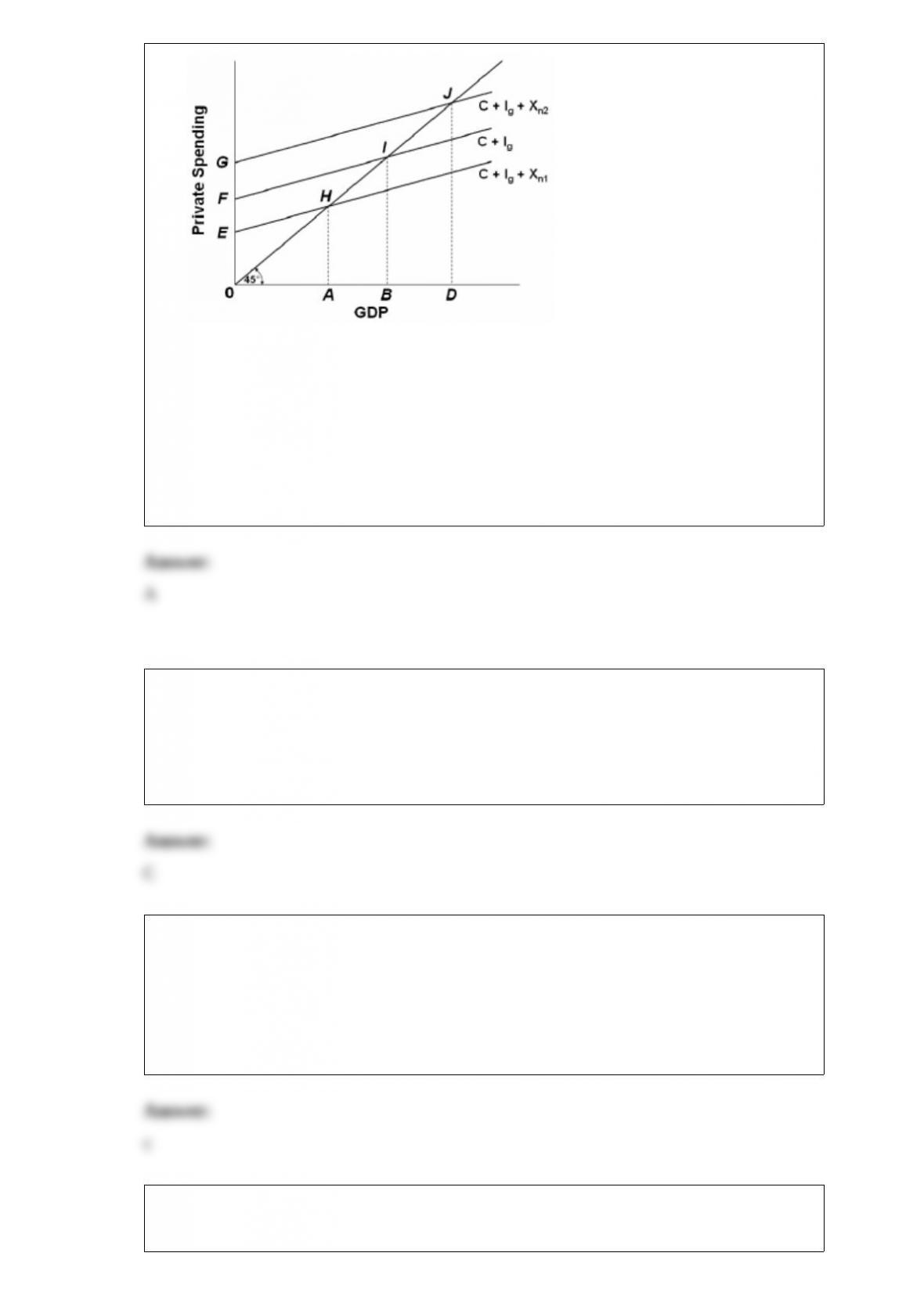
Refer to the above diagram. The change in aggregate expenditures as shown from (C +
Ig + Xn2) to (C + Ig + Xn1) might be caused by:
A.an appreciation of this nation’s currency relative to the currencies of its trading
partners.
B.a depreciation of this nation’s currency relative to the currencies of its trading
partners.
C.a decrease in this nation’s price level relative to price levels abroad.
D. a rightward shift in this nation’s 45-degree line.
3) Private-sector strikes and lockouts typically end because:
A.the Federal government intervenes with a “back-to-work” order.
B.the parties eventually tire of bickering.
C.they are costly in terms of lost profits and lost wage income.
D.the parties rely heavily on outside arbitration.
4) if you receive a gift whose market price is $20, but you consider it to be worth only
$10, then:
a.there is a $10 or 50 percent value gain.
b.there may or may not be a value loss.
c.there is a $10 or 50 percent value loss.
d.you can be relatively certain the giver was a sibling or other close relative.
5) real gdp per capita:
a.cannot grow more rapidly than real gdp.

b.cannot grow more slowly than real gdp.
c.necessarily grows more rapidly than real gdp.
d.can grow either more slowly or more rapidly than real gdp.
6) An exchange rate:
A.is the ratio of the dollar volume of a nation’s exports to the dollar volume of its
imports.
B.measures the interest rate ratios of any two nations.
C.is the amount that one nation must export to obtain $1 worth of imports.
D.is the price at that the currencies of any two nations exchange for one another.
7) Which of the following findings would be the most likely to lead the U.S. Justice
Department to block a corporate merger under terms of the Clayton Act?
A.a buyer-seller relationship between the two firms
B.a high pre-merger Herfindahl index in the industry and a large boost in the index
because of the merger
C.a low pre- and post-merger concentration ratio in the industry
D.evidence that one of the firms is highly unprofitable
8) “too much money chasing too few goods” best describes:
a.the gdp gap.
b.demand-pull inflation.
c.the inflation premium.
d.cost-push inflation.
9) a quasi-public good is:
a.a public good that is produced profitably by private firms, without government
subsidy.
b.one characterized by nonrivalry and nonexcludability.
c.one characterized by rivalry but not excludability.
d.a good for which exclusion could take place but that has such large spillover benefits
that government provides it to prevent an underallocation of resources.

10) suppose a firm in a purely competitive market discovers that the price of its product
is above its minimum avc point but everywhere below atc. given this, the firm:
a.minimizes losses by producing at the minimum point of its avc curve.
b.maximizes profits by producing where mr = atc.
c.should close down immediately.
d.should continue producing in the short run, but leave the industry in the long run if
the situation persists.