
Which of the following is not an example of a transfer payment?
A) unemployment insurance payments
B) health insurance payments to an army private
C) social security payments to retirees
D) social security payments to disabled persons
When the government runs a budget deficit, we would expect to see that
A) private saving will fall.
B) investment will fall.
C) G + TR < T.
D) public saving is positive.
The quantity theory of money predicts that, in the long run, inflation results from the
A) velocity of money growing at a faster rate than real GDP.
B) velocity of money growing at a lower rate than real GDP.
C) money supply growing at a lower rate than real GDP.
D) money supply growing at a faster rate than real GDP.
Most economists believe that the return of ________ during the 2007-2009 recession is
a key reason why the recession was so severe.
A) high tariffs
B) financial instability
C) rapid inflation
D) high interest rates
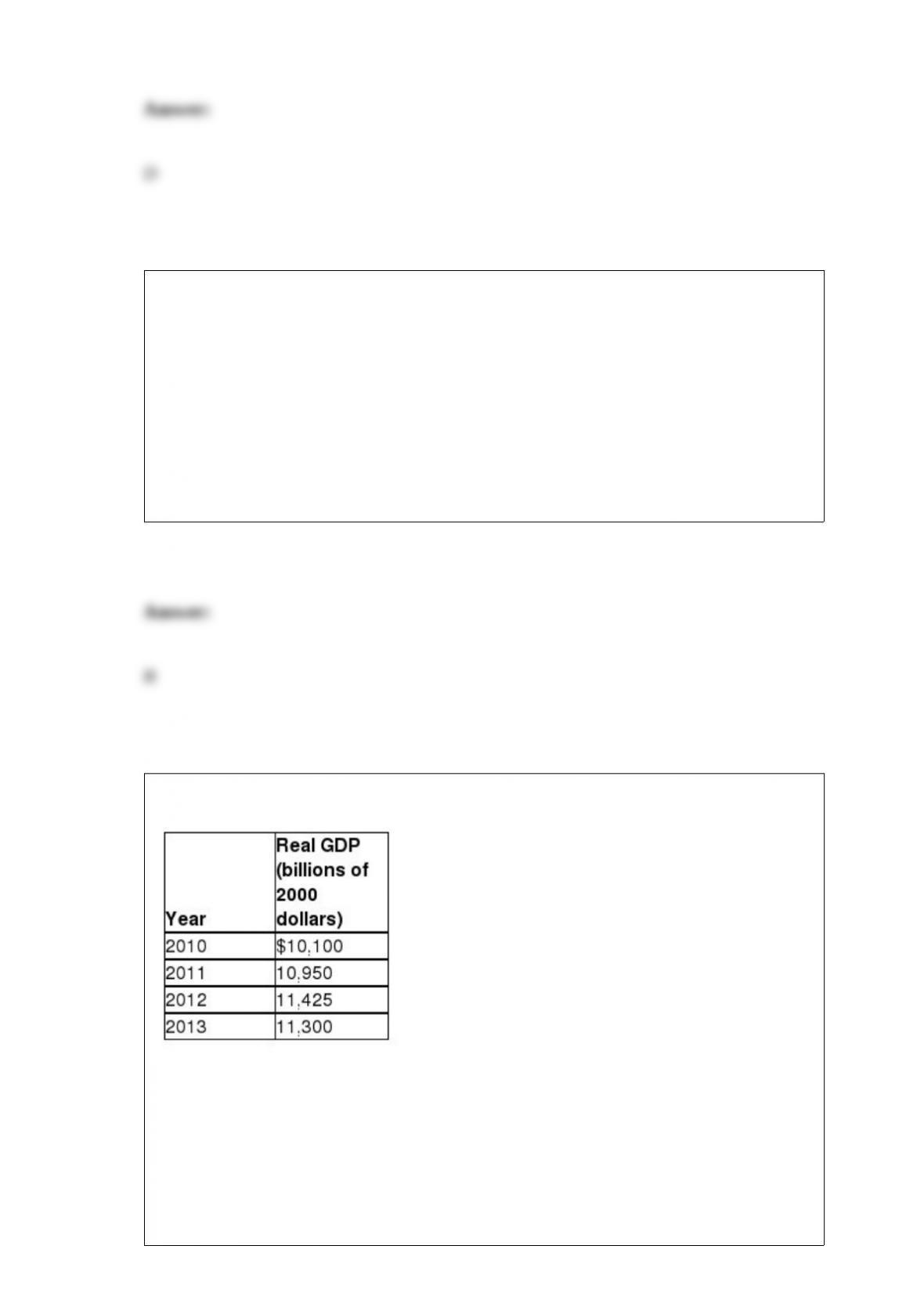
Table 10-2
Refer to Table 10-2. Using the table above, what is the approximate average annual
growth rate from 2010 to 2013?
A) -1%
B) 1%
C) 2%

D) 4%
Under the Bretton Woods exchange rate system, the U.S. government agreed to buy or
sell gold at a fixed price of ________ per ounce.
A) $1
B) $35
C) $100
D) $400
During recessions, government expenditure automatically
A) falls because of programs such as unemployment insurance and Medicaid.
B) rises because of programs such as unemployment insurance and Medicaid.
C) falls because of the progressive income tax system.
D) rises because of the progressive income tax system.

A supply curve shows
A) the quantities sold at different prices.
B) the marginal cost of producing one more unit of a good or service.
C) the marginal benefit from buying one more unit of a good or service.
D) the total cost of producing different quantities of a good or service.
Two actions by the Fed during Alan Greenspan’s term as chairman have been identified
as possibly contributing to the financial crisis in 2008. Which of the following was one
of those actions?
A) decreasing the money supply to fight the possibility of disinflation
B) the decision to keep the federal funds rate at 1 percent from June 2003 to June 2004
C) working in concert with the European Central Bank to stabilize the dollar / euro
exchange rate
D) financing the first Gulf War by printing money and generating rapid inflation
Figure 13-4
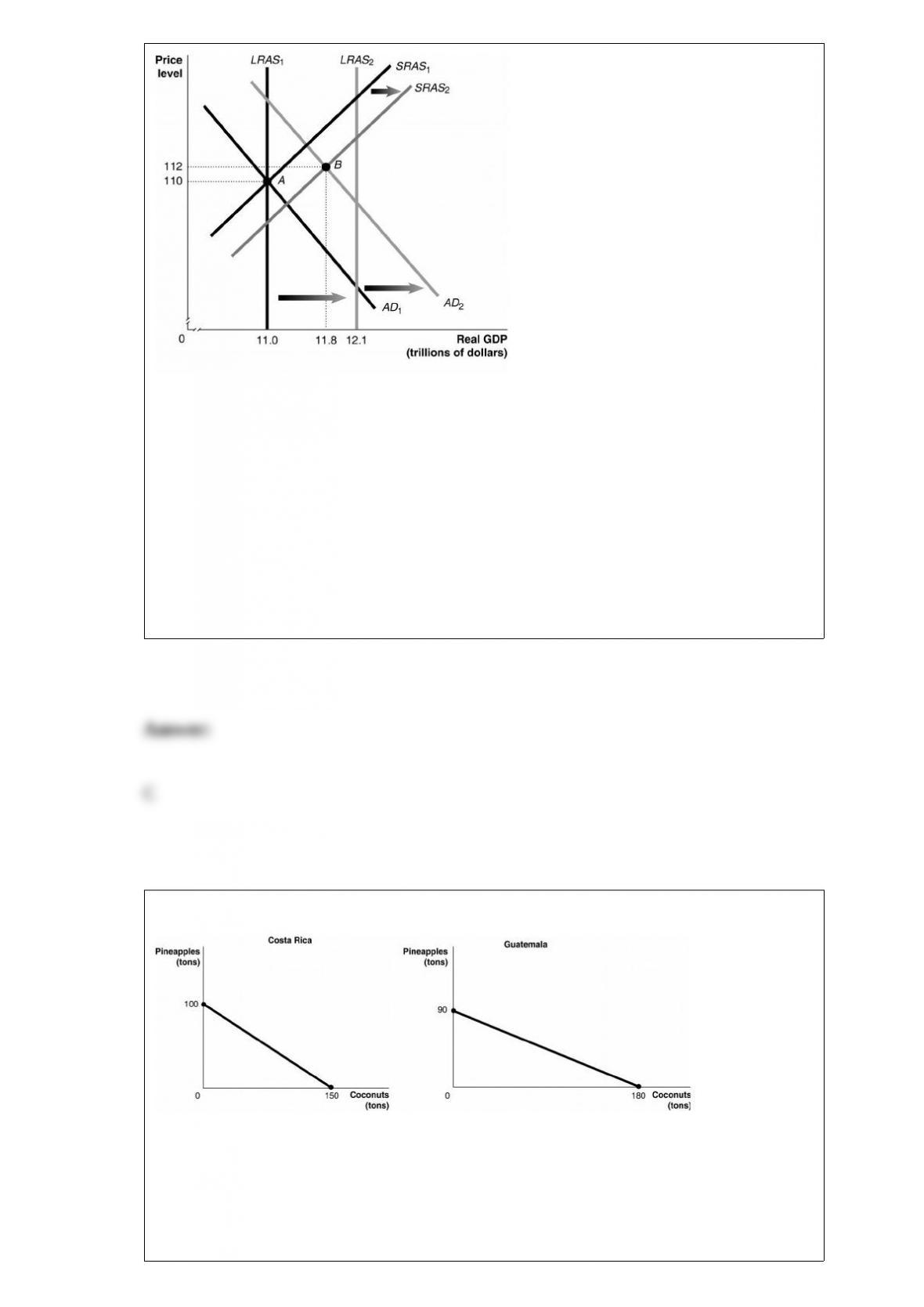
Refer to Figure 13-4. Given the economy is at point A in year 1, what is the difference
between the actual growth rate in GDP in year 2 and the potential growth rate in GDP in
year 2?
A) 0.3%
B) 1.1%
C) 2.7%
D) 3.7%
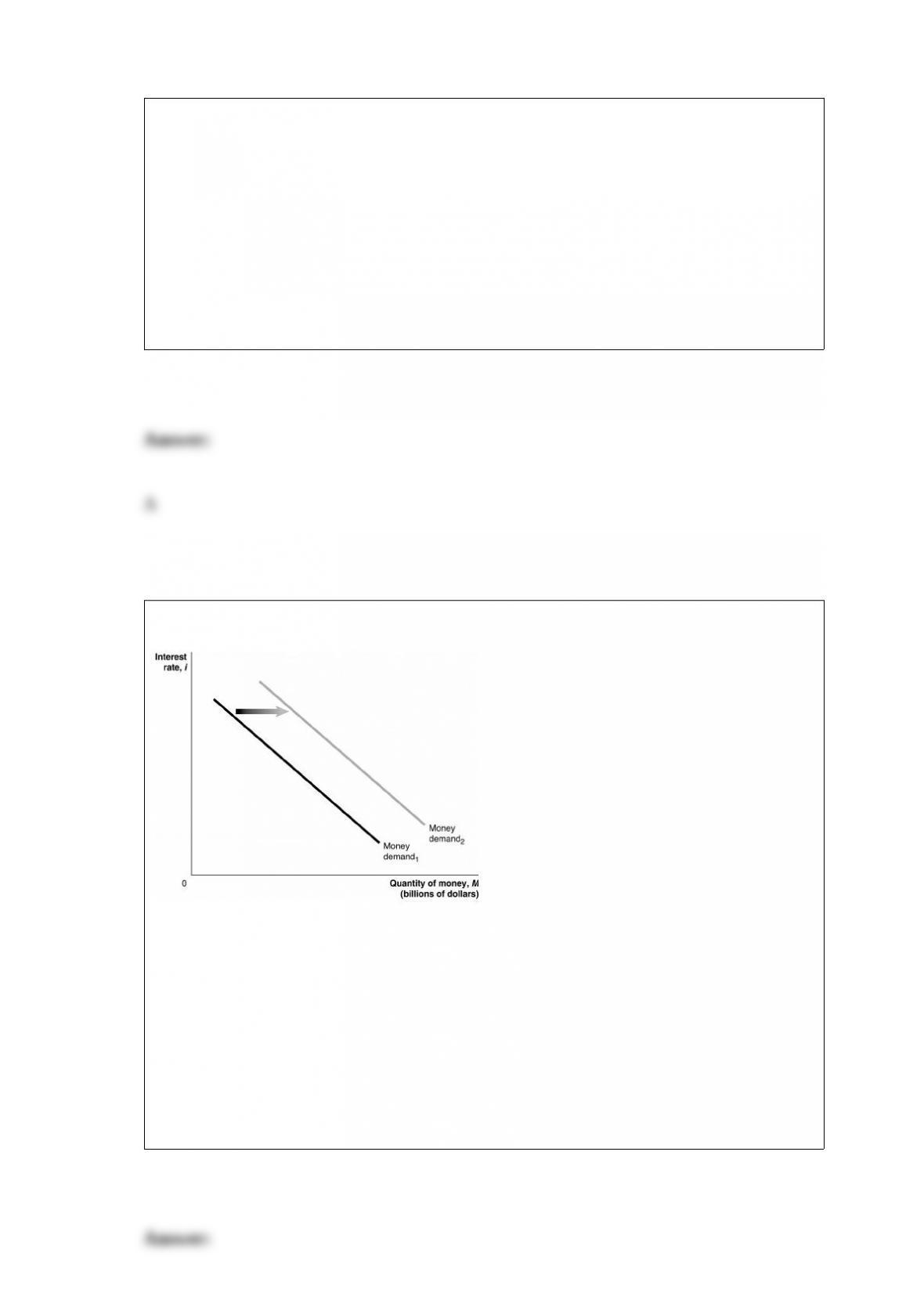
Figure 2-8
Figure 2-8 shows the production possibilities frontiers for Costa Rica and Guatemala.
Each country produces two goods, pineapples and coconuts.
Refer to Figure 2-8. What is the opportunity cost of producing 1 ton of coconuts in
Guatemala?

A) 1/2 of a ton of pineapples
B) 1 1/3 tons of pineapples
C) 2 tons of pineapples
D) 90 tons of pineapples
When aggregate expenditure = GDP,
A) macroeconomic equilibrium occurs.
B) the federal budget is balanced.
C) net exports equal zero.
D) saving equals zero.
The labor force participation rate is defined as
A) the percentage of the working-age population that is employed.
B) the percentage of the working-age population that is unemployed.
C) the percentage of the labor force that is employed.
D) the percentage of the labor force that is unemployed.
E) the percentage of the working-age population in the labor force.

Why does the short-run aggregate supply curve shift to the left in the long run,
following an increase in aggregate demand?
A) Workers and firms adjust their expectations of wages and prices downward and they
accept lower wages and prices.
B) Workers and firms adjust their expectations of wages and prices downward and they
push for higher wages and prices.
C) Workers and firms adjust their expectations of wages and prices upward and they
push for higher wages and prices.
D) Workers and firms adjust their expectations of wages and prices upward and they
accept lower wages and prices.
A consequence of increasing marginal costs of producing laptop computers in the
United States is
A) the United States will import laptop computers from countries that don’t experience
increasing marginal costs.
B) the United States will stop short of complete specialization in the production of
laptop computers.
C) the United States will not export laptop computers.
D) the United States will likely impose trade restrictions on imported laptop computers.

The crowding out of private spending by government spending will be greater the
A) less sensitive consumption, investment, and net exports are to changes in interest
rates.
B) more sensitive consumption, investment, and net exports are to changes in interest
rates.
C) less sensitive consumption, investment, and net exports are to changes in the price
level.
D) more sensitive consumption, investment, and net exports are to changes in the price
level.
In preparing their estimates of the stimulus package’s effect on GDP, Obama
administration economists estimated a government purchases multiplier of 1.57. This
indicates that a $1 billion increase in government purchases would increase equilibrium
real GDP by
A) $1 billion.
B) $1.57 billion.
C) $15.7 billion.
D) $157 billion.
The experience of Paul Volcker’s fight against inflation during the late 1970s and early
1980s indicates that firms and workers
A) had adaptive expectations.
B) had rational expectations and that they trusted Fed announcements.
C) preferred high unemployment to high inflation.
D) Both A and B are correct answers.
Figure 15-1
Refer to Figure 15-1. In the figure, the money demand curve would move from Money
demand1 to Money demand2 if
A) real GDP increased.
B) the price level decreased.
C) the interest rate increased.
D) the Federal Reserve sold Treasury securities.

In 2012, global profits for McDonald’s increased by 6.3 percent when measured in local
currencies, but fell by 0.7 percent when measured in dollars. The reason for this
discrepancy is the value of the
A) euro decreased relative to the British pound.
B) British pound increased relative to the U.S. dollar.
C) U.S. dollar increased relative to most other currencies.
D) U.S. dollar decreased relative to the Japanese yen.