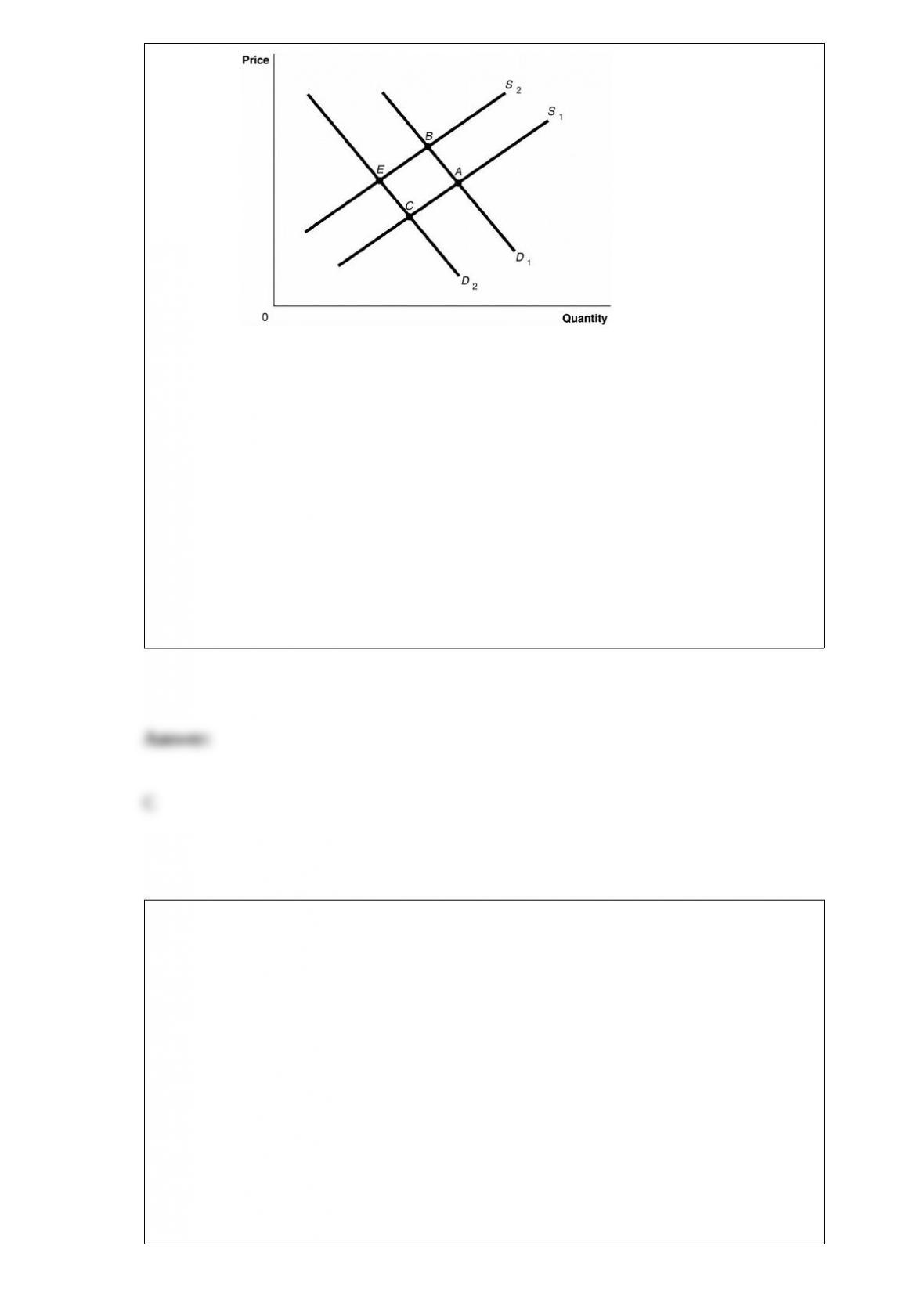
Figure 3-8
The graph in this figure illustrates an initial competitive equilibrium in the market for
motorcycles at the intersection of D1 and S2 (point B). If there is an increase in number
of companies producing motorcycles and a decrease in income (assume motorcycles are
a normal good), the equilibrium could move to which point?
A) A
B) B
C) C
D) E
Suppose that in Vietnam, a worker can produce either 16 units of cloth or 2 bicycles,
while in China, a worker can produce either 20 units of cloth or 5 bicycles.
a. Which country has an absolute advantage in cloth production? In bicycle production?
b. What is the opportunity cost of 1 unit of cloth in Vietnam? In China?
c. What is the opportunity cost of 1 bicycle in Vietnam? In China?
d. Which country has a comparative advantage in cloth production? In bicycle
production?
e. Suppose each country has 1,000 workers. Currently, each country devotes 40 percent
of its labor force to cloth production and 60 percent to bicycle production. What is the
output of cloth and bicycles for each country and what is the total output of cloth and
bicycles between the two countries?
f. Suppose each country specializes in the production of the good in which it has a
comparative advantage. What is the total output of cloth and bicycles in the two
countries?
g. Provide a numerical example to show how Vietnam and China can both gain from
trade. Assume that the terms of trade are established at 6 units of cloth for 1 bicycle.
When the federal government orders firms to use particular methods to reduce
pollution, it is said to be using
A) command-and-control policies.
B) strong-arm tactics.
C) global initiatives.
D) market-based policies.
________ consumption is consumption that depends upon the level of GDP and
________ consumption is consumption that does not depend upon the level of GDP.
A) Autonomous; induced
B) Induced; autonomous
C) Voluntary; autonomous

D) Autonomous; voluntary
What must balance on a balance sheet?
A) Total assets must equal total liabilities plus equity.
B) Revenues must equal costs.
C) Retained earnings plus dividends paid must equal earnings per share.
D) All of these must balance.
All of the following are components of aggregate expenditure except
A) consumption spending.
B) net export spending.
C) actual investment spending.
D) government spending.

In 1973, the Club of Rome published a book titled The Limits to Growth, which
predicted that economic growth would likely end in high-income countries because of
A) declining populations.
B) rapid increases in government debt.
C) increases in outsourcing of the production of goods and services to low-income
countries.
D) increasing pollution and the depletion of natural resources.
The price of wheat has fallen since 1950. Which of the following explains this price
decline?
A) The price elasticity of demand is less than 1 (in absolute value), and the income
elasticity of demand for wheat is low.
B) The price elasticity of demand is greater than 1 (in absolute value), and the income
elasticity of demand for wheat is low.
C) The price elasticity of demand is less than 1 (in absolute value), and wheat is an
inferior good.
D) The price elasticity of demand is greater than 1 (in absolute value), and the income
elasticity of demand for wheat is greater than 1.

For a monopolistically competitive firm, marginal revenue
A) equals the price.
B) is greater than the price.
C) is less than the price.
D) and price are unrelated.
A member of a corporate board of directors that is also a manager of the business is
known as
A) a shareholder.
B) an inside director.
C) a partner.
D) a corporate governor.
When Tesla, a U.S. company, purchases Italian-made Pirelli tires for its automobiles,
the purchase is
A) both a U.S. and an Italian import.
B) a U.S. import and an Italian export.
C) a U.S. export and an Italian import.
D) neither an export nor an import for either country.
What actions could the Federal Reserve take to achieve consistent growth in real GDP
at 4 percent per year?
A) The Fed could increase in the growth rate of the money supply by 1% each year
until the inflation rate was exactly equal to 4 percent.
B) The Fed could maintain a growth rate of the money supply of 4 percent, regardless
of whether inflation was rising or falling in the economy.
C) The Fed could follow contractionary monetary policy that would reduce the federal
funds rate to zero so investment will rise consistently.
D) The Fed has no direct control over real GDP in the long run, so there are no actions
it could take to achieve that goal.
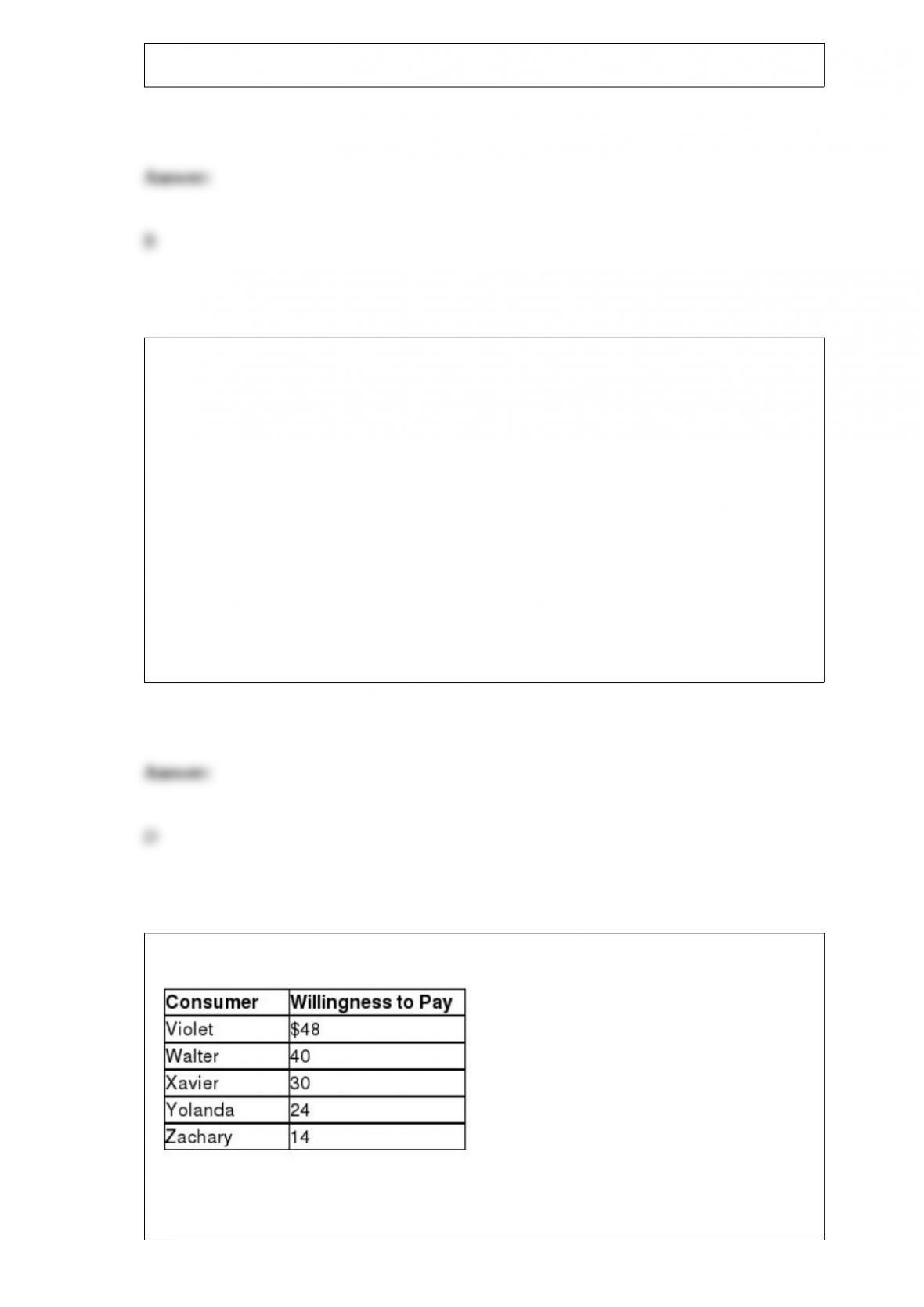
Table 4-2
The table above lists the highest prices five consumers are willing to pay for a concert
ticket. If the price of one of the tickets is $36

A) Violet and Walter will each buy two tickets.
B) Walter will receive $4 of consumer surplus from buying one ticket.
C) Violet and Walter receive a total of $52 of consumer surplus from buying one ticket
each. No one else will buy a ticket.
D) Xavier, Yolanda, and Zachary will receive a total of $68 of consumer surplus since
they will buy no tickets.