
AA Appliances sells refrigerators. In 2015 it added $100,000 to its inventory. $10,000
of this addition was from used refrigerators, and the remaining $90,000 was from their
purchases of newly manufactured refrigerators. How much of AA’s inventory is
included in 2015 GDP?
a. $0
b. $10,000
c. $90,000
d. $100,000
The long-run Phillips curve is consistent with monetary neutrality implied by the
classical dichotomy.
a. True
b. False
In 2009, based on concepts similar to those used to estimate U.S. employment figures,
the Swedish adult non- institutionalized population was 7.568 million, the labor force
was 4.888 million, and the number of people employed was 4.486 million. According to
these numbers, the Swedish labor-force participation rate and unemployment rate were
about
a. 64.6% and 8.2%.

b. 64.6% and 5.3%.
c. 59.3% and 8.2%.
d. 59.3% and 5.3%.
Suppose that an increased risk of mortgage defaults lowers the expected profitability of
banks. Then we would expect to see
a. the demand for bank stocks rise which would raise the prices of bank stocks.
b. the demand for bank stocks rise which would reduce the prices of bank stocks.
c. the demand for bank stocks fall which would raise the prices of bank stocks.
d. the demand for bank stocks fall which would reduce the prices of bank stocks.
Kyle puts a greater proportion of his portfolio into government bonds. Kyle’s action
a. increases both risk and the average rate of return.
b. decreases both risk and the average rate of return.
c. increases risk, but decreases the average rate of return.
d. decreases risk, but increases the average rate of return.

Policies such as rent control and trade barriers persist
a. because economists are about evenly divided as to the merits of those policies.
b. because almost all economists agree that those policies have no discernible economic
effects.
c. because almost all economists agree that those policies are desirable.
d. despite the fact that almost all economists agree that those policies are undesirable.
Some economists argue that
a. monetary policy should actively be used to stabilize the economy.
b. fiscal policy should actively be used to stabilize the economy.
c. fiscal policy can be used to shift the ADcurve.
d. All of the above are correct.
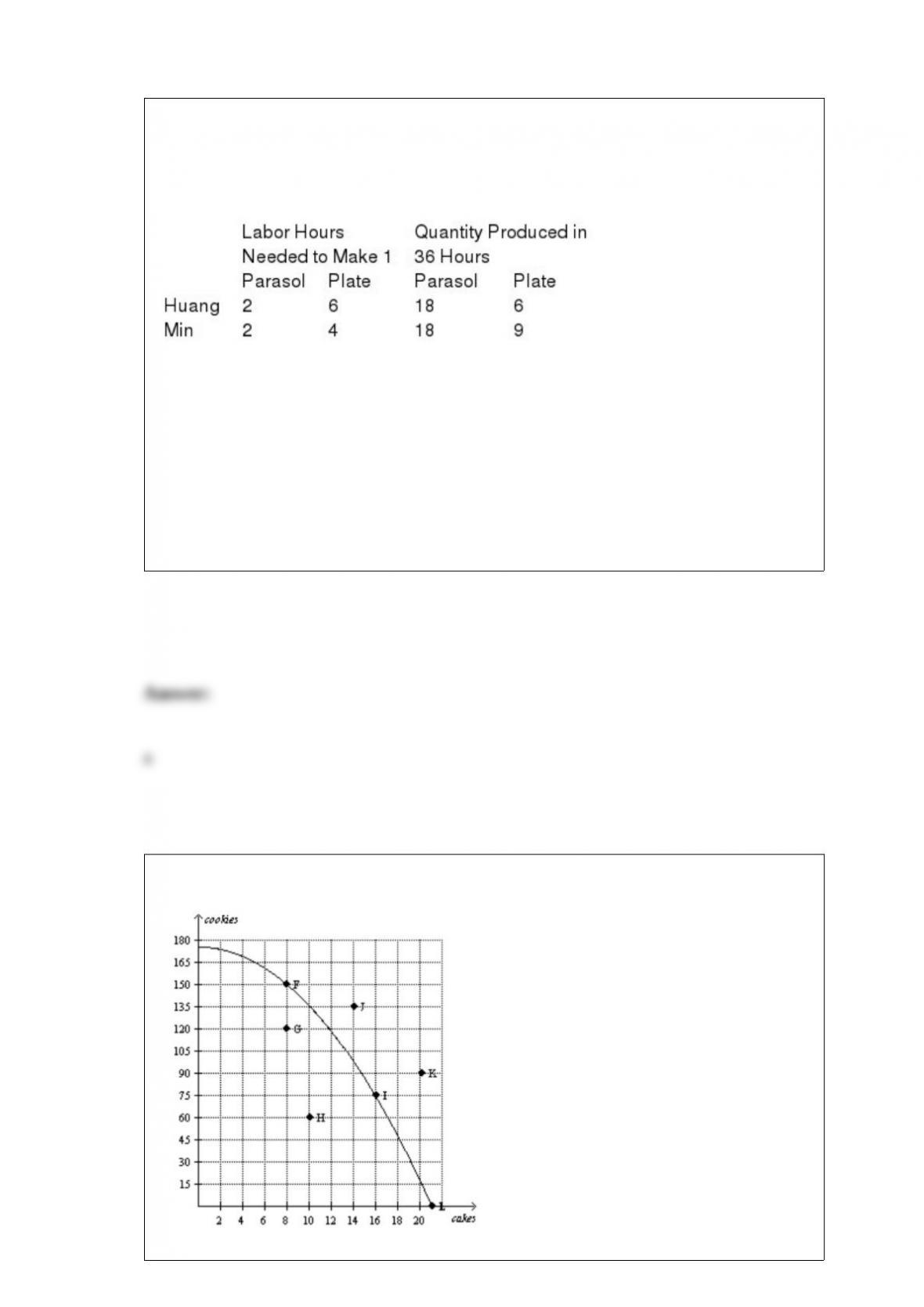
Table 3-27
Assume that Huang and Min can switch between producing parasols and producing
porcelain plates at a constant rate.
RefertoTable3-27.Min has an absolute advantage in the production of
a. plates and a comparative advantage in the production of plates.
b. parasols and a comparative advantage in the production of plates.
c. neither good and a comparative advantage in the production of parasols.
d. neither good and a comparative advantage in the production of plates.
Figure 2-13

RefertoFigure2-13. One difference between points F and G is that
a. Point G is unattainable with current resources, but point F is attainable.
b. All resources are fully employed at point F but there is unemployment at point G.
c. More output can be produced at point F but no additional output can be produced at
point G.
d. This economy produces more cookies at point G than at point F.
Other things the same, when the government spends more, the initial effect is that
a. aggregate demand shifts right.
b. aggregate demand shifts left.
c. aggregate supply shifts right.
d. aggregate supply shifts left.
Which of the following questions is more likely to be studied by a microeconomist than
a macroeconomist?
a. Why do prices in general rise by more in some countries than in others?
b. Why do wages differ across industries?

c. Why do national production and income increase in some periods and not in others?
d. How rapidly is GDP currently increasing?
The federal funds rate is a long-term interest rate banks charge one another for loans.
a. True
b. False
A mutual fund
a. is a financial market where small firms mutually agree to sell stocks and bonds to
raise funds.
b. is funds set aside by local governments to lend to small firms who want to invest in
projects that are mutually beneficial to the firm and community.
c. sells stocks and bonds on behalf of small and less known firms who would otherwise
have to pay high interest to obtain credit.
d. is an institution that sells shares to the public and uses the proceeds to buy a selection
of various types of stocks, bonds, or both stocks and bonds.

According to the rule of 70, if the interest rate is 5 percent, how long will it take for the
value of a savings account to double?
a. about 3.5 years
b. about 6.3 years
c. about 12 years
d. about 14 years
Other things the same, a fall in an economy’s overall level of prices tends to
a. raise both the quantity demanded and supplied of goods and services.
b. raise the quantity demanded of goods and services, but lower the quantity supplied.
c. lower the quantity demanded of goods and services, but raise the quantity supplied.
d. lower both the quantity demanded and the quantity supplied of goods and services.

Which of the following is notcorrect?
a. China allows only one child per family and couples that violate this rule are subject
to substantial fines.
b. In developed countries, population growth is consistently about 3 percent per year; in
developing countries it is consistently about 5 percent per year.
c. Educational attainment tends to be lowest in countries with the highest population
growth.
d. Economists generally believe that a country that decreases a high population growth
rate can increase its economic growth rate.
Which of the following is notan argument by those who oppose tax-law changes to
encourage saving?
a. Saving is not very responsive to changes in the tax rate.
b. Saving is not an important determinant of a nation’s ability to produce output.
c. Reducing the budget deficit instead of changing the tax laws could raise saving.
d. Changes in the tax laws to induce saving would distribute the tax burden less fairly.
Providing training for unemployed individuals is primarily intended to reduce
a. frictional unemployment.

b. seasonal unemployment.
c. structural unemployment.
d. cyclical unemployment.
Credit cards
a. represent the largest component of M1.
b. are not included in M1 but are included in M2.
c. are a form of money unique to the U.S.
d. are not considered money.
In the open-economy macroeconomic model, if a country’s interest rate rises, its net
capital outflow
a. rises and the real exchange rate rises.
b. falls and the real exchange rate falls.
c. rises and the real exchange rate falls.
d. falls and the real exchange rate rises.

In the early 1980s, U.S. economic policy was directed toward reducing inflation. What
would you have expected to observe during this short period of time?
a. Inflation fell and unemployment fell.
b. Inflation and unemployment were both unaffected.
c. Inflation fell and unemployment increased.
d. Inflation fell and unemployment was unchanged.
Demand refers to the amount buyers wish to buy, whereas the quantity demanded refers
to the position of the demand curve.
a. True
b. False

Table 3-15
Refer to Table3-15. Which of the following combinations of meat and potatoes could
the rancher not produce in 40 hours?
a. 2 pounds of meat and 3 pounds of potatoes.
b. 3 pounds of meat and 3 pounds of potatoes.
c. 4 pounds of meat and 2 pounds of potatoes.
d. 5 pounds of meat and 2 pound of potatoes.
The argument that purchases of minivans cause large families is an example of
a. omitted variables.
b. normative statements.
c. reverse causality.
d. bias.
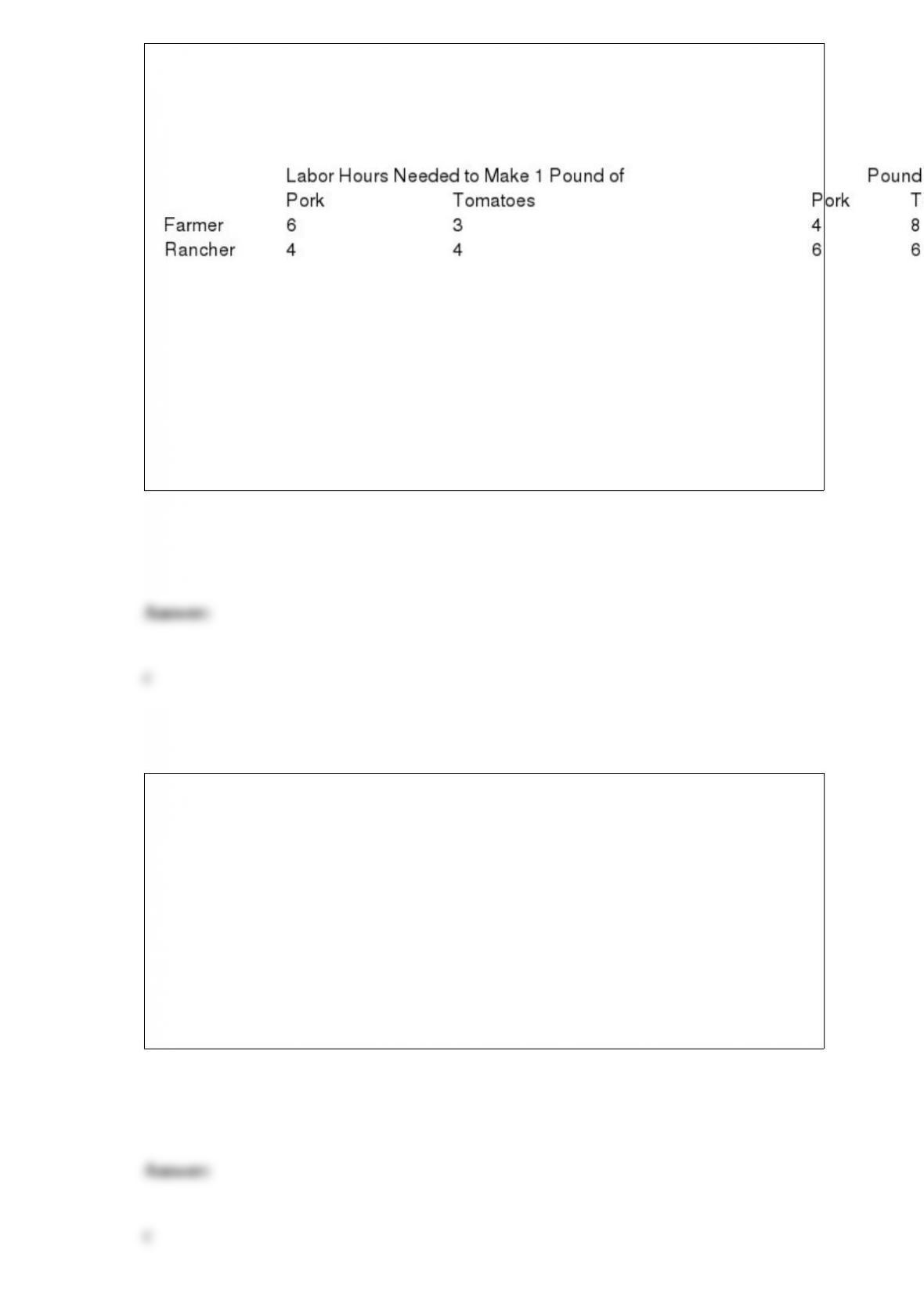
Table 3-23
Assume that the farmer and the rancher can switch between producing pork and
producing tomatoes at a constant rate.
RefertoTable3-23. The opportunity cost of 1 pound of pork for the farmer is
a. 1/2 pound of tomatoes.
b. 1/2 hour of labor.
c. 2 pounds of tomatoes.
d. 2 hours of labor.
Kaitlyn purchased one share of Northwest Energy stock for $200; one year later she
sold that share for $400. The inflation rate over the year was 50 percent. The tax rate on
nominal capital gains is 50 percent. What was the tax on Kaitlyn’s capital gain?
a. $50
b. $75
c. $100
d. $200

If the sacrifice ratio is 2, reducing the inflation rate from 4 percent to 2 percent would
a. cost 1 percent of annual output.
b. cost 4 percent of annual output.
c. imply that unemployment would rise by 1%.
d. imply that unemployment would rise by 4%.
Recent forest fires in the western states are expected to cause the price of lumber to rise
in the next six months. As a result, we can expect the supply of lumber to
a. fall in six months but not now.
b. increase in six months when the price goes up.
c. fall now.
d. increase now to meet as much demand as possible.
A painter pays $500 for paint he uses to repaint a house. He then presents a bill for
$1200 that covers his time and expenses to the homeowner. How much do these
transactions add to GDP?

a. $500
b. $700
c. $1200
d. $1700
Hector puts $150 into an account when the interest rate is 4 percent. Later he checks his
balance and finds he has about $168.73. How long did Hector wait to check his
balance?
a. 3 years
b. 3.5 years
c. 4 years
d. 4.5 years
The primary focus of the open-economy macroeconomic model is the determination of
GDP and the price level.
a. True
b. False

In 2014, a farmer grows and sells $3 million worth of corn to Big Flakes Cereal
Company. Big Flakes Cereal Company produces $8 million worth of cereal in 2014,
with sales to households during the year of $7 million. The unsold $1 million worth of
cereal remains in Big Flake Cereal Company’s inventory at the end of 2014. The
transactions just described contribute how much to GDP for 2014?
a. $3 million
b. $7 million
c. $8 million
d. $11 million
You have a choice among three options. Option 1: receive $900 immediately. Option 2:
receive $1,200 one year from now. Option 3: receive $2,000 five years from now. The
interest rate is 15 percent. Rank these three options from highest present value to lowest
present value.
a. Option 1; Option 2; Option 3
b. Option 3; Option 2; Option 1
c. Option 2; Option 3; Option 1
d. Option 3; Option 1; Option 2

Net capital outflow measures the imbalance between the amount of
a. foreign assets held by domestic residents and domestic assets held by foreign
residents.
b. foreign assets bought by domestic residents and the amount of domestic assets
bought by foreigners.
c. foreign assets bought by domestic residents and the amount of domestic goods and
services sold to foreigners.
d. None of the above is correct.