
Which of the following is the best example of a monopoly?
a. a local public utility
b. a fast-food restaurant
c. a department store
d. a wheat farmer
Concentration ratios are used to determine
a. the number of firms in an industry.
b. the potential for entry into an industry.
c. the degree of product differentiation.
d. the extent (degree) of oligopoly.
e. none of the above
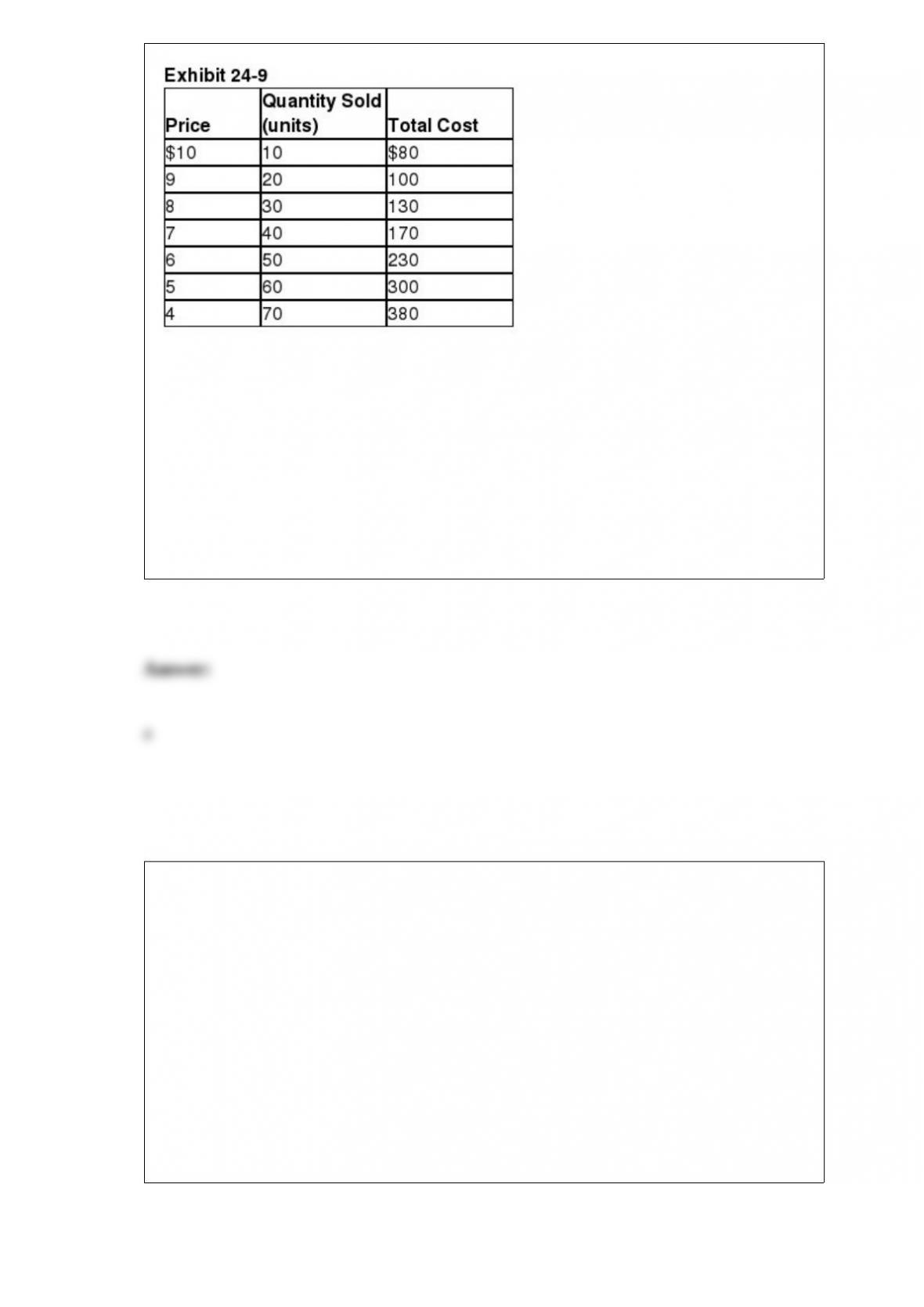
Refer to Exhibit 24-9. Assuming that the firm is maximizing profits, the marginal cost
of the last unit produced equals
a. $4.
b. $40.
c. $5.
d. $50.
e. $6.
The disagreement between A. C. Pigou and Ronald Coase arose because
a. Pigou argued that the government should ban all externality-generating activities,
while Coase thought that taxes and subsidies should be used instead.
b. Coase argued that the government should ban all externality-generating activities,
while Pigou thought that taxes and subsidies should be used instead.
c. Pigou argued that the government should use taxes and subsidies to adjust for
externalities, while Coase proposed a market solution to the externality problem.
d. Coase argued that the government should use taxes and subsidies to adjust for
externalities, while Pigou proposed a market solution to the externality problem.

An economist says, “Technological advances have the power to lower the prices of
many of the goods we buy.” Here is how this works:
a. Technological advances lead to lower demand, which leads to lower prices.
b. Technological advances lead to greater supply, which leads to lower prices.
c. Technological advances lead to greater quantity supplied, which leads to lower
prices.
d. Technological advances lead to lower taxes, which lead to greater supply, which
leads to lower prices.
e. Technological advances lead to higher taxes, which lead to fewer subsidies, which
lead to greater supply, which leads to lower prices.
Resource allocative efficiency exists for a perfectly competitive firm because
a. price equals marginal revenue and the firm equates marginal revenue and marginal
cost to maximize profits.
b. price equals average total cost and the firm equates marginal revenue and average
total cost to maximize profits.
c. price is greater than marginal revenue and the firm equates marginal revenue with
average total cost to maximize profits.
d. price is less than marginal revenue and the firm equates marginal cost and marginal
revenue to maximize profits.
e. none of the above

If there is a negative externality, and the market output is 100 units more than the
socially optimal output, then it follows that
a. the external costs associated with the negative externality are greater than the
marginal private costs.
b. the external costs associated with the negative externality are less than the marginal
private costs.
c. there is market failure.
d. any tax imposed on the production of the output will bring about the socially optimal
output.
e. none of the above
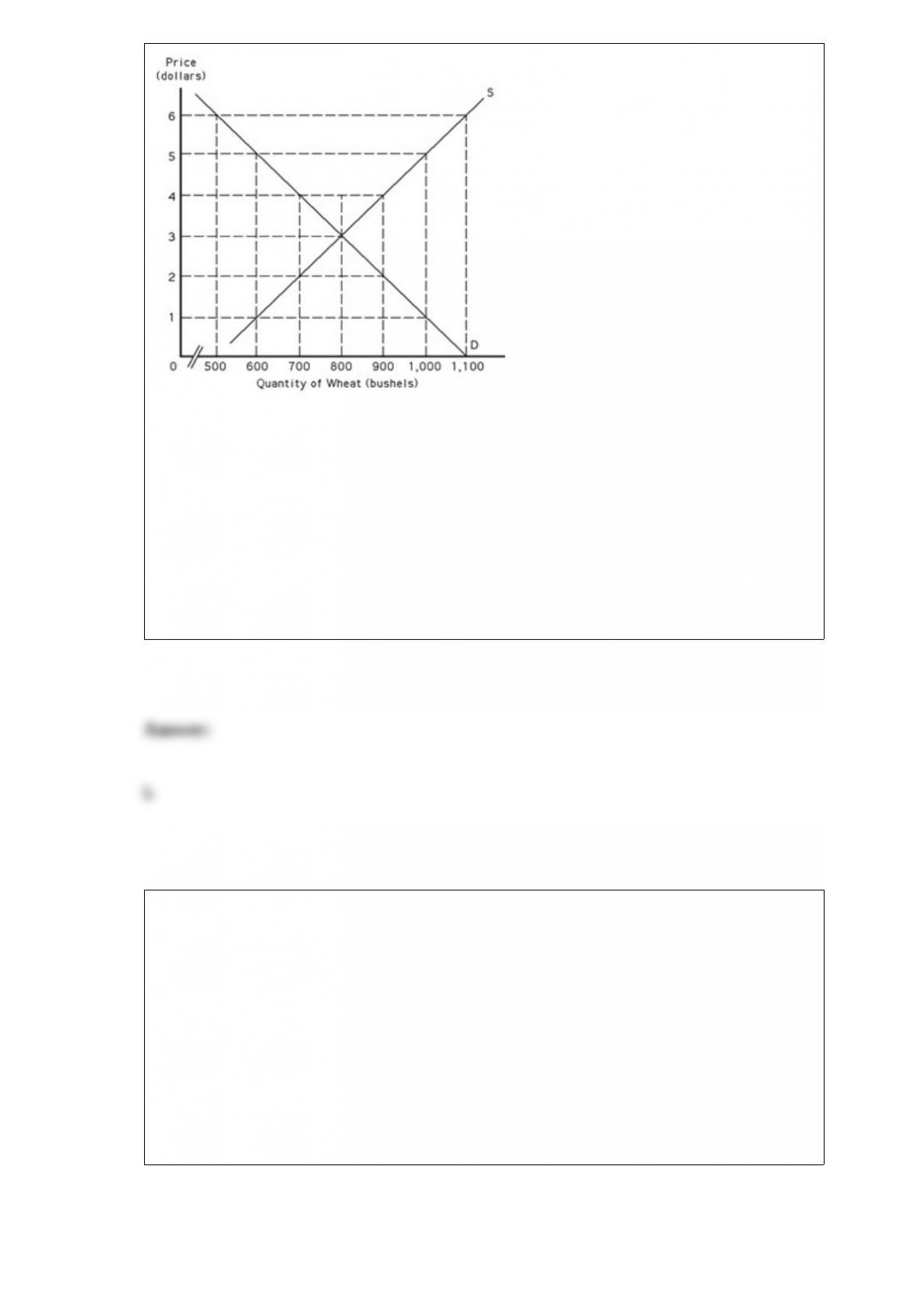
Refer to Exhibit 39-4. The price support of $6 per bushel results in private citizens
spending __________ on wheat.
Exhibit 39-4
a. $600
b. $3,000
c. $3,600
d. $4,800
e. $6,600
If a demand curve is a straight downward sloping line, demand is
a. unit elastic.
b. elastic.
c. inelastic.
d. perfectly inelastic.
e. There is not enough information to answer the question.

If a production possibilities frontier (PPF) is concave outward, it follows that
a. opportunity costs are constant between two goods.
b. the opportunity cost (of producing the good on the horizontal axis) rises as more of
the good is produced.
c. the opportunity cost (of producing the good on the horizontal axis) falls as more of
the good is produced.
d. the opportunity cost (of producing the good on the horizontal axis) first rises and then
falls as more of the good is produced.
e. none of the above
When an economist talks about utility, she is talking about
a. a company that provides electricity, water, gas, etc.
b. the satisfaction, in terms of price, that a producer receives from selling his product.
c. the satisfaction that results from the consumption of a good.
d. the amount of one good that a person is willing to give up in order to get a unit of
another good.
e. the satisfaction that results from the consumption of a good minus the price that must
be paid to get the good.

The yield on a bond is the
a. annual coupon payment divided by the price paid for the bond.
b. coupon rate divided by the price paid for the bond.
c. annual coupon payment divided by the face value of the bond.
d. same as the interest rate on the bond.
e. a and d
The concentration ratio provides a measure of the extent to which an industry
a. produces a useful product.
b. is dominated by a small number of firms.
c. is earning economic profits.
d. is earning accounting profits.

A single buyer in a factor market is known as a
a. monopoly.
b. monopsony.
c. oligopsony.
d. pure buyer.
In maximizing profits, a single-price monopolist will charge a price that is
a. less than marginal cost.
b. equal to marginal cost.
c. greater than marginal cost.
d. There is not enough information to answer the question.
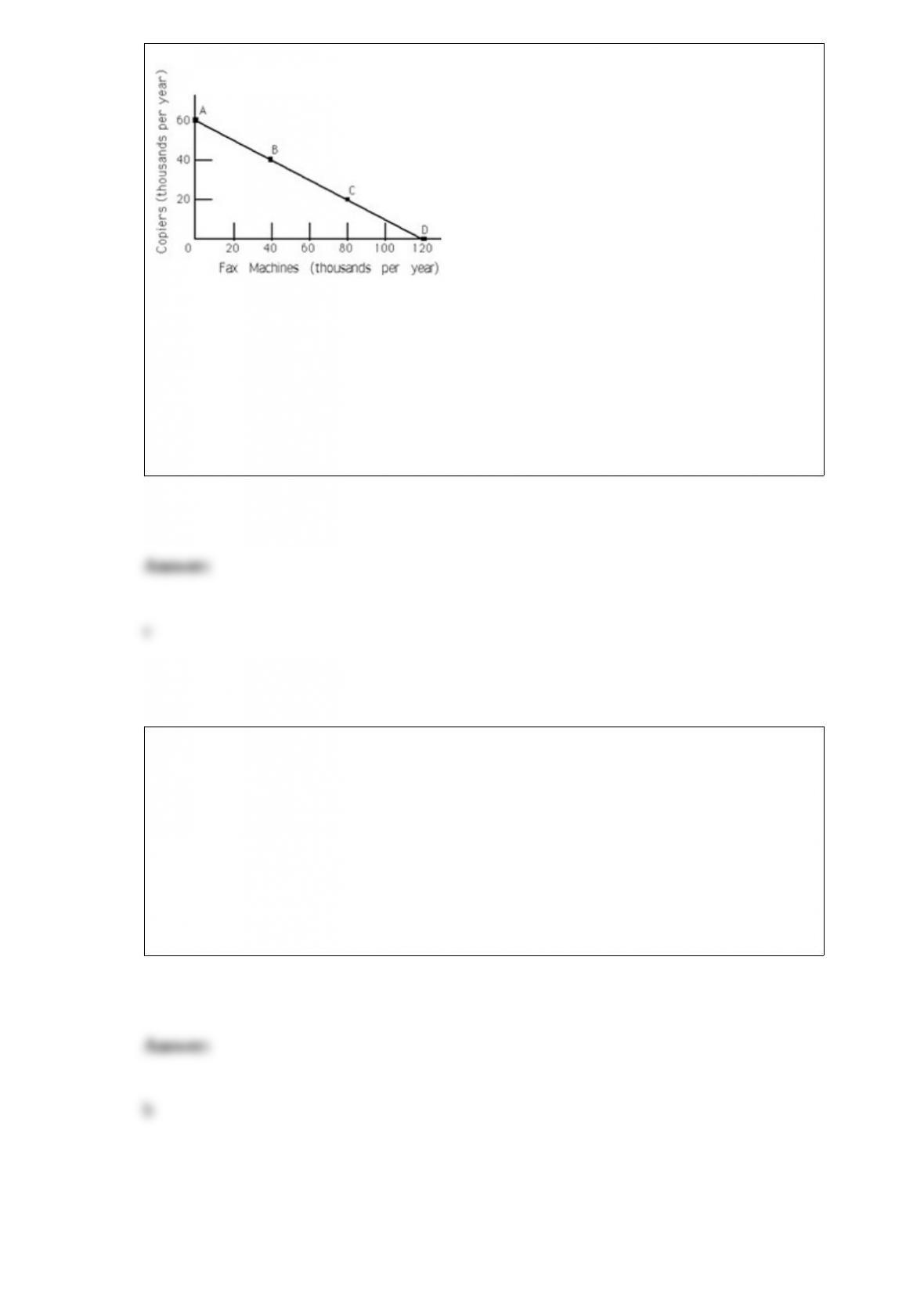
Refer to Exhibit 2-4. The opportunity cost of moving from point A to point B is
Exhibit 2-4
a. 60,000 copiers.
b. 40,000 copiers.
c. 20,000 copiers.
d. 20,000 fax machines.
e. 40,000 fax machines.
A firm obeys the least-cost rule for factors X and Y by equating
a. MRPx to MRPy.
b. MPPx/Px to MPPy/Py.
c. Px/MPPx to Py/MPPy.
d. MFCx to MFCy.
If the demand for a good is currently elastic, then
a. the percentage change in quantity demanded of the good is greater than the
percentage change in price of the good.
b. the percentage change in quantity demanded of the good is less than the percentage
change in price of the good.
c. the percentage change in quantity demanded of the good is equal to the percentage
change in price of the good.
d. quantity demanded of the good is not responsive to changes in the price of the good.
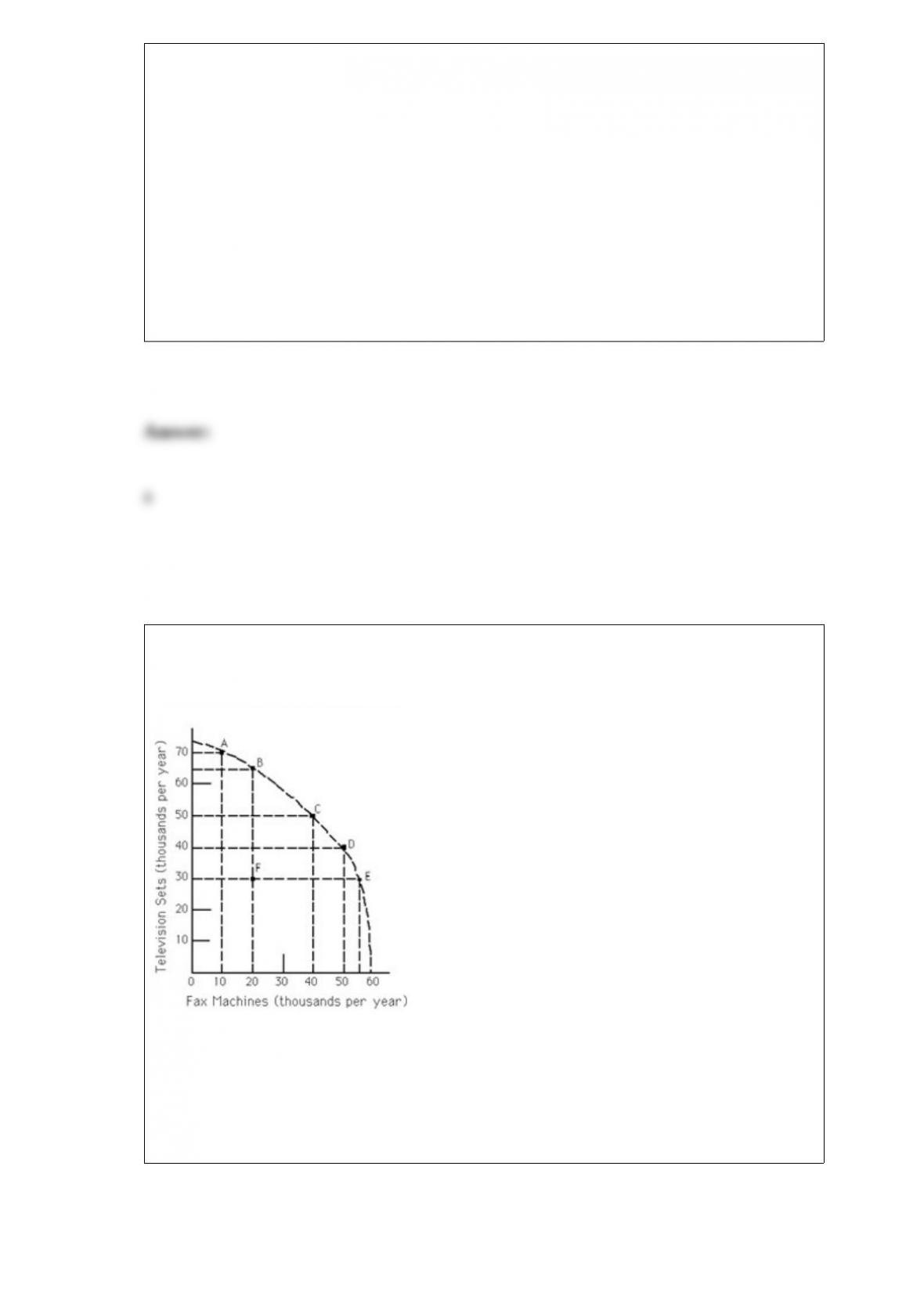
Refer to Exhibit 2-5. The opportunity cost of moving from point C to point B is
Exhibit 2-5
a. 15,000 televisions.
b. 15,000 fax machines.
c. 10,000 televisions.
d. 20,000 fax machines.

Which of the following statements is false?
a. The value marginal product is a measure of the value that each factor unit adds to the
firm’s product.
b. For a monopolist, value marginal product equals marginal revenue product.
c. A change in the price of the product labor produces or a change in the marginal
physical product of labor (reflect in a shift in the MPP curve) will shift the demand
curve for labor.
d. For a perfectly competitive firm, value marginal product equals marginal revenue
product.
Which of the following statements is true?
a. The motivation for rent seeking is not the same as the motivation for profit seeking.
b. Economic rent is a payment in excess of opportunity cost.
c. The deadweight loss triangle is not considered the graphic representation of one of
the costs of monopoly; instead, it is one of the costs of not having a monopoly.
d. Rent seeking is almost always an irrational activity as far as the rent seekers are
concerned.
e. a and d