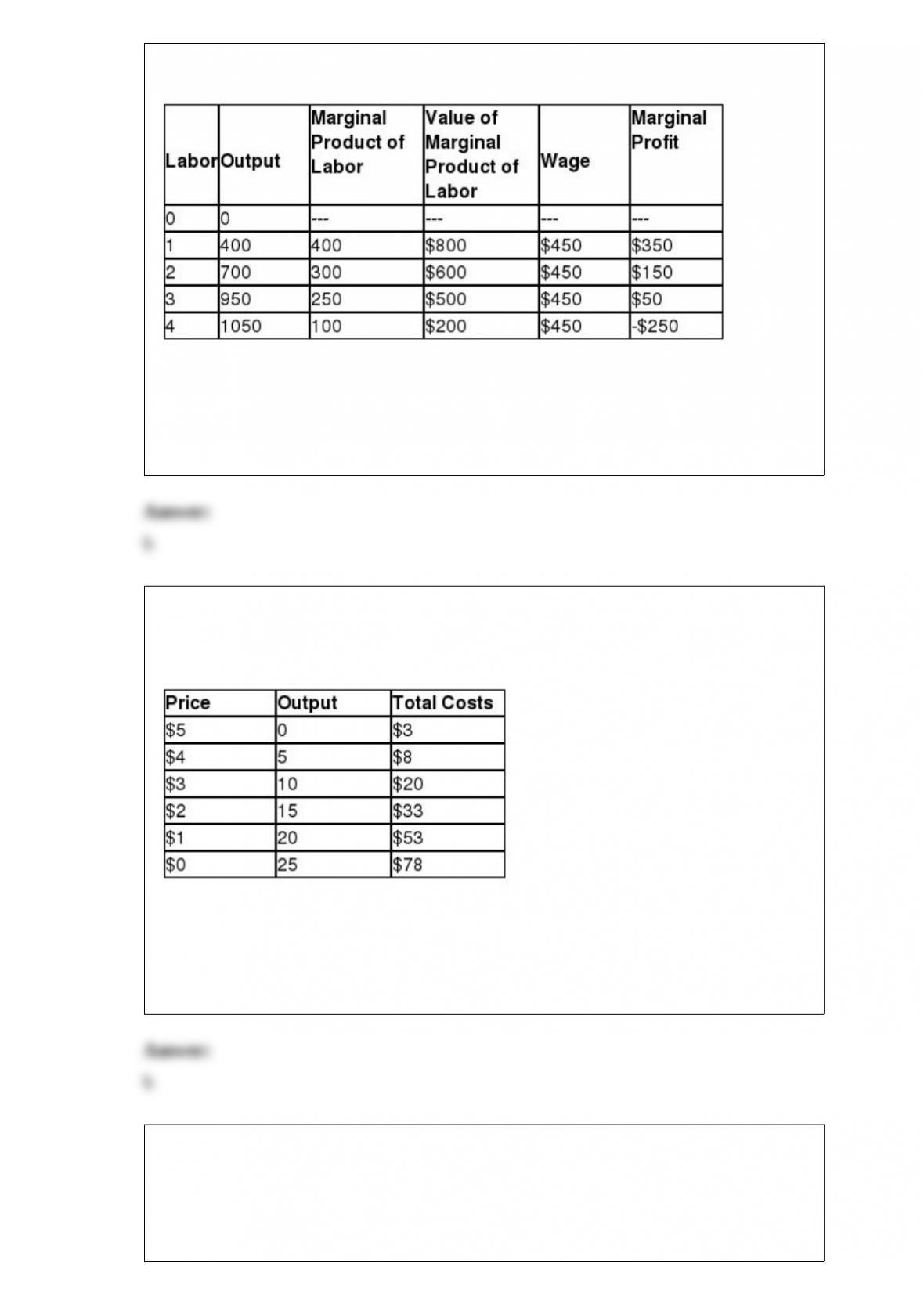
1) Table 18-5
Refer to Table 18-5. The price of output is
a.$1
b.$2.
c.$3.
d.$4.
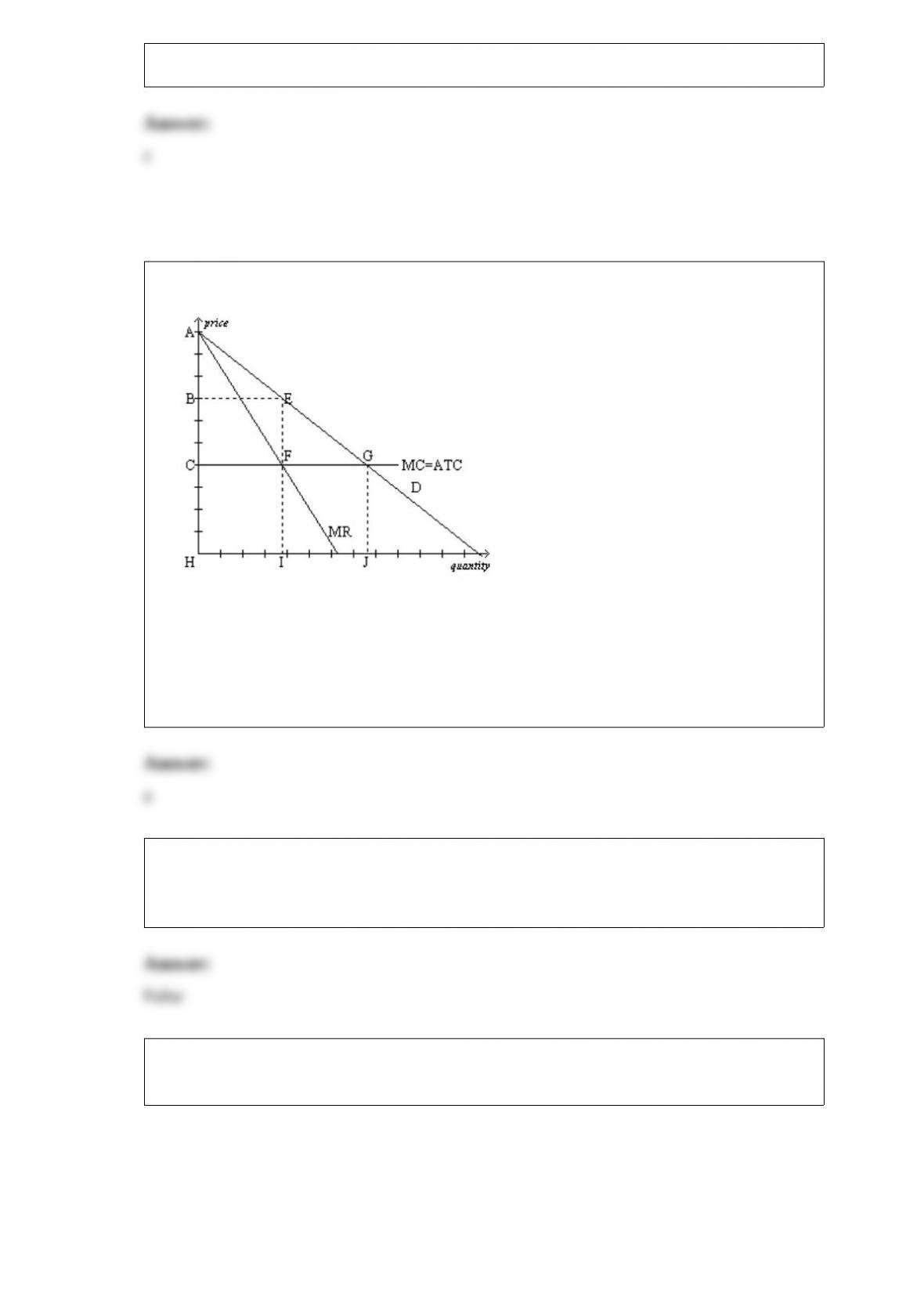
2) Table 15-13
The following table gives information on the price, quantity, and total cost of
production for a monopolist.
How much profit will the firm earn at the profit-maximizing price?
a. $9
b. $12
c. $15
d. $18
3) When the price of a good is measured in dollars, then the size of the deadweight loss
that results from taxing that good is measured in
a.units of the good that is being taxed.
b.units of a related good that is not being taxed.
c.dollars.
d.percentage change.
4) Figure 15-17
Which of the following areas represents
the consumer surplus from this profit-maximizing monopolist?
a.ABE
b.BCFE
c.EFG
d.ACG
5) A decrease in the price of pizza will shift the supply curve for pizza to the left.
a.True
b.False
6) Table 15-15
A monopolist faces the following demand curve:
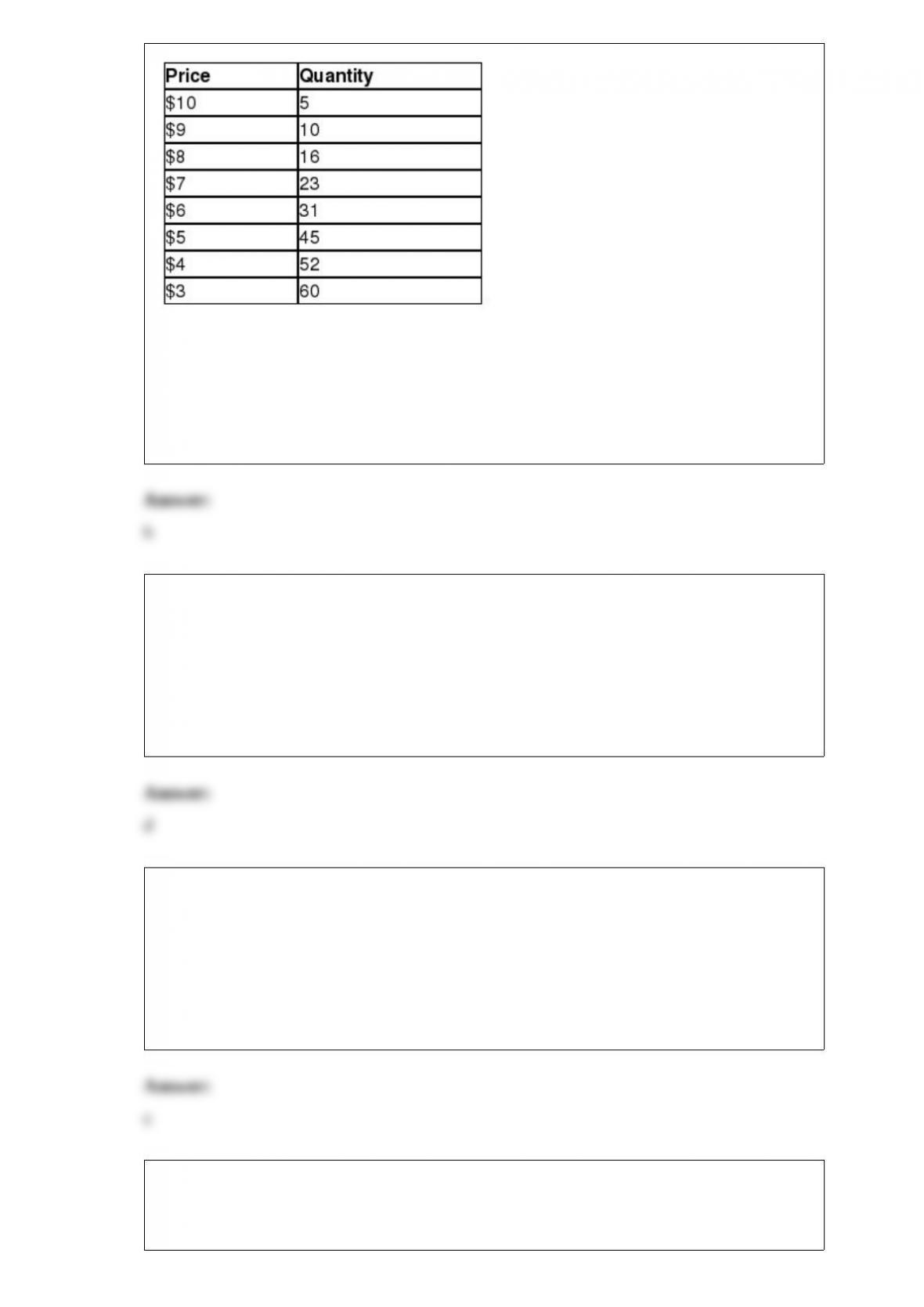
The monopolist has total fixed costs of $40 and a constant marginal cost of $5. At the
profit-maximizing level of output, the monopolist’s profit is
a.$88.
b.$8.
c.$6.
d.We do not have enough information to determine profit.
7) Economists regard events from the past as
a.irrelevant, since history is unlikely to repeat itself.
b.of limited interest, since those events seldom provide any useful economic data.
c.interesting but not particularly valuable, since those events cannot be used to evaluate
present-day economic theories.
d.interesting and valuable, since those events are capable of helping us to understand
the past, the present, and the future.
8) Suppose the government taxes the wealthy at a higher rate than it taxes the poor and
then develops programs to redistribute the tax revenue from the wealthy to the poor.
This redistribution of wealth
a.is more efficient and more equal for society.
b.is more efficient but less equal for society.
c.is more equal but less efficient for society.
d.is less equal and less efficient for society.
9) A decrease in the price of baseball bats will decrease the demand for baseballs.
a.True
b.False
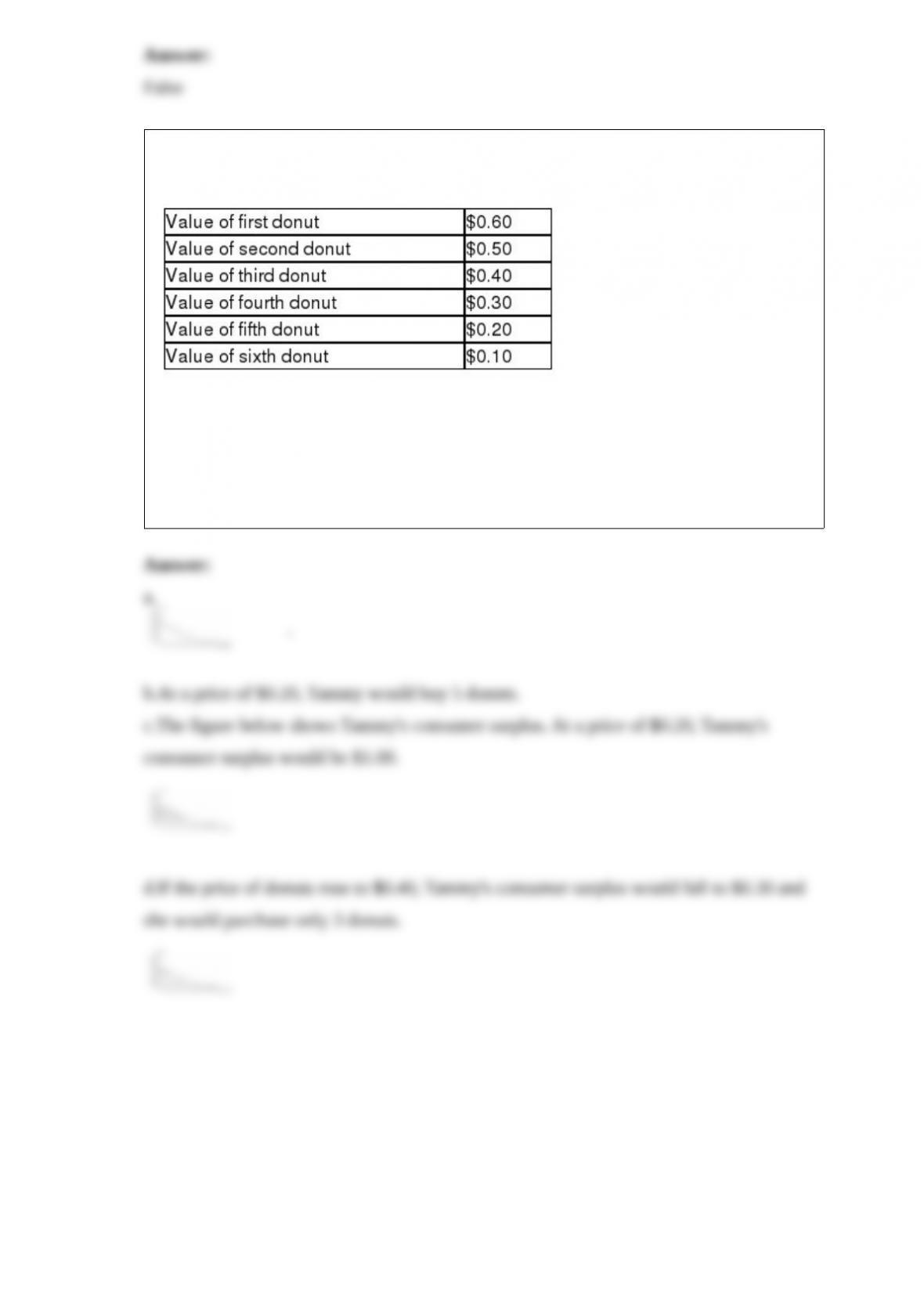
10) Tammy loves donuts. The table shown reflects the value Tammy places on each
donut she eats:
a.Use this information to construct Tammy’s demand curve for donuts.
b.If the price of donuts is $0.20, how many donuts will Tammy buy?
c.Show Tammy’s consumer surplus on your graph. How much consumer surplus would
she have at a price of $0.20?
d.If the price of donuts rose to $0.40, how many donuts would she purchase now? What
would happen to Tammy’s consumer surplus? Show this change on your graph.