At a price for which the quantity supplied exceeds the quantity demanded, a
__________ is experienced, which pushes the price __________ toward its equilibrium
value.
a. surplus; downward
b. surplus; upward
c. shortage; downward
d. shortage; upward
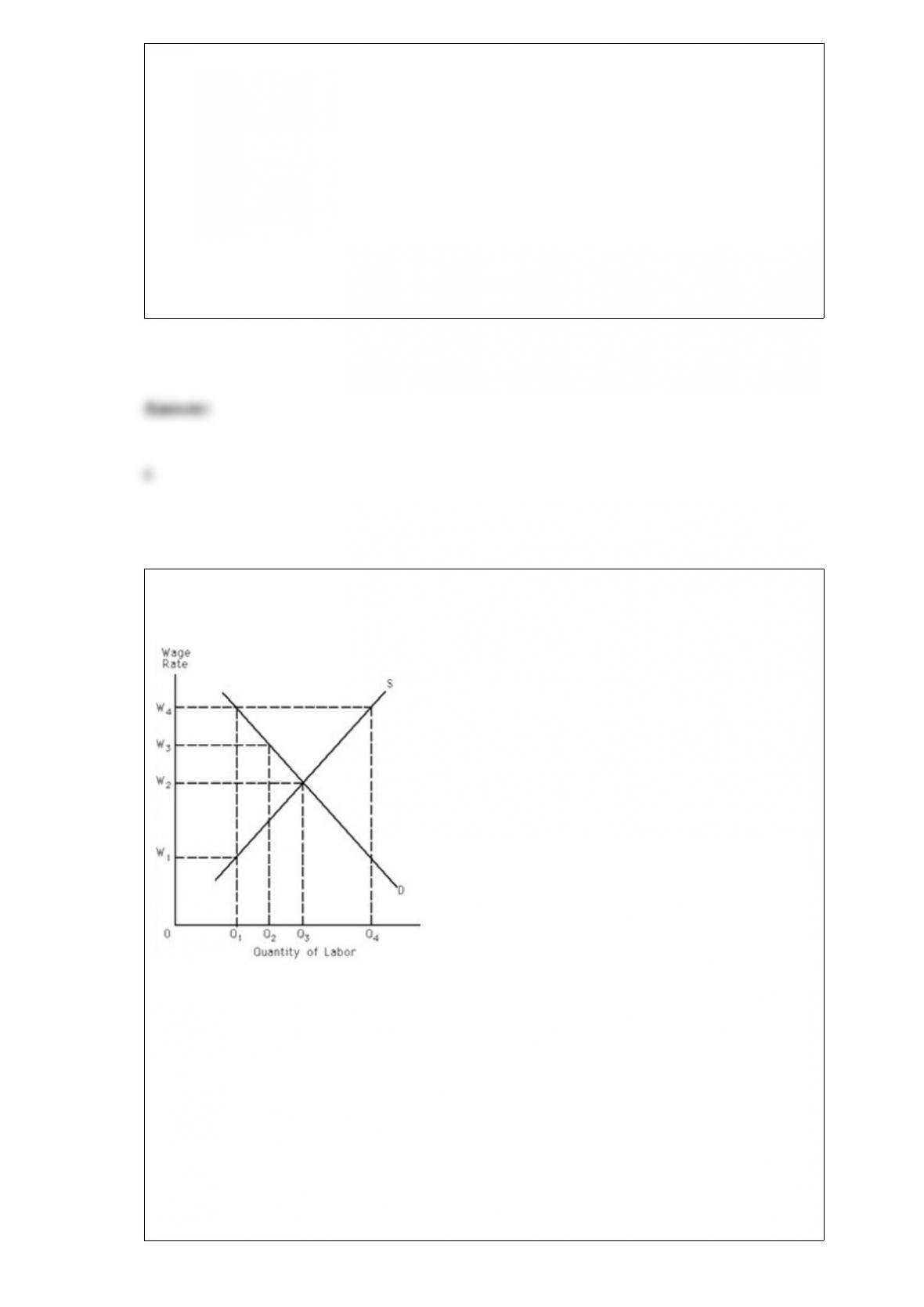
Exhibit 28-4
If a labor union successfully organizes the labor
market and sets the wage rate at W4, the quantity of labor hired will be
a. Q1.
b. Q2.
c. Q3.
d. Q4.

e. cannot be determined
Consider a setting in which there is a negative externality, but no positive
externality.The market outcome is __________________; government can bring about
the ___________________ outcome if it sets a tax equal to the __________________.
a. efficient; inefficient;
b. efficient; inefficient; MEC
c. inefficient; efficient; MEC
d. inefficient; efficient; MPC
e. inefficient; efficient; MSB
Which of the following statements is true?
a. The monopolist can sell all it can produce at the market price.
b. The marginal revenue curve of the single-price monopolist lies above its demand
curve.
c. The marginal revenue curve of the single-price monopolist is the same as its demand
curve.
d. The marginal revenue curve of the single-price monopolist lies below its demand
curve.

The larger a percentage of the population a person is, the ______________ likely that
person will have to further engage with people she meets.This implies that she will
generally be ____________ likely to behave unethically and poorly with the people in
her town as the population of her town increases.
a. more; less
b. less; less
c. more; more
d. less; more
Which of the following statements is false?
a. If a firm is a factor price taker, marginal factor cost is constant and equal to factor
price. This means a factor price taker pays a wage equal to its marginal factor cost.
b. Firms hire the factor quantity at which marginal revenue product equals marginal
factor cost.
c. If a firm is a product price taker, marginal revenue product is greater than value
marginal product.
d. If a firm is product price taker and a factor price taker, it pays labor a wage equal to
its value marginal product.
If, at the world price, domestic producers are producing and selling 100 units of a good,
then at the world price plus tariff it follows that
a. they will be producing and selling more than 100 units of the good.
b. they will be producing and selling fewer than 100 units of the good.
c. producers’ surplus will be less than what it is when domestic producers produce and
sell 100 units.
d. consumers’ surplus will be greater than what it is when domestic producers produce
and sell 100 units.
e. c and d
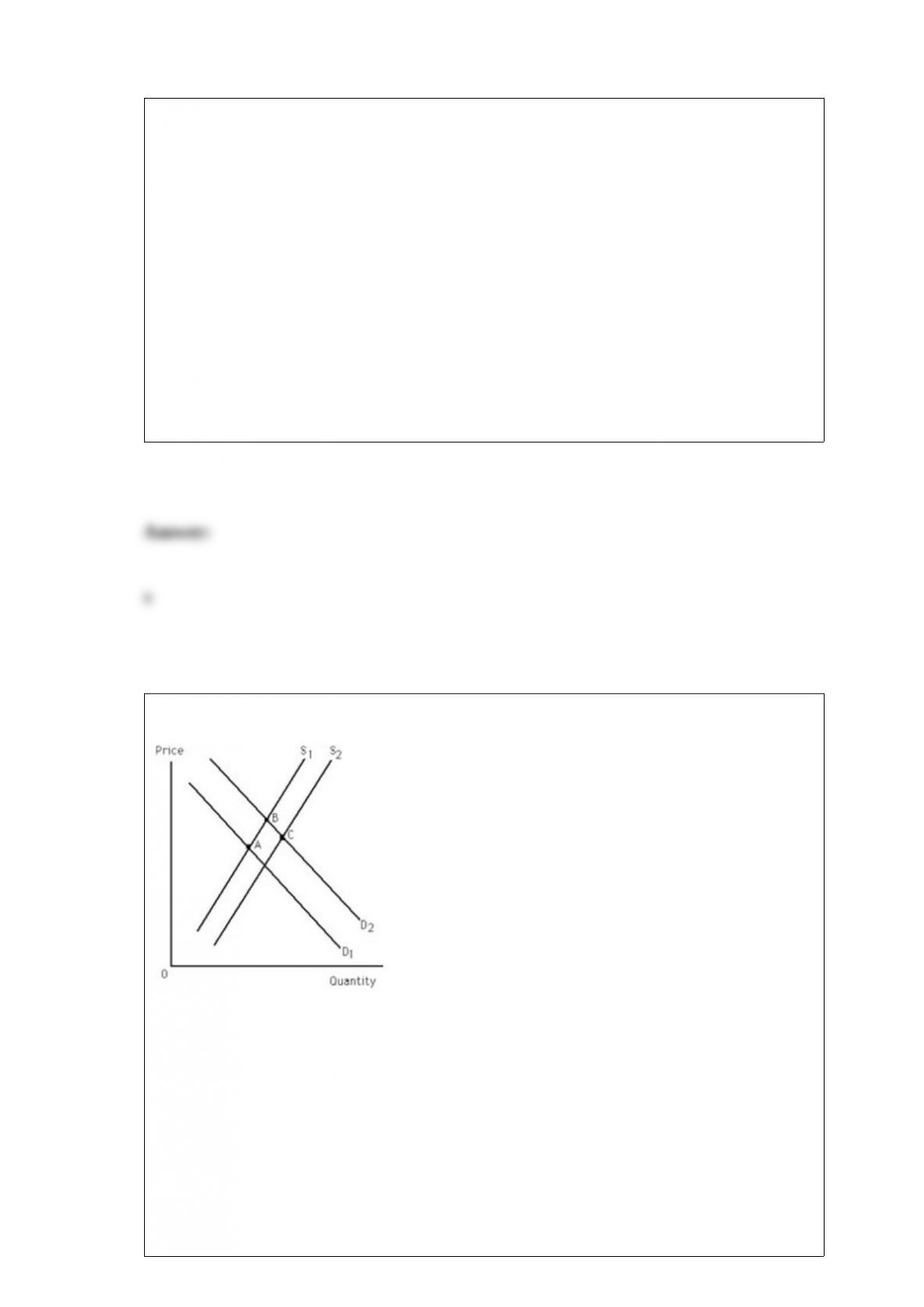
Exhibit 3-2
Suppose equilibrium is at point C. Something then changes and equilibrium becomes
point B. Which of the following is consistent with the change in equilibrium from point
C to B (assuming that good X is a normal good)?
a. There was an increase in resource prices and income stayed constant.
b. There was a decrease in resource prices and income stayed constant.
c. There was an increase in resource prices and income decreased.
d. There was a decrease in resource prices and income increased.
A perfectly competitive firm will continue to hire more factor units as long as
a. MRP > MFC.
b. VMP > MFC.
c. MRP > VMP.
d. VMP = MFC.
e. a and b
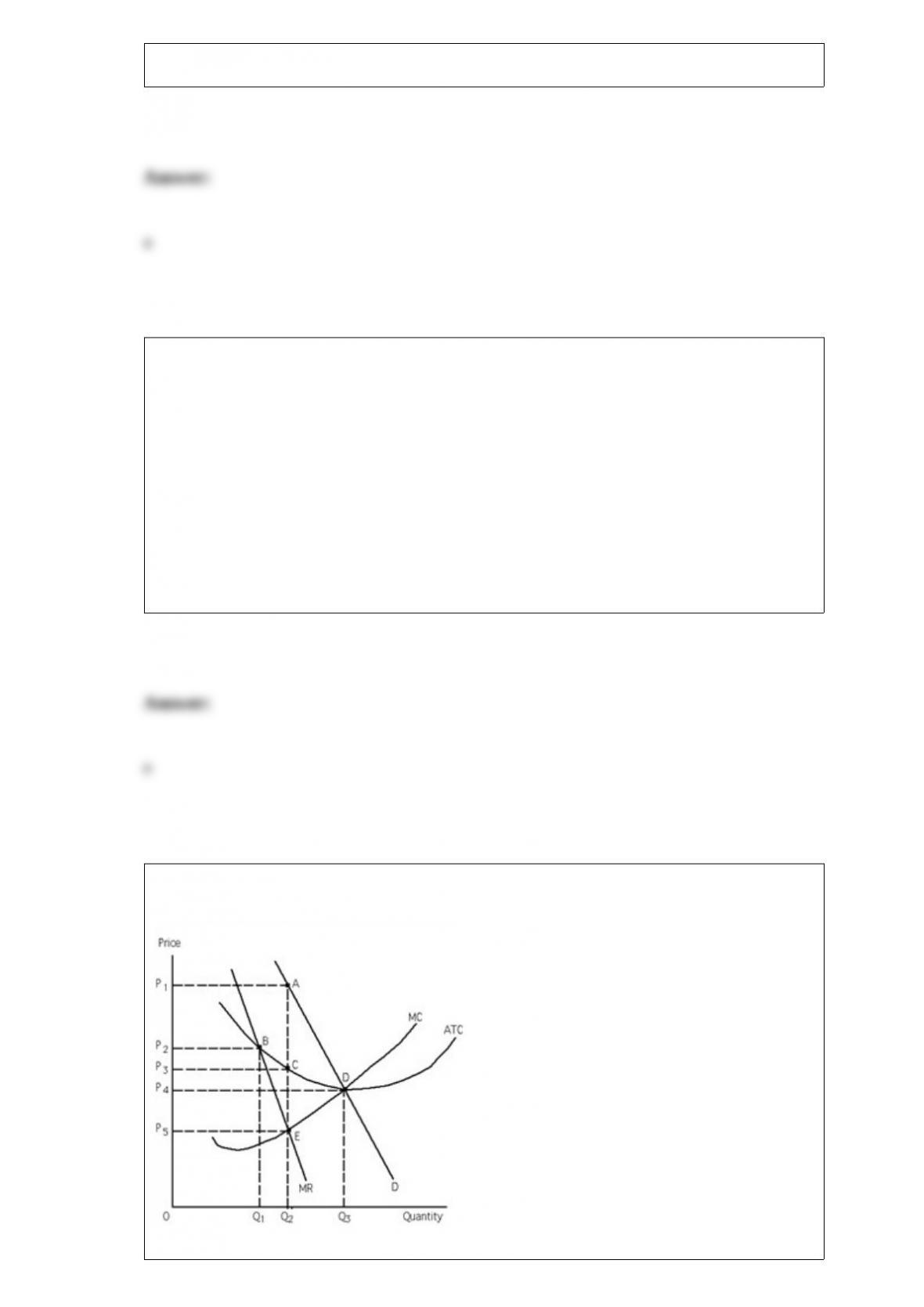
Exhibit 25-3
For this profit maximizing monopolistic competitor profit is represented by the area
a. 0P4DQ3.
b. P5P3CE.
c. P3P1AC.
d. 0Q1 times P2P4.
e. 0Q1 times P2P5.
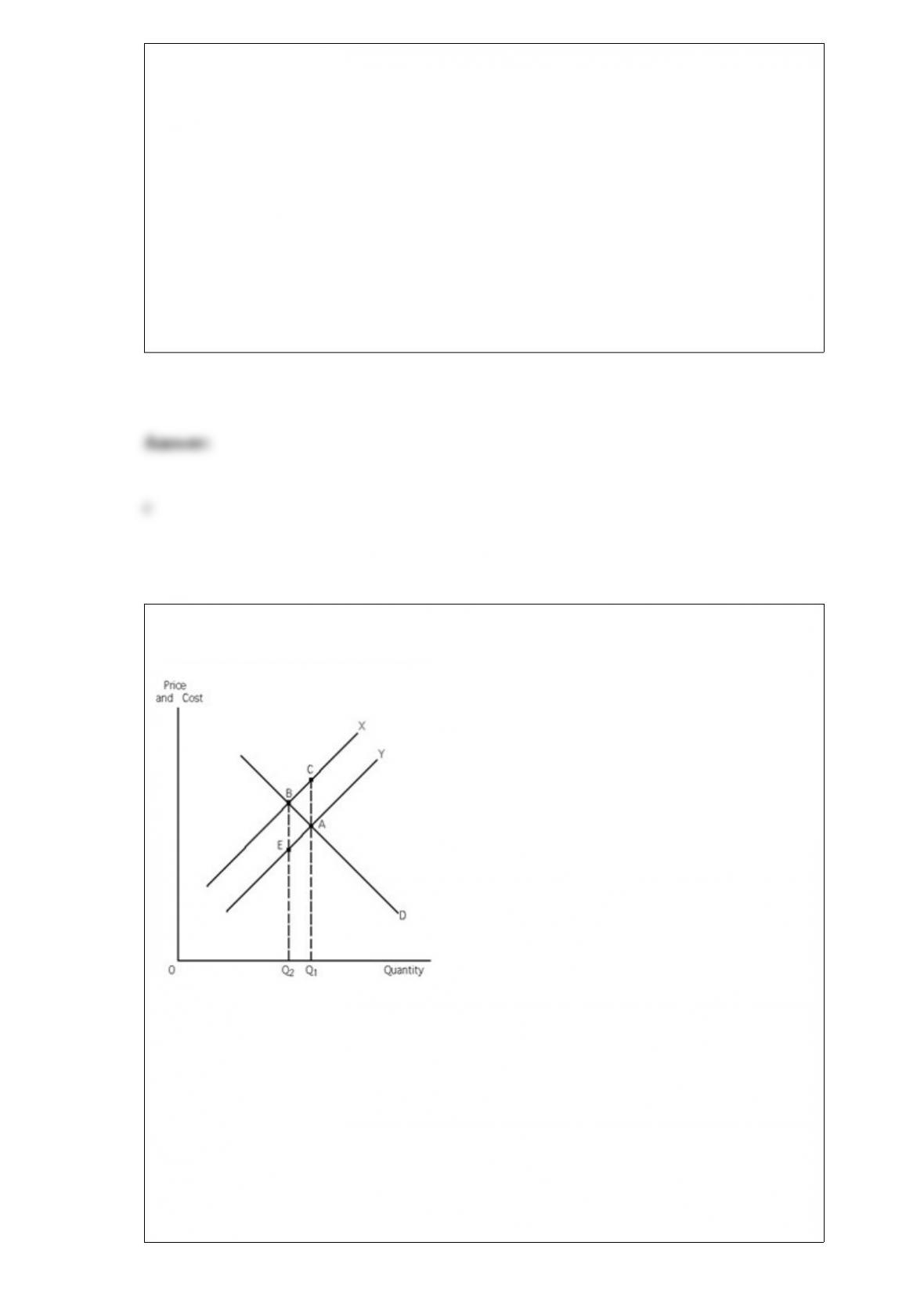
Exhibit 31-1
If the exhibit represents a negative externality situation, the social cost of expanding
output from Q2 to Q1 is the area of
a. ABC.
b. Q2BCQ1.
c. Q2BAQ1.

d. Q2EAQ1.
A tariff is imposed on strawberries.The tariff will ___________ the price of
strawberries in the domestic market, _____________ the quantity of strawberries
imported in the domestic market, and ____________ consumers€ surplus.
a. raise; lower; lower
b. lower; raise; lower
c. raise; lower; raise
d. lower; lower; raise
In a monopsony model of the labor market, the firm finds that (over a range) as more
workers are hired, the wage rate
a. increases.
b. decreases.
c. remains constant.
d. remains identical to the marginal factor cost per worker.
e. b and d

“In equilibrium, a monopolistic competitor will produce an output level that is less than
the level that would minimize its average total costs.” This is a statement of the
a. law of diminishing returns.
b. law of second best.
c. law of variable proportions.
d. excess capacity theorem.
If a farmer rents the land he works on, then any price support or deficiency payments he
receives __________ capitalized into the value of that land, and so his economic profit
from farming __________.
a. are; goes to zero
b. are; remains positive
c. are not; goes to zero
d. are not; remains positive

An individual’s income equals
a. labor income + wages + asset income.
b. labor income + asset income.
c. labor income + asset income – taxes.
d. labor income – taxes.
e. labor income + asset income + transfer payments – taxes.