
Increasing transactions costs of selling an asset make the asset
A. more valuable.
B. more liquid.
C. less liquid.
D. more moneylike.
Answer:
Everything else held constant, if aggregate output is to the right of the LM curve, then
there is an excess ________ of money which will cause the interest rate to ________.
A. supply; fall
B. supply; rise
C. demand; fall
D. demand; rise
Answer:
Of the following, the one that appears in the current account of the balance of payments
is

A) an Italian investor’s purchase of IBM stock.
B) income earned by U.S. subsidiaries of Barclay’s Bank of London.
C) a loan by a Swiss bank to an American corporation.
D) a purchase of a British Treasury bond by the Fed.
Answer:
In the open-economy ISLM model, the goods market equilibrium condition is
A. output = consumption + investment + government spending.
B. output = consumption + investment + government spending – tax.
C. output = consumption + investment + government spending + net export.
D. output = potential output.
Answer:
If real GDP grows from $10 trillion in 2002 to $10.5 trillion in 2003, the growth rate for
real GDP is
A. 5%.
B. 10%.

C. 50%.
D. 0.5%.
Answer:
Everything else held constant, if interest rates are expected to fall in the future, the
demand for long-term bonds today ________ and the demand curve shifts to the
________.
A. rises; right
B. rises; left
C. falls; right
D. falls; left
Answer:
If, in retaliation for “unfair” trade practices, Congress imposes a 30 percent tariff on
Japanese DVD recorders, but at the same time, U.S. demand for Japanese goods
increases, then, in the long run, ________, everything else held constant.
A. the Japanese yen should appreciate relative to the U.S. dollar
B. the Japanese yen should depreciate relative to the U.S. dollar

C. there is no effect on the Japanese yen relative to the U.S. dollar
D. the Japanese yen could appreciate, depreciate or remain constant relative to the U.S.
dollar
Answer:
That only large, well-established corporations have access to securities markets
A. explains why indirect finance is such an important source of external funds for
businesses.
B. can be explained by the problem of moral hazard.
C. can be explained by government regulations that prohibit small firms from acquiring
funds in securities markets.
D. explains why newer and smaller corporations rely so heavily on the new issues
market for funds.
Answer:
The nine directors of the Federal Reserve Banks are split into three categories:
________ are professional bankers, ________ are leaders from industry, and ________
are to represent the public interest and are not allowed to be officers, employees, or
stockholders of banks.

A. 5; 2; 2
B. 2; 5; 2
C. 4; 2; 3
D. 3; 3; 3
Answer:
The ________ states that the nominal interest rate equals the real interest rate plus the
expected rate of inflation.
A. Fisher equation
B. Keynesian equation
C. Monetarist equation
D. Marshall equation
Answer:
In September 1992, the Bundesbank attempted to keep the mark from appreciating
relative to the British pound, but it failed because participants in the foreign exchange
market came to expect the
A) appreciation of the mark.

B) depreciation of the mark.
C) revaluation of the dollar.
D) end of the Exchange Rate Mechanism.
Answer:
If nominal GDP in 2001 is $9 trillion, and 2001 real GDP in 1996 prices is $6 trillion,
the GDP deflator price index is
A. 7.
B. 100.
C. 150.
D. 200.
Answer:
Duration analysis involves comparing the average duration of the bank’s ________ to
the average duration of its ________.
A. securities portfolio; non-deposit liabilities
B. assets; liabilities

C. loan portfolio; deposit liabilities
D. assets; deposit liabilities
Answer:
Financial crises in advanced economies might start from a
A. debt deflation.
B. currency crisis.
C. mismanagement of financial innovations.
D. currency mismatch.
Answer:
The view that velocity is constant in the short run transforms the equation of exchange
into the quantity theory of money. According to the quantity theory of money, when the
money supply doubles
A. velocity falls by 50 percent.
B. velocity doubles.
C. nominal incomes falls by 50 percent.

D. nominal income doubles.
Answer:
“Bureaucratic gambling” refers to
A. the strategy of thrift managers that they would not be audited by thrift regulators in
the 1980s due to the relatively weak bureaucratic power of thrift regulators.
B. the risk that thrift regulators took in publicizing the plight of the S&L industry in the
early 1980s.
C. the strategy adopted by thrift regulators of lowering capital requirements and
pursuing regulatory forbearance in the 1980s in the hope that conditions in the S&L
industry would improve.
D. the risk that regulators took in going to Congress to ask for additional funds.
Answer:
Equity of U.S. companies can be purchased by
A. U.S. citizens only.
B. foreign citizens only.
C. U.S. citizens and foreign citizens.

D. U.S. mutual funds only.
Answer:
In September 2008, the Reserve Primary Fund, a money market mutual fund, found
itself in the situation know as “breaking the buck.” This means that
A. they could no longer afford to redeem shares at the par value of $1.
B. they required shareholders to contribute a dollar more in fees each month.
C. shareholders were able to redeem shares for more than a $1.
D. shares earned more than a dollar in interest.
Answer:
The policy tool of changing reserve requirements is
A. the most widely used.
B. the preferred tool from the bank’s perspective.
C. no longer used.
D. still used, even with its disadvantages.

Answer:
When real income ________, the demand curve for money shifts to the ________ and
the interest rate ________, everything else held constant.
A. falls; right; rises
B. rises; right; rises
C. falls; left; rises
D. rises; left; rises
Answer:
Which of the following statements about the characteristics of debt and equity is
FALSE?
A. They can both be long-term financial instruments.
B. They can both be short-term financial instruments.
C. They both involve a claim on the issuer’s income.
D. They both enable a corporation to raise funds.

Answer:
Suppose you are currently in the long position of a long-term bond. In this case, to
hedge against a capital loss, you would enter into a ________ contract to ________ a
long-term bond in the future.
A. interest-rate forward; sell
B. interest-rate forward; buy
C. exchange-rate forward; buy
D. exchange-rate forward; sell
Answer:
Discount policy affects the money supply by affecting the volume of ________ and the
________.
A. excess reserves; monetary base
B. borrowed reserves; monetary base
C. excess reserves; money multiplier
D. borrowed reserves; money multiplier
Answer:

Which policy measure increases the punishment for white-collar crime and obstruction
of official investigations?
A. Sarbanes-Oxley Act of 2002
B. Global Legal Settlement of 2002
C. Gramm-Leach-Bliley Act of 1999
D. Riegle-Neal Act of 1994
Answer:
Options are contracts that give the purchasers the
A. option to buy or sell an underlying asset.
B. obligation to buy or sell an underlying asset.
C. right to hold an underlying asset.
D. right to switch payment streams.
Answer:

In his Liquidity Preference Framework, Keynes assumed that money has a zero rate of
return; thus
A. when interest rates rise, the expected return on money falls relative to the expected
return on bonds, causing the demand for money to fall.
B. when interest rates rise, the expected return on money falls relative to the expected
return on bonds, causing the demand for money to rise.
C. when interest rates fall, the expected return on money falls relative to the expected
return on bonds, causing the demand for money to fall.
D. when interest rates fall, the expected return on money falls relative to the expected
return on bonds, causing the demand for money to rise.
Answer:
A rise in short-term interest rates that is believed to be only temporary
A. is likely to have a significant effect on long-term interest rates.
B. will have a bigger impact on long-term interest rates than if the rise in short-term
rates had been permanent.
C. is likely to have only a small impact on long-term interest rates.
D. cannot possibly affect long-term interest rates.
Answer:

In the ten year period 1981-1990, 1202 commercial banks were closed, with a peak of
206 failures in 1989. This rate of failures was approximately ________ times greater
than that in the period from 1934 to 1980.
A. two
B. three
C. five
D. ten
Answer:
An increase in the liquidity of corporate bonds, other things being equal, shifts the
demand curve for corporate bonds to the ________ and the demand curve for Treasury
bonds shifts to the ________.
A. right; right
B. right; left
C. left; left
D. left; right
Answer:

Of the following, the largest is
A. money market deposit accounts.
B. demand deposits.
C. M1.
D. M2.
Answer:
Securitization is a process of asset transformation that involves a number of different
financial institutions working together. These financial institutions are known
collectively as the
A. transformers.
B. amalgamation.
C. movers and shakers.
D. shadow banking system.
Answer:
If people expect nominal interest rates to be higher in the future, the expected return to
bonds ________, and the demand for money ________.

A. rises; increases
B. rises; decreases
C. falls; increases
D. falls; decreases
Answer:
An increase in interest rates might ________ saving because more can be earned in
interest income.
A. encourage
B. discourage
C. disallow
D. invalidate
Answer:
Explain the Keynesian theory of money demand. What motives did Keynes think
determined money demand? What are the two reasons why Keynes thought velocity
could NOT be treated as a constant?

Answer:
Explain the factors that account for the large increase in market share experienced by
mutual funds since 1980.
Answer:
Explain dynamic and defensive open market operations. What is the purpose of each
type? Describe two situations when defensive open market operations are used. How
are defensive open market operations typically conducted?

Answer:
Distinguish between direct finance and indirect finance. Which of these is the most
important source of funds for corporations in the United States?
Answer:
Distinguish between a foreign bond and a Eurobond.
Answer:

Explain how cigarettes could be called “money” in prisoner-of-war camps of World War
II.
Answer:
Typically, the economy recovers fairly quickly from a recession. Why did this NOT
happen in the United States during the Great Depression?
Answer:
Explain how expansionary and contractionary monetary policies affect aggregate
demand through the exchange rate channel.

Answer:
Discuss three ways in which U.S. banks can become involved in international banking.
Answer:
Your favorite uncle advises you to purchase long-term bonds because their interest rate
is 10%. Should you follow his advice?
Answer:

Your bank has the following balance sheet:
Assets Liabilities
Reserves $ 50 million Checkable deposits $200 million
Securities 50 million
Loans 150 million Bank capital 50 million
If the required reserve ratio is 10%, what actions should the bank manager take if there
is an unexpected deposit outflow of $50 million?
Answer:
Explain the principal-agent problem as it pertains to equity contracts.
Answer:

What is arbitrage? Explain why arbitrage drives the contract price of futures to the price
of the underlying asset on the expiration date, for prices above and below the asset
price.
Answer:
Why is it important to understand the bond market?
Answer:
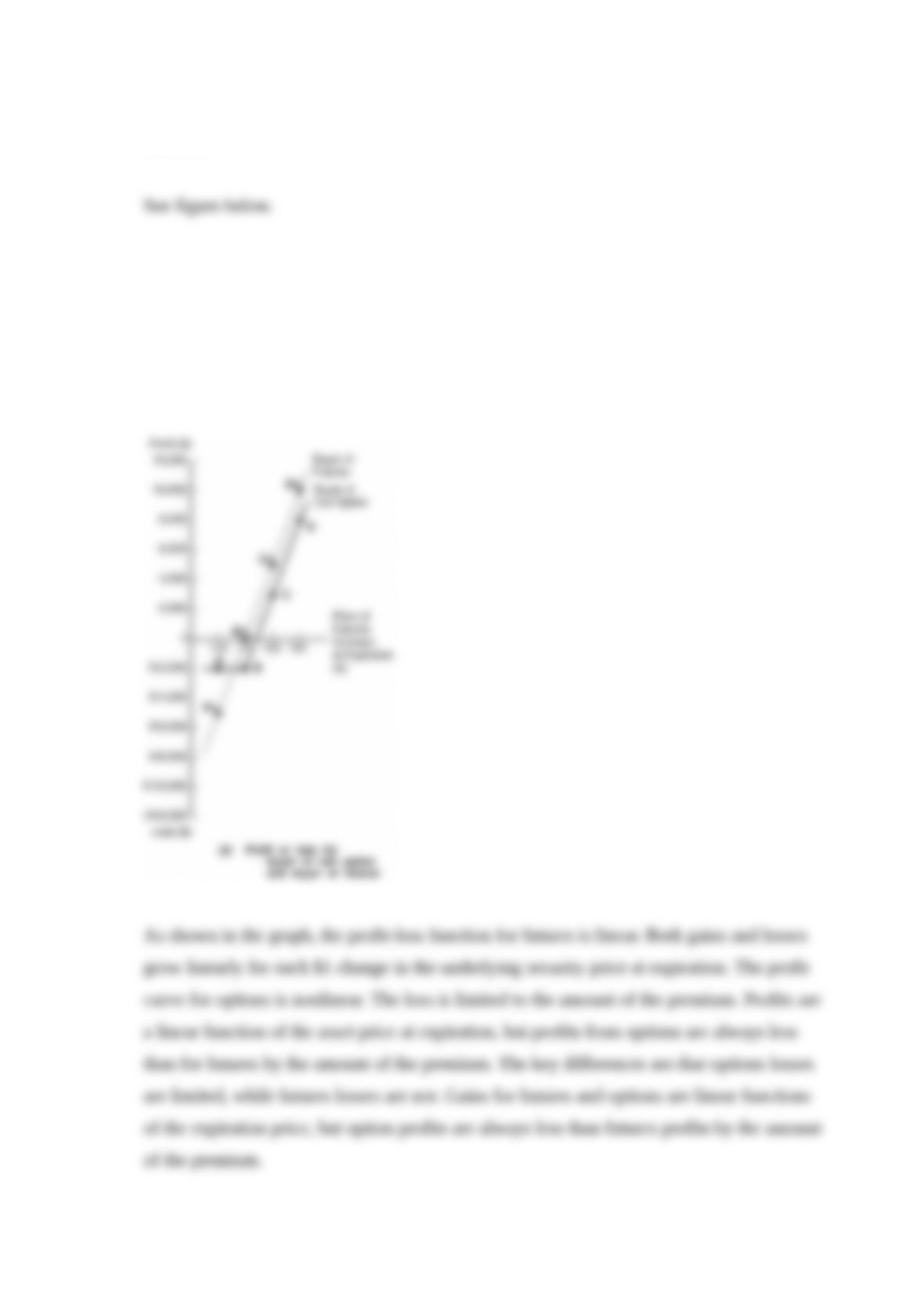
Show graphically and explain the profits and losses of buying futures relative to buying
call options.
Answer:

What crucial role do financial intermediaries perform in an economy?
Answer: