The longer the period of time allowed for the producer of a good to adjust to a change
in the price of the good, the ____________ the price elasticity of supply will be.This
statement assumes that the quantity supplied __________ be altered with time.
a. more elastic; can
b. more elastic; cannot
c. more inelastic; can
d. more inelastic; cannot
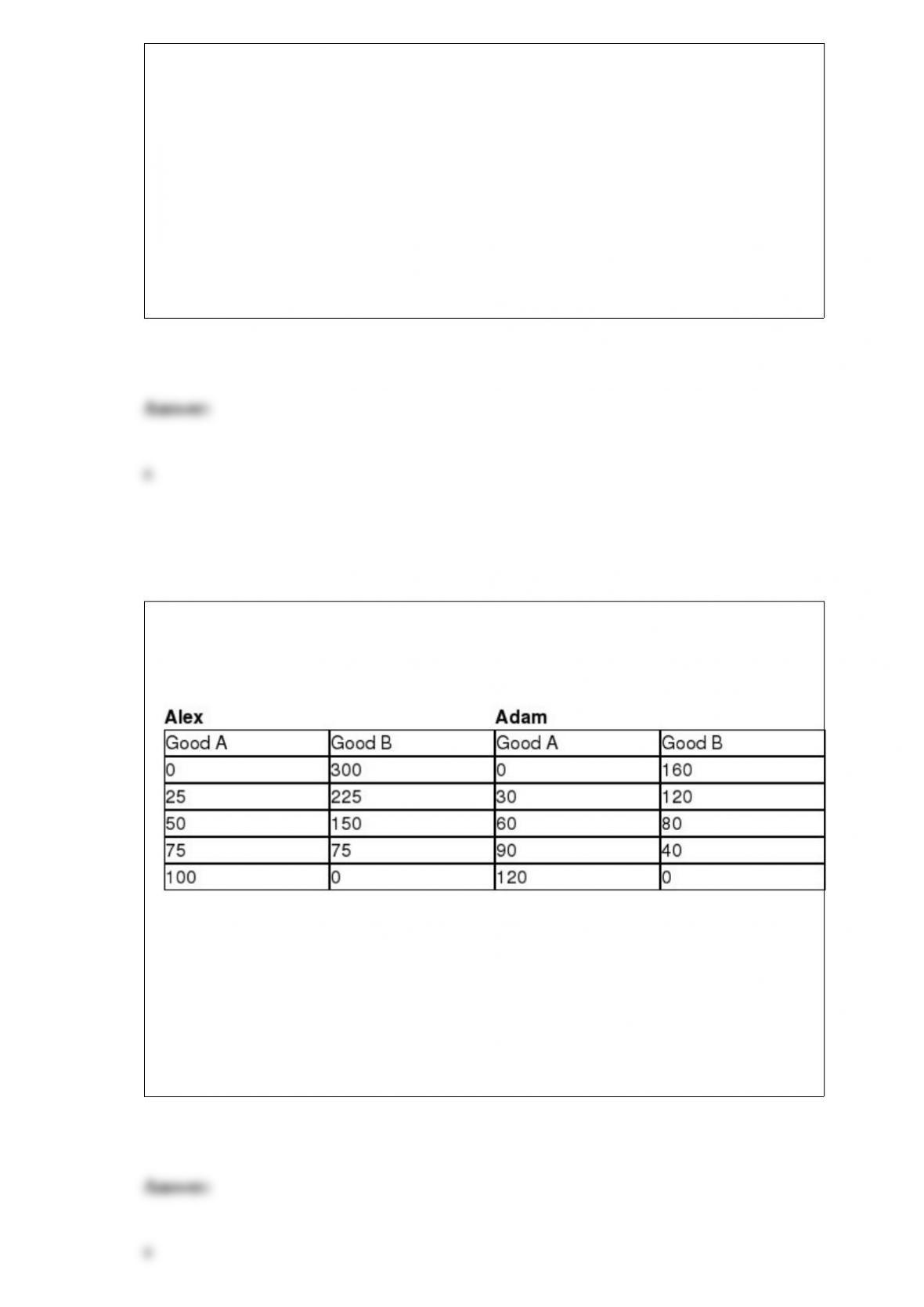
Refer to Exhibit 2-9. For Alex, the opportunity cost of producing one unit of good A is
____________ unit(s) of good B.
Exhibit 2-9
a. 3.00
b. 0.33
c. 0.75
d. 1.33

If a positive externality exists, __________ for the socially optimal output to be
reached.
a. supply needs to decrease
b. demand needs to increase
c. demand needs to decrease
d. a and c
e. none of the above
Country A has a Gini coefficient of 0.5 and country B has a Gini coefficient of 0.7. It
follows that
a. there is greater income inequality in country A than B.
b. there is greater income inequality in country B than A.
c. it is possible for the Lorenz curve in country A is the same as the Lorenz curve in
country B.
d. it is possible that the adjusted Gini coefficient in country A is equal to the Gini
coefficient in country B.
e. c and d

In 1973 and 1979, the U.S. federal government imposed price ceilings on gasoline
which resulted in surpluses of gasoline.
a. True
b. False
Economic rent is a payment received in excess of marginal cost.
a. True
b. False
Income elasticity of demand for good A is -0.22. Good A is income __________ and is
a(n) __________ good.
a. unit elastic; normal
b. elastic; inferior
c. inelastic; normal
d. elastic; normal
e. inelastic; inferior

When the government _____________ mortgage lending standards, the indirect result
is likely to be _____________ home prices.
a. lowers; higher
b. increases; lower
c. lowers; lower
d. increases; higher
e. a and b
If you have a low rate of time preference, then you
a. buy goods right now because “you just can’t wait.”
b. are willing to save a larger percentage of your income than a person who has a high
rate of time preference.
c. find it difficult to save much of your income because money “just sitting around” is
worthless to you.
d. are willing to borrow money to buy goods now.
e. a, c, and d

The Coase theorem states that
a. transaction costs consist of marginal private costs and marginal social costs and are
higher when exchange is subject to increasing marginal costs.
b. transaction costs are the difference between marginal social costs and marginal
private costs and are higher when exchange is subject to decreasing marginal costs.
c. when transaction costs are significant, the resource-allocative outcome will be the
same regardless of who is assigned the property rights.
d. when transaction costs are insignificant, the resource-allocative outcome will be the
same regardless of who is assigned the property rights.
e. b and c
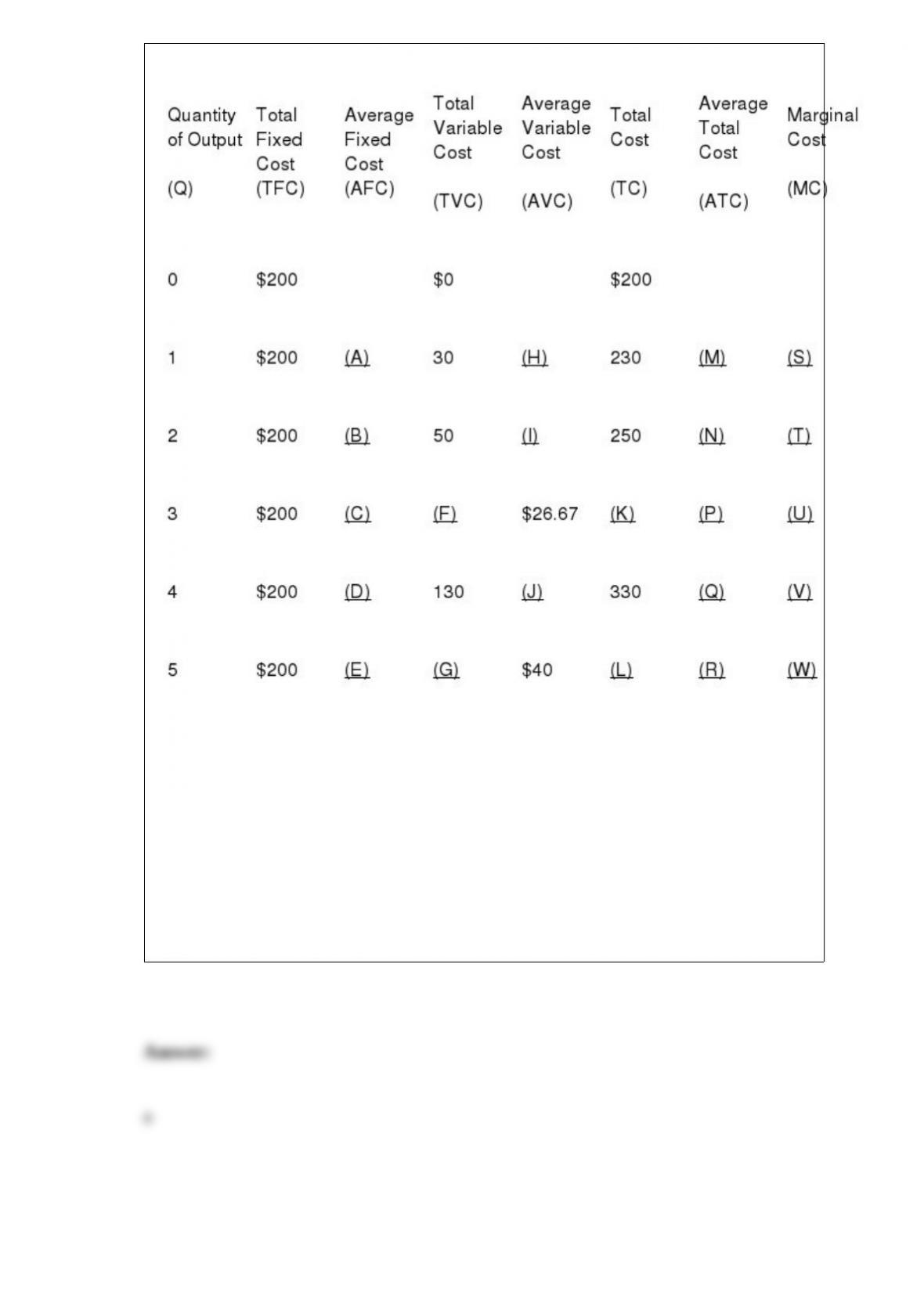
Refer to Exhibit 22-13.What dollar amounts go in blanks (A) and (B), respectively?
Exhibit 22-13
a. $200; $100
b. $200; $200
c. $50; $100
d. $10; $100
e. There is not enough information to answer this question.
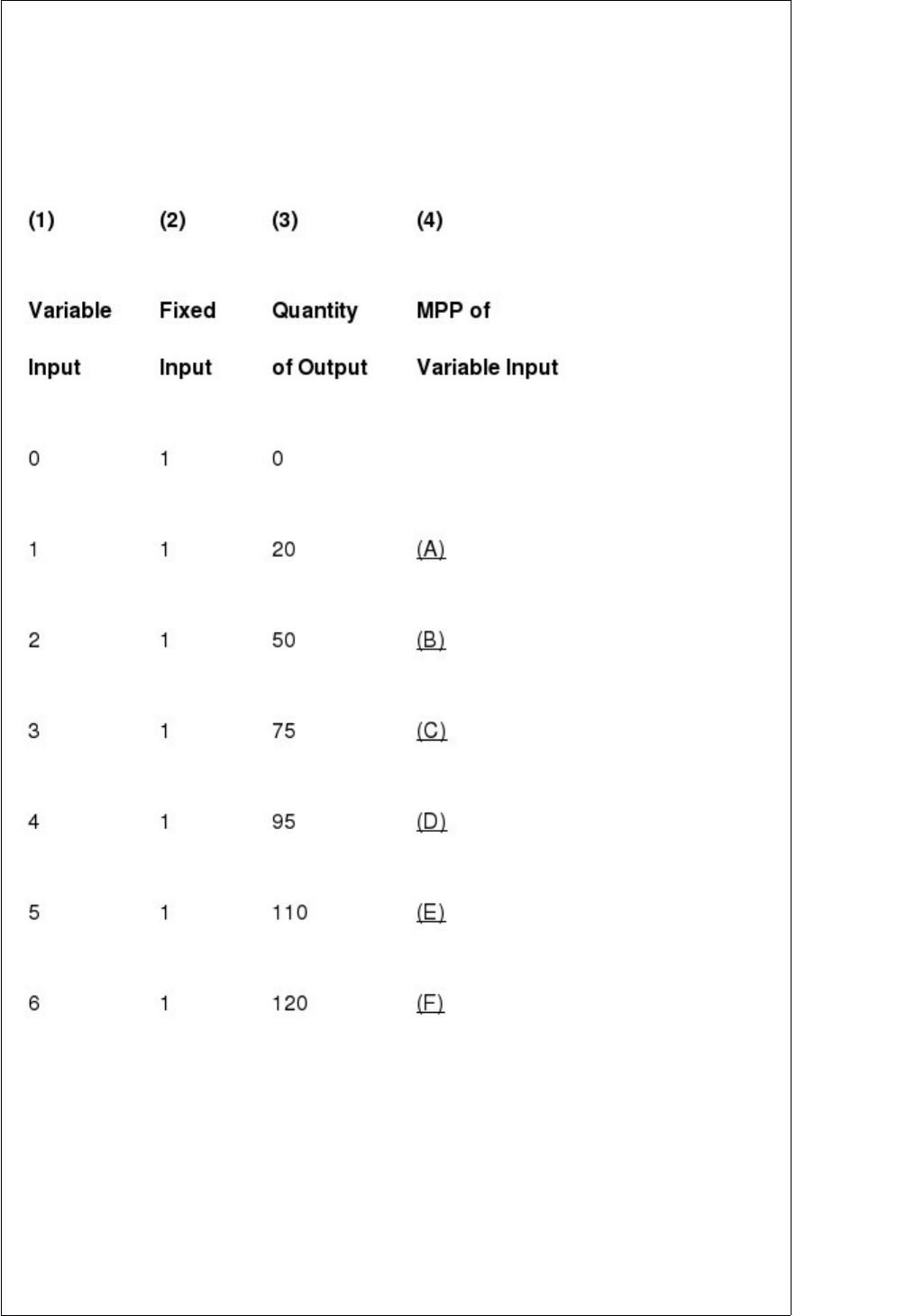
Refer to Exhibit 22-l. The numbers that go in blanks (C) and (D) are, respectively,
Exhibit 22-1
a. 25 and 20.
b. 20 and 22.
c. 25 and 24.
d. 22 and 20.
e. none of the above

If the demand curve for tickets to a taping of a television show intersects the supply
curve for tickets to that show at a negative price, then in order to put that market in
equilibrium the producers would need to pay people to view the show being taped.
a. True
b. False
In 2009, the top 20 percent of households in the United States earned collectively
approximately what percent of the total income of all households?
a. 20 percent
b. 30 percent
c. 40 percent
d. 50 percent
e. 60 percent
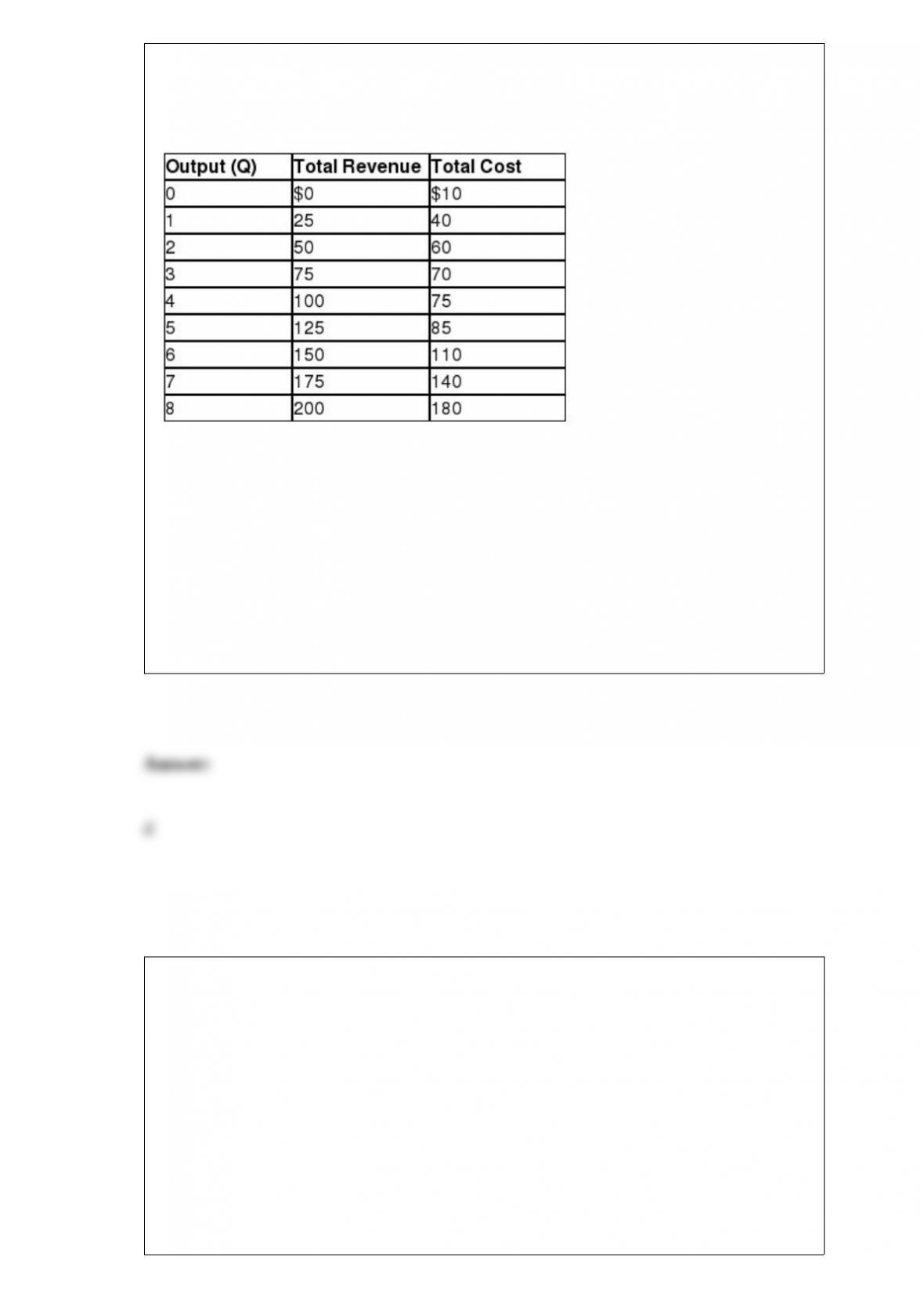
Refer to Exhibit 23-10.What is the marginal revenue and marginal cost, respectively, of
the 7th unit of output?
Exhibit 23-10
a. $25 and $25
b. $30 and $20
c. $25 and $15
d. $25 and $30
e. There is not enough information to answer this question.
At 500 units of output, total cost is $35,000 and total variable cost is $22,000. What
does total fixed cost equal at 500 units?
a. $57,000
b. $900
c. $13,000
d. $34
e. There is not enough information provided to answer this question.

Marginal factor cost (MFC) is
a. the additional cost generated by producing an additional unit of output.
b. the additional revenue generated by employing an additional factor unit.
c. the additional cost generated by employing an additional factor unit.
d. total cost from the production of a product divided by the total number of factor units
used.
Consider two points on the PPF: point A, at which there are 10 apples and 20 pears, and
point B, at which there are 7 apples and 21 pears. If the economy is currently at point A,
the opportunity cost of moving to point B is
a. 1 pear.
b. 7 apples.
c. 3 apples.
d. 21 pears.
A monopolistic competitive firm differentiates its product (from similar products) in the
minds of the buying public. As a result, the firm
a. may earn positive economic profits, even with easy entry into the industry.
b. will definitely earn positive economic profits.
c. will be able to lower its costs below that of its competitors.
d. finds that its fixed costs are sunk costs.
e. a and c
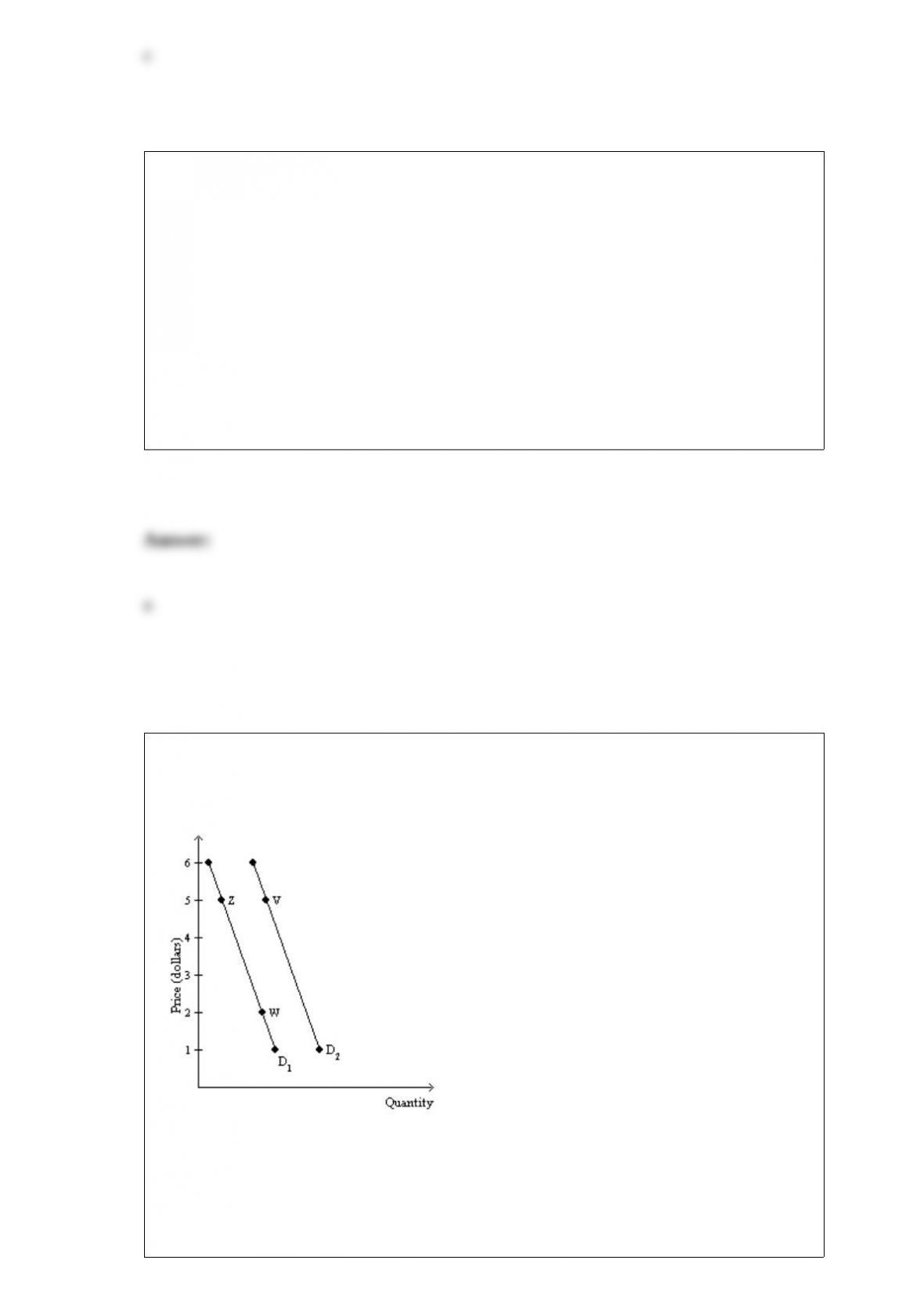
Refer to Exhibit 3-3. A movement from point W to point Z would have been the result
of
Exhibit 3-3
Good Y
a. a reduction in the price of good Y.

b. an increase in the number of buyers in the area where good Y is being sold.
c. a decrease in business taxes paid by the producers of good Y.
d. a decrease in the number of buyers in the area where good Y is being sold.
e. an increase in the price of good Y.
Which of the following situations would prompt individuals to try to form a team
(firm), according to Alchian and Demsetz.
a. Jones, Smith, and Brown together produce 100 units of good X each day working
alone and 90 units of good X each day working together.
b. Jones, Smith, and Brown together produce 100 units of good X each day working
alone and 120 units of good X each day working together.
c. Jones, Smith, and Brown together produce 100 units of good X each day working
alone and 100 units of good X each day working together.
d. Jones produces more working alone than Smith or Brown produce working alone.
e. Jones produces more working as a member of a team than Smith or Brown produce
working as a member of a team.
Supply of a food item increases by more than the demand for the food item increases.
One thing for certain is that

a. the price of the food item rises.
b. income elasticity of demand is less than 0.
c. the supply curve is price inelastic.
d. real income falls as a result.
e. none of the above
Which of the following statements is false?
a. The list of stocks that are included in the Dow Jones Industrial Average changes from
time to time, and is determined by the editors of the Wall Street Journal.
b. The Dow Jones Industrial Average first appeared on the scene in 1896.
c. When the Dow Jones Industrial Average was first computed, prudent investors
bought bonds, not stocks.
d. The Dow Jones Industrial Average is computed by summing the prices of the thirty
stocks included in the average and dividing by 30.
Logrolling refers to
a. choosing political platforms to appeal to special interests.
b. trading votes to gain support for legislation.
c. choosing political platforms to appeal to the “middle-of-the-road” voter.
d. gathering votes by pretending to support policies that appeal to voters.
e. c and d
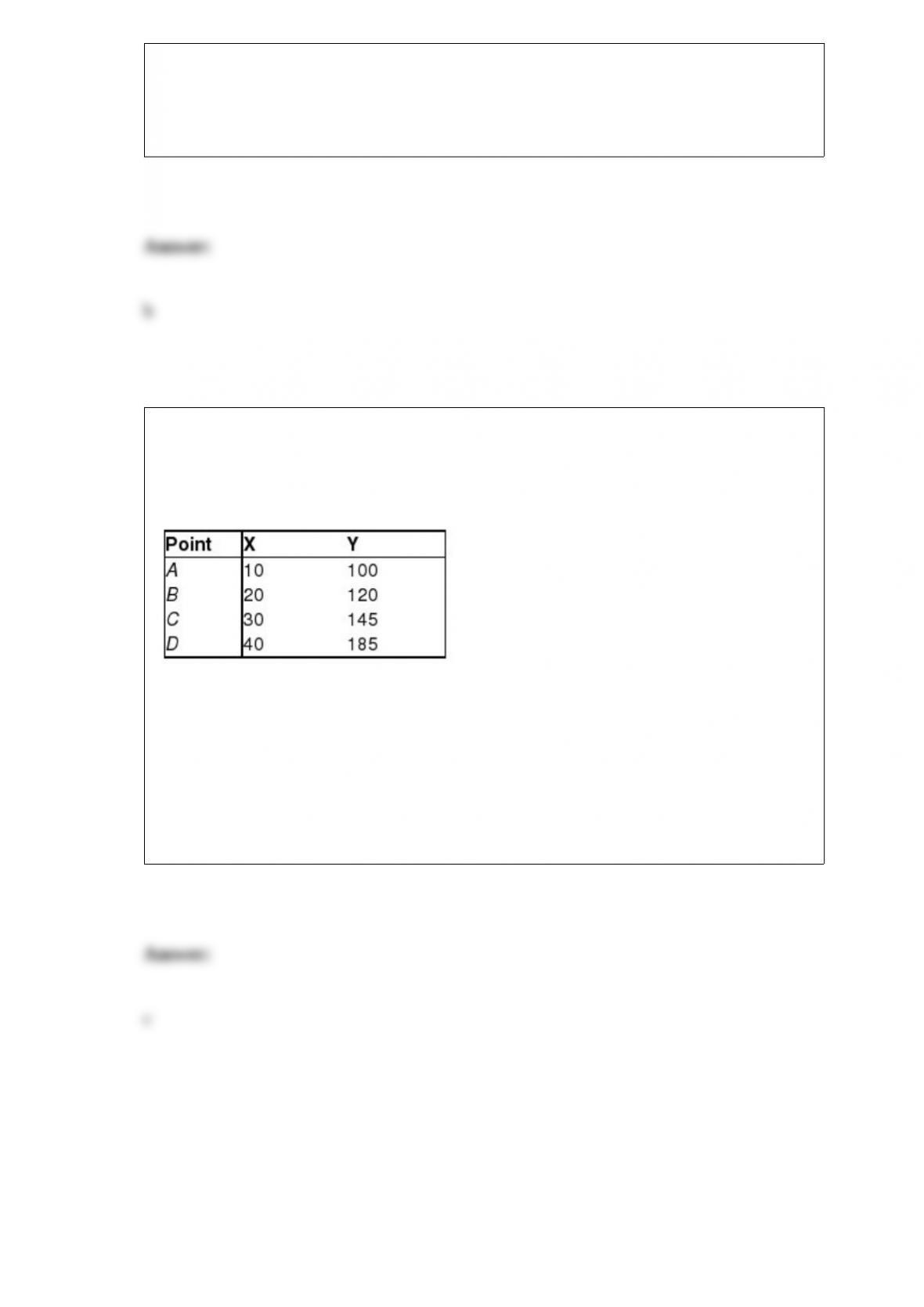
Refer to Exhibit 1-2.According to the data provided in this table, what is the slope of
the line between points A and B, if these data were graphed with X on the horizontal
axis and Y on the vertical axis?
Exhibit 1-2
a. -2.00
b. -0.50
c. 2.00
d. 0.50