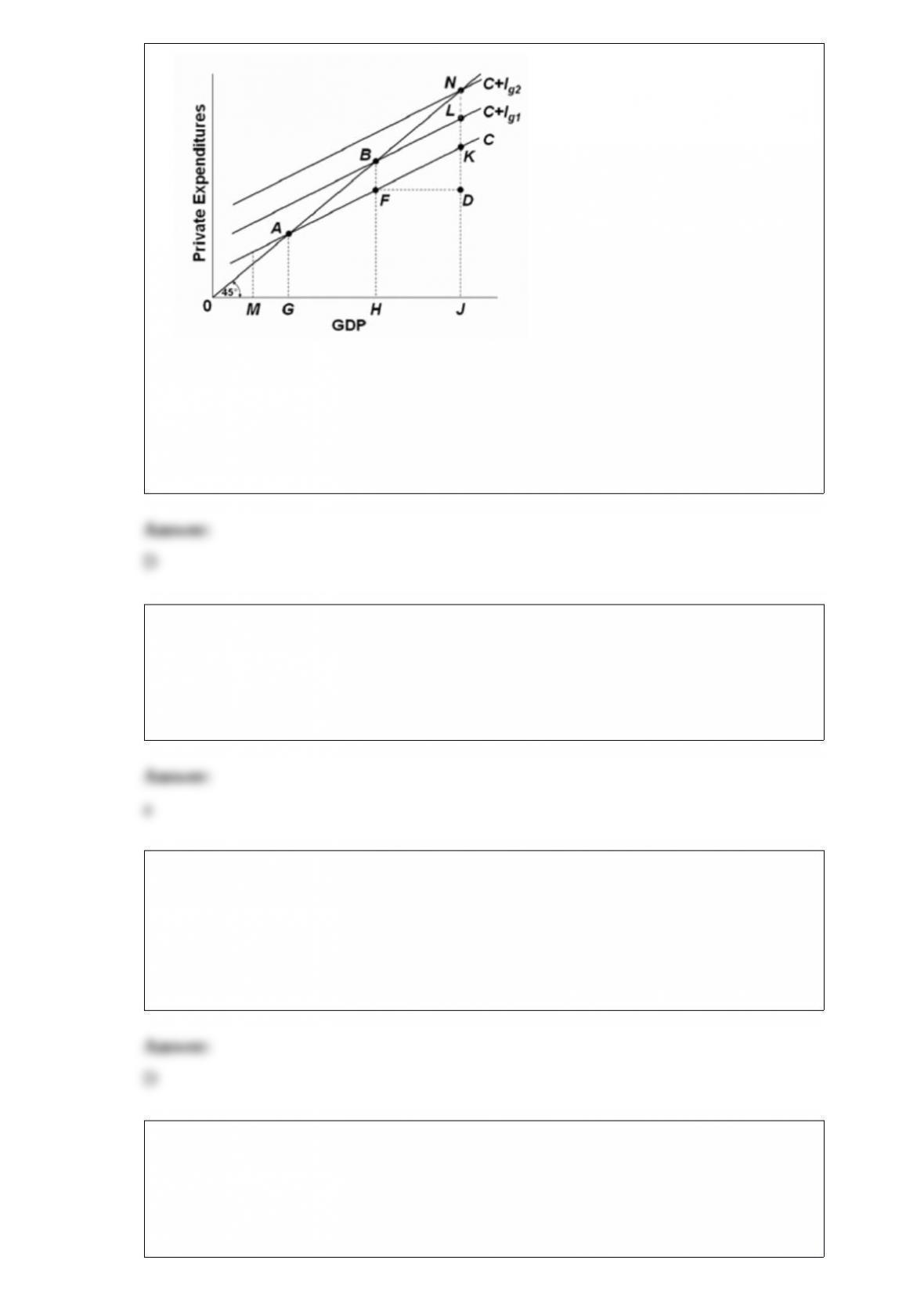
1)
Refer to the above diagram that applies to a private closed economy. If gross investment
is Ig 1, the equilibrium GDP and the level of consumption will be:
A.H and HB respectively.
B.J and JI respectively.
C.J and JK respectively.
D.H and HF respectively.
2) if quantity demanded is completely unresponsive to price changes, demand is:
a.perfectly inelastic.
b.perfectly elastic.
c.relatively inelastic.
d.relatively elastic.
3) In an aggregate demand-aggregate supply diagram, equal decreases in government
spending and taxes will:
A.shift the AD curve to the right.
B.increase the equilibrium GDP.
C.not affect the AD curve.
D.shift the AD curve to the left.
4) The marginal productivity theory of income distribution suggests that:
A.government should subsidize the most productive workers through a system of
transfer payments.
B.each individual should receive income based on his contribution to total output.
C.resource owners should receive income based on the idea of “from each according to
his ability, to each according to his wants.”
D.resource owners should receive income based upon their needs.
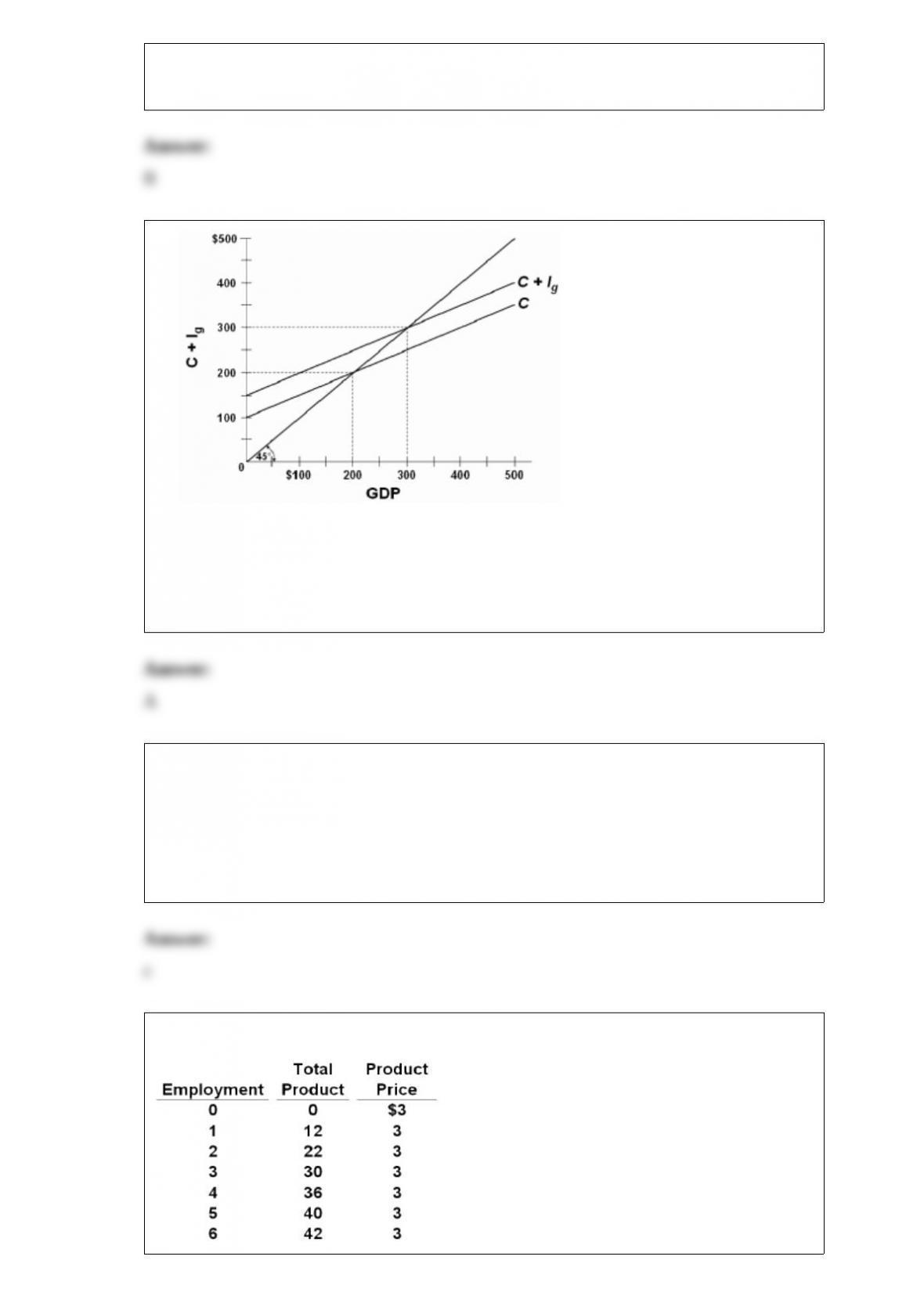
5)
Refer to the above diagram for a private closed economy. At the $300 level of GDP:
A.aggregate expenditures and GDP are equal.
B.consumption is $200 and planned investment is $50.
C.saving exceeds planned investment.
D.consumption plus saving is $400.
6) if money income increases and the prices of products a and b both increase, then the
budget line:
a.must shift to the right.
b.must shift to the left.
c.may shift either to the right or the left.
d.will no longer be tangent to an indifference curve.
7)
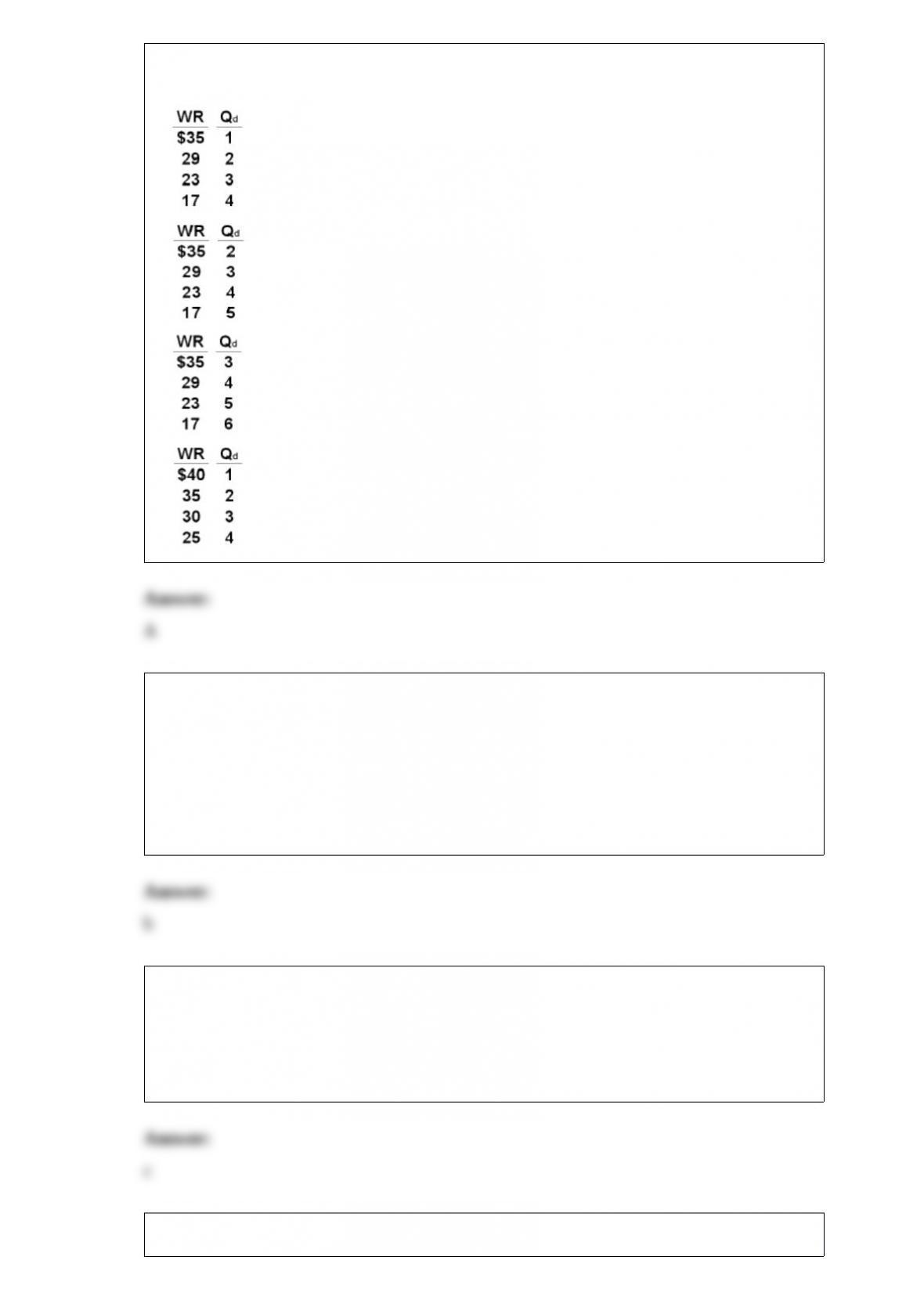
Refer to the above data. Which of the following best represents the labor demand
schedule for this firm?
A.
B.
C.
D.
8) in 2007 the price of oil increased, which in turn caused the price of natural gas to
rise. this can best be explained by saying that oil and natural gas are:
a.complementary goods and the higher price for oil increased the demand for natural
gas.
b.substitute goods and the higher price for oil increased the demand for natural gas.
c.complementary goods and the higher price for oil decreased the supply of natural gas.
d.substitute goods and the higher price for oil decreased the supply of natural gas.
9) the amount of after-tax income received by households is measured by:
a.discretionary income.
b.national income.
c.disposable income.
d.personal income.
10) the demand for health care in industrially advanced economies is:

a.highly elastic with respect to both price and income.
b.highly inelastic with respect to both price and income.
c.highly elastic with respect to income, but highly inelastic with respect to price.
d.about unit elasticity with respect to income and relatively inelastic with respect to
price.
11) Small changes in the demand for agricultural products cause large changes in farm
prices and incomes because:
A.demand is relatively elastic with respect to price.
B.demand is relatively inelastic with respect to price.
C.agricultural supply is stable in the long run.
D.the supply of agricultural products is perfectly elastic.
12) assume that in 2002 the nominal gdp was $350 billion and in 2003 it was $375
billion. on the basis of this information we:
a.cannot make a meaningful comparison of the economy’s performance in 2002 relative
to 2003.
b.can conclude that the economy was achieving real economic growth.
c.can conclude that real gdp was higher in 2002 than in 2003.
d.can conclude that real gdp was lower in 2002 than in 2003.
13)
(Consider This) The central idea illustrated by the vignette on “catgut” used as violin
strings is:
A.patent rights.
B.research and development activity.
C.derived demand.
D.trade secrets.
14) Which of the following is correct?

A.Income is a stock and wealth is a flow concept.
B.Both income and wealth are flow concepts.
C.Both income and wealth are stock concepts.
D.Income is a flow and wealth is a stock concept.
15) in a market economy the distribution of output will be determined primarily by:
a.consumer needs and preferences.
b.the quantities and prices of the resources that households supply.
c.government regulations that provide a minimum income for all.
d.a social consensus as to what distribution of income is most equitable.
16) Excess reserves refer to the:
A.difference between a bank’s vault cash and its reserves deposited at the Federal
Reserve Bank.
B.minimum amount of actual reserves a bank must keep on hand to back up its
customers deposits.
C.difference between actual reserves and loans.
D.difference between actual reserves and required reserves.
17) which of the following is a normative statement?
a.the temperature is high today.
b.the humidity is high today.
c.it is too hot to play tennis today.
d.it will cool off later this evening.