
If wages and prices adjust slowly, we would expect expansionary monetary policy to be
A) less likely to reduce the natural unemployment rate.
B) more likely to reduce inflation.
C) more likely to affect the unemployment rate.
D) more likely to result in a vertical short-run Phillips curve.
On a balance sheet, short-term debts such as accounts payable are listed as
A) current assets.
B) current liabilities.
C) stockholders’ equity.
D) goodwill.
If inventories decline by more than analysts predict they will decline, this implies that
A) actual investment spending was greater than planned investment spending.
B) actual investment spending was less than planned investment spending.
C) actual investment spending was equal to than planned investment spending.
D) there is no relationship between actual investment spending and planned investment
spending.

Doctors have ________ incentive to control their costs when consumers ________ for a
visit to the doctor’s office.
A) more; only pay a deductible
B) less; only pay a deductible
C) less; pay entirely out of pocket
D) more; have a third-party payer that pays
Which of the following is a problem inherent in centrally planned economies?
A) There are no problems and everyone, including consumers, is satisfied.
B) There is too much production of low-cost, high-quality goods and services.
C) Production managers are more concerned with satisfying government’s orders than
with satisfying consumer wants.
D) Unemployment is too high.
Suppose in Belgium, the opportunity cost of producing a trombone is 8 clarinets. In
Denmark, the opportunity cost of producing a trombone is 6 clarinets.
a. What is the opportunity cost of producing a clarinet for Belgium?
b. What is the opportunity cost of producing a clarinet for Denmark?
c. Which country has a comparative advantage in the production of clarinets?
d. Which country has a comparative advantage in the production of trombones?
If economists forecast an increase in aggregate expenditure, which of the following is
likely to occur?
A) GDP will rise.
B) GDP will fall.
C) Wages will fall.
D) Inventories will rise.

The labor force participation rate is defined as
A) the percentage of the working-age population that is employed.
B) the percentage of the working-age population that is unemployed.
C) the percentage of the labor force that is employed.
D) the percentage of the labor force that is unemployed.
E) the percentage of the working-age population in the labor force.
The natural rate of unemployment equals
A) the rate of structural unemployment.
B) structural plus frictional unemployment.
C) structural plus frictional plus cyclical unemployment.
D) the rate of unemployment we observe in any given period of measurement.
For a perfectly competitive firm, which of the following is not true at profit
maximization?
A) Market price is greater than marginal cost.
B) Marginal revenue equals marginal cost.
C) Total revenue minus total cost is maximized.
D) Price equals marginal cost.
Private solutions to the problem of externalities are most likely when
A) government actively encourages these solutions.
B) transaction costs are low and the number of bargaining parties is small.
C) transaction costs are low and the number of bargaining parties is large.
D) transaction costs are low and the monetary damages to third parties is high.
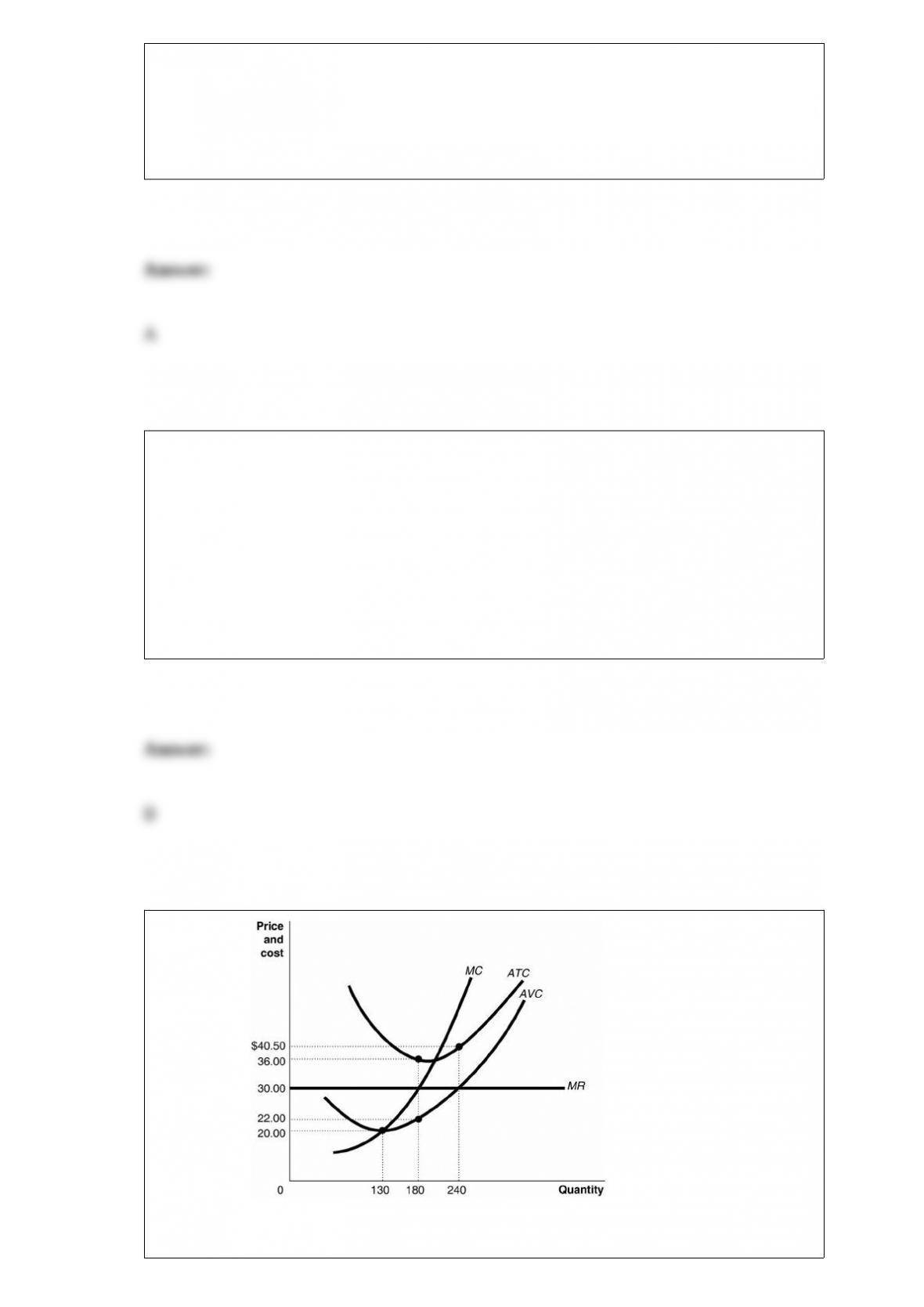
Figure 12-4 Figure 12-4 shows the cost
and demand curves for a profit-maximizing firm in a perfectly competitive market. If
the market price is $30, should the firm represented in the diagram continue to stay in

business?
A) No, it should shut down because it is making a loss.
B) No, it should shut down because it cannot cover its variable cost.
C) Yes, because it is covering part of its fixed cost.
D) Yes, because it is making a profit.
If you received negative marginal utility from consuming the 4th slice of pizza, then
your total utility from 4 slices of pizza must be less than your total utility from 3 slices
of pizza.
If we use a narrow definition of monopoly, then a monopoly is defined as a firm
A) that has been granted special production rights by the government.
B) that can ignore the actions of all other firms because it produces a superior product
compared to its rivals’ products.
C) that can ignore the actions of all other firms because it produces a product for which
there are no close substitutes.
D) that has the largest market share in an industry.