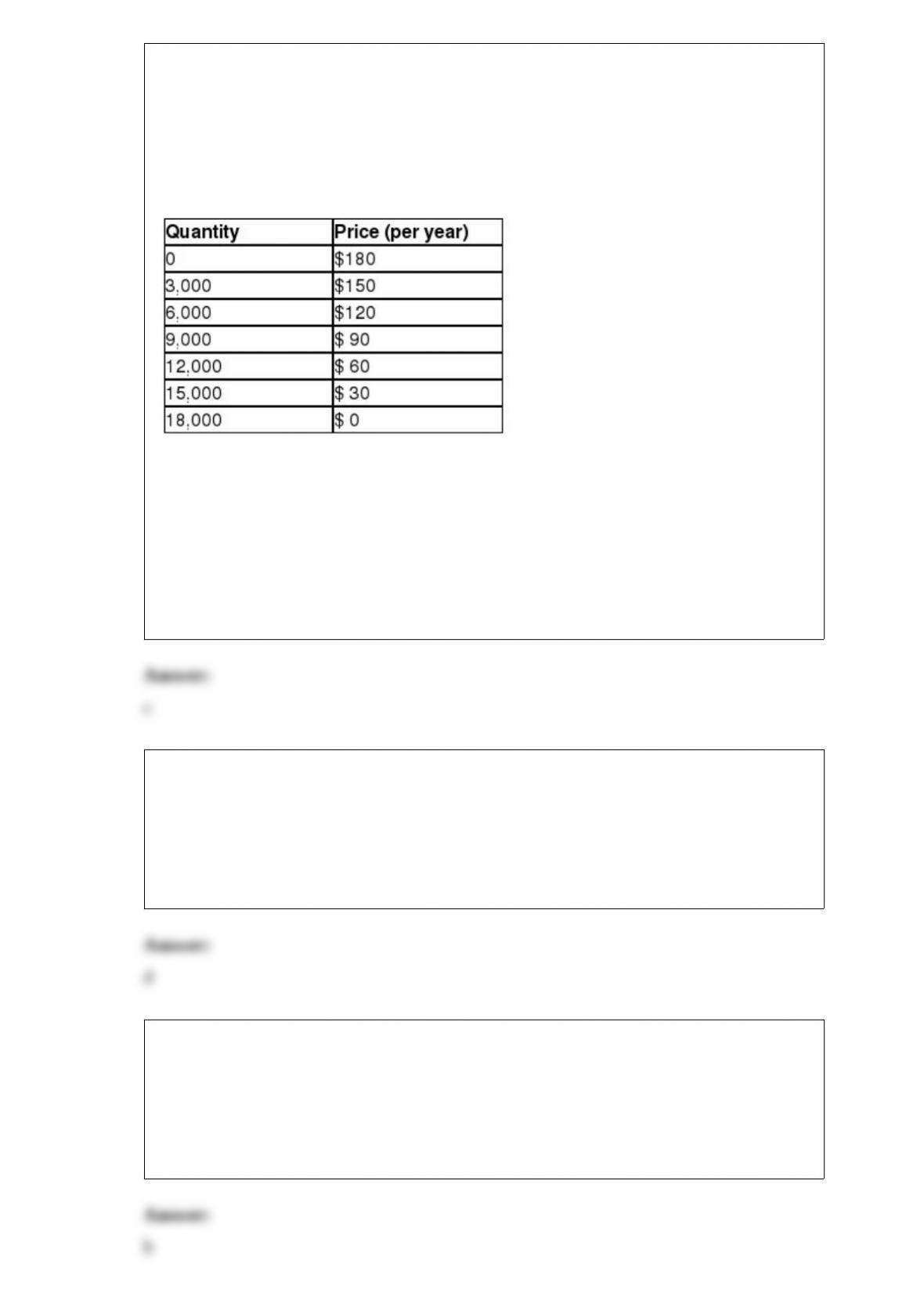
1) Table 17-5
The information in the table below shows the total demand for premium-channel digital
cable TV subscriptions in a small urban market. Assume that each digital cable TV
operator pays a fixed cost of $200,000 (per year) to provide premium digital channels in
the market area and that the marginal cost of providing the premium channel service to
a household is zero.
Refer to Table 17-5. Assume that there are two profit-maximizing digital cable TV
companies operating in this market. Further assume that they are not able to collude on
the price and quantity of premium digital channel subscriptions to sell. How much
profit will each firm earn when this market reaches a Nash equilibrium?
a. $25,000
b. $90,000
c. $160,000
d. $215,000
2) Employing a lawyer to draft and enforce a private contract between parties wishing
to solve an externality problem is an example of
a.an opportunity cost.
b.an implicit cost.
c.a sunk cost.
d.a transaction cost.
3) Suppose demand is perfectly inelastic, and the supply of the good in question
decreases. As a result,
a.the equilibrium quantity decreases, and the equilibrium price is unchanged.
b.the equilibrium price increases, and the equilibrium quantity is unchanged.
c.the equilibrium quantity and the equilibrium price both are unchanged.
d.buyers’ total expenditure on the good is unchanged.

4) When a firm’s demand curve is tangent to its average total cost curve, the
a.firm’s economic profit is zero.
b.firm must be earning economic profits.
c.firm must be incurring economic losses.
d.firm must be operating at its efficient scale.
5) Which of the following is not an example of a moral hazard problem?
a.A manager stays late one evening so that her employee can leave early to attend his
child’s music recital.
b.A small child takes an extra cookie from the cookie jar when he thinks his mom isn’t
watching him closely.
c.An employee plays solitaire on her computer at 4:30 p.m. on a Friday when her boss
has left for the day.
d.A customer whose new eyeglasses come with a “60day insurance policy in case of
breakage” leaves her glasses out where her new puppy can chew on them.
6) Entry by new firms into a monopolistically competitive market
a.creates additional consumer surplus.
b.imposes a positive externality on existing firms.
c.leads to the same externalities that are observed when new firms enter a perfectly
competitive market.
d.increases the demand for existing firms’ products.
7) Who pays a corporate income tax?
a.owners of the corporation
b.customers of the corporation
c.workers of the corporation
d.All of the above are correct.
8) Assume that Greece has a comparative advantage in fish and Germany has a
comparative advantage in cars. Also assume that Germany has an absolute advantage in
both fish and cars. If these two countries specialize and trade so as to maximize the
benefits of specialization and trade, then
a.the two countries’ combined output of both goods will be higher than it would be in
the absence of trade.
b.Greece will produce more fish than it would produce in the absence of trade.
c.Germany will produce more cars than it would produce in the absence of trade.
d.All of the above are correct.
9) Which of the following would cause a movement along the supply curve for
cupcakes?
a.an improvement in technology for commercial mixers
b.a decrease in the price of cupcakes
c.an increase in the price of cake flour
d.All of the above are correct.
10) Critics argue that a disadvantage of the Earned Income Tax Credit is that it does not
effectively target the working poor because many recipients are the teenage children of
middle-income families.
a.True
b.False
11) Consumer surplus can be measured as the area between the demand curve and the
supply curve.
a.True
b.False
12) A streetlight is a
a.private good.
b.club good.
c.common resource.
d.public good.

13) Which of the following statements is not correct?
a.Welfare programs may encourage illegitimate births.
b.The decline in welfare benefits since the 1970s has been associated with a decline in
the percentage of children living with a single parent.
c.Welfare programs may reduce incentives for people to work.
d.A negative income tax program uses tax revenues collected from high-income
families to provide cash subsidies to low-income families.
14) Good news for farming can be bad news for farmers because the
a.supply curve for an individual farmer is usually perfectly elastic.
b.supply curve for an individual farmer is usually perfectly inelastic.
c.demand for basic foodstuffs is usually inelastic, meaning that factors that shift supply
to the right decrease total revenues to sellers.
d.demand for basic foodstuffs is usually elastic, meaning that factors that shift supply to
the right increase total revenues to sellers.
15) Who said, The whole of science is nothing more than the refinement of everyday
thinking?
a.Isaac Newton
b.Albert Einstein
c.Adam Smith
d.Benjamin Franklin
16) Figure 8-11
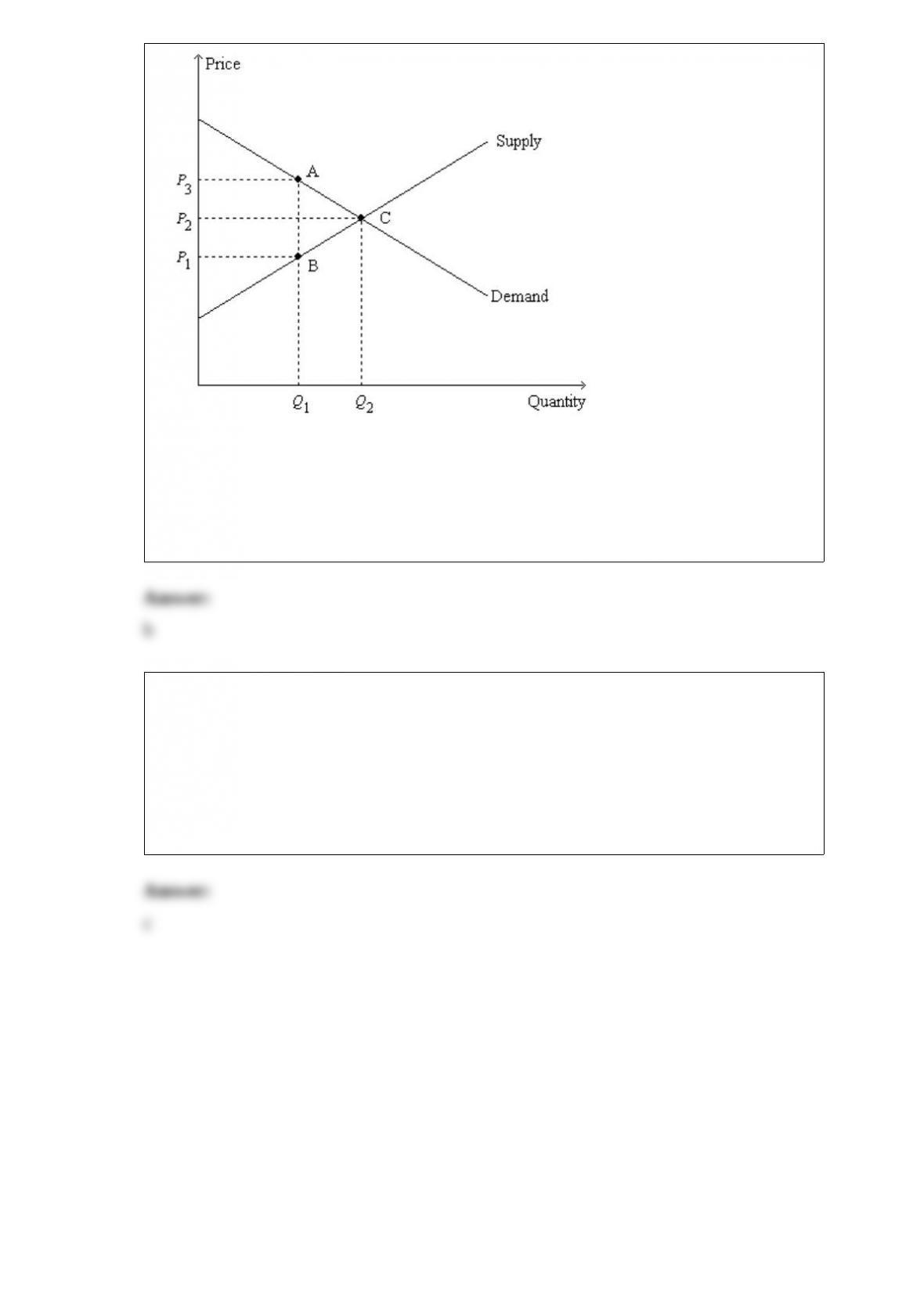
The price labeled as P1on the vertical axis represents the price
a.received by sellers before the tax is imposed.
b.received by sellers after the tax is imposed.
c.paid by buyers before the tax is imposed.
d.paid by buyers after the tax is imposed.
17) In a natural monopoly,
a.society would be better off if antitrust laws were used to create many different firms
in the market.
b.the marginal cost curve is positively sloped.
c.if the government requires marginal cost pricing, it will likely have to subsidize the
firm.
d.the marginal revenue curve is horizontal.