
1) about three-fourths of all health care costs are paid out-of-pocket by patients.
2) Changes in the interest rate are more likely to affect investment spending than
consumer spending.
3) Fisheries have been overexploited relative to forests primarily because people care
more about trees than fish.
4) a price index is 100 times the ratio of real gdp to nominal gdp.
5) minimum efficient scale varies by industry.
6) allocative efficiency occurs where (for the last unit) maximum willingness to pay
exceeds minimum acceptable price by the greatest amount.
7) In an uncontrolled or unregulated system commercial bank lending will tend to
intensify the business cycle.
8) Cost-benefit analysis is frequently difficult to apply because it is difficult to quantify
the full benefits of a public good or service.
9) gross private domestic investment exceeds depreciation in an economy that
experiences expanding production capacity.
10) The U.S. poverty rate for African-Americans is substantially higher than that for
Asians.
11) The interest-rate effect is one of the determinants of aggregate demand.
12) The Economist’s Commodity Price Index reveals that the supply of productive
resources has increased faster than the demand for decades.
13)
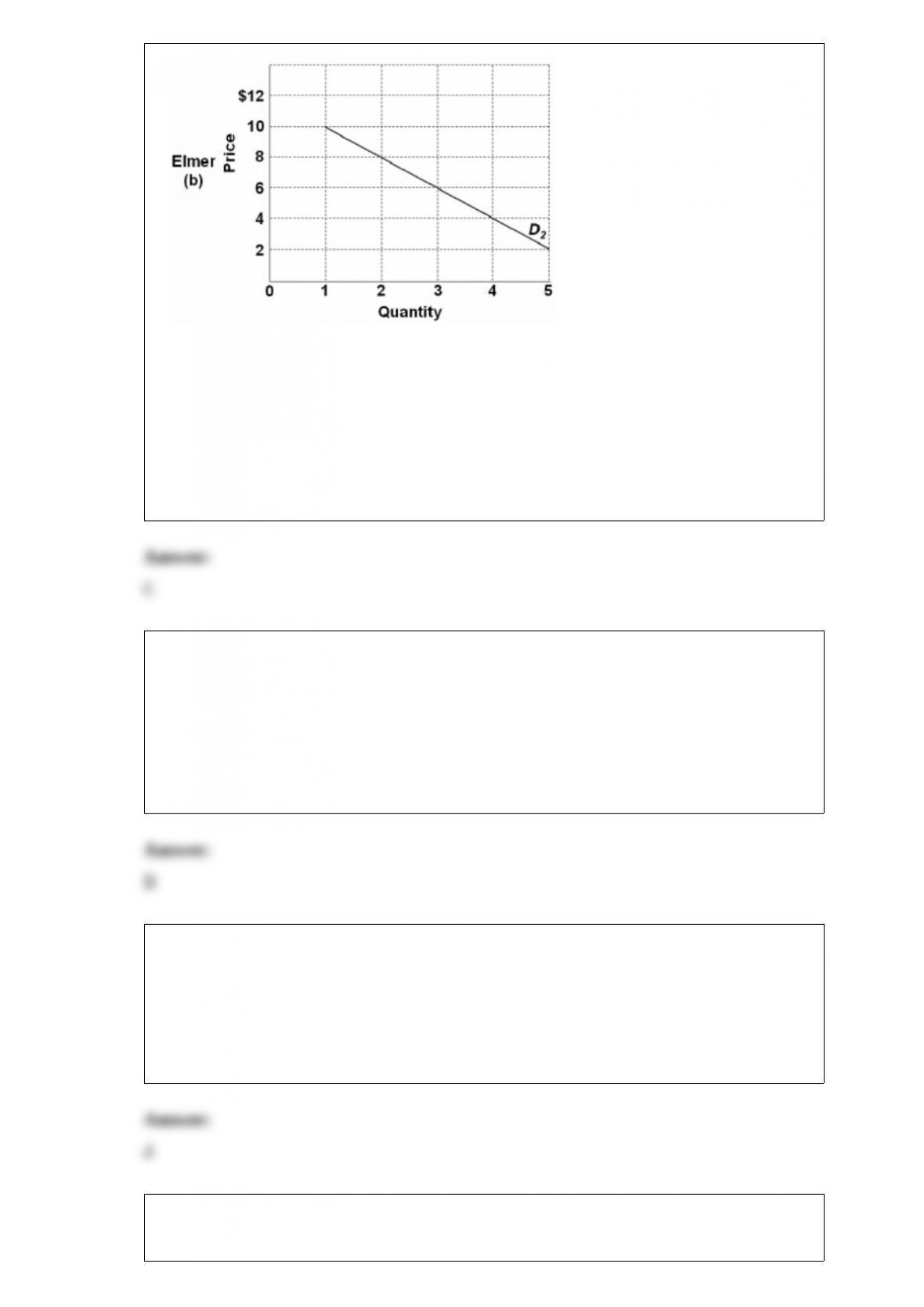
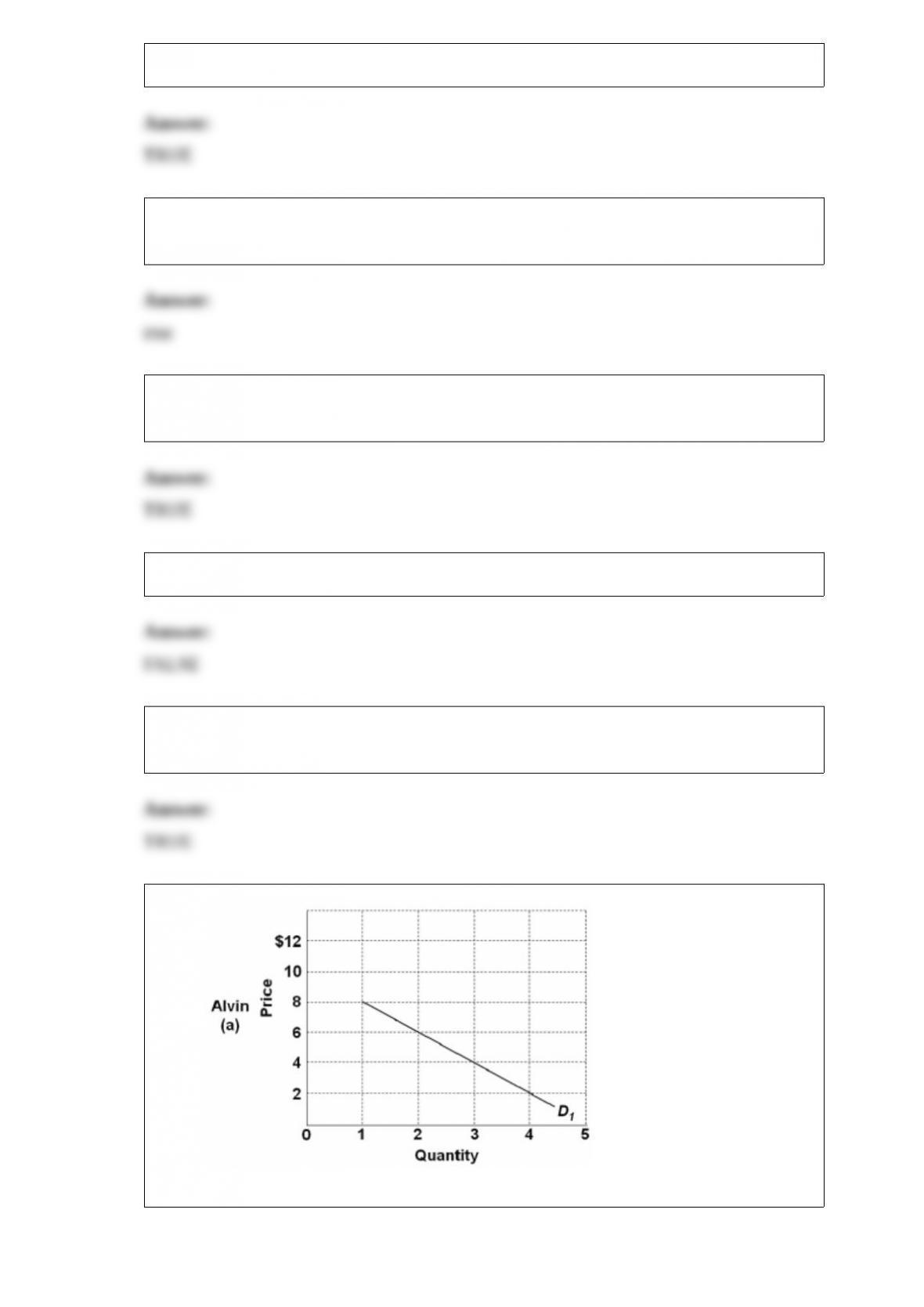
Refer to the above diagrams in which figures (a) and (b) show demand curves reflecting
the prices Alvin and Elmer are willing to pay for a public good, rather than do without
it. If the marginal cost of the optimal quantity of this public good is $10, the optimal
quantity must be:
A.1 unit.
B.2 units.
C.3 units.
D.4 units.
14) The share of income going to the highest 10 percent of income receivers is:
A.nearly 75 percent in the United States.
B.lower in the United States than in some South American countries such as Mexico,
Guatemala, and Brazil.
C.lower today in the United States than in 1969.
D.remarkably similar over a wide range of nations, including those which are rich and
those which are poor.
15) if real gdp in a particular year is $80 billion and nominal gdp is $240 billion, the
gdp price index for that year is:
a.100.
b.200.
c.240.
d.300.
16) which of the following is not a basic characteristic of pure competition?
a.considerable nonprice competition
b.no barriers to the entry or exodus of firms
c.a standardized or homogeneous product
d.a large number of buyers and sellers
17) A nation’s export supply curve for a specific product:
A.is upsloping.
B.shows the amount of the product it will export at prices below its domestic price.
C.lies below its import demand curve for the product.
D.depends on domestic supply of the product, but not on domestic demand.
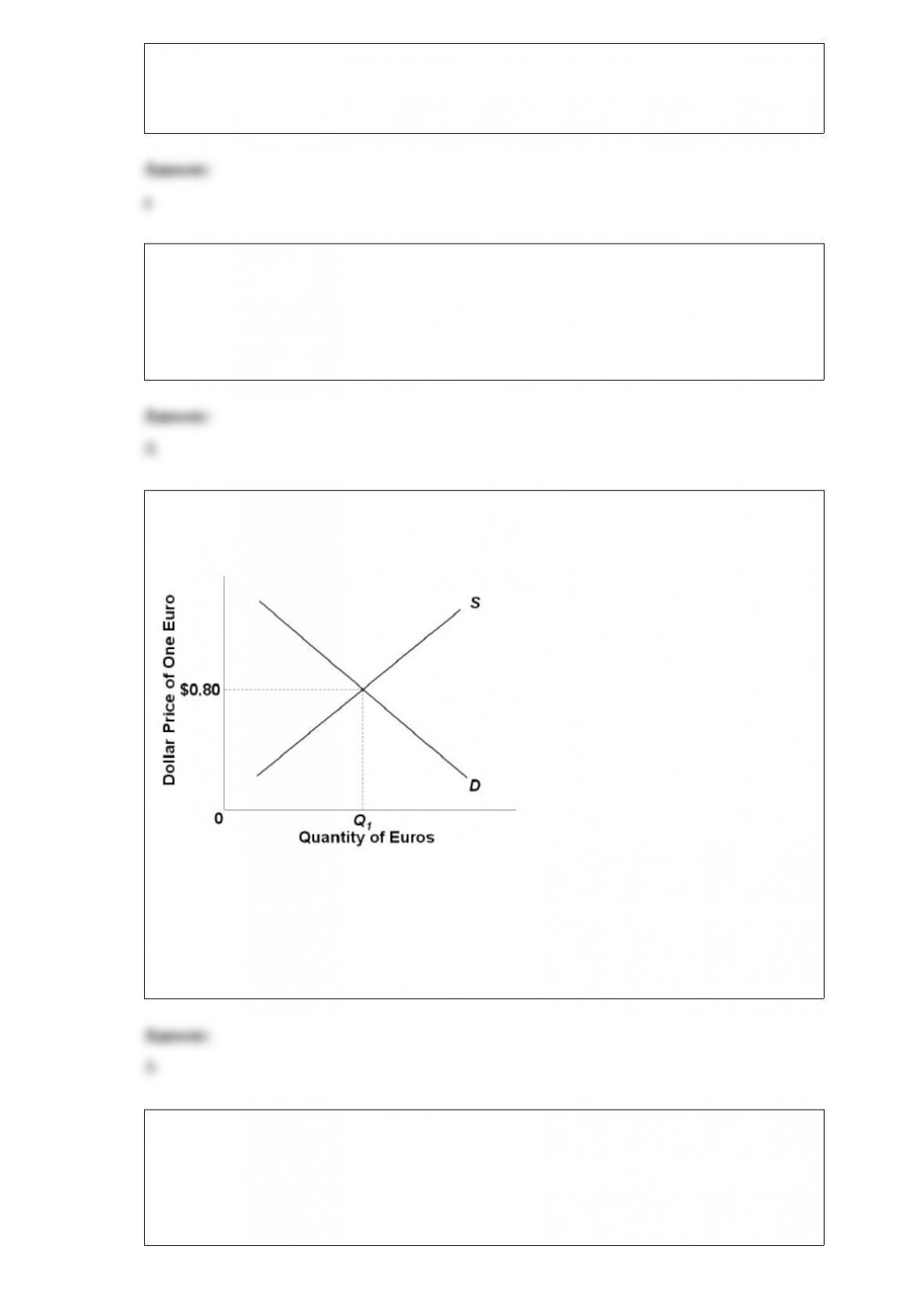
18) The following diagram is a flexible exchange market for foreign currency:
Refer to the above diagram. Other things equal, a rightward shift of the demand curve
would:
A.depreciate the dollar.
B.appreciate the dollar.
C.reduce the equilibrium quantity of euros.
D.depreciate the euro.
19) According to the Taylor rule, if inflation has risen by 6 percentage points above its
target of 2 percent, the Fed should:
A.grow the money supply at a rate of 6 percent per year.
B.raise the real Federal funds rate by 6 percentage points.
C.raise the real Federal funds rate by 3 percentage points.
D.raise the real Federal funds rate by 12 percentage points.
20) (Consider This) Violin strings made from sheep intestines were first called “catgut”
because:
A.at the time it was thought to be extremely unlucky to kill sheep.
B.the inventor wanted to establish a legally protected brand name.
C.the inventor wanted to preserve his trade secret.
D.the inventor thought that “catgut” would sound less offensive to buyers than ‘sheep
intestines.”
21) some modern theories of consumer behavior have:
a.emphasized that consumption is basically an instantaneous act.
b.contended that in the mux/px = muy/py equation mu is understated for time-intensive
goods.
c.introduced the opportunity cost of time as a component of product price.
d.argued that inflationary expectations negate the theory of consumer behavior.
22)
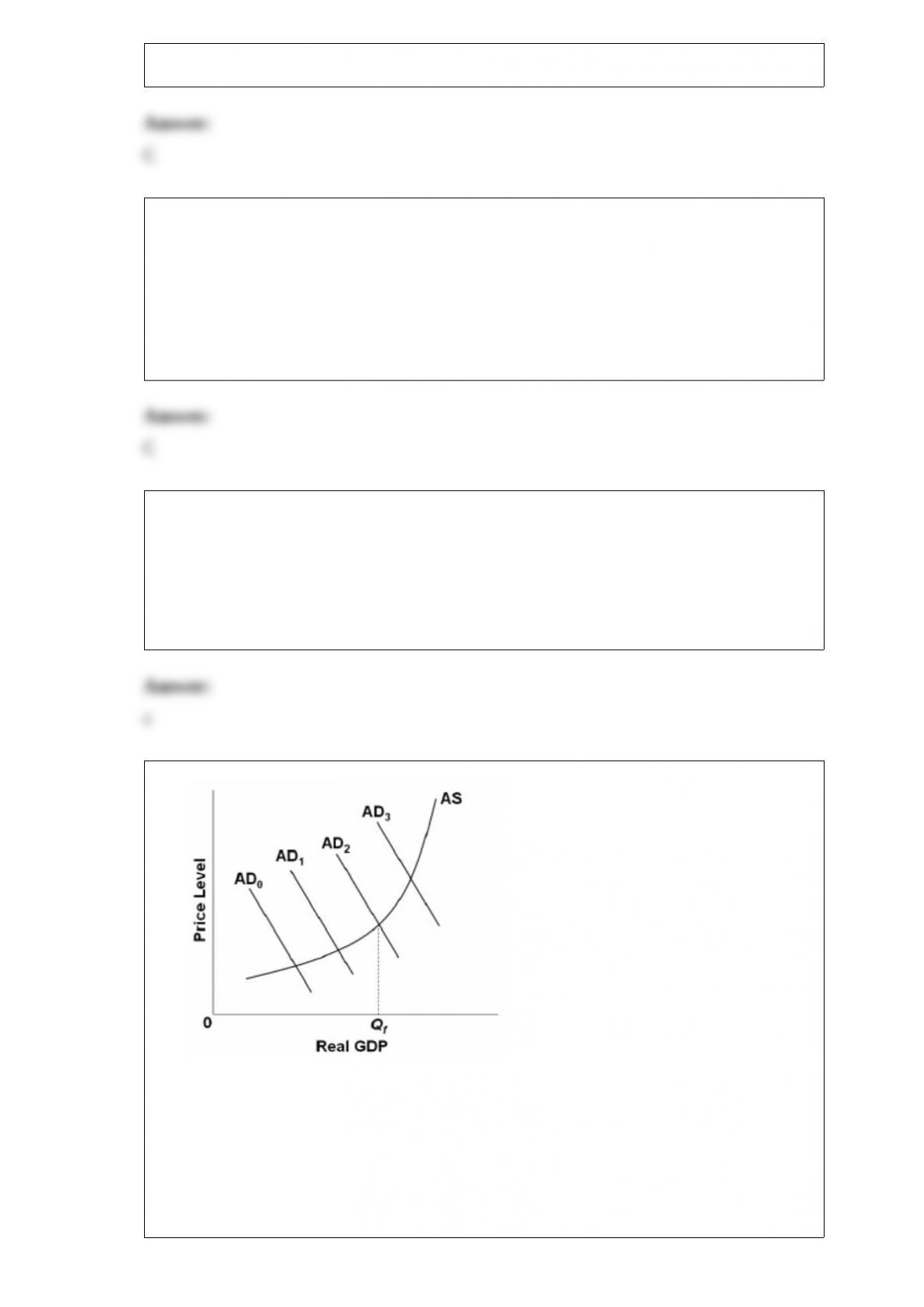
Refer to the above diagram, in which Qf is the full-employment output. A
contractionary fiscal policy would be most appropriate if the economy’s present
aggregate demand curve were at:
A.AD0.
B.AD1.
C.AD2.
D.AD3.
23) The Clean Air Act of 1990:
A.places taxes on utilities emitting sulfur dioxide, the major cause of acid rain.
B.sets aside billions of dollars to promote recycling.
C.allows utilities to buy and sell sulfur dioxide emission credits provided by
government.
D.places taxes on producers who emit toxic chemicals.
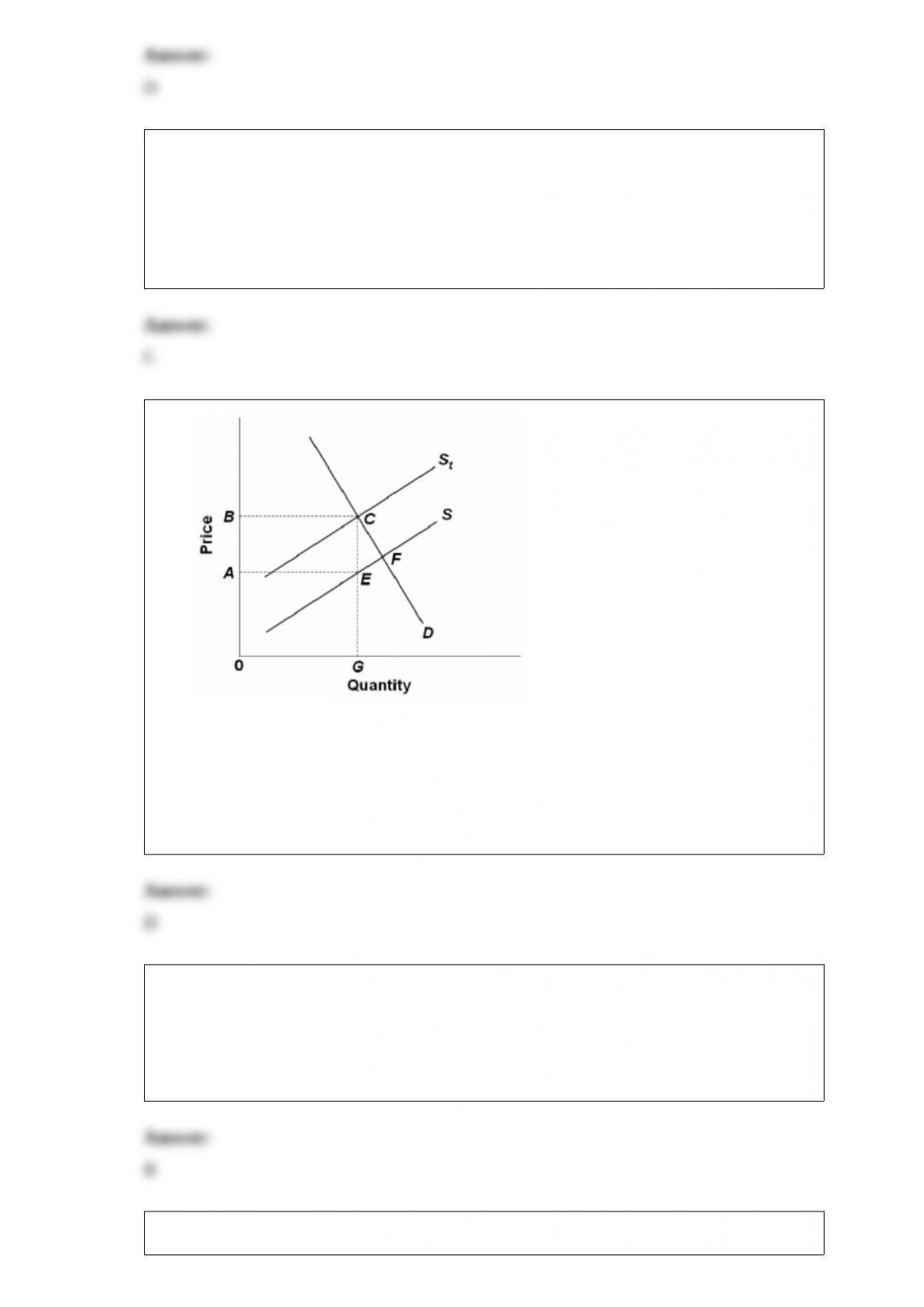
24)
Refer to the above figure in which S is the before-tax supply curve and St is the supply
curve after an excise tax is imposed. The efficiency loss of this tax will be area:
A.ABCE.
B.ABCE + ECF.
C.0AEG.
D.ECF.
25) Which of the following would call for outpayments from the United States?
A.U.S. exports computer software
B.U.S. purchases assets abroad
C.foreigners purchase assets in the United States
D.foreign tourists spend money in the United States
26) the mr = mc rule applies:

a.to firms in all types of industries.
b.only when the firm is a “price taker.”
c.only to monopolies.
d.only to purely competitive firms.
27) As it relates to R&D, the imitation problem is that:
A.patents, copyrights, and trademarks hinder imitation and thus limit economically
desirable diffusion.
B.brand names create entry barriers for would-be competitors.
C.diffusion of innovation occurs more slowly than is desirable from society’s
perspective.
D.a firm’s rivals may be able to copy its new product or process innovation, reducing its
return on R&D.
28) If the MPS in an economy is .1, government could shift the aggregate demand curve
rightward by $40 billion by:
A.increasing government spending by $4 billion.
B.increasing government spending by $40 billion.
C.decreasing taxes by $4 billion.
D.increasing taxes by $4 billion.
29) the scarcity problem:
a.persists only because countries have failed to achieve continuous full employment.
b.persists because economic wants exceed available productive resources.
c.has been solved in all industrialized nations.
d.has been eliminated in affluent societies such as the united states and canada.
30) The following data for the hypothetical nations of Alpha and Beta. Qs is domestic
quantity supplied and Qd is domestic quantity demanded.
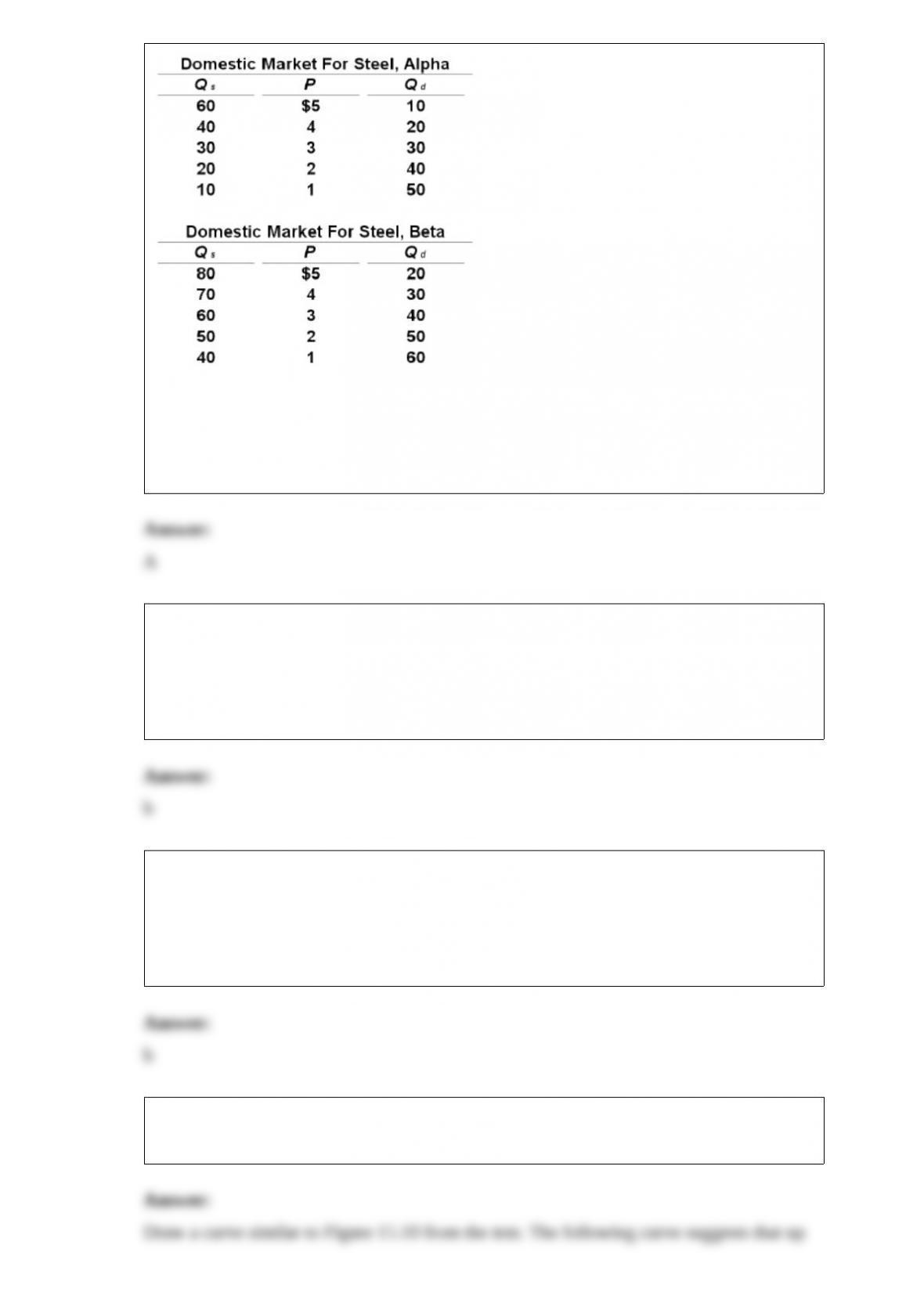
Refer to the above data. At a world price of $2:
A.Alpha will want to import 20 units of steel.
B.Beta will want to export 20 units of steel.
C.Alpha will want to export 20 units of steel.
D.neither country will want to import steel.
31) when a consumer is maximizing total utility,
a.the average utility from each dollar spent is the same.
b.total utility cannot be increased by reallocating expenditures among various products.
c.the total utility obtainable from each product is at a maximum.
d.the marginal utility of the last unit of each product purchased is zero.
32) daily newspapers are relatively inexpensive because:
a.total variable costs and total fixed costs are low.
b.the overhead costs are spread over a large number of buyers.
c.capital has replaced virtually all labor used to produce a newspaper.
d.government subsidizes their production in most major cities.
33) Draw a Laffer Curve and explain the relationship it purports to portray. Why might
this curve be important for macroeconomic policy?
34) Differentiate between expansionary and restrictive monetary policies.
35) How effective have antitrust laws been in breaking up existing monopolies?
36) What are the major differences between industrial regulation and social regulation?
Cite examples of Federal commissions that address the two types of regulation.

37) What is the extent of income inequality among nations? Explain, citing relevant
data on incomes received by populations and total GDP in the United States and
developing nations.
38) What determines the equilibrium price level and the level of real domestic output in
the aggregate demandaggregate supply model?