
If a perfectly competitive firm and a monopolistic competitive firm face the same
demand and cost curves, then
a. the perfectly competitive firm will attain resource-allocative efficiency, but the
monopolistic competitive firm will not.
b. the perfectly competitive firm will attain resource-allocative efficiency, but the
monopolistic competitive firm may or may not, depending upon the demand for its
product.
c. the perfectly competitive firm will not attain resource-allocative efficiency, but the
monopolistic competitive firm will.
d. both the perfectly competitive firm and the monopolistic competitive firm will attain
resource-allocative efficiency.
e. neither the perfectly competitive firm nor the monopolistic competitive firm will
attain resource-allocative efficiency.
Consider two labor markets, A and B. Wages in labor market A rise. This could be due
to
a. decreasing wages in labor market B.
b. an increase in the negative nonpecuniary aspects of working in labor market A.
c. an increase in the number of people who can do the work that is done in labor market
A.
d. a decrease in the demand for the product that employees in labor market A produce.
e. a and d

Situation 27-2 A company is trying to decide whether it should produce good Y in the
U.S. or in Mexico.Suppose a U.S. worker earns $12 per hour and a worker in Mexico
earns $4 per hour.Also suppose that the marginal physical product (MPP) of the U.S.
worker is 10 units of good Y and the MPP of the Mexican worker is 5 units of good Y.
The output produced per $1 of cost in the U.S. is
a. 120 units of good Y.
b. 0.83 units of good Y.
c. 22 units of good Y.
d. 2 units of good Y.
Exhibit 23-10
What price does this firm charge for its product?
a. $10
b. $20
c. $25
d. $30
e. There is not enough information to answer this question.
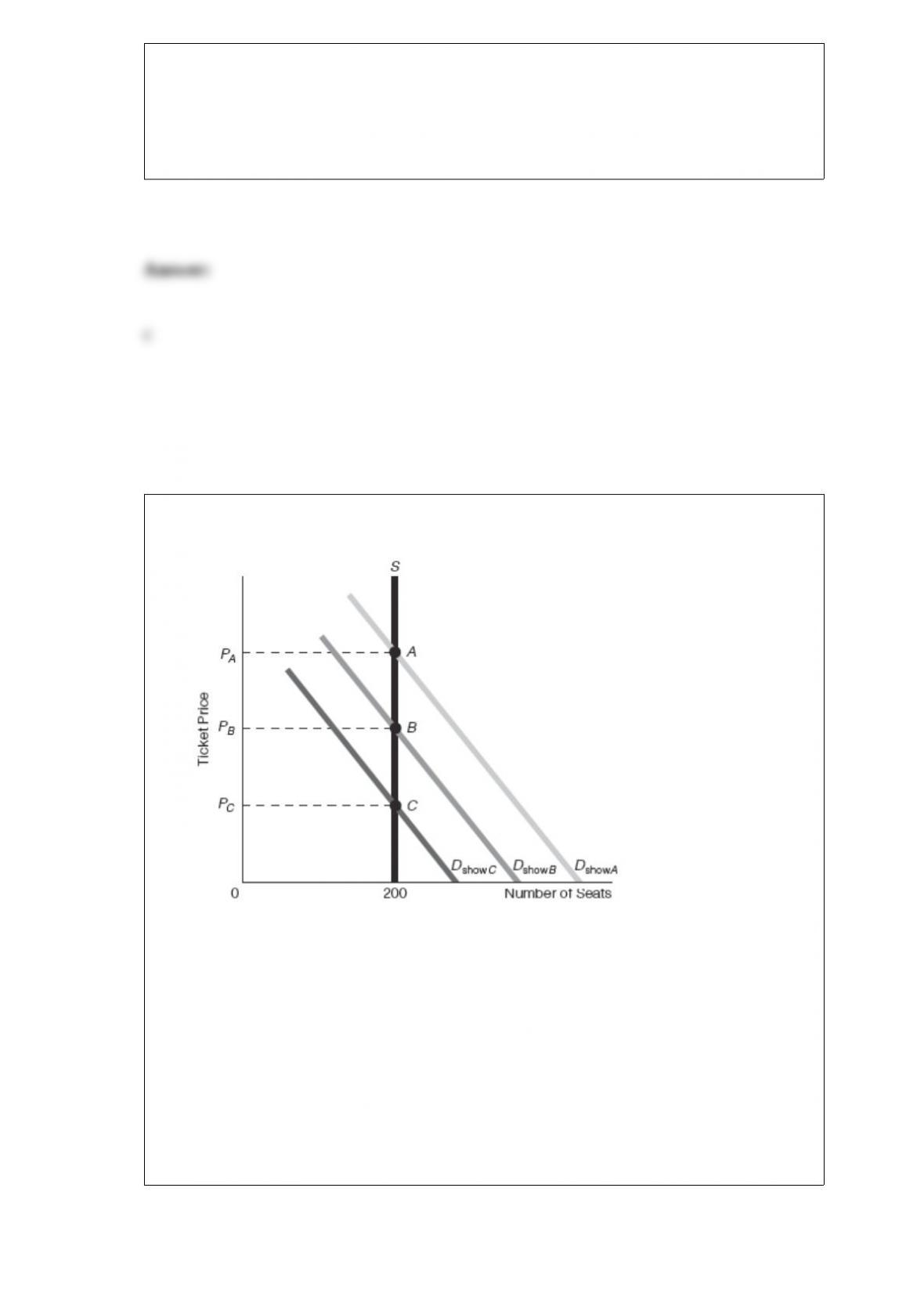
Exhibit 5-4
If tickets for viewing television show tapings are free, for which show will fans most
likely have the longest wait to get tickets?
a. A
b. B
c. C
d. Wait times for tickets to all shows are equally long.
Which of the following curves should one look at to observe the law of diminishing
marginal returns?
a. the average fixed cost curve
b. the total fixed cost curve
c. the marginal physical product curve
d. the long run average total cost curve
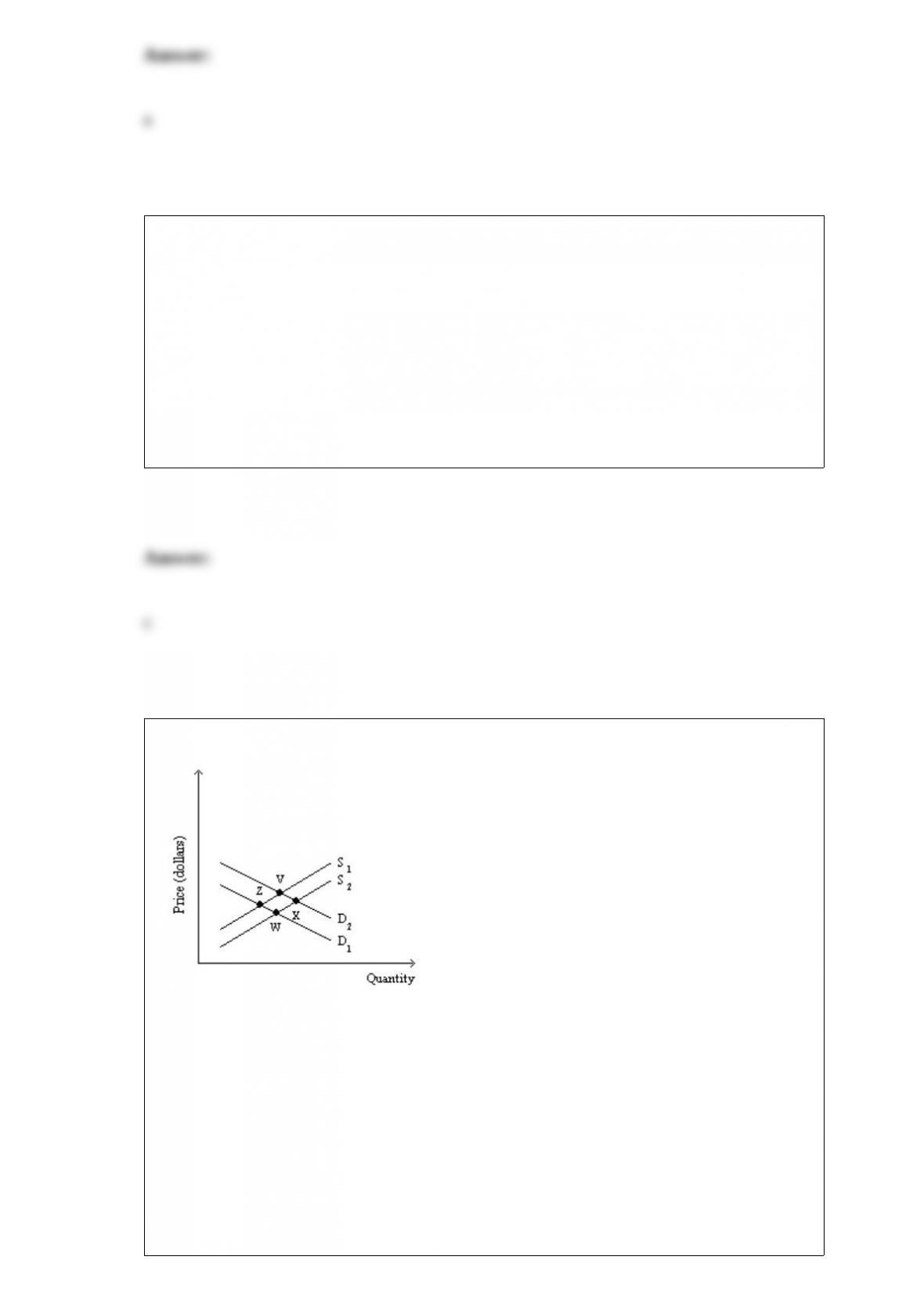
Exhibit 3-5
In the market shown, a rightward shift in supply from S1 to S2 could have been caused
by
a. a decline in the number of buyers in the market.
b. a decline in the price of a substitute good.
c. a decrease in income (assuming the good is a normal good).

d. the granting of a subsidy to the producer.
e. none of the above
The infant industry argument for trade protectionism holds that
a. new industries sometimes need a protective environment in which to grow so that
they can compete with older, more established foreign competitors.
b. foreign competitors are often viewed as “infants” by large U.S. firms.
c. tariffs are often preferred to quotas.
d. quotas raise prices more than tariffs raise prices.
e. a and c
A good is nonexcludable if no externalities, either negative or positive, are associated
with its production or consumption.
a. True
b. False

Given an 8 percent increase in wages, firm A cuts back on labor more than firm B. It
follows that, ceteris paribus,
a. there are likely fewer substitutes for labor in firm B than firm A.
b. there are likely fewer substitutes for labor in firm A than firm B.
c. sunk costs are greater for firm A than firm B.
d. the demand for the product that firm A produces is likely less elastic than the product
that firm B produces.
e. a and d
Which of the following statements is false?
a. Under an emission tax, a tax is set and then the quantity of permissible pollution is
determined.
b. Under both emission taxes and tradable pollution permits polluters must pay to
pollute.
c. One possible approach to dealing with the problem of environmental negative
externalities is a policy of tradable pollution permits, also known as cap and trade.
d. Under a tradable pollution permits system, a price of pollution is set and then the
quantity of permissible pollution is determined based upon that price.

Interdependence implies that each firm in an industry
a. is independent of one another and are essentially price takers.
b. is aware that its actions influence the others and that the actions of the other firms
affect it.
c. is so large and powerful that they do not need to consider how their actions will affect
their rivals.
d. must depend on the other firms to maintain consumers’ interest in their “mutual”
product.
As the price of good X rises from $1.50 to $1.75 the result is a decrease in the quantity
demanded of good X from 650 units to 590 units. The price elasticity of demand for
good X is _____________ and total revenue __________ as the price of good X rises
from $1.50 to $1.75.
a. 0.63; falls
b. 1.59; rises
c. 1.59; falls
d. 0.63; rises
Exhibit 26-4

The problem with average-cost pricing regulation is that once it is in place, there is a
tendency for the
a. D curve to shift rightward.
b. D curve to shift leftward.
c. ATC curve to shift upward.
d. ATC curve to shift downward.
e. MR curve to shift leftward.
A Gini coefficient of zero means there is
a. perfect income equality.
b. perfect income inequality.
c. a more equal distribution of income than before.
d. a less equal distribution of income than before.
e. the same distribution of income as before.