
1) to fully realize economic growth through the efficiency factor, an economy must
increase its stock of capital goods and improve its technology.
2) The following information. Assume that by devoting all its resources to the
production of X, nation Alpha can produce 40 units of X. By devoting all its resources
to Y, Alpha can produce 60Y. Comparable figures for nation Beta are 60X and 40Y.
Refer to the above information. Beta would prefer terms of trade at, or close to, 1X =
11/2Y.
3) Exports are added to, and imports are subtracted from, aggregate expenditures in
moving from a closed to an open economy.
4) allocative efficiency occurs where (for the last unit) maximum willingness to pay
exceeds minimum acceptable price by the greatest amount.
5) antiques tend to have highly inelastic supply curves.
6) Fisheries have been overexploited relative to forests primarily because people care
more about trees than fish.
7) The law of increasing opportunity costs limits international specialization.

8) The United States is in imminent danger of running out of energy.
9) Commercial bank reserves are an asset to commercial banks but a liability to the
Federal Reserve Bank holding them.
10) because employer payments for health insurance are not subject to income or
payroll taxes, government in effect provides a subsidy to health care.
11) If two resources are complementary, a decrease in the price of one will reduce the
demand for the other.
12) When congressional representatives vote on an appropriations bill, they must vote
yea or nay, taking the bad with the good. This statement best reflects the:
A.paradox of voting.
B.special-interest effect.
C.benefits-received principle.
D.idea of limited and bundled choice.
13) a large underground economy results in an:
a.understated gdp.
b.overstated gdp.
c.understated gdp price index.
d.overstated gdp price index.

14) Which of the following best describes the short-run problem faced by farms?
A.New technology has increased the productivity of farmers and therefore resulted in
declining farm prices and low farm incomes.
B.The highly inelastic nature of agricultural demand, together with fluctuations in
exports of farm goods, has caused small year-to-year fluctuations in farm output to
result in highly unstable farm incomes.
C.The supply of farm products has increased relative to the demand for them, and
because demand is inelastic, prices of farm output and farm income have therefore
declined.
D.The demand for farm products has increased relative to their supply, but the elastic
nature of agricultural demand has caused these shifts to result in declining farm
incomes.
15) All of the following increase the expected rate of return on R&D expenditures,
except:
A.patents.
B.trademarks.
C.imitation by others.
D.trade secrets.
16) farmers often find that large bumper crops are associated with declines in their
gross incomes. this suggests that:
a.farm products are normal goods.
b.farm products are inferior goods.
c.the price elasticity of demand for farm products is less than 1.
d.the price elasticity of demand for farm products is greater than 1.
17) the law of diminishing marginal utility explains why:
a.supply curves slope upward.
b.demand curves slope downward.
c.drug addicts can never get enough.
d.people will only consume their favorite goods and not try new things.

18) A rightward shift of the AD curve in the very steep upper part of the upsloping AS
curve will:
A.increase real output by more than the price level.
B.increase the price level by more than real output.
C.reduce real output by more than the price level.
D.reduce the price level by more than real output.
19) Assume the current equilibrium level of income is $200 billion as compared to the
full-employment income level of $240 billion. If the MPC is 0.625, what change in
aggregate expenditures is needed to achieve full employment?
A.a decrease of $12 billion
B.an increase of $25 billion
C.an increase of $10 billion
D.an increase of $15 billion
20) the consumer price index was 177.1 in 2001 and 179.9 in 2002. therefore, the rate
of inflation in 2002 was about:
a.6.7 percent.
b.3.4 percent.
c.1.6 percent.
d.4.1 percent.
21)
Refer to the above diagram. The multiplier in this economy is:
A.0E/0A.
B.BD/FG.
C.FG/BD.
D. BD/AD
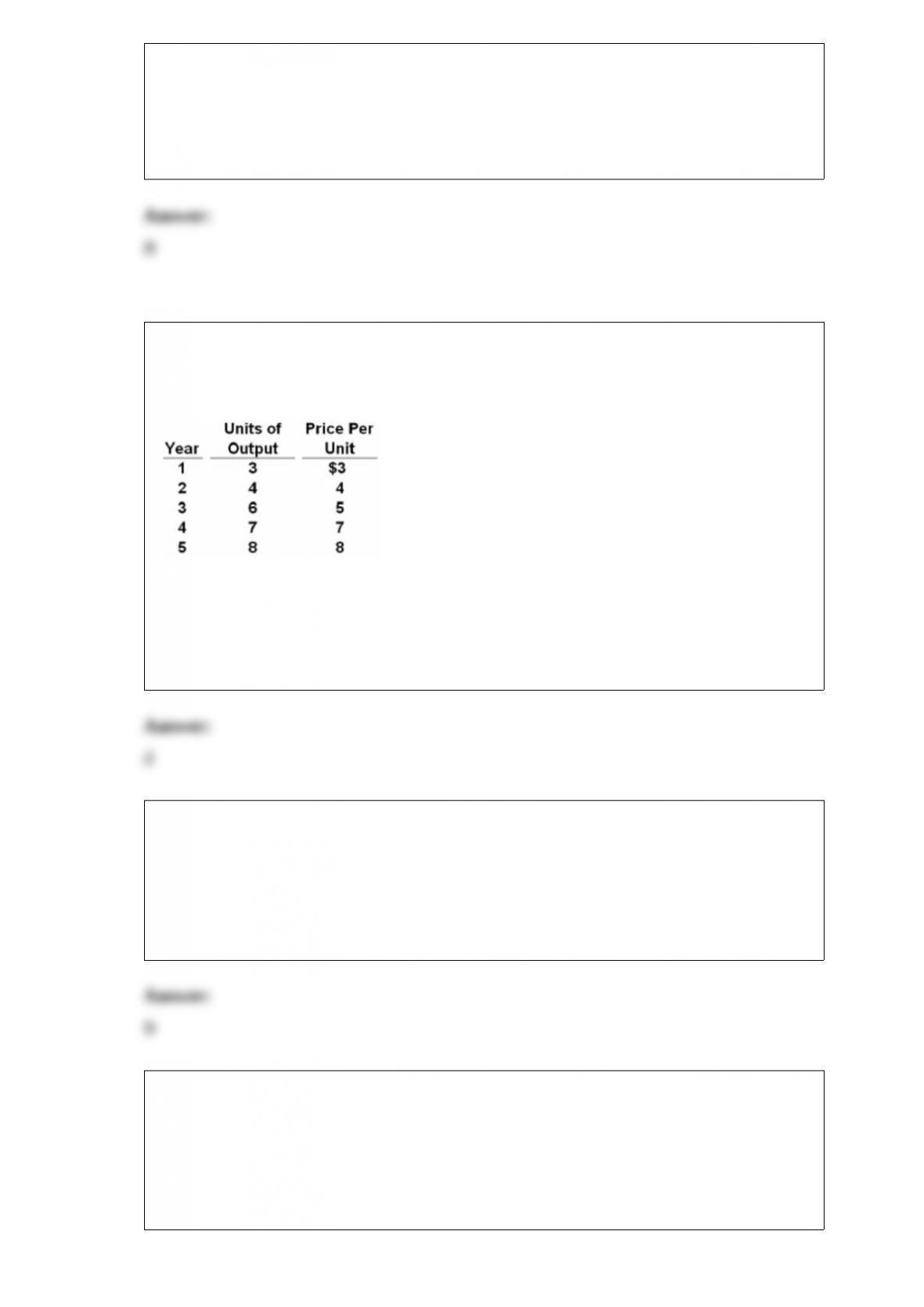
22) assume an economy that is producing only one product and that year 3 is the base
year. output and price data for a five-year period are as follows. answer the next
question(s) on the basis of these data.
refer to the above data. if year 3 is chosen as the base year, the price index for year 1 is:
a.140.
b.40.
c.167.
d.60.
23) The productivity and real wages of workers in the industrially advanced economies
have risen historically partly because:
A.workers have acquired less education and training over time.
B.workers have been able to use larger quantities of capital equipment.
C.over time the capital equipment used by workers has deteriorated in quality.
D.the supply of labor has increased.
24) when an economy is operating under conditions of full employment, the production
of more of commodity a will mean the production of less of commodity b because:
a.of the law of increasing opportunity costs.
b.economic wants are insatiable.
c.resources are limited.
d.resources are specialized and only imperfectly substitutable.

25) How would you describe the demand curve for the purely competitive firm? For the
industry?
26) Why cant an individual firm raise its price by reducing output or lower its price to
increase sales volume in a purely competitive market?
27) Summarize the historical growth record of the United States over the past 50 years
in terms of real GDP growth and in terms of real GDP per capita growth. What three
qualifications should be made about these growth rates?
28) According to the monetarists, what is the main cause of macroeconomic instability?
29) What are likely factors that have contributed the rapid increase in population from
1800 to today?
30) Discuss the unequal burden of unemployment for different demographic groups in
the United States.

31) What is the meaning of negative self-selection as it relates to unemployment in
low-income nations and immigration?
32) Calculate the rate of inflation between Year 1 and Year 2. The price index in Year 1
was 10. It was 130.7 in Year 2.