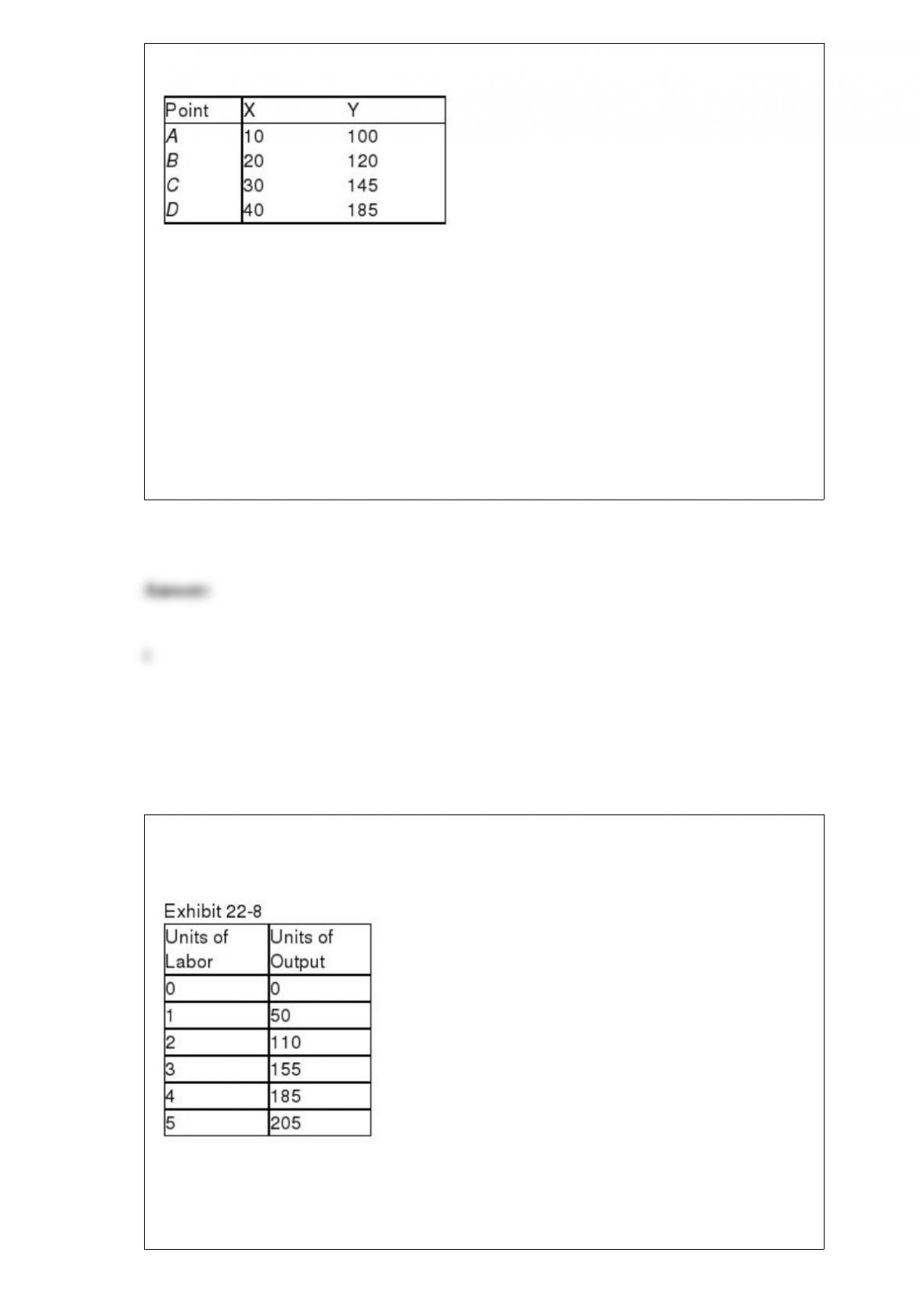
Exhibit 1-2
According to the data provided in this table, what is the slope of the line between points
A and B, if these data were graphed with X on the horizontal axis and Y on the vertical
axis?
a. -2.00
b. -0.50
c. 2.00
d. 0.50
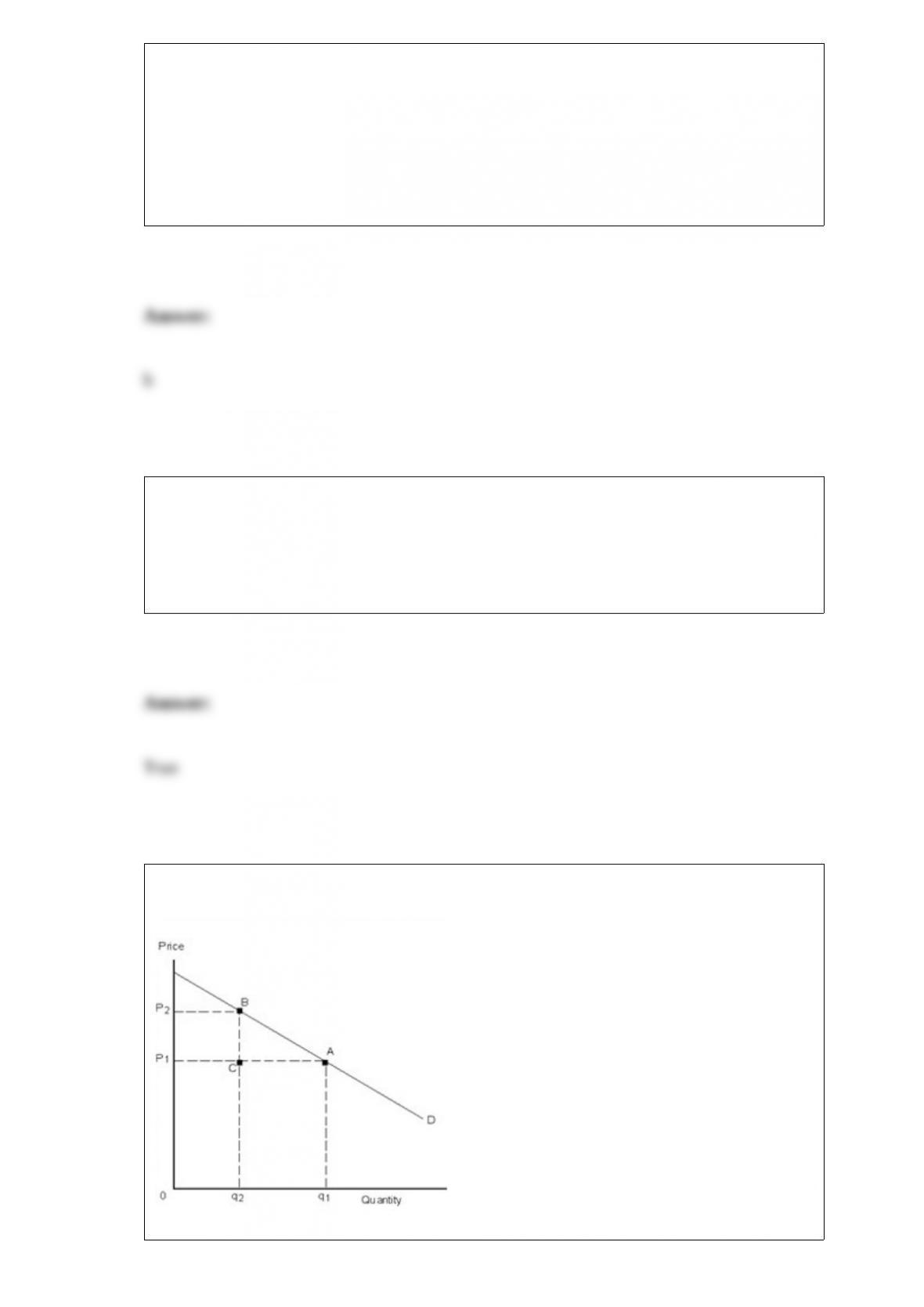
shows how output varies with the only variable input used in its production. Marginal
physical product of the fifth unit of labor is
a. 0.
b. 20.
c. 50.
d. 172.
Scarcity affects everyone, even billionaires.
a. True
b. False
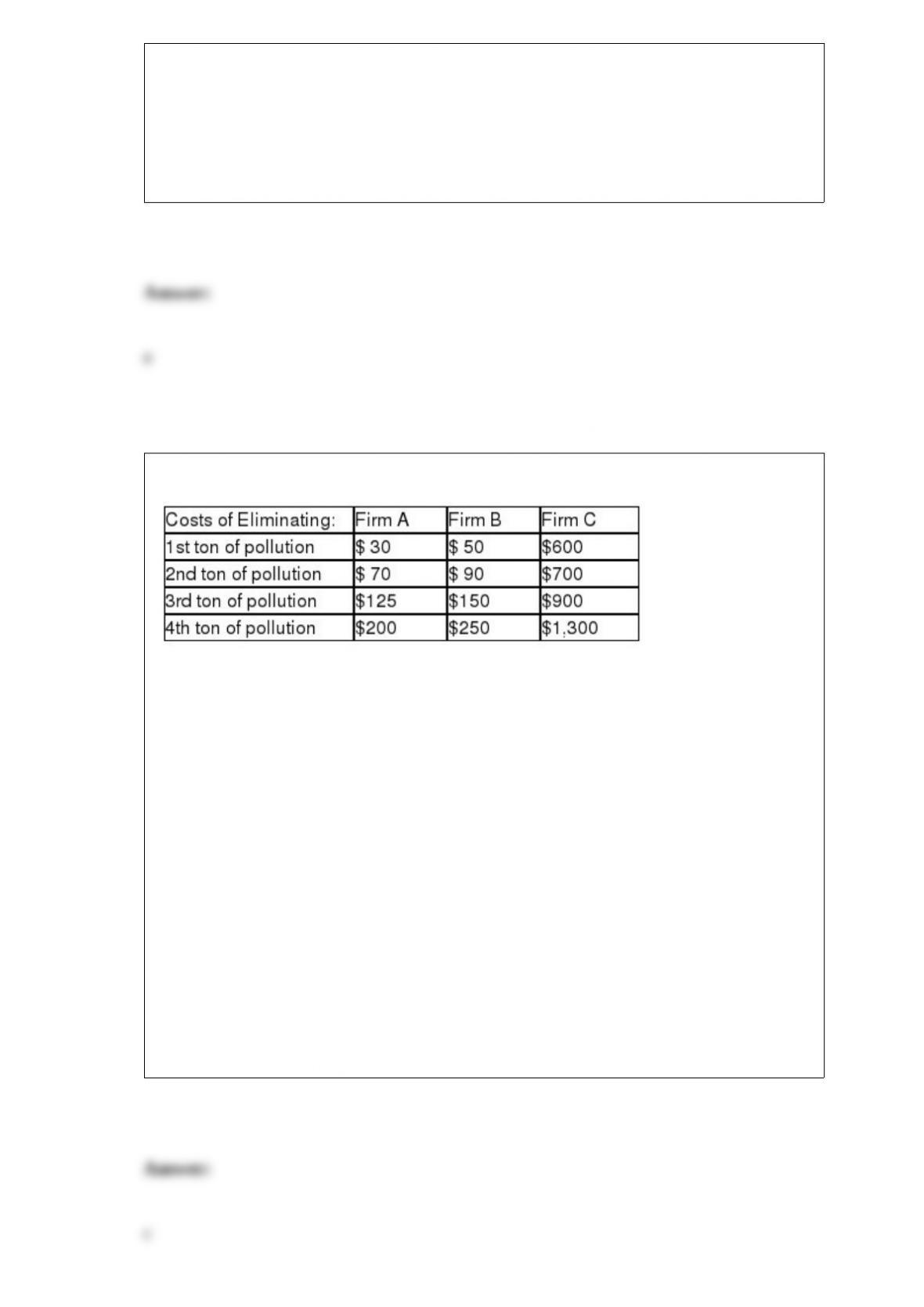
Exhibit 24-5

What area represents the revenue gained when price goes from P2 to P1?
a. P1CBP2
b. q2CAq1
c. 0P1Aq1
d. CBA
If the return on capital is 12 percent and the price for loanable funds is 9 percent, then
a. firms will not be willing to borrow loanable funds until either the return on capital
decreases or the price for loanable funds increases, because the market for loanable
funds is not in equilibrium and businesses will be wary of further investment.
b. firms will realize that if they borrow loanable funds and invest in capital goods, it
will cause the return on capital to decrease, so they won’t want to borrow the funds.
c. savers will realize that they can earn more if they invest their savings in capital, so
they will withdraw their savings and supply them to firms at 14 percent.
d. none of the above
In long-run competitive equilibrium, the market equilibrium price equals
a. marginal cost.
b. short-run average total cost.
c. long-run average total cost.
d. a and c
e. a, b, and c
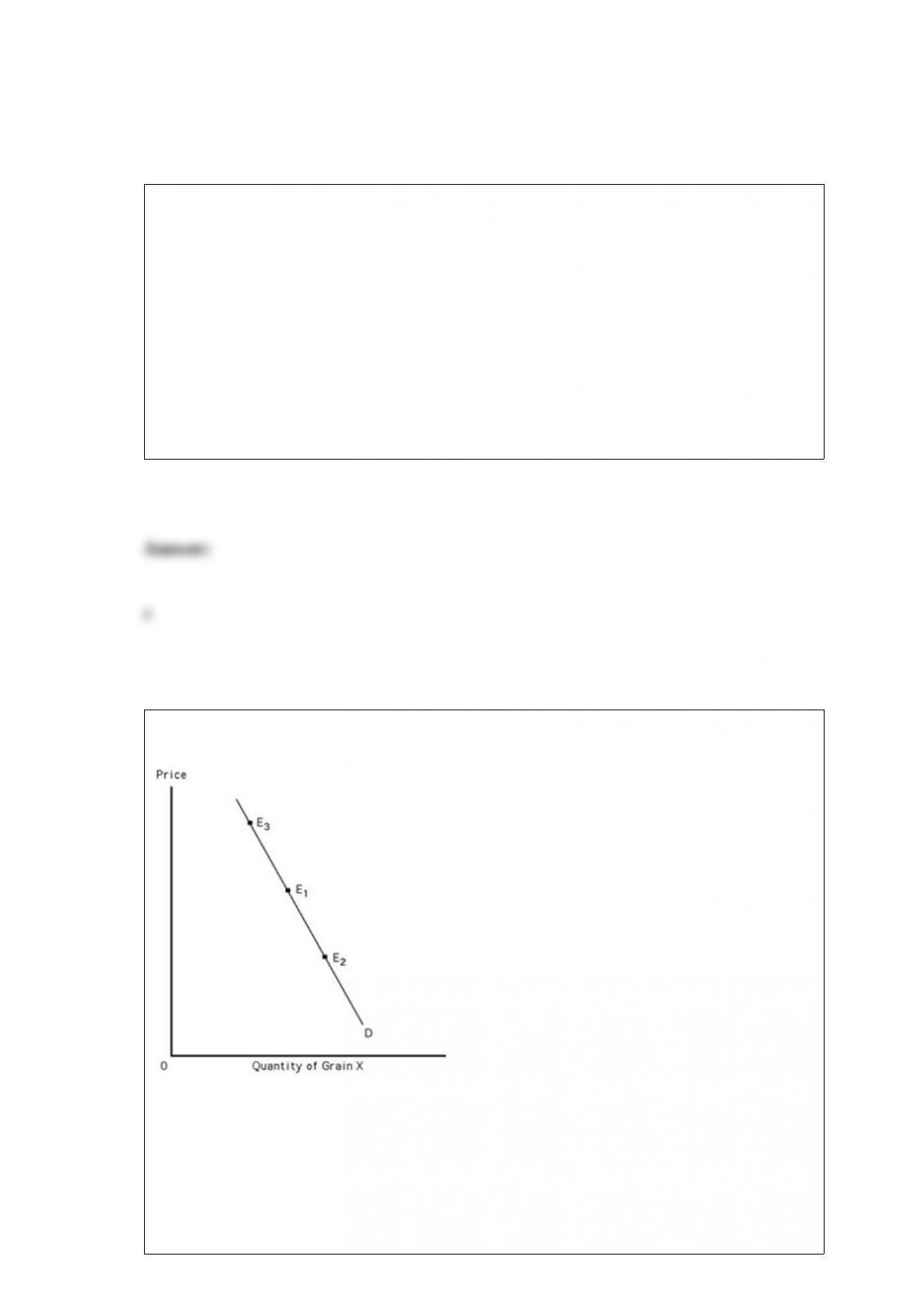
Exhibit 31-3
Suppose that Firms A, B, and C are the only polluters in the state and that each emits 4
tons of pollution into the atmosphere. To cut the level of pollution the government
imposes an emission tax of $300 per ton of pollution.As a result of this tax, Firm A
would _________________, firm B would ____________________ and firm C would
__________________.
a. not reduce any of its pollution; not reduce any of its pollution; reduce all 4 tons of its
pollution
b. reduce all 4 tons of its pollution; only reduce 1 ton of its pollution; not reduce any of
its pollution
c. reduce all 4 tons of its pollution; reduce all 4 tons of its pollution; not reduce any of
its pollution
d. not reduce any of its pollution; reduce 3 tons of its pollution; reduce all 4 tons of its
pollution
Which of the following is least likely to be an effect of scarcity?
a. rationing device
b. choice
c. opportunity cost
d. dollar price
e. utility
Exhibit 39-8
Assume that E1 represents the initial equilibrium in the market for grain X. If all the
farmers agree to restrict production and abide by the agreement,
a. the price of X increases.
b. the equilibrium quantity decreases.

c. total revenues increase if the demand curve is inelastic between E1 and E3.
d. all of the above
e. a and b only
It has been argued that because the monopolistic competitive firm faces a
downward-sloping demand curve, in long run equilibrium it
a. underutilizes its plant size.
b. has excess capacity.
c. produces an output smaller than the one that would minimize its costs of production.
d. a and b
e. all of the above
Good weather in cities such as San Diego
a. is absolutely free for the residents of that city.
b. is allocated using a weather market.
c. imposes indirect payments for the residents of that city.
d. b and c
e. none of the above
Which of the following is a definition of poverty in absolute terms?
a. A family is in poverty if it receives less than $10,000 a year in money income.
b. A family is in poverty if it receives an income that places it in the lowest 5 percent of
family income recipients.
c. A family is in poverty if the majority of families receive more income than it
receives.
d. a, b, and c
An increase in the price of good B caused an increase in the demand for good C. This
indicates that goods B and C are
a. complements.
b. substitutes.
c. neither substitutes nor complements.
d. normal goods.
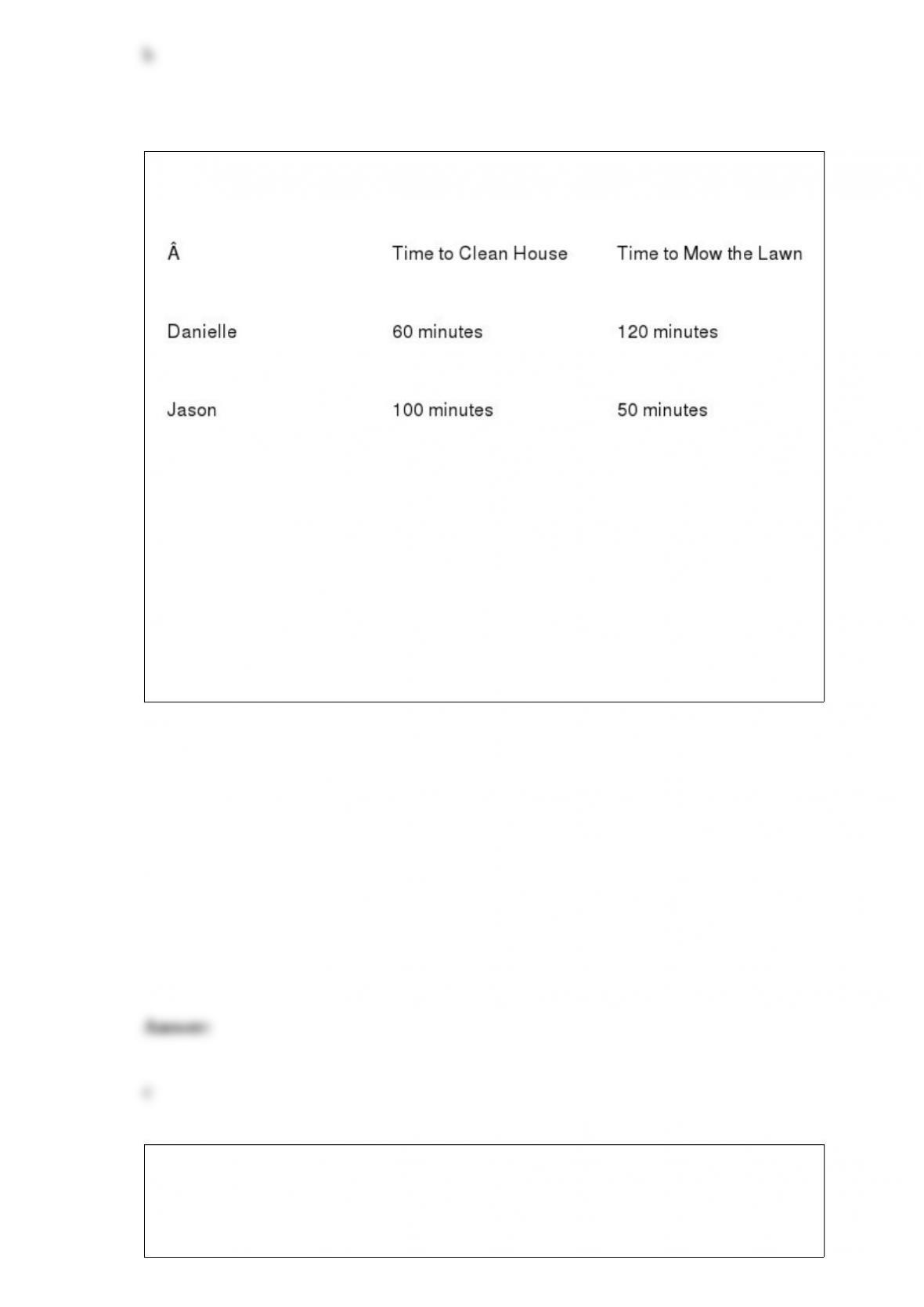
Exhibit 34-10
Danielle’s opportunity cost of mowing the lawn is
a. 0.50 clean houses.
b. 2.40 clean houses.
c. 2.00 clean houses.
d. 0.60 clean houses.
Which of the following is true?
a. Buyers always prefer lower prices to higher prices.

b. Buyers never prefer lower prices to higher prices.
c. Buyers rarely prefer lower prices to higher prices.
d. Buyers prefer lower prices to higher prices, ceteris paribus.