Economist Jerry Hausman estimated the price elasticity of demand for “Post Raisin
Bran” and “All types of breakfast cereals.” He found that the price elasticity of demand
for Post Raisin Bran was -2.5 and the price elasticity of demand for “All types of
breakfast cereals” was -0.9. Which of the following can be implied from Hausman’s
estimates?
A) The demand for “All types of breakfast cereals” is elastic.
B) A 1 percent increase in the price of Post Raisin Bran will lead to a 25 percent
decrease in the quantity demanded of Post Raisin Bran.
C) The demand for Post Raisin Bran is more elastic than the demand for “All types of
breakfast cereals.”
D) A 1 percent decrease in the price of breakfast cereals will lead to a 2.5 percent
increase in the quantity demanded of Post Raisin Bran.
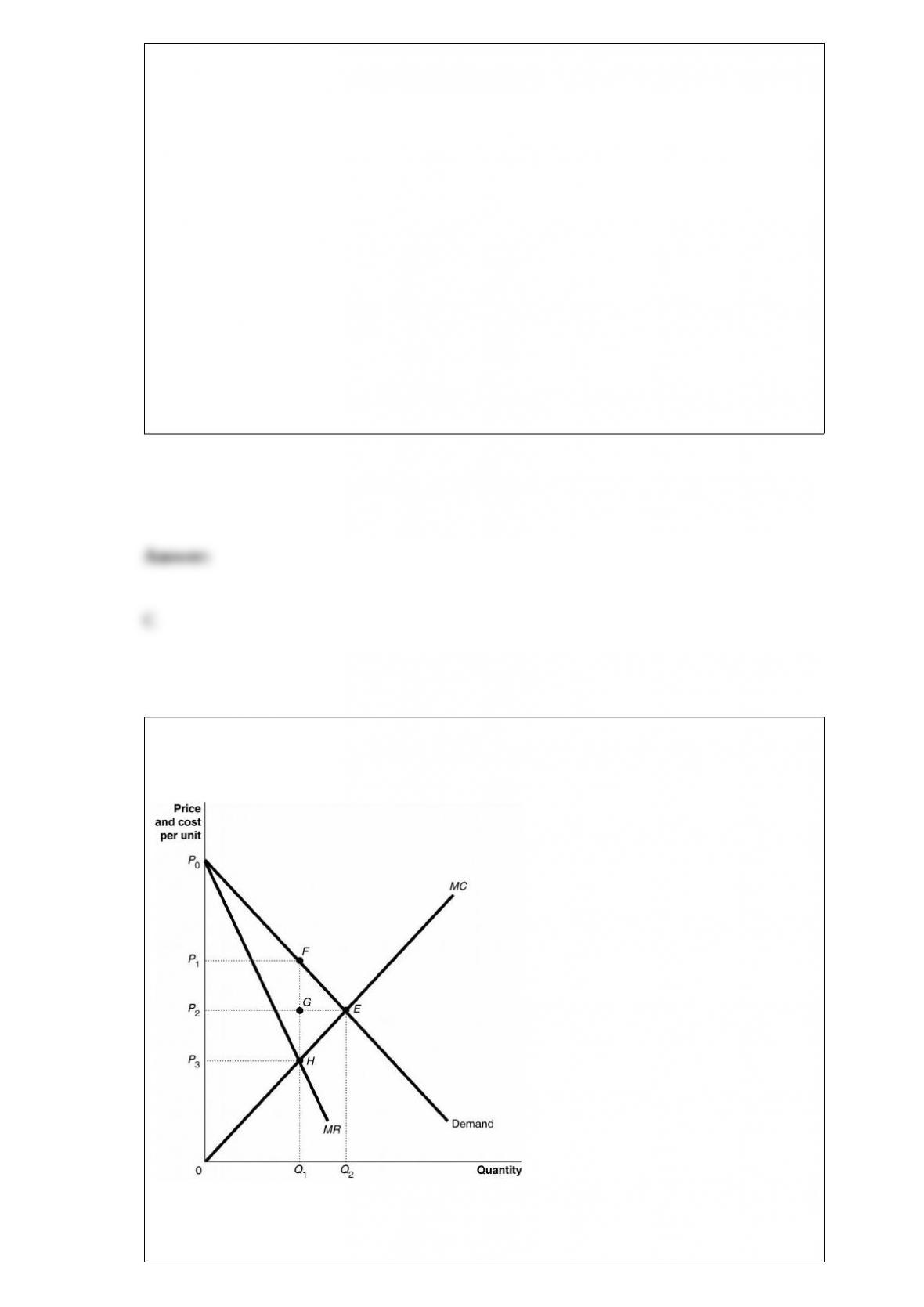
Figure 15-10
Refer to Figure 15-10. The deadweight loss due to a monopoly is represented by the
area

A) FHE.
B) FGE.
C) GEH.
D) FQ1Q2E.
Many people leave their servers tips in restaurants, even when they are not likely to
visit the restaurant again. This is evidence that
A) people would rather pay for good service at an inexpensive restaurant than pay
higher prices and receive poor service at an expensive restaurant.
B) people enjoy eating at restaurants more than eating at home.
C) people treat others fairly even if doing so makes them worse off financially.
D) there has been an improvement in the service people receive in restaurants over
time, partly because the restaurant industry has become more competitive.
An economist observes two consumers in a supermarket. One of the consumers buys a
case of Coca-Cola and the other buys a case of Pepsi-Cola. Both colas sell for the same
price and the ages and incomes of the consumers are also the same. Based on this
information, how would the economist explain the consumers’ choices?
A) One of the consumers made the wrong choice, but it is impossible to say which one.

B) Both consumers should have considered buying other colas that had lower prices.
C) Both consumers should have purchased less than a case because they would be able
to buy more later.
D) Apparently, the consumers had different tastes.
The public choice model raises questions about the government’s ability to regulate
economic activity efficiently. Which of the following statements represents the views of
most economists with regard to the role of government?
A) Congress should abolish the Food and Drug Administration, the Environmental
Protection Agency and other agencies and commissions because the costs of their
actions exceed the benefits they provide to the public.
B) Government should do more to regulate markets. The public choice model has
shown that rent seeking and rational ignorance affect more markets than are currently
subject to regulation.
C) U.S. citizens can afford more government regulation if the cost of this regulation is
borne mostly by taxpayers with the highest incomes.
D) Agencies such as the Food and Drug Administration and the Environmental
Protection Agency can serve a useful purpose, but we need to take the costs of
regulation into account along with the benefits.

Figure 11-10
Refer to Figure 11-10. Suppose for the past 8 years the firm has been producing
Qdunits per period using plant size ATC4. Now, following a permanent change in
demand, it plans to cut production to Qc units. What will happen to its average cost of
production?
A) In the short run, its average cost falls from $47 to $41, and in the long run, average
cost falls even further to $37.
B) In the short run, its average cost rises from $47 to $55, and in the long run, average
cost falls to $41.
C) In the short run, its average cost falls from $47 to $37, and in the long run, average
cost rises to $41.
D) In the short run, its average cost rises from $47 to $55, and in the long run, average
cost falls to $37.
An increase in a perfectly competitive firm’s demand for labor could be caused by
A) a decrease in the market wage rate.
B) an increase in the market demand for the firm’s product.

C) a decrease in the marginal product of workers.
D) an increase in the quantity of labor supplied.
If the marginal benefit of reducing emissions of some air pollutant is greater than the
marginal cost
A) further reductions will make society better off.
B) the marginal benefit will rise and the marginal cost will fall as further reductions are
made.
C) economic efficiency will be achieved when emissions are reduced to zero.
D) private businesses, rather the consumers, should be made to pay for the cost of
further reductions.
Some firms require consumers to pay an initial fee for the right to buy their product and
an additional fee for each unit of the product they purchase. This practice is referred to
as
A) odd pricing.
B) dual pricing.
C) a two-part tariff.

D) intertemporal pricing.
You are planning to open a new Italian restaurant in your hometown where there are
three other Italian restaurants. You plan to distinguish your restaurant from your
competitors by offering northern Italian cuisine and using locally grown organic
produce. What is likely to happen in the restaurant market in your hometown after you
open?
A) Your competitors are likely to change their menus to make their products more
similar to yours.
B) The demand curve facing each restaurant owner shifts to the right.
C) The demand curve facing each restaurant owner becomes more elastic.
D) While the demand curves facing your competitors becomes more elastic, your
demand curve will be inelastic.
Consider the following items:
a. the album “21” by Adele
b. a Dutch horticulturalist’s new method for cultivating hybrid tulips
c. Rolls Royce’s “Spirit of Ecstasy” hood ornament design
d. the sale of Tumi luggage at a Macy’s department store

Which of the items listed is an example of intellectual property?
A) a and b only
B) a, b, and c
C) a and d only
D) all of the items listed
An article on how prices in South Bend, Indiana rise during Notre Dame home football
games noted: “For the Sept. 16 game against the University of Michigan, the South
Bend Marriott is charging $649 a night for a double room…. The Marriott’s regular
weekend price is $149 a night.”
Source: Ilan Brat, “Notre Dame Football Introduces Its Fans To Inflationary
Spiral,”Wall Street Journal, September 7, 2006, p. A1.
Which of the following statements is true?
A) The Marriott is practicing first-degree price discrimination by charging what the
market will bear.
B) This is evidence of third-degree price discrimination because hotel accommodation
on a particular day is not a product that can be resold later.
C) There is no evidence of price discrimination; the Marriott is responding to increased
demand for hotel rooms in the face of constant supply.
D) The Marriott has adopted this pricing strategy to capitalize on arbitrage profits.

Figure 9-1
Figure 9-1 shows the U.S. demand and supply for leather footwear.
Refer to Figure 9-1. Under autarky, the deadweight loss is
A) $0.
B) $15.
C) $30.
D) $40.
Marginal cost is equal to the
A) change in total cost divided by the change in output.
B) change in average total costs divided by the change in output.
C) change in total product divided by the change in output.
D) change in average product divided by the change in output.

Studies have shown links between calcium consumption and a reduction in
osteoporosis. How does this affect the market for calcium?
A) The calcium supply curve shifts to the right because of a change in tastes in favor of
calcium.
B) The calcium demand curve shifts to the right because of a change in tastes in favor
of calcium.
C) The calcium demand curve shifts to the left because this new information will
increase the price of calcium.
D) The calcium supply curve shifts to the left because this new information will
increase the price of calcium.
The marginal rate of technical substitution is
A) the rate at which a firm is able to substitute one input for another, while keeping
total cost constant.
B) the rate at which a firm is able to substitute one input for another, while keeping the
level of output constant.
C) the rate at which a firm is able to institute positive technological changes to its
production process.
D) the rate at which a firm is able to increase its output by replacing labor with
technology.

For a perfectly competitive firm, at profit maximization
A) market price exceeds marginal cost.
B) total revenue is maximized.
C) marginal revenue equals marginal cost.
D) production must occur where average cost is minimized.
Economists have long debated whether there is a significant loss of well-being to
society in markets that are monopolistically competitive rather than perfectly
competitive. Which of the following offers the best reason why some economists
believe that monopolistically competitive markets benefit consumers despite any loss of
well-being?
A) Although consumers may pay a price greater than marginal cost for a product, the
product is produced at the minimum average total cost.
B) Although consumers may pay a price greater than marginal cost and the product is
not produced at minimum average total cost, they benefit from being able to buy a
differentiated product more closely suited to their tastes.
C) Consumers pay a price equal to the marginal cost of producing a product, even
though it is not produced at the minimum average total cost.
D) Consumers are better off choosing from a variety of differentiated products, even
though product differentiation causes barriers that restrict entry into monopolistically
competitive markets.
When the demand for a product is less elastic than the supply
A) consumers pay the majority of the tax on the product.
B) firms pay the majority of the tax on the product.
C) firms pay the entire tax on the product.
D) consumers pay the entire tax on the product.
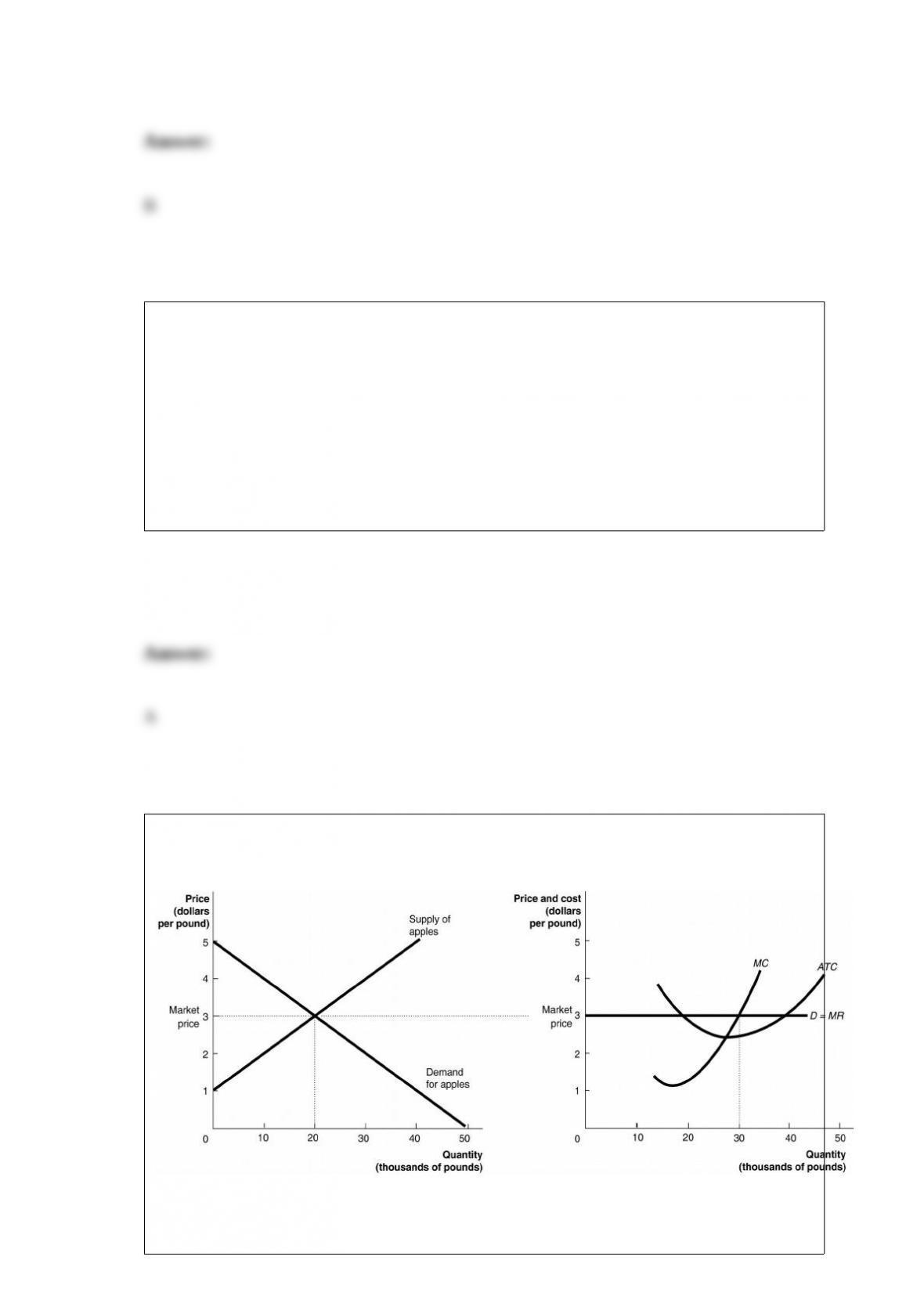
Figure 12-17
The graphs in Figure 12-17 represent the perfectly competitive market demand and
supply curves for the apple industry and demand and cost curves for a typical firm in

the industry.
Refer to Figure 12-17. Which of the following statements is true?
A) The firm will produce 30 thousand pounds of apples in the short run and earn an
economic profit. New firms will enter the market and shift the market supply curve to
the left.
B) The firm will produce 30 thousand pounds of apples in the short run and earn an
economic profit, but it would earn a greater profit if it produced at the lowest point on
the ATC curve.
C) The firm will produce 30 thousand pounds of apples in the short run and earn an
economic profit. New firms will enter the industry; as a result, the firm will be forced to
exit the industry in the long run.
D) The firm will produce 30 thousands pounds of apples in the short run and earn an
economic profit. In the long run the firm will break even.
The formula for total fixed cost is
A) TFC = TC + TVC.
B) TFC = TVC – TC.
C) TFC = TC/TVC.
D) TFC = TC – TVC.

Table 12-2
Table 12-2 lists the various pounds (lbs.) of apples that Margie Stattler can sell. Assume
that Margie operates in a perfectly competitive market.
Refer to Table 12-2. How many pounds of apples should Margie sell to maximize her
profit?
A) 300 pounds
B) 400 pounds
C) This cannot be determined without knowing Margie’s total or marginal production
costs.
D) This can be determined only when all of the values for market price, total revenue,
average revenue and marginal revenue are given.
Which of the following is a possible solution when a scarce resource is subject to the
tragedy of the commons?
A) access to the commons can be restricted through community norms and laws
B) offer subsidies to consumers
C) force people to move away from the commons
D) persuade people to use less of the scarce resource through an advertising campaign
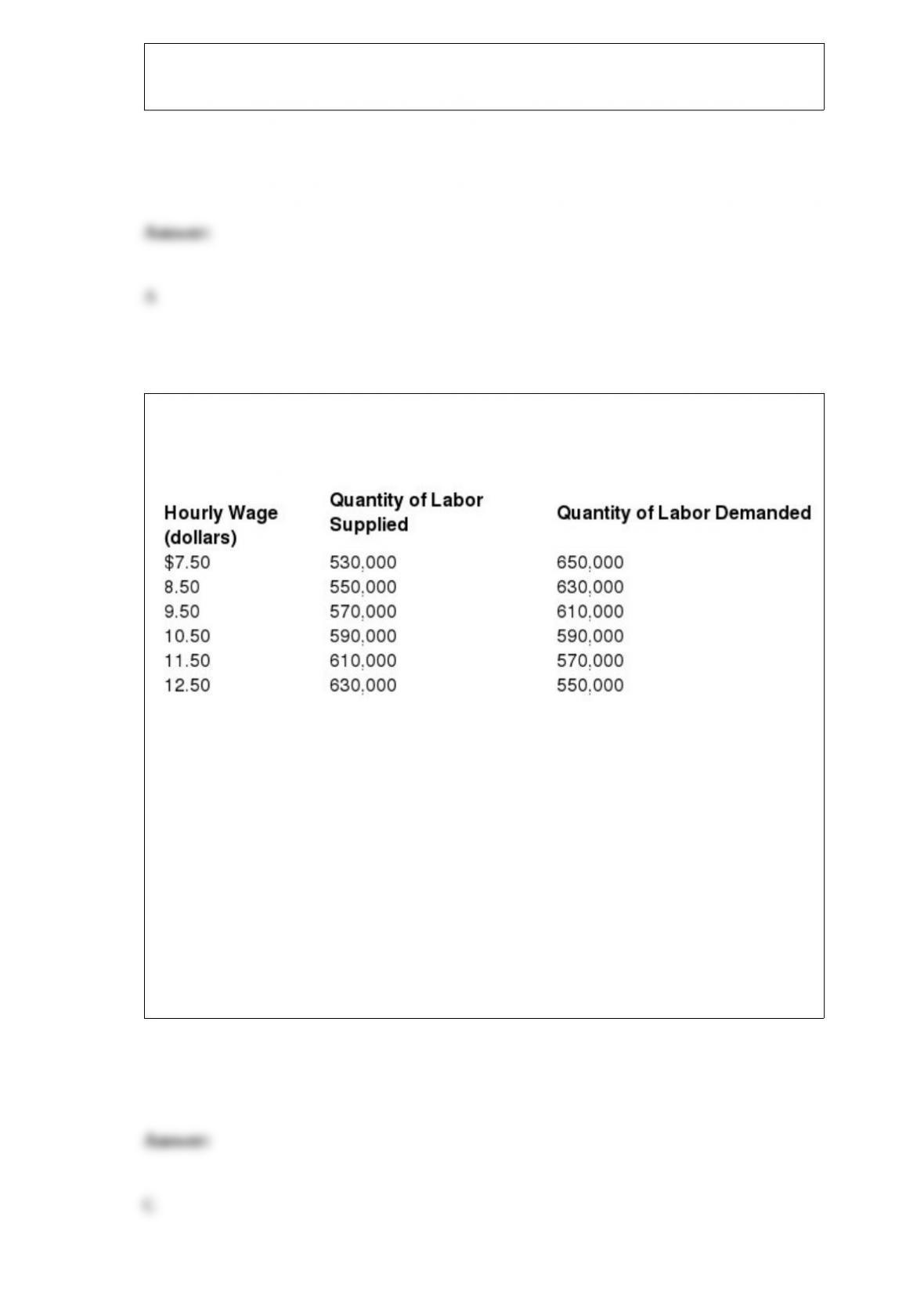
Table 4-4
Table 4-4 shows the demand and supply schedules for labor market in the city of Pixley.
Refer to Table 4-4. Suppose that the quantity of labor supplied increases by 40,000 at
each wage level. What are the new free market equilibrium hourly wage and the new
equilibrium quantity of labor?
A) W = $8.50; Q = 550,000
B) W = $12.50; Q = 630,000
C) W = $9.50; Q = 610,000
D) W = $11.50; Q = 610,000

Jonah lives in a small town where there is only one Mexican restaurant. Which of the
following is likely to be true about the price elasticity of demand for meals at the
Mexican restaurant?
A) Demand is likely to be perfectly inelastic.
B) Demand is likely to be perfectly elastic.
C) Demand is likely to be relatively elastic.
D) Demand is likely to be relatively inelastic.
Opera Estate Girls’ School is considering increasing its tuition to raise revenue. If the
school believes that raising tuition will increase revenue
A) it is assuming that the demand for attending the school is inelastic.
B) it is assuming that the demand for attending the school is elastic.
C) it is assuming that the demand for attending the school is unit-elastic.
D) it is assuming that the demand for attending the school is perfectly elastic.
All of the following occur whenever a government taxes a product except

A) the quantity consumed of that product falls.
B) the price of that product rises.
C) the marginal benefit of the last unit sold exceeds the marginal cost of producing it.
D) there will be no excess burden if the government’s tax revenue is sufficiently large to
offset the deadweight loss.
In a survey of consumers, Daniel Kaheman, Jack Knetsch and Richard Thaler asked
their opinion of a hardware store’s decision to
A) go out of business because a larger hardware store opened in the same city; 82
percent of those surveyed believed it was unfair for the larger store to compete with the
smaller store.
B) raise the price of snow shovels the day following a snowstorm; 82 percent of those
surveyed believed this was unfair.
C) sell tickets to sporting and cultural events at prices higher than prices paid at the
ticket windows for the same events; 82 percent of those surveyed believed this was
unfair.
D) remain in business even though the store was not making an economic profit; 82
percent of those surveyed believed it would be unfair for the store to go out of business
if there no other hardware stores in the same area.

The term “derived demand” refers to
A) the demand for financial products called derivatives.
B) the demand for a factor of production that is derived from the demand for the good
the factor produces.
C) a firm’s estimated demand curve derived from sales data.
D) a demand curve that derives from the availability of resources.
In May 2012, Facebook stock sold for $38 per share in its initial public offering (IPO).
More than a year later, in June 2013, the value of Facebook stock
A) had more than doubled in price.
B) had declined by nearly 40 percent from the IPO price.
C) languished at the same $38 per share price.
D) had increased by almost 60 percent from the IPO price.
Edward Lazear analyzed data provided by the Safelite Group, the nation’s largest
installer of auto glass, after the company changed the way it paid its glass installers
beginning in the mid-1990s. Instead of paying workers hourly wages, Safelite began to
pay workers on the basis of how many windows they installed. Which of the following
describes what Lazear concluded from his analysis of Safelite’s data?

A) Although workers installed more windows under the new system, Lazear found that
there was also an increase in the number of workmanship-related defects. Lazear
attributed this to workers taking short-cuts in order to earn higher wages. As a result,
productivity did not improve and Safelite went back to paying hourly wages.
B) Lazear found that worker productivity increased with the new system; about half of
the increase in productivity was due to workers who continued with the company and
half was due to new workers being more productive than those who left the company.
C) Although worker productivity improved, the increase in hourly wages resulted in a
significant decline in Safelite’s profits.
D) Because of a principal-agent problem, worker productivity was not affected by the
new compensation system. However, Lazear attributed this to management problems
that had nothing to do with Safelite’s compensation system.