
Although government spending increased during the 1930s:
A) the money supply increased too, so there was no net monetary expansion.
B) the exchange rate rose too, so there was no net trade expansion.
C) taxes increased too, so there was no net fiscal expansion.
D) interest rates rose too, so there was no lending expansion.
The economic theory that emphasizes how shocks to technology can cause fluctuations
in economic activity is known as the:
A) real business cycle theory.
B) technological advancement theory.
C) economic fluctuations theory.
D) nominal business cycle theory.
Ricardian equivalence is the proposition that
A) government expenditure should only be financed by issuing new debt.
B) it does not matter whether government expenditure is financed by taxes or debt.
C) it does not matter whether government expenditure is financed by creating new
money or issuing debt.
D) government expenditure should only be financed by taxes.
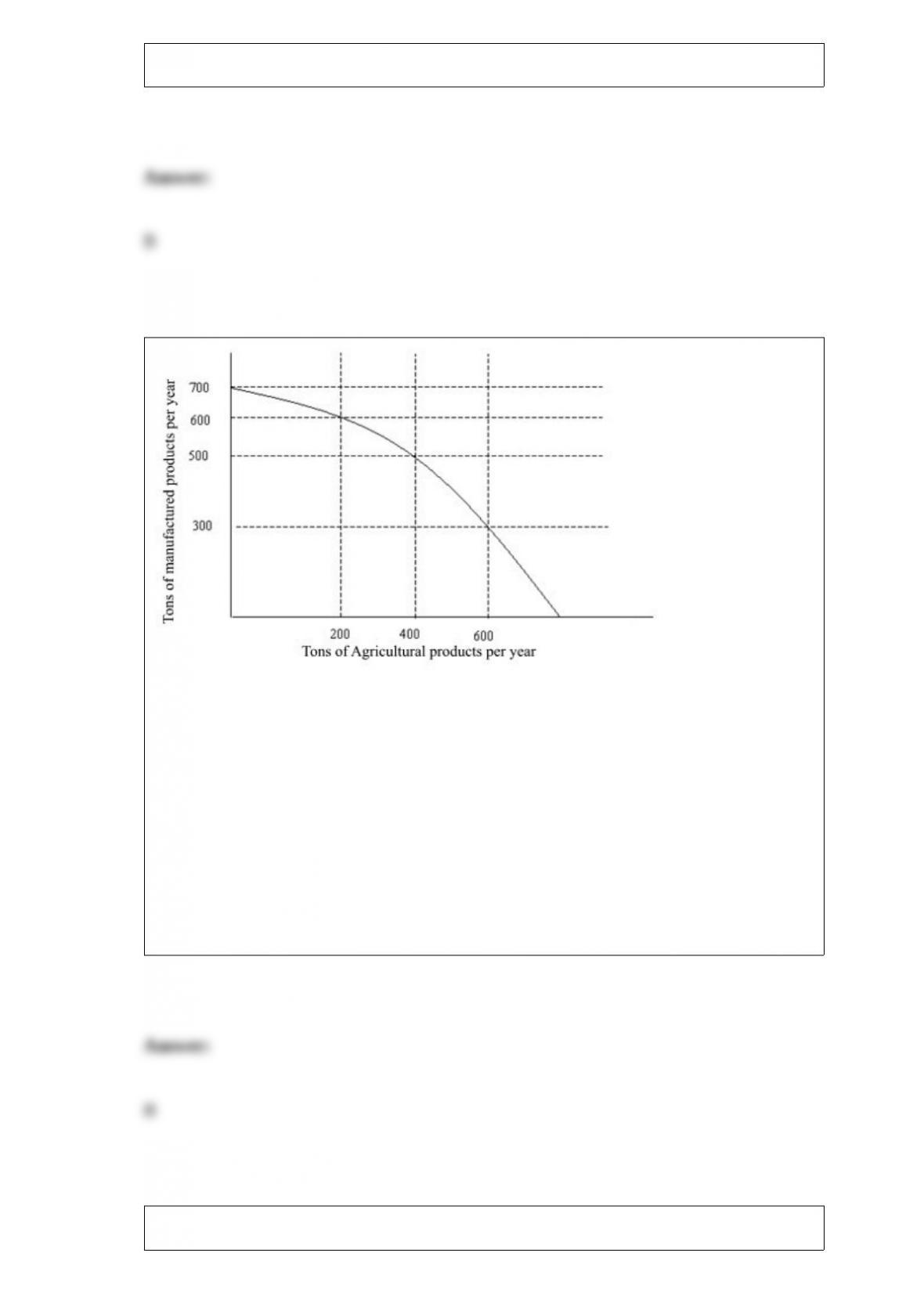
Figure 2.1
Referring to Figure 2.1,if you increase the production of farm goods, what other area is
affected?
A) the price of produce
B) the production of manufactured goods
C) how much people can purchase
D) the wages earned by farm workers
Economic growth is generally defined as an increase in nominal GDP per capita.

Financial intermediaries have more expertise than individual investors in:
A) evaluating investment projects.
B) monitoring investment projects.
C) negotiating the terms of loans to be made to investors.
D) all of the above
If the price of a 32GB memory card decreases from $25 to $20, the percentage change
is
A) -20 percent.
B) -33 percent.
C) -50 percent.
D) -60 percent.
In practice, the Federal Reserve keeps the discount rate close to the ________ rate in
order to avoid large swings in borrowed reserves by banks.
A) inflation
B) six-month Treasury bill
C) federal funds
D) prime
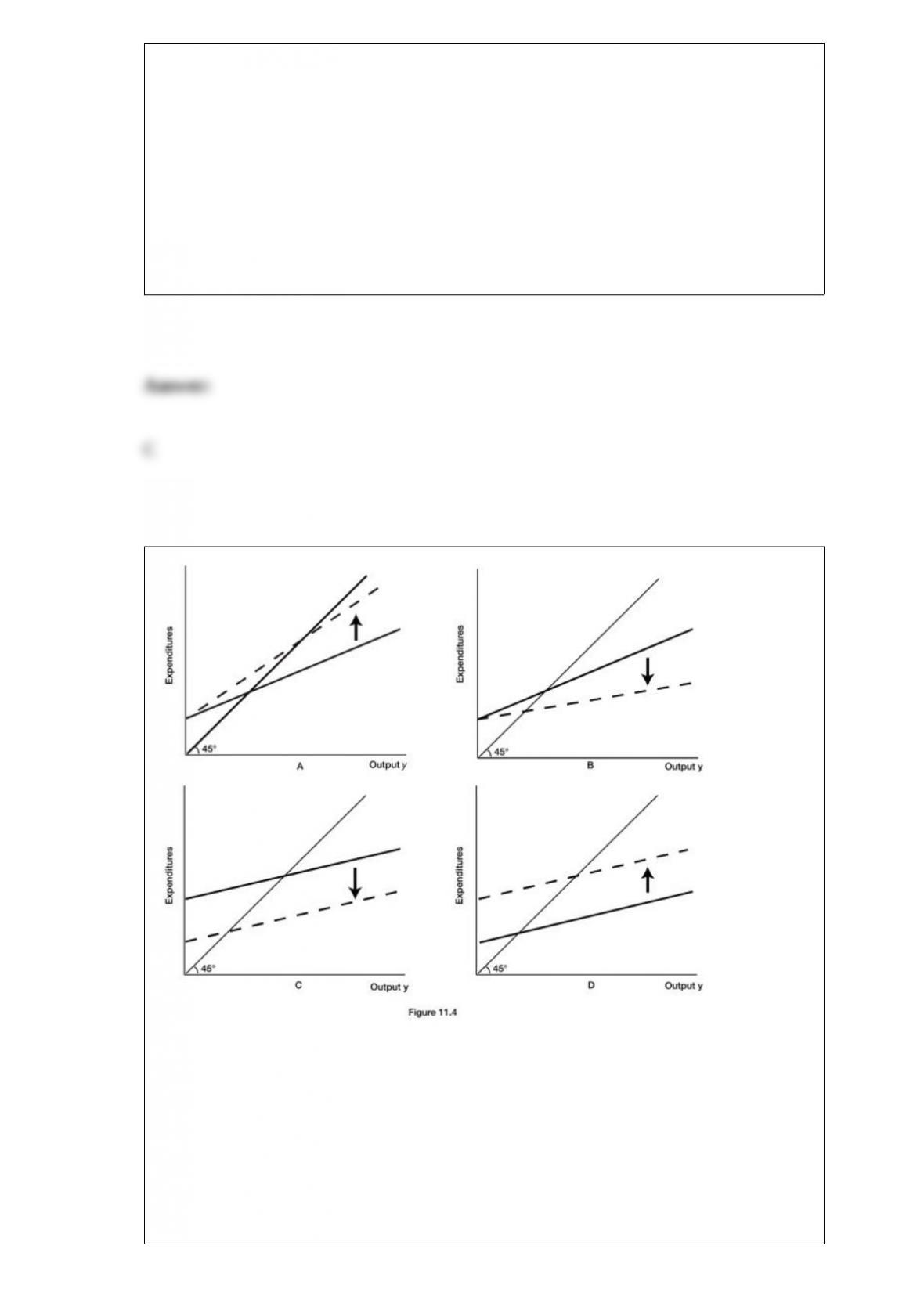
Refer to Figure 11.4. Which diagram illustrates the effect of a decrease in the marginal
propensity to consume?
A) A
B) B
C) C

D) D
Which of the following is a criticism that economists have against regional free trade
areas?
A) Regional trade areas promote trade within the trade area, but they do little to
promote trade across the globe.
B) Regional trade areas have been more successful in promoting worldwide trade than
the WTO.
C) Some countries have abandoned the WTO to join the regional trade areas.
D) Regional trade areas require that member countries first withdraw membership from
the WTO.