If a firm in Thailand borrows dollars from a U.S. bank, its interest payments on the loan
in bahts will decrease if the baht appreciates against the dollar.
The circular flow of income shows that GDP can be measured as the sum of wages,
interest, rent, and profits received by households or total expenditures on goods and
services by households, firms, government, and the rest of the world.
One drawback of the patent system is that firms must disclose to the public information
about the product or process.
For all points below the 45-degree line, planned aggregate expenditure will be less than
GDP.

Expansionary monetary policy lowers interest rates and forces a real appreciation of the
dollar in international currency markets.
Banks hold 100% of their checking deposits as vault cash to ensure that bank runs do
not occur.
Those who favor changes in the market for health care that would make it more like the
markets for other goods and services favor what are generally known as market-based
reforms.
For the recessions in the United States since the 1950s,
A) cyclical unemployment has been non-existent.
B) unemployment rises on average by about 1.2 percentage points 12 months after a
recession begins.

C) unemployment falls on average by 2 percentage points 12 months after a recession
begins.
D) unemployment rises on average about 5 percentage points 12 months after a
recession begins.
By offering more generous unemployment insurance programs, European countries can
expect
A) to pay less in taxes than in the United States.
B) workers to gain new skills quickly in response to fluctuations in the labor market.
C) shorter periods of unemployment for their workers.
D) longer periods of unemployment for their workers.
The aggregate demand curve will shift to the left ________ the initial decrease in
government purchases.
A) by less than
B) by more than
C) by the same amount as
D) sometimes by more than and other times by less than

The currency adopted by most countries in ________ is referred to as the euro.
A) Western Europe
B) Eastern Europe
C) Europe and Asia
D) Southern Europe and Northern Africa
Contractionary fiscal policy to prevent real GDP from rising above potential real GDP
would cause the inflation rate to be ________ and real GDP to be ________.
A) higher; higher
B) higher; lower
C) lower; higher
D) lower; lower
If the probability of losing your job remains ________, a recession would be a good

time to purchase a home because the Fed usually ________ interest rates during this
time.
A) low; lowers
B) low; raises
C) high; lowers
D) high; raises
E) low; does not change
Fiscal policy refers to changes in
A) state and local taxes and purchases that are intended to achieve macroeconomic
policy objectives.
B) federal taxes and purchases that are intended to achieve macroeconomic policy
objectives.
C) federal taxes and purchases that are intended to fund the war on terrorism.
D) the money supply and interest rates that are intended to achieve macroeconomic
policy objectives.
Suppose you borrow $1,000 at an interest rate of 12 percent. If the expected real interest
rate is 5 percent, then the rate of inflation over the upcoming year that would be most
beneficial to you would be a rate of inflation

A) equal to 0 percent.
B) greater than 7 percent.
C) equal to 7 percent.
D) less than 7 percent.
In 1931, the first major country to abandon the gold standard – in order to increase its
policy options in face of the Great Depression – was
A) Great Britain.
B) the United States.
C) Germany.
D) France.
Efficiency wages cause unemployment because
A) firms pay wages that are below the market wage, causing the quantity of labor
demanded to be greater than the quantity of labor supplied.
B) firms pay wages that are below the market wage, causing the quantity of labor
demanded to be less than the quantity of labor supplied.
C) firms pay wages that are above the market wage, causing the quantity of labor
demanded to be greater than the quantity of labor supplied.

D) firms pay wages that are above the market wage, causing the quantity of labor
demanded to be less than the quantity of labor supplied.
Money market mutual funds sell shares to investors and use the money to buy
A) mortgage-backed securities.
B) foreign currency.
C) short-term securities.
D) overseas assets through foreign direct investment.
Suppose that households became mistrustful of the banking system and decide to
decrease their checking accounts and increase their holdings of currency. Using the
money demand and money supply model and assuming everything else is held constant,
the equilibrium interest rate should
A) increase.
B) decrease.
C) not change.
D) increase, then decrease.

If an employee receives health insurance through his or her employer, the employer
A) still withholds contributions for Medicare and Medicaid from the employee’s
paycheck.
B) still withholds contributions for Medicare, but not Medicaid, from the employee’s
paycheck.
C) still withholds contributions for Medicaid, but not Medicare, from the employee’s
paycheck.
D) is no longer required to withhold contributions for Medicare or Medicaid from the
employee’s paycheck.
Which of the following is the best example of a tariff?
A) a limit imposed on the number of sports utility vehicles that the United States can
import from Japan
B) a subsidy granted by the U.S. government to domestic garment manufacturers so
they can compete more effectively with foreign garment manufacturers
C) a tax placed on all sports utility vehicles sold in the domestic market
D) a $5,000 per-car fee imposed on all sports utility vehicles imported into the United
States

Government spending ________ is included in gross domestic product.
A) at federal, state, and local levels of government
B) at the federal level of government only
C) at state and local levels of government only
D) on defense goods only
If an increase in investment spending of $20 million results in a $200 million increase
in equilibrium real GDP, then
A) the multiplier is 0.1
B) the multiplier is 1
C) the multiplier is 10
D) the multiplier is 100
How can a sole proprietorship raise funds needed for firm expansion?
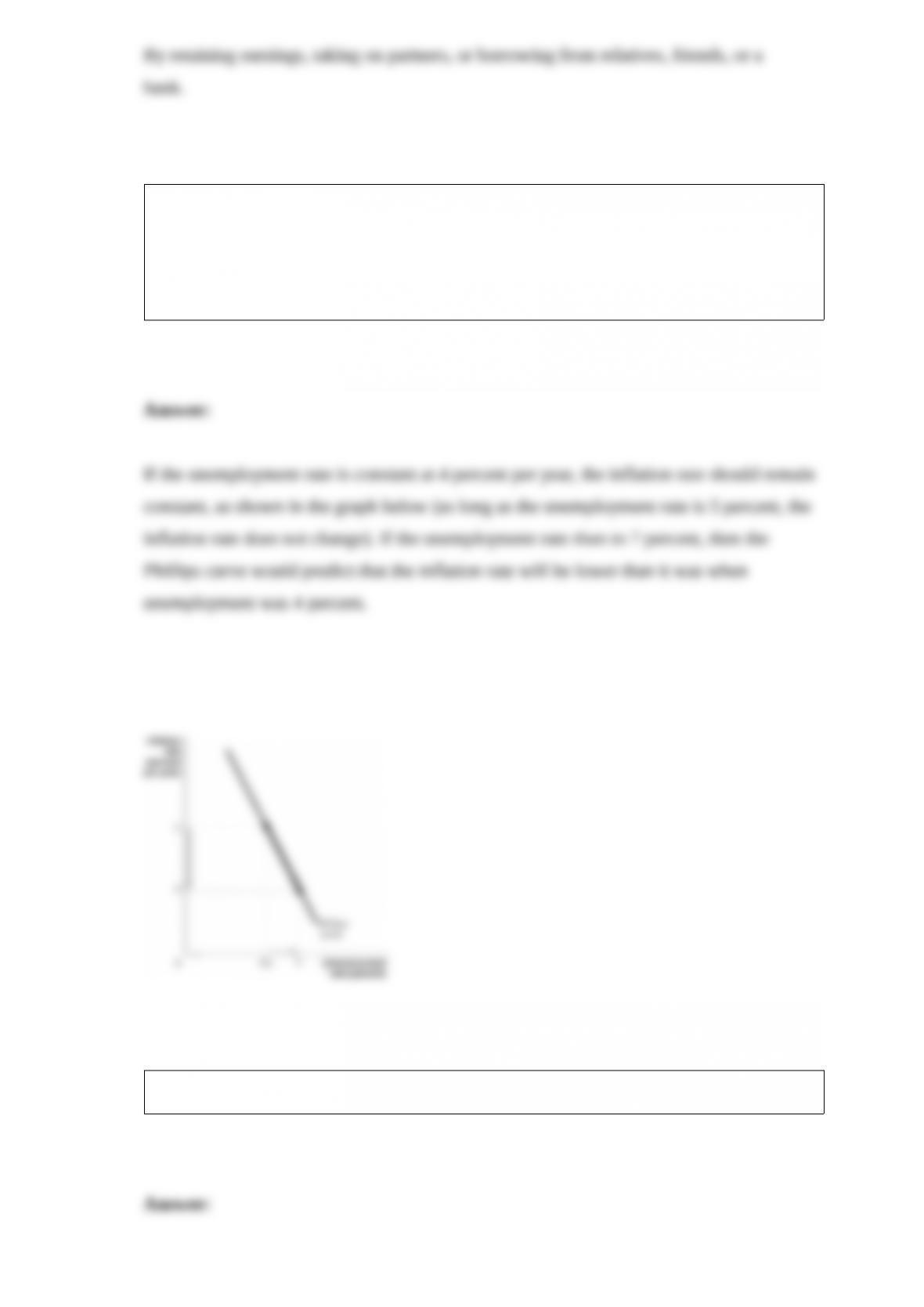
If the unemployment rate in the economy is steady at 4 percent per year, how does the
short-run Phillips curve predict that the inflation rate will be changing, if at all? What
will happen if the unemployment rate now rises to 7 percent per year? Assume there are
no changes to inflation expectations. Provide an appropriate graph to support your
discussion.
What is a household? How do households interact with firms in a market?
List the four broad categories of factors of production.
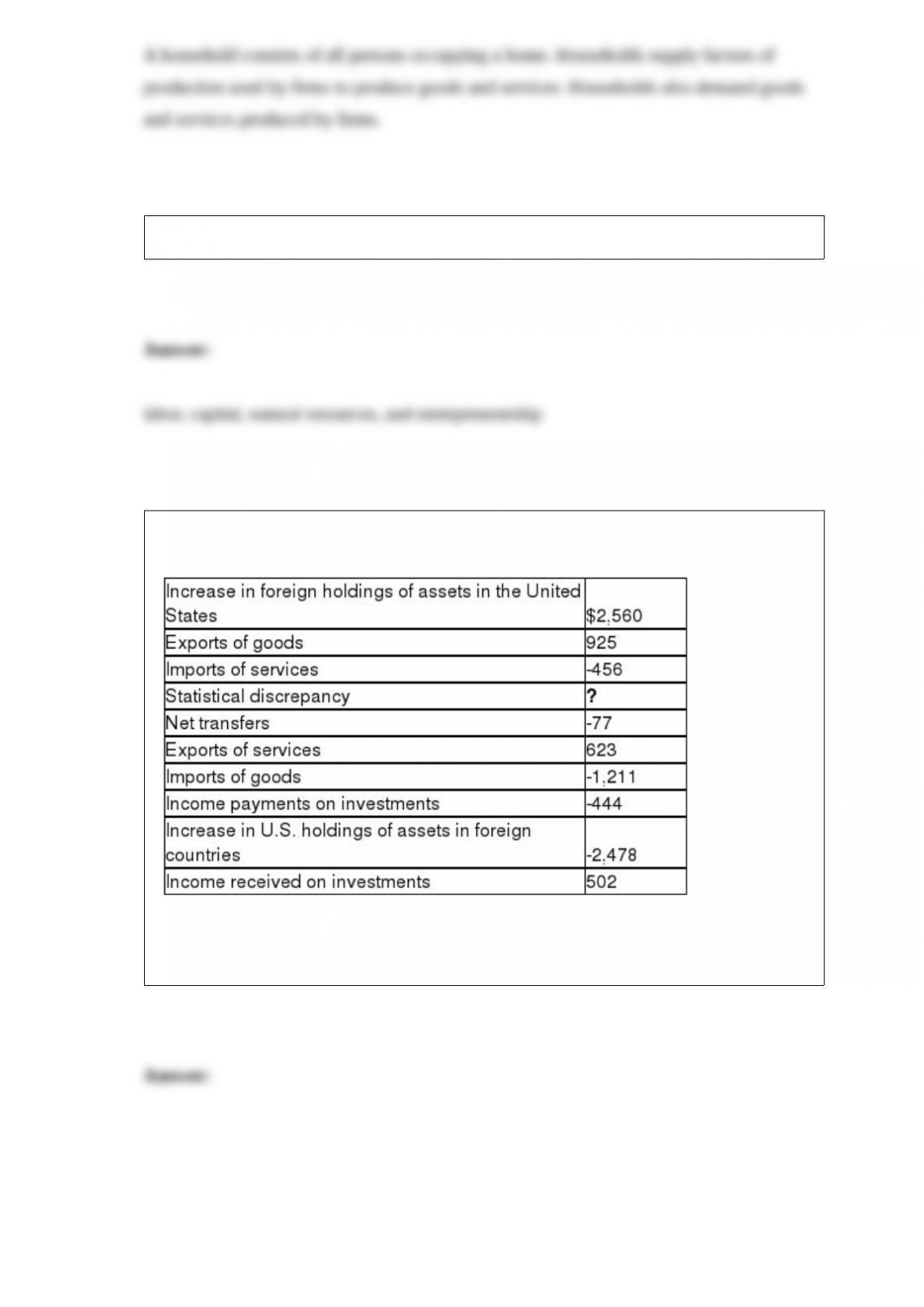
Table 18-1
Refer to Table 18-1. Use the information in the table to prepare a balance of payments
account and find the value of the statistical discrepancy. Assume that the balance on the
capital account is zero.
C = 2,800 + 0.9Y
I = 750
G= 1,200
NX = 150
Given the equations for C, I, G, and NX above, what is the equilibrium level of GDP
(Y)?
What is technology and what factors does it depend on?
Explain what happens to inflation during the business cycle. Give an intuitive
explanation as to why inflation changes the way it does over the business cycle.
Suppose you withdraw $1,000 in cash from your checking account. Draw a T-account
to show the effect of this transaction on your bank’s balance sheet.
Will the use of the euro help increase economic growth in countries in the European
Union? Will it help individual countries using the euro in times of recession? Explain.