When average variable cost is at its minimum:
a. average total cost is increasing with increases in output.
b. average variable cost plus average fixed cost is increasing with increases in output.
c. average total cost is equal to average variable cost.
d. marginal cost is less than average total cost.
e. marginal cost is greater than average total cost.
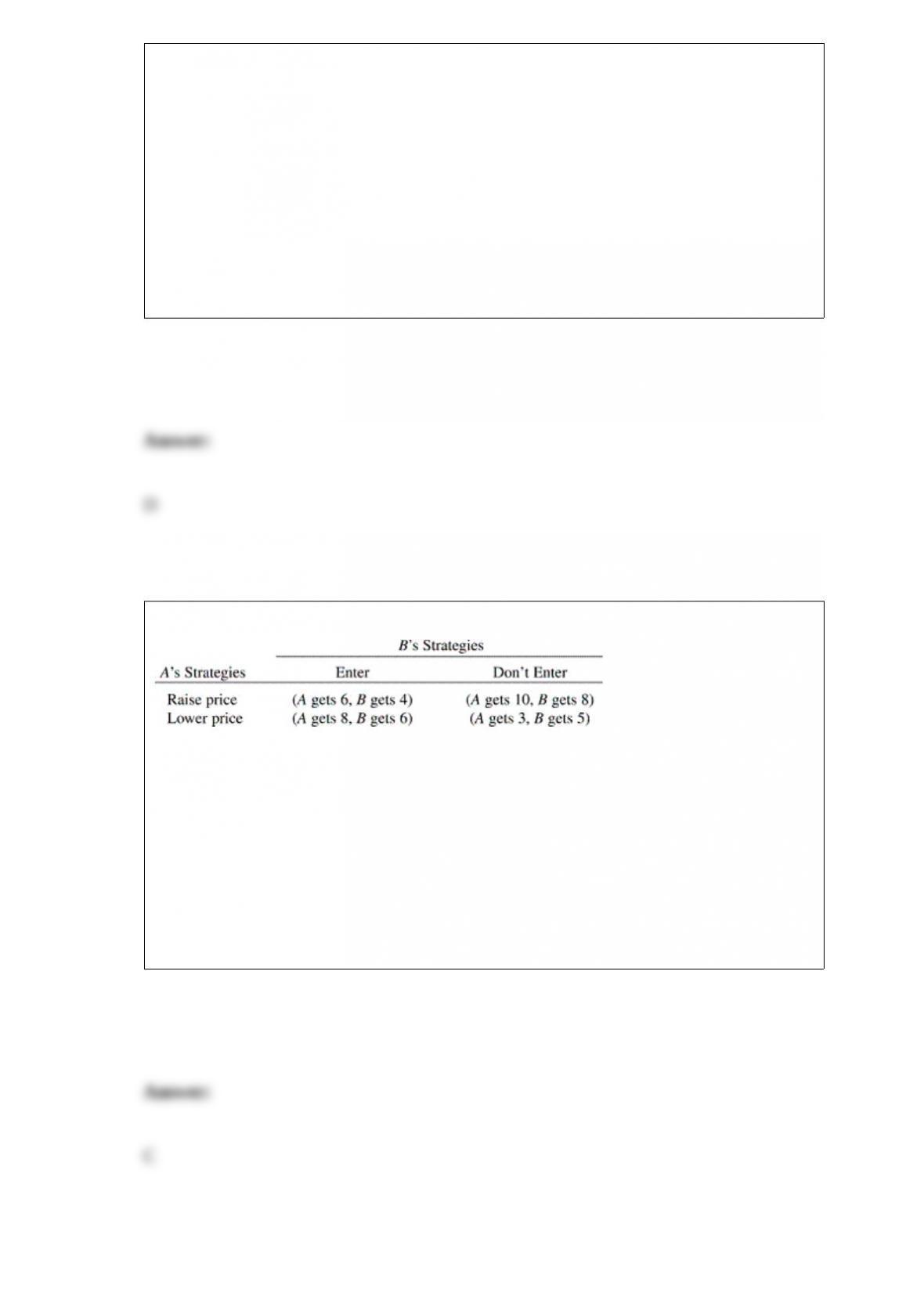
How many Nash equilibria are there in this payoff matrix?
a. 0
b. 1
c. 2
d. 3
e. 4

The market demand curve is:
a. the vertical summation of the individual demand curves.
b. the horizontal summation of the individual demand curves.
c. the sum of the prices that each consumer is willing to pay for each quantity of output.
d. the sum of the quantities that each consumer is willing to buy at each price.
e. b and d
An external economy occurs whenever a(n):
a. action taken by a firm or individual results in uncompensated benefits to others.
b. action taken by a firm or individual results in compensated benefits to others.
c. action taken by a firm or individual results in compensated costs to others.
d. firm trains workers in a highly specialized, firm-specific skill.
e. action taken by a firm or individual results in uncompensated costs to others.
If revenues from selling quantities x and y of jointly produced goods X and Y were TRX
= 100 ” xy + 2x and TRY = 500 ” xy + 3y, then marginal revenue with respect to X would

be:
a. “2 ” y.
b. “y.
c. “x(2y + 5).
d. “(2y + 5).
e. 2(1 ” y).
Sally can advertise on radio, A1, or on television, A2, as long as she spends no more
than $10. Profits depend on her advertising according to p = 100 + 10A1 + 20A2 ” A2
1 ”
A2
2 + 0.5A1A2. The constrained profit-maximizing levels of radio and television
advertising are:
a. A1 = $3 and A2 = $7.
b. A1 = $7 and A2 = $3.
c. A1 = $10 and A2 = $0.
d. A1 = $0 and A2 = $10.
e. A1 = $5 and A2 = $5.

The standard error of the estimate is also known as:
a. the root-mean-squared error.
b. the standard error of the coefficient estimate.
c. R-squared.
d. the t-ratio.
e. t-squared.
In a Dutch auction:
a. buyers bid against each other with a succession of increasingly higher prices until
only one remains.
b. a bid is announced, and if no buyer accepts the bid in a given period of time, a new,
slightly lower, bid is announced; this procedure continues until a bidder accepts the
announced price.
c. each bidder submits a price that is known only to that bidder; bids are opened and the
highest (lowest) bid is accepted.
d. each bidder submits a price that is known only to that bidder; bids are opened and the
highest (lowest) bidder wins, but the transaction occurs at the second highest (lowest)
price.
e. none of the above.

Down and Out Co. operates an executive placement service for corporate executives
displaced by corporate restructuring. Its monthly total cost of cases is given by TC =
25Q1/2 + 2,500; the average cost at a caseload of 25 attempted placements per month is:
a. $100.
b. $105.
c. $200.
d. $205.
e. $225.
The principal”agent problem refers to:
a. the threat from foreign competition.
b. the need to manage inventory more effectively.
c. double-entry bookkeeping.
d. the potential costs of separation of ownership and control.
e. the time value of money.

Suppose that in Milford, Connecticut, owners of used cars that are lemons value their
cars at $2,500, and owners of used cars that are reliable value their cars at $6,000. There
are equal quantities of each type of car on the market. Buyers value low-quality cars at
$1,500 and high-quality cars at $7,000. In this market:
a. only low-quality cars will be sold at a price of $1,500.
b. only low-quality cars will be sold at a price of $2,500.
c. all cars will sell at a price of $4,250.
d. only high-quality cars will be sold at a price of $6,000.
e. only high-quality cars will be sold at a price of $7,000.
The winner’s curse occurs because:
a. competitors in auctions often make poor bids.
b. there are too many competitors in most auctions.
c. competitors in auctions usually make bids that are below the expected value of the
prize.
d. sealed-bid auctions have too much uncertainty attached to them.
e. the winning competitor in an auction will make a bid that is greater than the average
bid.

Serial correlation occurs when:
a. independent variables are correlated across observations.
b. dependent variables are correlated across observations.
c. error terms are correlated across observations.
d. R-squared is near 1 and the t-statistics are near 0.
e. R-squared is near 0 and the t-statistics are near 1.
If Y = aXb(c + Xd), then dY/dX is:
a. abXb” 1(c + X)d + aXbdXd” 1.
b. abXb” 1(c + X)d + aXb(d ” 1)Xd.
c. a(b ” 1)Xb(c + Xd) + aXb(d ” 1)Xd.
d. abXb” 1dXd” 1.
e. a(b ” 1)Xb(c + Xd).
Whopper Stoppers Inc. chooses a price for its sink stoppers, and other firms always
charge the same price. Whopper Stoppers Inc. is:

a. colluding.
b. losing money in the long run.
c. threatening competitors.
d. a price leader.
e. preempting the competitors.
If the perfectly competitive market demand for cholesterol-free cookies shifts from
QD,93 = 1,150 ” 5P to QD,94 = 1,640 ” 5P, and the market supply is given by QS = “100
+ 2P, then the change in equilibrium price will be:
a. $70.
b. $80.
c. $90.
d. $100.
e. $110.
When total product is at its maximum:
a. average product is greater than marginal product.
b. average product is maximized.
c. average product equals marginal product.
d. marginal product equals 1.
e. average product equals 1.
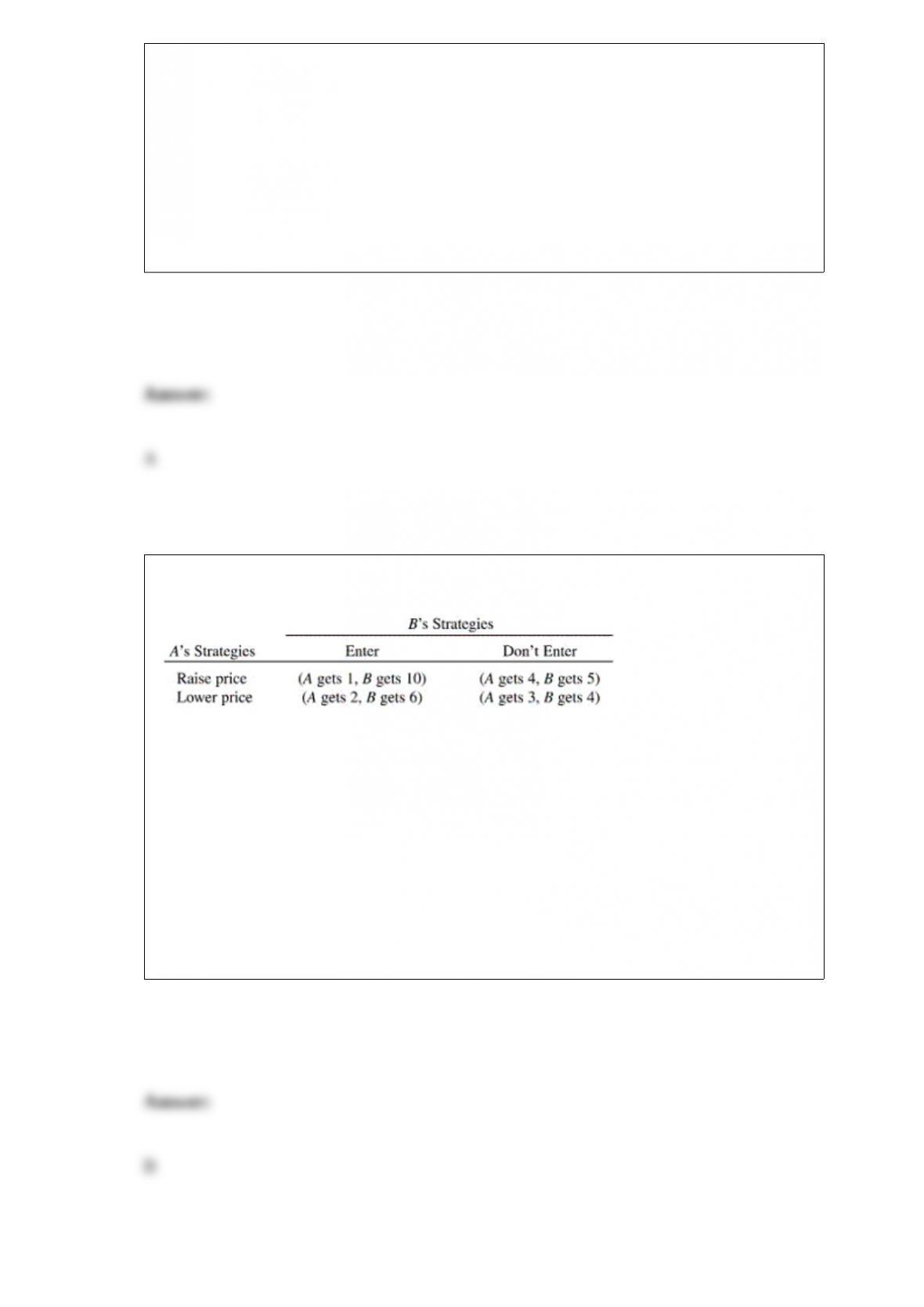
Given the following payoff matrix, what will A‘s profits be?
a. 1
b. 2
c. 3
d. 4
e. Unknown until B‘s action is observed.

Adverse selection implies that:
a. the market for used cars is perfectly competitive.
b. the market for used cars will contain more cars of higher than average quality.
c. the market for used cars will contain more cars of lower than average quality.
d. all used cars will be of equal quality.
e. the government overinsures the market for used cars.
In the model of monopolistic competition, firms produce a:
a. standardized product with considerable control over price.
b. differentiated product with considerable control over price.
c. standardized product with no control over price.
d. differentiated product with no control over price.
e. differentiated product with some control over price.
When producing 10 units, Jean has total variable costs of $100, total fixed costs of
$100, and assets of $100. She wants a return of 10%. What price should she charge?

a. $11.
b. $21.
c. $30.
d. $210.
e. $300.
You only have 12 ovens in which to bake over 200 specialty pastries. Subject to the
oven constraint, you determine the profit-maximizing quantities of each pastry to
produce and find that the Lagrangian multiplier is equal to 0. From this you conclude
that you:
a. should be producing fewer types of pastry.
b. should be producing more types of pastry.
c. should purchase additional ovens.
d. are effectively unconstrained with 12 ovens.
e. should purchase 2 more ovens.
The demand for fax machines has been estimated to be Q = 1,000 ” P + 40L, where P is
the price of the machines and L is the average cost of a 10-minute midday call from Los

Angeles to New York. At a fax machine price of $400 and a phone call cost of $10, the
cross-price elasticity of demand for fax machines with respect to the price of phone
service is:
a. 0.4.
b. 2.5.
c. “0.25.
d. 4.0.
e. 4.25.
A short-run average cost curve is tangent to the long-run average cost curve at the
quantity where:
a. the fixed plant size would have been optimal.
b. short-run marginal cost is minimized.
c. short-run marginal cost is equal to average cost.
d. short-run average cost is minimized.
e. long-run average cost is minimized.
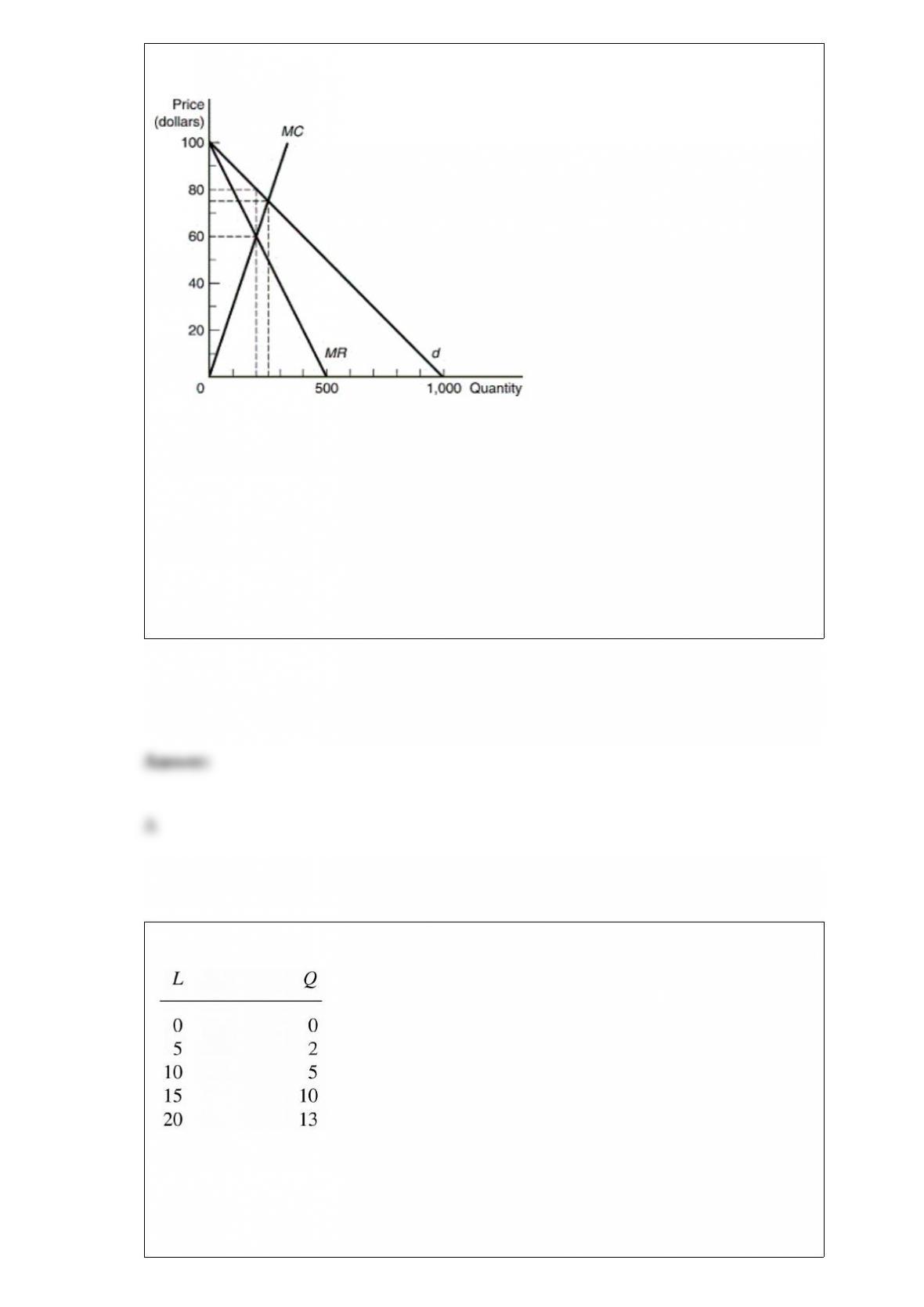
The optimal output and price for the cartel shown in the accompanying diagram is:
a. Q = 200 and P = $80.
b. Q = 260 and P = $60.
c. Q = 250 and P = $80.
d. Q = 500 and P = $75.
e. none of the above.
In the following table, the average product of labor at L = 10 is:
a. “5.
b. 0.5.

c. 2.
d. 3.
e. “1.
A competitive market with demand Q = 120 ” 4P and supply Q = “30 + 2P is in
equilibrium. If government imposes a price floor of 23, what quantity will be traded on
the market?
a. 28
b. 16
c. 20
d. 22
e. None of the above.
Total revenue is rising with increases in output whenever:
a. output increases.
b. marginal revenue is positive.
c. average revenue is positive.

d. demand is inelastic.
e. average revenue is negative.
When setting rates that natural monopolists can charge, regulatory commissions attempt
to establish a maximum price:
a. at the minimum long-run average cost of the monopolist.
b. at the minimum short-run average cost of the monopolist.
c. where price equals average total cost plus a fair rate of return on the invested capital
of the monopolist.
d. where price equals average variable cost plus a fair rate of return on the invested
capital of the monopolist.
e. at the minimum long-run average variable cost of the monopolist.
The market supply curve shows the quantity of a good or service that , holding
other possible influences constant.
a. households would sell at various prices
b. households would buy at various outputs

c. firms would sell at various prices
d. firms would buy at various prices
e. households would buy at various prices
Which of the following is an example of a descending-bid auction?
a. Sealed-bid auction.
b. Japanese auction.
c. Dutch auction.
d. Vickrey auction.
e. Rabbit auction.
Marginal revenue can be defined in terms of price (P) and elasticity (ç) as:
a. MR = P(h + 1/h).
b. P = MR(1/h).
c. MR = Ph.
d. MR = P(1 + 1/h).

e. P = MR(1 ” 1/h).