
When Joe maximizes utility, he finds that his MRS of X for Y is greater than Px/Py. It is
most likely that:
A) Joe’s preferences are incomplete.
B) Joe’s preferences are irrational.
C) Joe is not consuming good X.
D) Joe is not consuming good Y.
If the isoquants are straight lines, then
A) inputs have fixed costs at all use rates.
B) the marginal rate of technical substitution of inputs is constant.
C) only one combination of inputs is possible.
D) there are constant returns to scale.
Scenario 3:
Consider the following information.
Melissa Qwerty was killed in a freak typewriter accident. Her family sued the

typewriter company for the value of the income loss her death represented. The family
demanded $X in compensation.
$X would be higher if
A) her income were higher and she were younger.
B) her income were higher and she were older.
C) her income and the mortality rates for someone of Ms. Qwerty’s statistical profile
were both lower.
D) her income and the mortality rates for someone of Ms. Qwerty’s statistical profile
were both higher.
E) she were older and the relevant mortality rate were lower.
The following data pertain to products A and B, both of which are purchased by
Madame X. Initially, the prices of the products and quantities consumed are:
PA = $10, QA = 3, PB = $10, QB = 7.
Madame X has $100 to spend per time period. After a reduction in price of B, the prices
and quantities consumed are:
PA = $10, QA = 2.5, PB = $5, QB = 15.
Assume that Madame X maximizes utility under both price conditions above. Also,
note that if after the price reduction enough income were taken away from Madame X
to put her back on the original indifference curve, she would consume this combination
of A and B:
QA = 1.5, QB = 9
a. Determine the change in consumption rate of good B due to (1) the substitution effect
and (2) the income effect.
b. Determine if product B is a normal, inferior, or Giffen good. Explain.
Suppose the price of rice increases and you view rice as an inferior good. The
substitution effect results in a ________ change in rice consumption, and the income
effect leads to a ________ change in rice consumption.
A) positive, positive
B) positive, negative
C) negative, positive
D) negative, negative

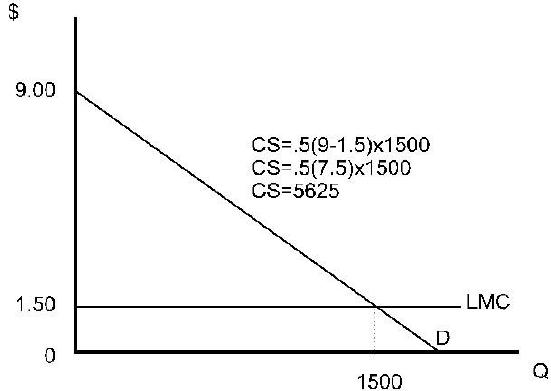
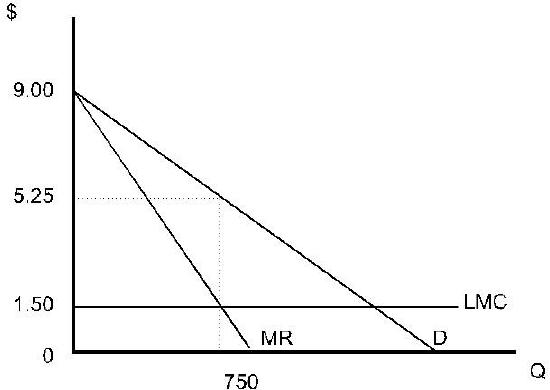
The industry demand curve for a particular market is:
Q = 1800 – 200P.
The industry exhibits constant long-run average cost at all levels of output, regardless
of the market structure. Long-run average cost is a constant $1.50 per unit of output.
Calculate market output, price (if applicable), consumer surplus, and producer surplus
(profit) for each of the scenarios below. Compare the economic efficiency of each
possibility.
a. Perfect Competition
b. Pure Monopoly (Hint: MR = 9 – 0.01Q)
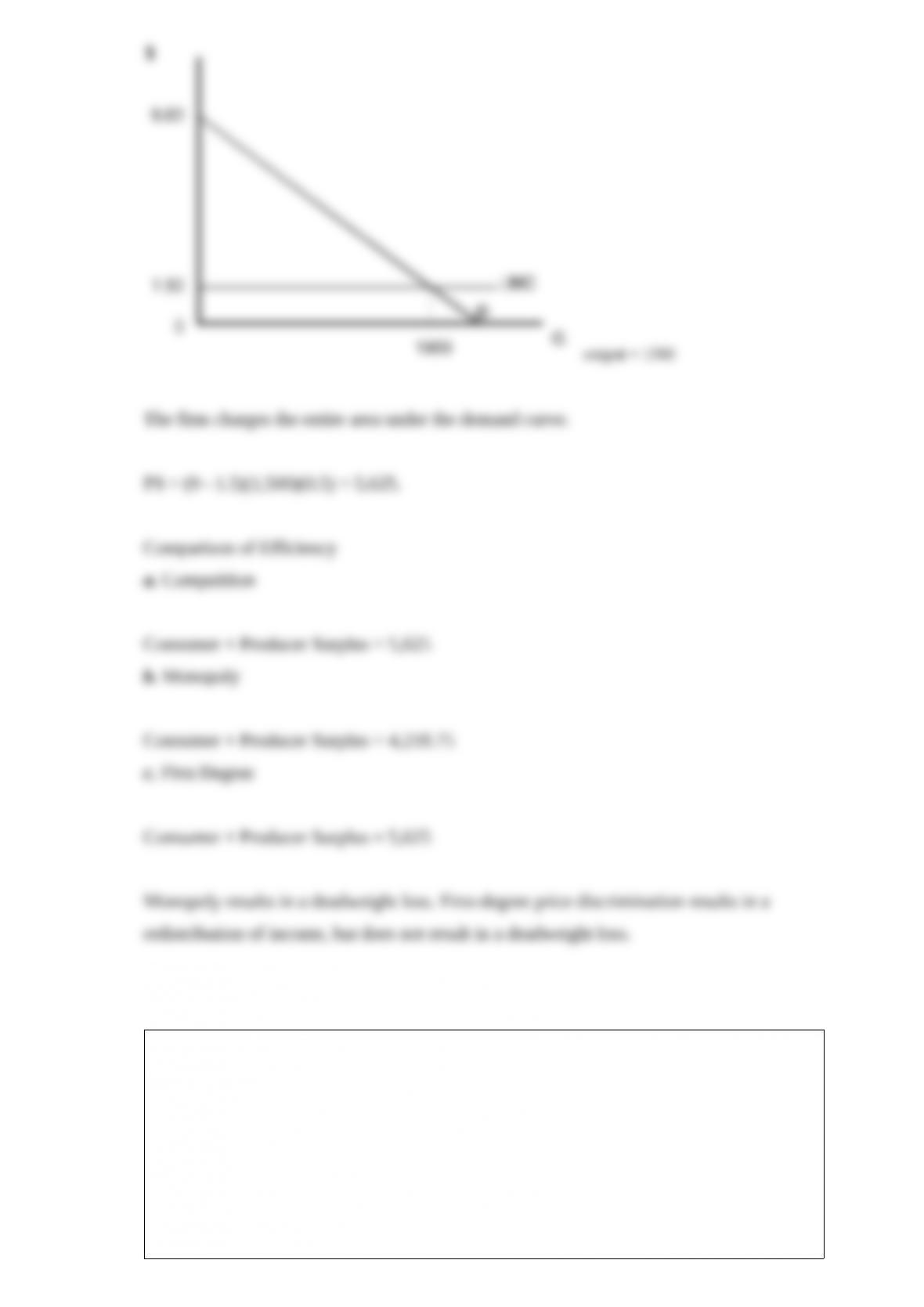
c. First Degree Price Discrimination
The risk-return indifference curves for a risk-neutral investor are:
A) vertical lines.
B) straight lines with slope equal to one.
C) horizontal lines.
D) upward sloping lines that are bowed downward.

Which of the following questions is addressed when hiring capital, but not addressed
when hiring labor?
A) How much are future profits worth today?
B) How much are today’s profits worth in the future?
C) How much are the future’s profits worth in the future?
D) How much are today’s profits worth today?
E) All questions present when capital is purchased are present when labor is purchased.
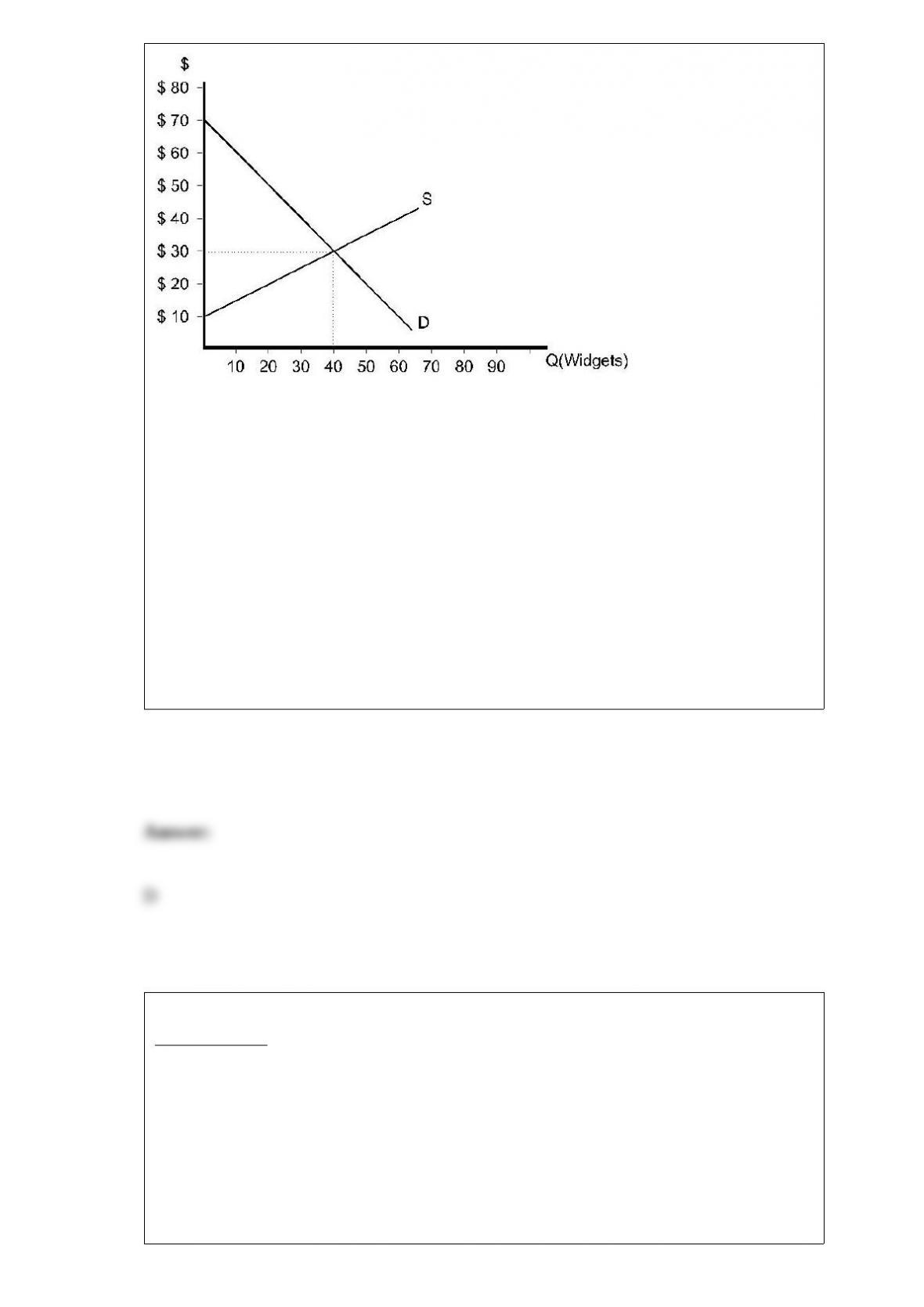
Figure 9.1
Refer to Figure 9.1. If the market is in equilibrium, the producer surplus earned by the
seller of the 1st unit is ________.
A) $5.00
B) $10.00
C) $15.00
D) $20.00
E) $40.00
Scenario 10.4:
The demand for tickets to the Katy Perry concert (Q) is given as follows:
Q = 120,000 – 2,000P
The marginal revenue is given as:
MR = 60 – .001Q

The stadium at which the concert is planned holds 60,000 people. The marginal cost of
each additional concert goer is essentially zero up to 60,000 fans, but becomes infinite
beyond that point.
Refer to Scenario 10.4. Given the information above, what are the profit maximizing
number of tickets sold and the price of tickets?
A) 0, $60
B) 20,000, $50
C) 40,000, $40
D) 60,000, $30
E) 80,000, $20
Due to capacity constraints, the price elasticity of supply for most products is:
A) the same in the long run and the short run.
B) greater in the long run than the short run.
C) greater in the short run than in the long run.
D) too uncertain to be estimated.

Suppose the state legislature in your state imposes a state licensing fee of $100 per year
to be paid by all firms that file state tax revenue reports. This new business tax:
A) increases marginal cost.
B) decreases marginal cost.
C) increases marginal revenue.
D) decreases marginal revenue.
E) none of the above
________ questions have to do with explanation and prediction, ________ questions
have to do with what ought to be.
A) Positive; negative.
B) Negative; normative.
C) Affirmative; positive.
D) Positive; normative.
E) Econometric; theoretical.
The magnitude of the slope of an indifference curve is:

A) called the marginal rate of substitution.
B) equal to the ratio of the total utility of the goods.
C) always equal to the ratio of the prices of the goods.
D) all of the above
E) A and C only
Scenario 5.10:
Hillary can invest her family savings in two assets: riskless Treasury bills or a risky
vacation home real estate project on an Arkansas river. The expected return on Treasury
bills is 4 percent with a standard deviation of zero. The expected return on the real
estate project is 30 percent with a standard deviation of 40 percent.
Refer to Scenario 5.10. Hillary’s indifference curves showing her preferences toward
risk and return can be shown in a diagram. Expected return is plotted on the vertical
axis and standard deviation of return on the horizontal axis. Although her indifference
curves are upward sloping and bowed downward, their slope is very gradual (they are
almost horizontal). These indifference curves reveal that Hillary is:
A) risk neutral.
B) risk averse.
C) risk loving.
D) irrational.

When compared to the demand curve for only one variable input, the demand curve for
a factor input when several inputs are variable is
A) less elastic.
B) more elastic.
C) vertical.
D) horizontal.
An effective price ceiling causes a loss of
A) producer surplus for certain and possibly consumer surplus as well.
B) consumer surplus only.
C) producer surplus only.
D) consumer surplus for certain and possibly producer surplus as well.
E) neither producer nor consumer surplus.

A local theater charges $5.00 for every matinee (daytime) ticket, but the ticket prices
are much higher during the evening. This is an example of
A) peak-load pricing.
B) second-degree price discrimination.
C) a two-part tariff.
D) bundling.
E) none of the above
A monopolistically competitive firm in long-run equilibrium:
A) will make negative profit.
B) will make zero profit.
C) will make positive profit.
D) Any of the above are possible.
Which of the following events will help to burst an asset price bubble?
A) Speculative demand for the asset quickly declines.

B) Speculative demand for the asset quickly increases.
C) New information leads buyers to doubt that prices will continue to increase in the
future.
D) A and C are correct
As long as the actual market price exceeds the equilibrium market price, there will be:
A) downward pressure on the market price.
B) upward pressure on the market price.
C) no purchases made.
D) Both A and C are correct.
E) Both B and C are correct.
Which of the following is true at the exchange equilibrium between two individuals?
A) Their marginal rates of substitution are equal.
B) The slopes of the individuals’ indifference curves are equal.
C) Both individuals’ marginal rates of substitution are equal to the ratio of the prices of
the goods.
D) A and B only
E) A, B, and C are all true.
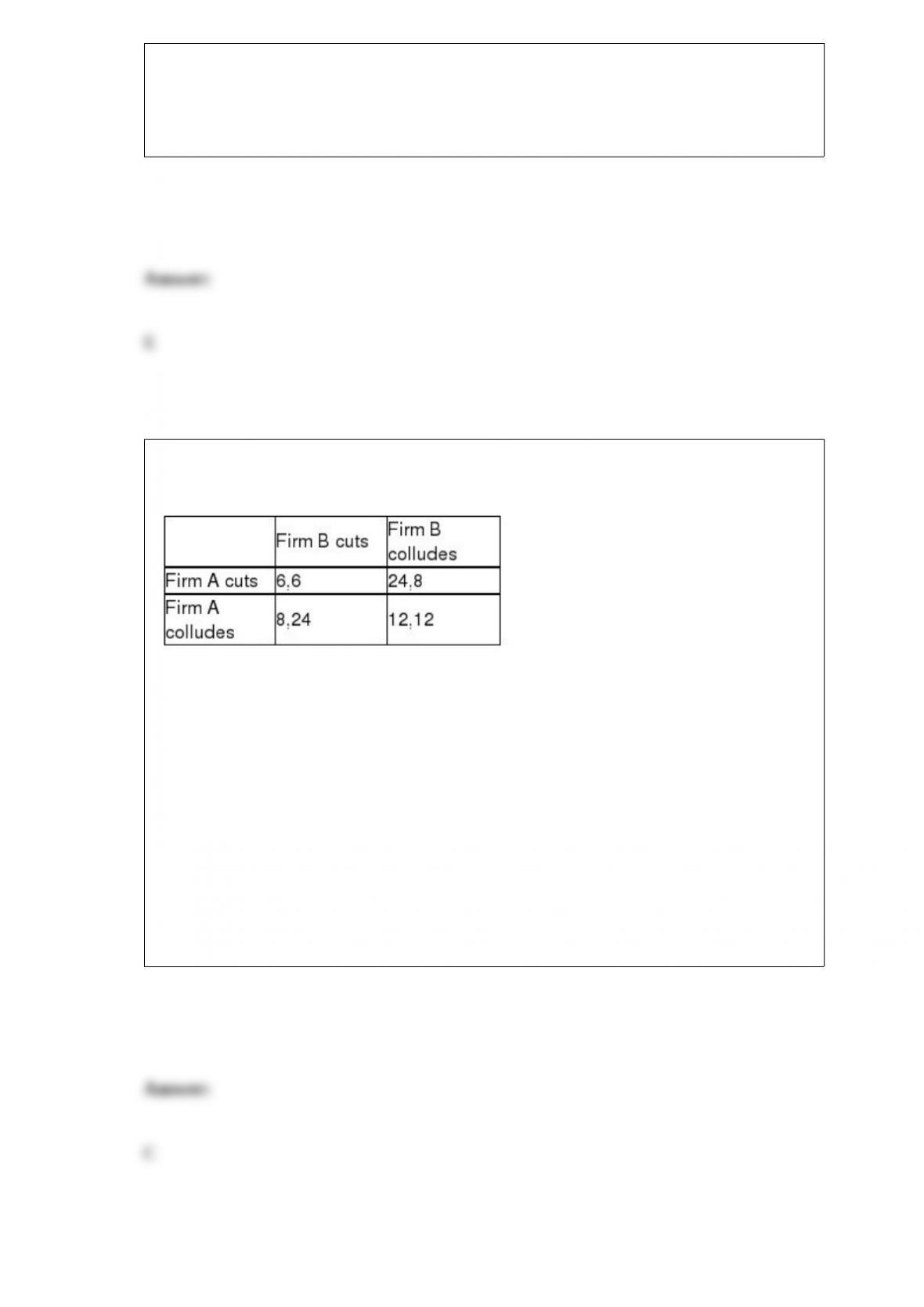
Consider the following payoff matrix for a game in which two firms attempt to collude
under the Bertrand model:
Here, the possible options are to retain the collusive price (collude) or to lower the price
in attempt to increase the firm’s market share (cut). The payoffs are stated in terms of
millions of dollars of profits earned per year. What is the Nash equilibrium for this
game?
A) Both firms cut prices.
B) Both firms collude.
C) There are two Nash equilibria: A cuts and B colludes, and A colludes and B cuts.
D) There are no Nash equilibria in this game.

Scenario 17.5
Consider the following information:
Income to the firm from workers who sell door-to-door
Bad Luck Good Luck
Low Effort (e = 0) $5,000 $7,000
High Effort (e = 1) $7,000 $13,000
Cost of effort: c = $2500e
Probabilities: Bad luck = .75; Good luck = .25
A principal-agent problem arises in the situation in Scenario 17.5 because
A) the principal can measure effort and output; the agent can measure only output.
B) the principal can measure only effort, and the agent can measure only output.
C) the principal can measure only output, and the agent can measure effort and output.
D) neither the principal nor the agent can measure effort.
E) neither the principal nor the agent can measure output.
Coffee and cream:
A) are both luxury goods.
B) are complements.
C) are both more inelastic in demand in the long run than in the short run.
D) have a positive cross price elasticity of demand.

When a person consumes two goods (A and B), that person’s utility is maximized when
the budget is allocated such that:
A) the marginal utility of A equals the marginal utility of B.
B) the marginal utility of A times the price of A equals the marginal utility of B times
the price of B
C) the ratio of total utility of A to the price of A equals the ratio of the marginal utility
of B to the price of A.
D) the ratio of the marginal utility of A to the price of A equals the ratio of the marginal
utility of B to the price of B.
Use the following two statements about monopolistic competition to answer this
question.
I. In the long run, the price of the good will equal the minimum of the average cost.
II. In the short run, firms may earn a profit.
A) I and II are true.
B) I is true, and II is false.
C) I is false, and II is true.
D) I and II are false.

Which factors determine the firm’s elasticity of demand?
A) Elasticity of market demand and number of firms
B) Number of firms and the nature of interaction among firms
C) Elasticity of market demand, number of firms, and the nature of interaction among
firms
D) none of the above
The most important factor in determining the long-run profit potential in monopolistic
competition is
A) free entry and exit.
B) the elasticity of the market demand curve.
C) the elasticity of the firm’s demand curve.
D) the reaction of rival firms to a change in price.

If the regulatory agency sets a price where AR = AC for a natural monopoly, output will
be
A) equal to the competitive level.
B) equal to the monopoly profit maximizing level.
C) greater than the monopoly profit maximizing level and less than the competitive
level.
D) greater than the competitive level.