According to Douglass North, the Industrial Revolution occurred in England because
A) the British Parliament took control of the government and could credibly commit to
upholding property rights.
B) the British monarchy took control of the government and pledged not to raise taxes
arbitrarily.
C) the British courts became tied to the king and began to refuse to enforce property
rights.
D) the British Parliament instituted a command economy structure and implemented a
planned economy.
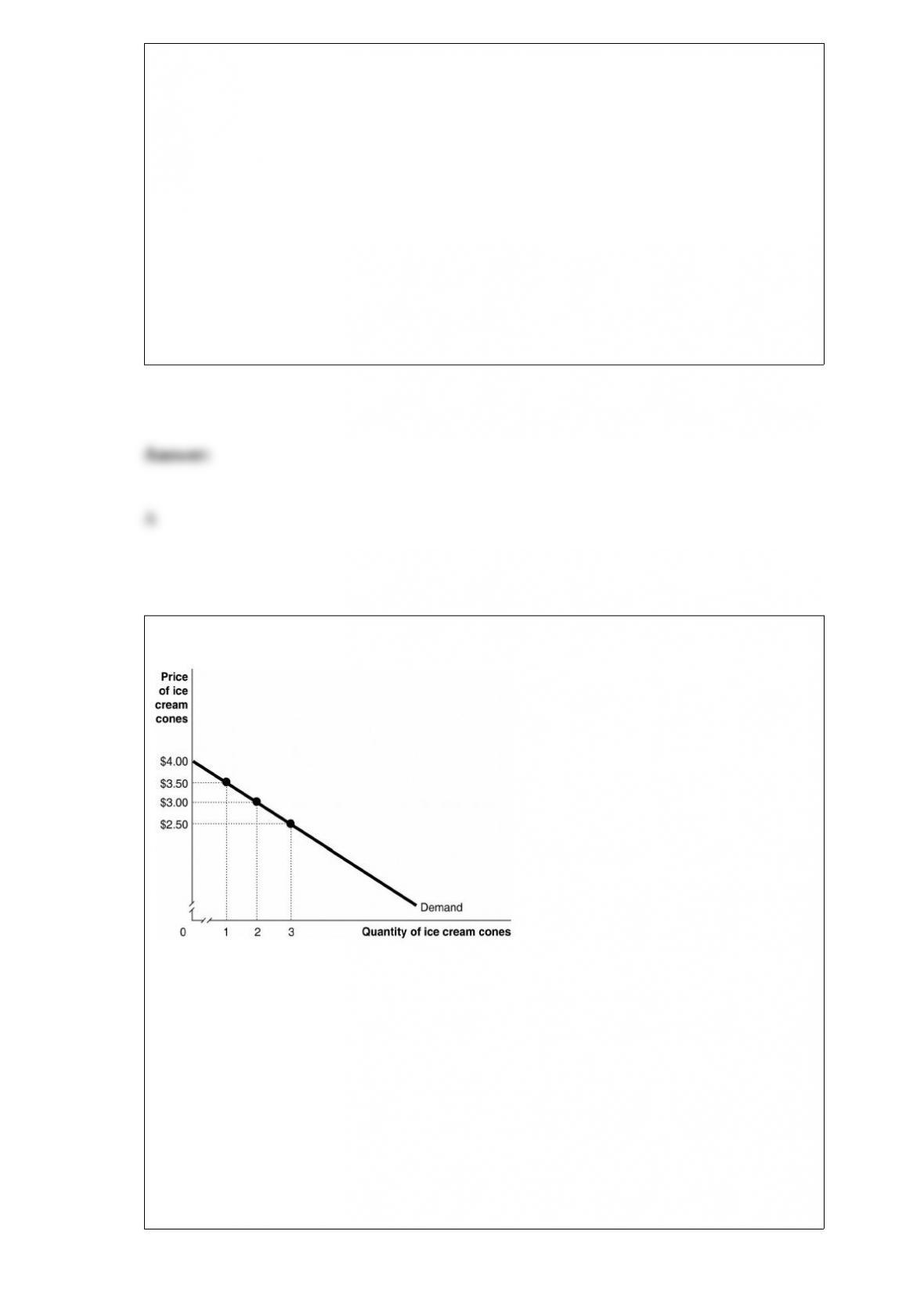
Figure 4-1
Figure 4-1 shows Kendra’s demand curve for ice-cream cones.
Refer to Figure 4-1. What is the total amount that Kendra is willing to pay for 3 ice
cream cones?
A) $2.50
B) $7.50
C) $9.00
D) $13.50
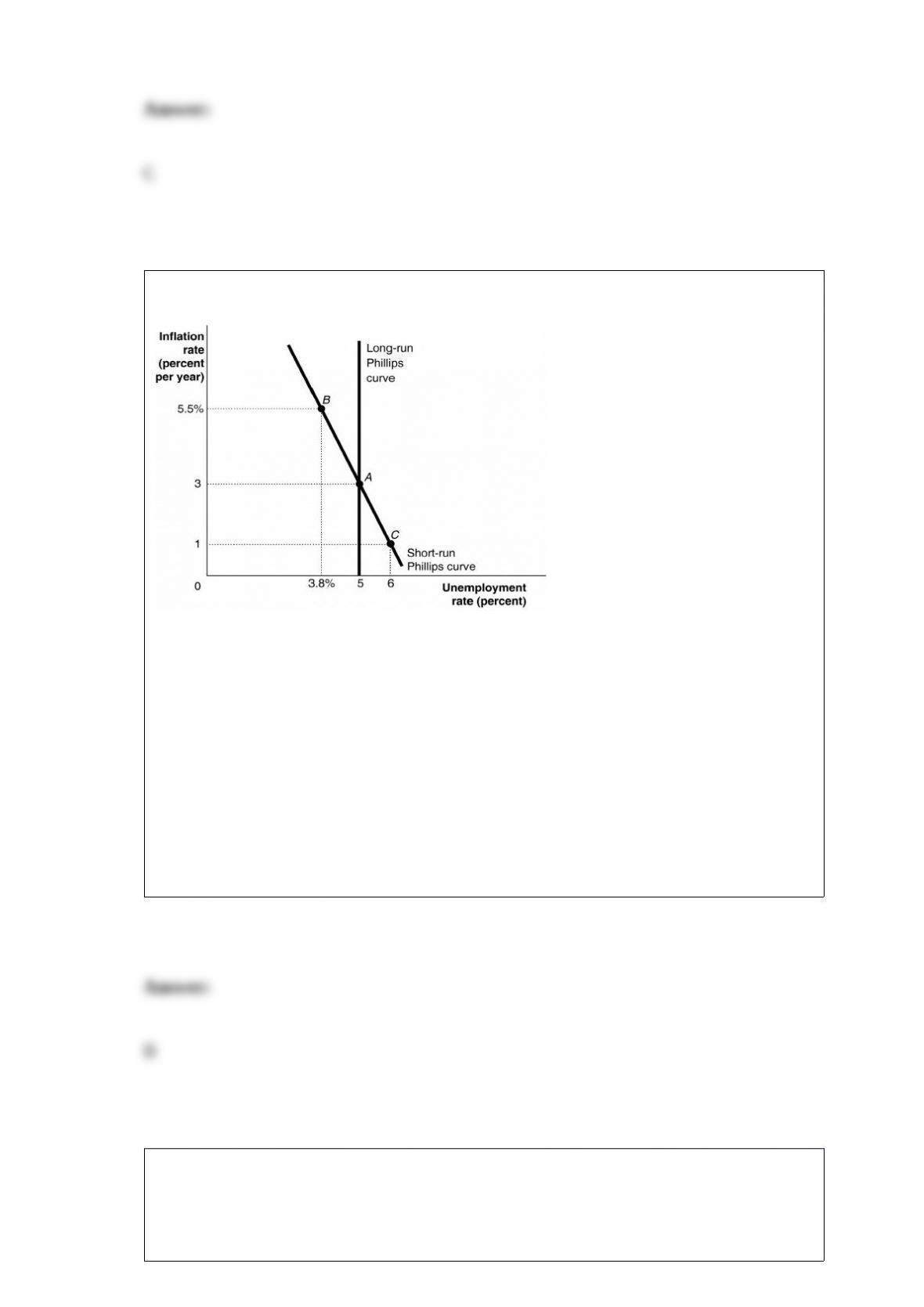
Figure 17-2
Refer to Figure 17-2. Suppose the economy is at point A in the figure above. Which of
the following is true?
A) The expected rate of inflation is 5.5%.
B) The current unemployment rate is equal to the natural rate of unemployment.
C) The current unemployment rate is 3.8%.
D) Actual inflation is 1%.
E) The economy will move from A to B.
Under Alan Greenspan, the Fed strived to hit its goals of price stability and high
employment through
A) setting targets for the federal funds rate of interest.

B) setting targets for rates of growth in the M1 and M2 money supplies.
C) practicing discretionary monetary policy, reacting to counter-changes in the level of
unemployment during recessions and booms.
D) strict adherence to rules based strategies.
In August 2011, Standard & Poor’s (S&P) changed its rating on U.S. Treasury bonds
from ________ based on the state of the federal government’s budget deficit.
A) “A” to “D”
B) “A” to “AAA”
C) “A+” to “B+”
D) “AAA” to “AA+”
Which of the following statements is false?
A) Exports benefit trading countries because exports create jobs. Imports do not benefit
trading countries because they result in a loss of jobs.
B) Each year the United States exports about 50 percent of its wheat crop and 20
percent of its corn crop.
C) Most of the leading exporting countries are large, high-income countries.
D) Not all sectors of the U.S. economy are affected equally by international trade.

Jeremy is thinking of starting up a small business selling NASCAR memorabilia. He
asks his friend, Carmen, if she’d like to join him in setting up a partnership to start the
business. What is one disadvantage in joining the partnership that Carmen should
consider?
A) Carmen should realize that profits in the partnership will be reduced by dividend
payments to shareholders.
B) Carmen should realize that, as an owner of the business, she will be personally
responsible for the debts of the business.
C) Carmen should realize that the profits of the business will also be taxed as dividend
income, so she faces the potential for double taxation of that business income.
D) Carmen should realize that the Jeremy will have complete control over the business
because it was his idea.
Which of the following is counted in GDP?
A) the value of goods and services produced in the underground economy
B) the cost of a speed boat purchased by drug smugglers
C) the value of do-it-yourself work
D) the value of leisure

Equilibrium in the loanable funds market determines
A) the nominal interest rate.
B) the current interest rate.
C) the real interest rate.
D) the expected interest rate.
Selling tickets to graduation ceremonies has long been a tradition among students at
institutions that limit the number of guests. Suppose your classmate, Heidi purchased
two tickets for $40 each. Is this transaction economically efficient?
A) No, people should never be allowed to sell items they received for free.
B) Yes, it was a voluntary exchange that benefited both parties.
C) No, Heidi paid too much for the tickets.
D) Yes, it is efficient only from the perspective of the seller and not from the
perspective of the buyer.
In the dynamic aggregated demand and aggregate supply model, if AD shifts faster than

AS,
A) inflation occurs.
B) deflation occurs.
C) stagflation occurs.
D) disinflation occurs.
How might a budget deficit affect the balance of trade?
A) A budget deficit raises interest rates, which raises exchange rates and increases the
balance of trade.
B) A budget deficit raises interest rates, which raises exchange rates and reduces the
balance of trade.
C) A budget deficit reduces interest rates, which raises exchange rates and reduces the
balance of trade.
D) A budget deficit reduces interest rates, which reduces exchange rates and reduces the
balance of trade.