
Technological advancements that increase labor’s productivity shift the labor supply
curve to the right.
Contractionary fiscal policy is used to decrease aggregate demand in an attempt to fight
rising inflation.
When colleges use yield management techniques, they increase financial aid offers to
students likely to be more price sensitive and they reduce financial aid offers to students
likely to be less price sensitive.
Scarcity refers to a situation in which unlimited wants exceed the limited resources
available to fulfill those wants.
Jobs lost to foreign trade are generally easy to identify, but jobs created by foreign trade
are generally less easy to identify.
Figure 15-12
In the dynamic AD–AS model, the economy is at point A in year 1 and is expected to go
to point B in year 2, and the Federal Reserve pursues policy. This will result in
A) unemployment rates higher than what would occur if no policy had been pursued.
B) inflation rates higher than what would occur if no policy had been pursued.
C) potential real GDP levels lower than what would occur if no policy had been
pursued.
D) real GDP levels higher than what would occur if no policy had been pursued.
Table 11-8
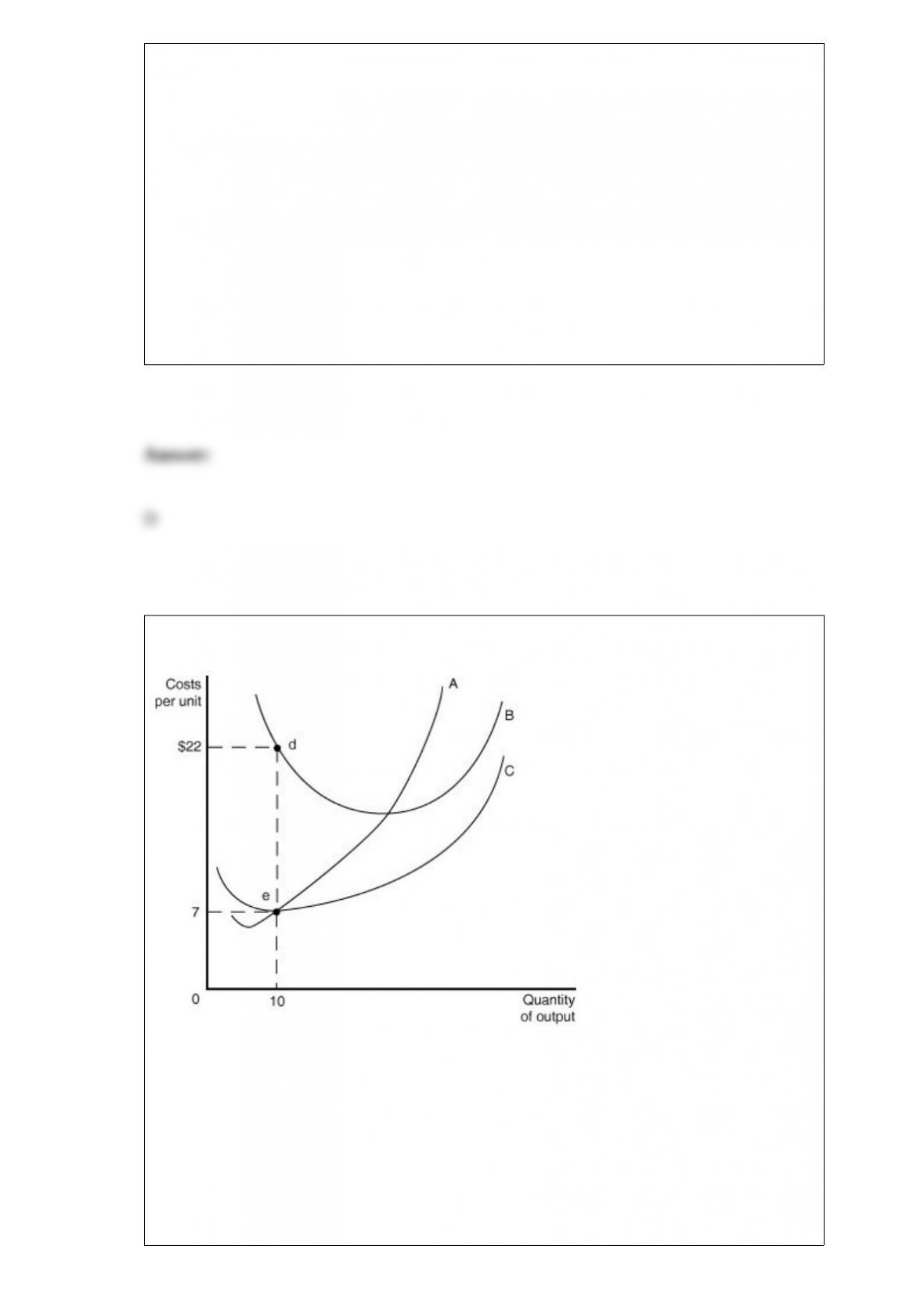
Elegant Settings manufactures stainless steel cutlery. Table 11-8 shows the company’s
cost data.
Elegant Settings experiences
A) economies of scale up to an output level of 400.
B) diminishing returns up to an output level of 400.
C) increasing returns beyond an output level of 400.
D) economies of scale at an output of 300 or less and diseconomies of scale at an output
level above 400.
Figure 11-8
above to answer the following questions.
a. Identify the curves in the diagram.
A ________
B ________
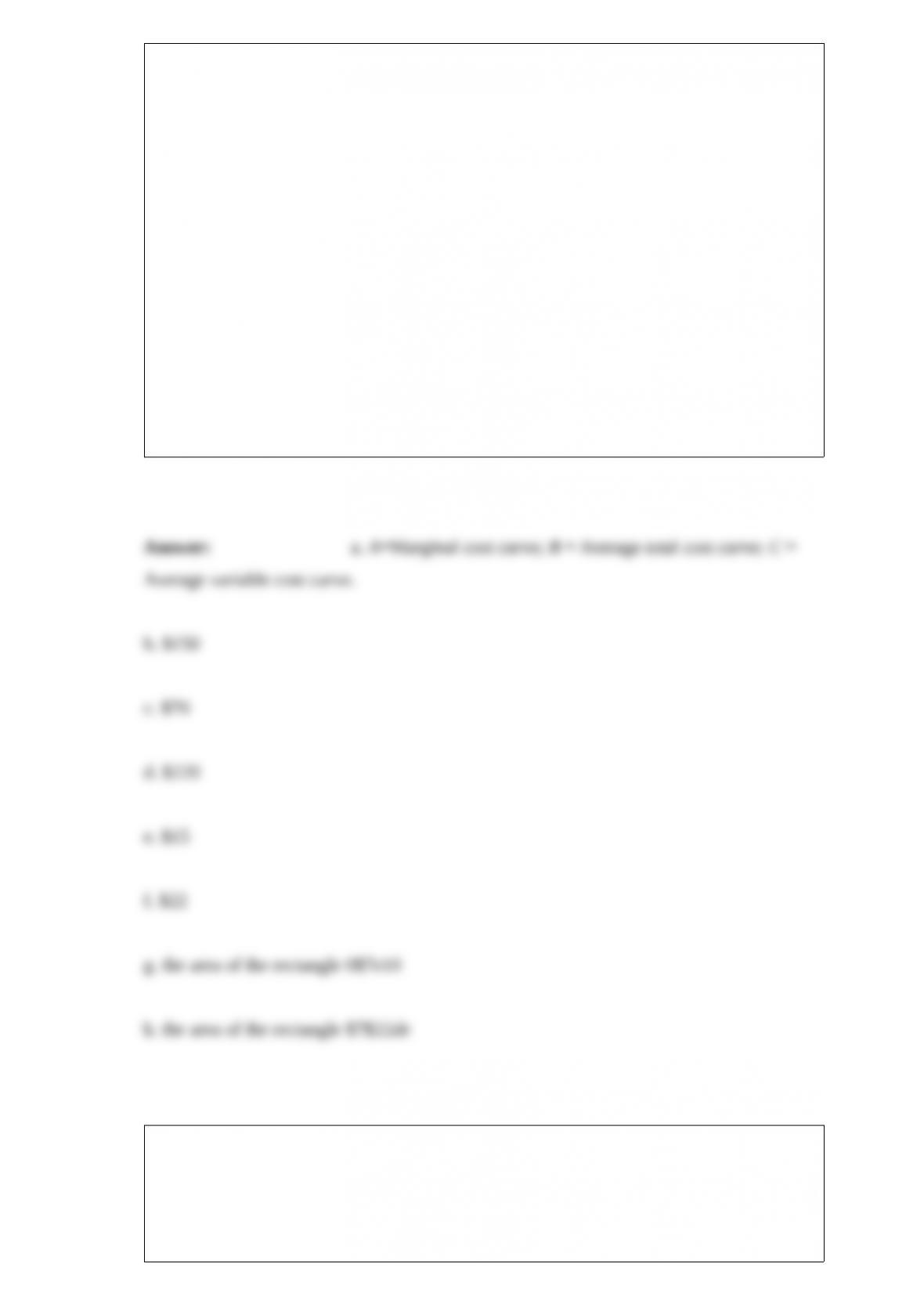
C ________
b. What is the numerical value of fixed cost when the quantity of output=10?
c. What is the numerical value of variable cost when the quantity of output=10?
d. What is the numerical value of total cost when the quantity of output =10?
e. What is the numerical value of average fixed cost when the quantity of output =10?
f. What is the numerical value of average total cost when the quantity of output =10?
g. On the graph identify the area that represents the total variable cost of production
when the quantity of output =10.
h. On the graph identify the area that represents the fixed cost of production when the
quantity of output =10.
How will an increase in labor productivity affect equilibrium in the labor market?
A) The supply of labor will increase and the equilibrium wage and quantity of labor
will increase.

B) The demand for jobs will increase and the equilibrium wage and quantity of labor
will increase.
C) The demand for labor will increase and the equilibrium wage and quantity of labor
will increase.
D) The demand for labor will decrease because fewer workers will be needed to
produce the same output. The equilibrium wage and quantity of labor will decrease.
Suppose real GDP is $12.6 trillion and potential GDP is $12.4 trillion. To move the
economy back to potential GDP, Congress should
A) lower government purchases by an amount less than $200 billion.
B) lower government purchases by $200 billion.
C) raise taxes by $200 billion.
D) lower taxes by $200 billion.
E) raise taxes by an amount more than $200 billion.
If the Fed raises its target for the federal fund rate, this indicates that
A) the Fed is pursuing an expansionary monetary policy.
B) the Fed is pursuing a contractionary monetary policy.
C) the Fed is attempting to combat deflation.

D) The Fed is concerned that the growth in aggregate demand is too slow to keep up
with potential GDP.
In a closed economy, which of the following equations reflects investment? (Y = GDP,
C = Consumption, G = Government purchases, T = Taxes, and TR = Transfers)
A) Y – C – G
B) Y – C – T
C) Y – T + TR
D) C + G –T
Worker discrimination occurs when
A) workers refuse to perform risky tasks.
B) workers refuse to work with persons of a different race.
C) customers refuse to buy products produced by a racially diverse workforce.
D) employers pay different employees different wages based on race.

Once an industry becomes established in a certain area firms that locate in that area gain
advantages over firms located elsewhere, leading to lower costs of production.
Economists refer to the lower costs that result from increases in the size of an industry
in a certain area as
A) external economies.
B) positive externalities.
C) strategic advantages.
D) technological change.
Tony’s Italian Ice is a monopolistically competitive firm. If Tony’s earns a profit in the
short run, which of the following is most likely to occur?
A) New firms that sell Italian ice will enter the market, and Tony’s cost curves will shift
to the left.
B) New firms that sell Italian ice will enter the market, and Tony’s demand curve will
shift to the left.
C) New firms that sell Italian ice will enter the market, and Tony’s demand curve will
shift to the right.
D) New firms that sell Italian ice will enter the market, and Tony’s demand curve will
become more inelastic.

A Big Mac costs $4.56 in the United States and 9.2 zlotys in Poland. If the exchange
rate is 3 zlotys per dollar, what is the dollar cost of a Big Mac in Poland?
A) $1.52
B) $2.02
C) $3.07
D) $4.64
After selling 1,000 three-ring binders, Tony DiFulvio realizes that the marginal revenue
from selling the last binder was less than the marginal cost. From this we can conclude
that
A) Tony’s business earns a short-run economic profit.
B) Tony should shut down his business temporarily.
C) Tony’s profit fell after selling his 1,000th three-ring binder.
D) Tony’s profit would be greater if he sold an additional three-ring binder.
Marginal cost is equal to the
A) change in total cost divided by the change in output.
B) change in average total costs divided by the change in output.
C) change in total product divided by the change in output.
D) change in average product divided by the change in output.
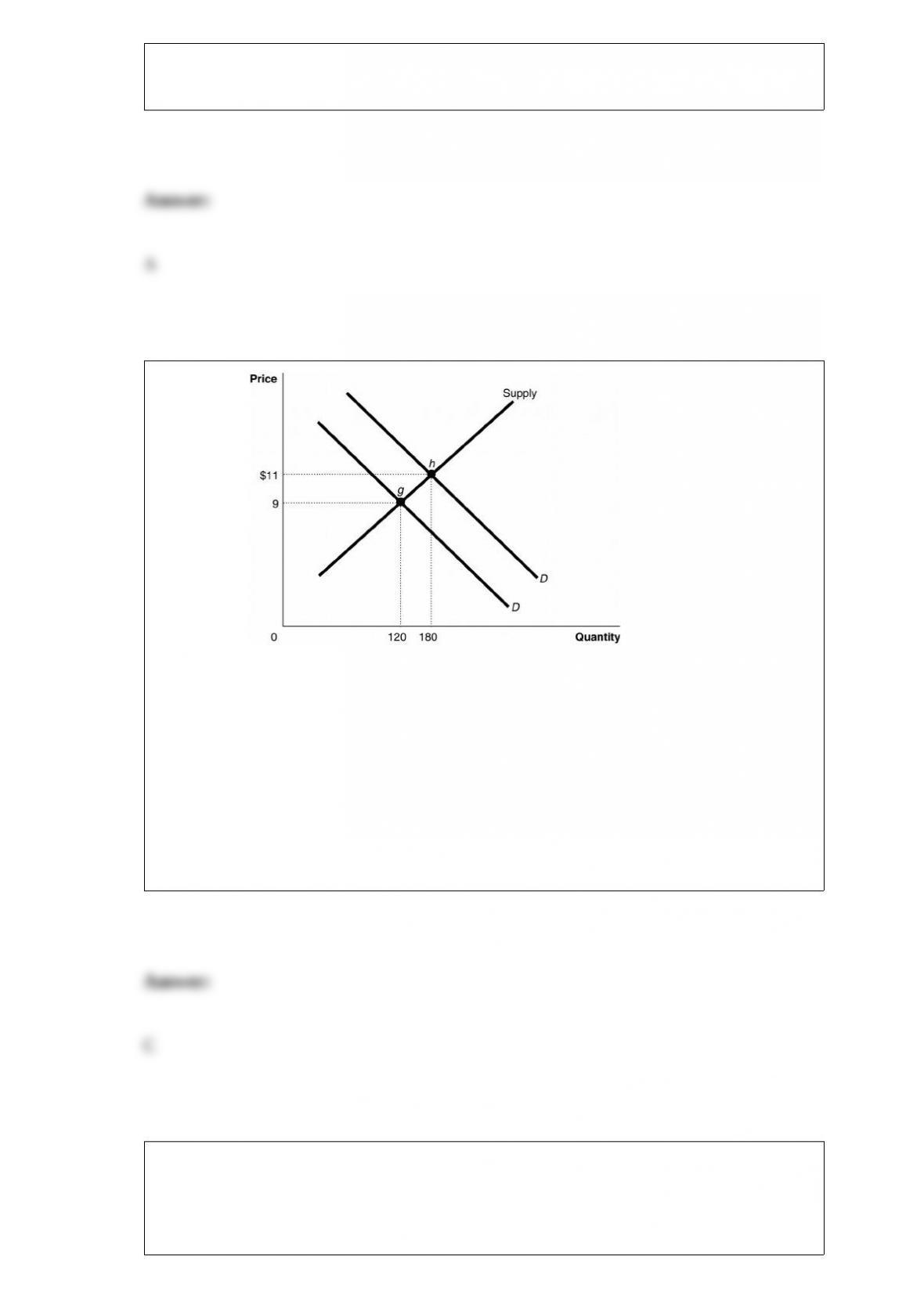
Figure 6-11
What is the value of the price elasticity of supply between g and h?
A) 20 percent
B) 0.5
C) 2
D) 0.02
An example of a factor of production is
A) a car produced by an auto manufacturer.
B) a worker hired by an auto manufacturer.
C) a loan granted to an auto manufacturer.
D) the automobiles exported by an auto manufacturer.
A government budget surplus from reduced government spending (no change in net
taxes) will ________ the level of investment in the economy and ________ the level of
saving (private plus public) in the economy.
A) increase; decrease
B) increase; increase
C) decrease; increase
D) decrease; decrease
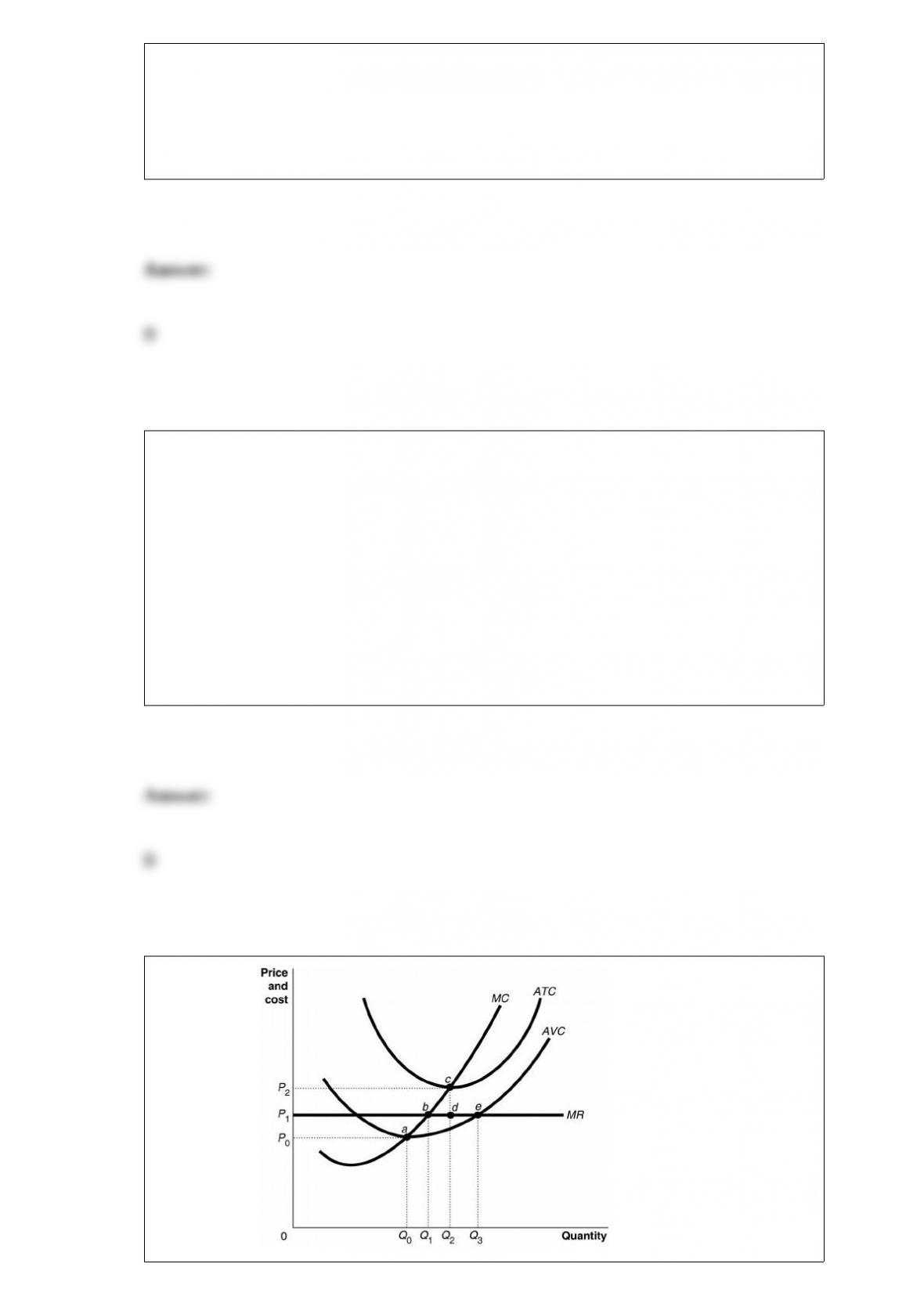
Figure 12-13

Suppose the prevailing price is P1 and the firm is currently producing its
loss-minimizing quantity. In the long-run equilibrium,
A) there will be fewer firms in the industry and total industry output decreases.
B) there will be more firms in the industry and total industry output increases.
C) there will be fewer firms in the industry but total industry output increases.
D) there will be more firms in the industry and total industry output remains constant.
The health care system in Canada is referred to as ________, and is a system in which
the government provides national health insurance to all Canadian residents.
A) an out-of-pocket system
B) a single-payer health care system
C) a universal health insurance system
D) socialized medicine
If the federal budget goes from a budget deficit in Year 1 to a budget surplus in Year 2,
does it follow that the federal government acted to raise taxes or cut government
spending in Year 2?

What is the principle-agent problem?
Explain why international trade is less important to the United States than it is to many
other countries.
The “Big Mac Theory of Exchange Rates” tests the accuracy of purchasing power
parity theory. In July 2013, The Economist reported that the average price of a Big Mac
in the United States was $4.56. In Switzerland, the average price of a Big Mac at that
time was 6.50 Swiss francs. If the exchange rate between the dollar and the Swiss franc
was 0.93 Swiss francs per dollar, explain how it would be profitable to buy Big Macs in
the United States instead of in Switzerland.
On January 2, 1971, all cigarette advertising was banned on U.S. television and radio
stations. Did this ban likely increase or decrease the profits of cigarette companies in
1971? Briefly explain.
Figure 30-9
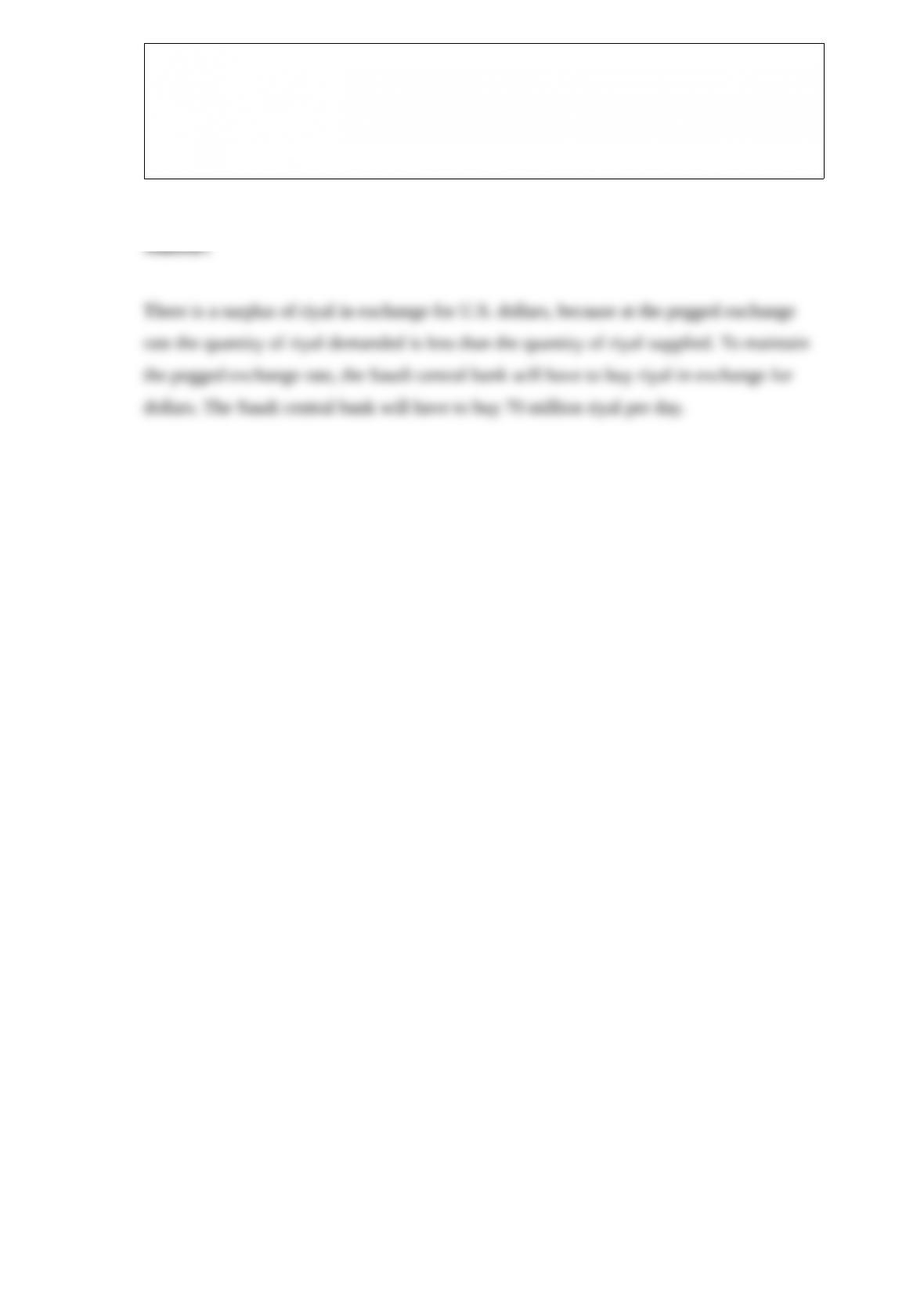
According to the graph, is there a surplus or shortage of Saudi Arabian riyal in
exchange for U.S. dollars? To maintain the pegged exchange rate, will the Saudi central
bank need to buy riyal in exchange for dollars or sell riyal in exchange for dollars? How
many riyal will the Saudi central bank need to buy or sell?