
For an inferior good, the income and substitution effects
A) work together.
B) work against each other.
C) can work together or in opposition to each other depending upon their relative
magnitudes.
D) always exactly cancel each other.
Monica consumes only goods A and B. Suppose that her marginal utility from
consuming good A is equal to 1/Qa, and her marginal utility from consuming good B is
1/Qb. If the price of A is $0.50, the price of B is $4.00, and the Monica’s income is
$120.00, how much of good A will she purchase?
A) 0
B) 12
C) 24
D) 48
E) 120
Suppose that a market basket of two goods is changed by adding more of one of the

goods and subtracting one unit of the other. The consumer will:
A) rank the market basket more highly after the change.
B) rank the market basket more highly before the change.
C) rank the market basket just as desirable as before.
D) any one of the above statements may be true.
The oligopoly model that predicts that oligopoly prices will tend to be very rigid is the
________ model.
A) Cournot
B) Stackelberg
C) dominant firm
D) kinked demand
Scenario 3.1:
Andy derives utility from two goods, potato chips (Qp) and Cola (Qc). Andy receives
zero utility unless he consumes some of at least one good. The marginal utility that he
receives from the two goods is given as follows:
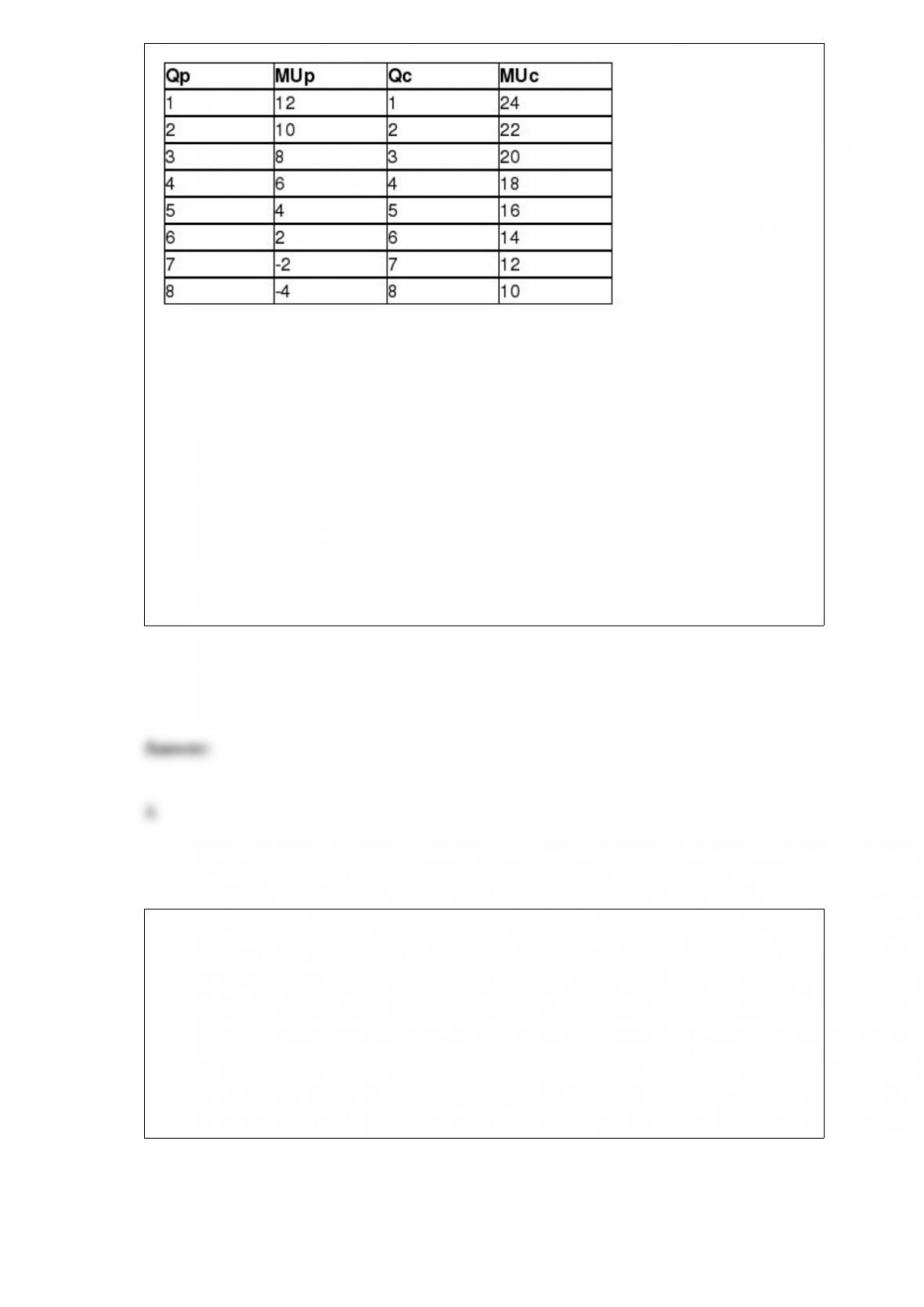
Refer to Scenario 3.1. If the price of potato chips is $0.50 and the price of Cola is $4.00,
and Andy has an income of $14.50, how many units of potato chips will he consume?
A) 5
B) 6
C) 7
D) 8
E) none of the above
A vertical demand curve is
A) completely inelastic.
B) infinitely elastic.
C) highly (but not infinitely) elastic.
D) highly (but not completely) inelastic.
Suppose the supply of textbooks is upward sloping and shifts leftward due to higher ink
and paper costs. Which of the following events would leave the equilibrium price of
textbooks at the same level observed before the supply shift?
A) Demand is perfectly elastic (horizontal).
B) Demand is downward sloping and shifts leftward.
C) all of the above
D) none of the above
In a competitive labor market, shirking on the job can be a problem. In this market for
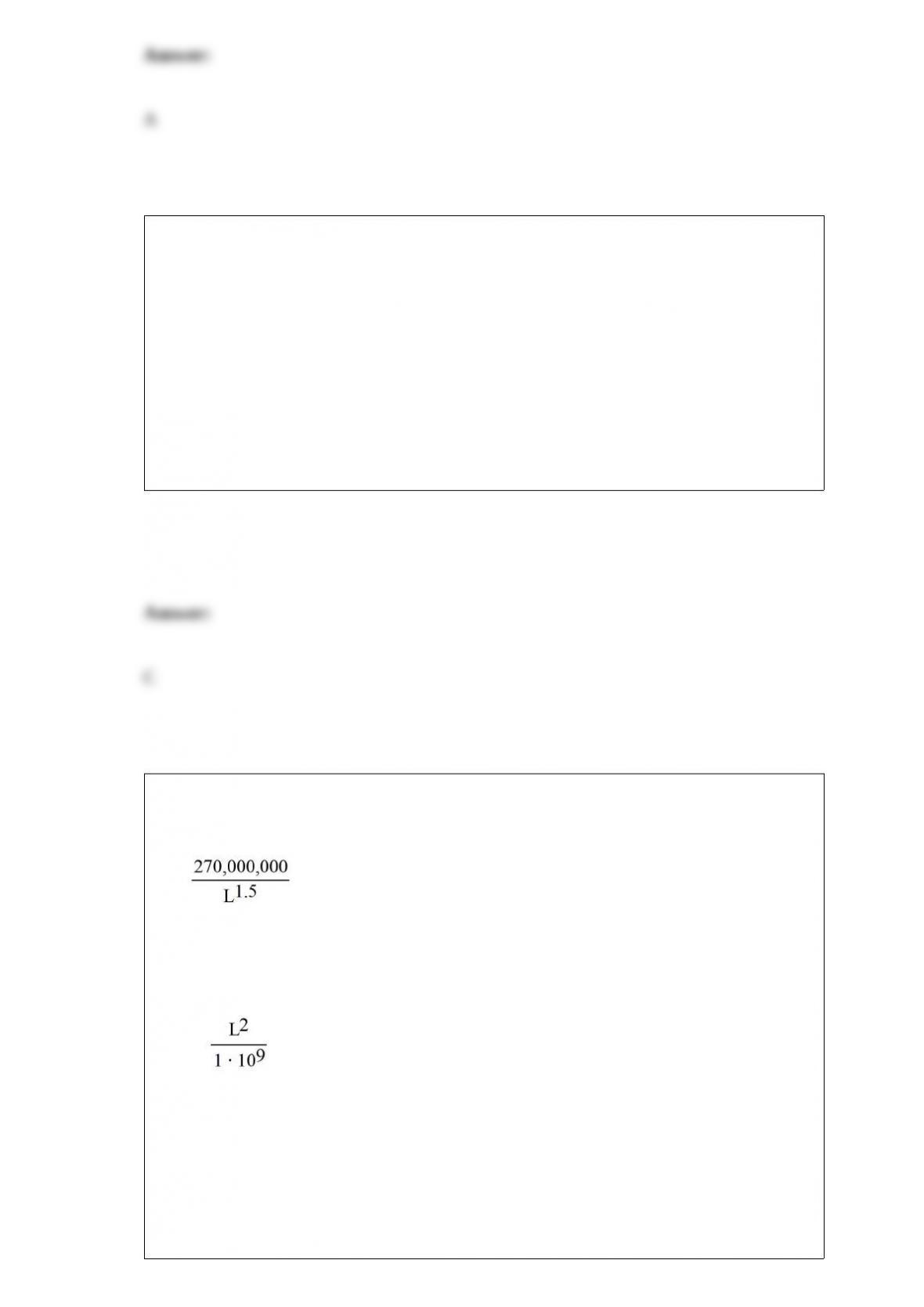
labor services, the demand for labor is expressed as:
W =
where W is wage rate (dollars per hour) and L is number employed per unit of time. The
no shirking constraint (NSC) is expressed as:
NSC =
where NSC is the minimum wage workers need not to shirk, and L is the number
employed per unit of time. Assume that the labor force L* = 150,000. Determine the
following:
a. the level of unemployment that would result when firms pay the efficiency wage
b. the market clearing wage
c. the efficiency wage
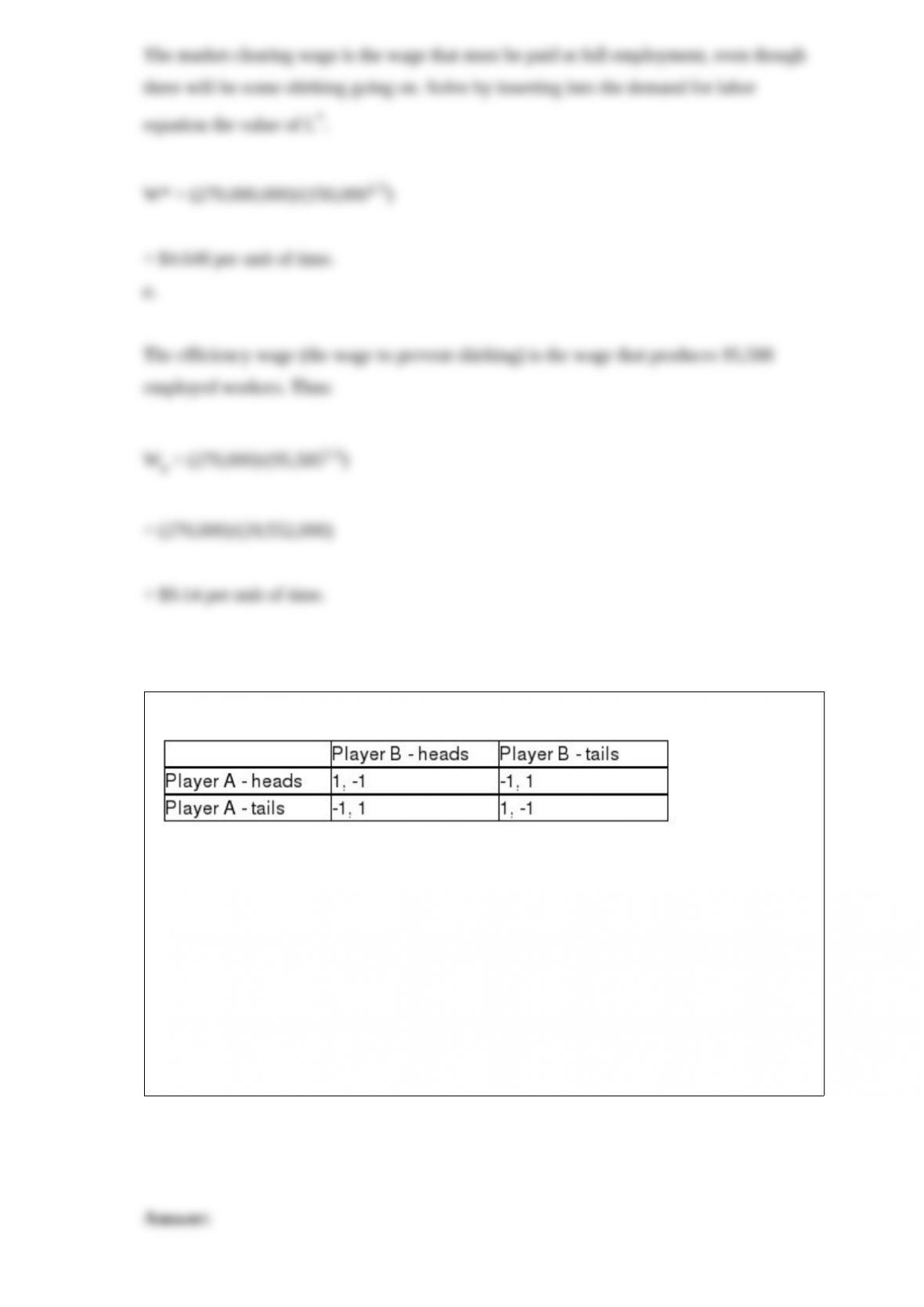
Consider the Matching Pennies game:
Suppose both players use maximin strategies for this game. Is there a clear equilibrium
outcome to the game in this case?
A) Yes, both players select heads
B) Yes, both players select tails
C) No, both players face the minimum payoff (-1) under both actions.
D) We do not have enough information to answer this question.

The consumer’s gain from the imposition of a price ceiling is higher when
A) the own price elasticity of market demand is high and the price elasticity of market
supply is high.
B) the own price elasticity of market demand is high and the price elasticity of market
supply is low.
C) the own price elasticity of market demand is low and the price elasticity of market
supply is high.
D) the own price elasticity of market demand is low and the price elasticity of market
supply is low.
If an individual has $10,000 in a savings account paying 3% and the inflation rate is
2%, the nominal interest rate is
A) 3% and the real rate is 5%.
B) 5% and the real rate is 7%.
C) 5% and the real rate is 3%.
D) 3% and the real rate is 1%.
E) 5%.
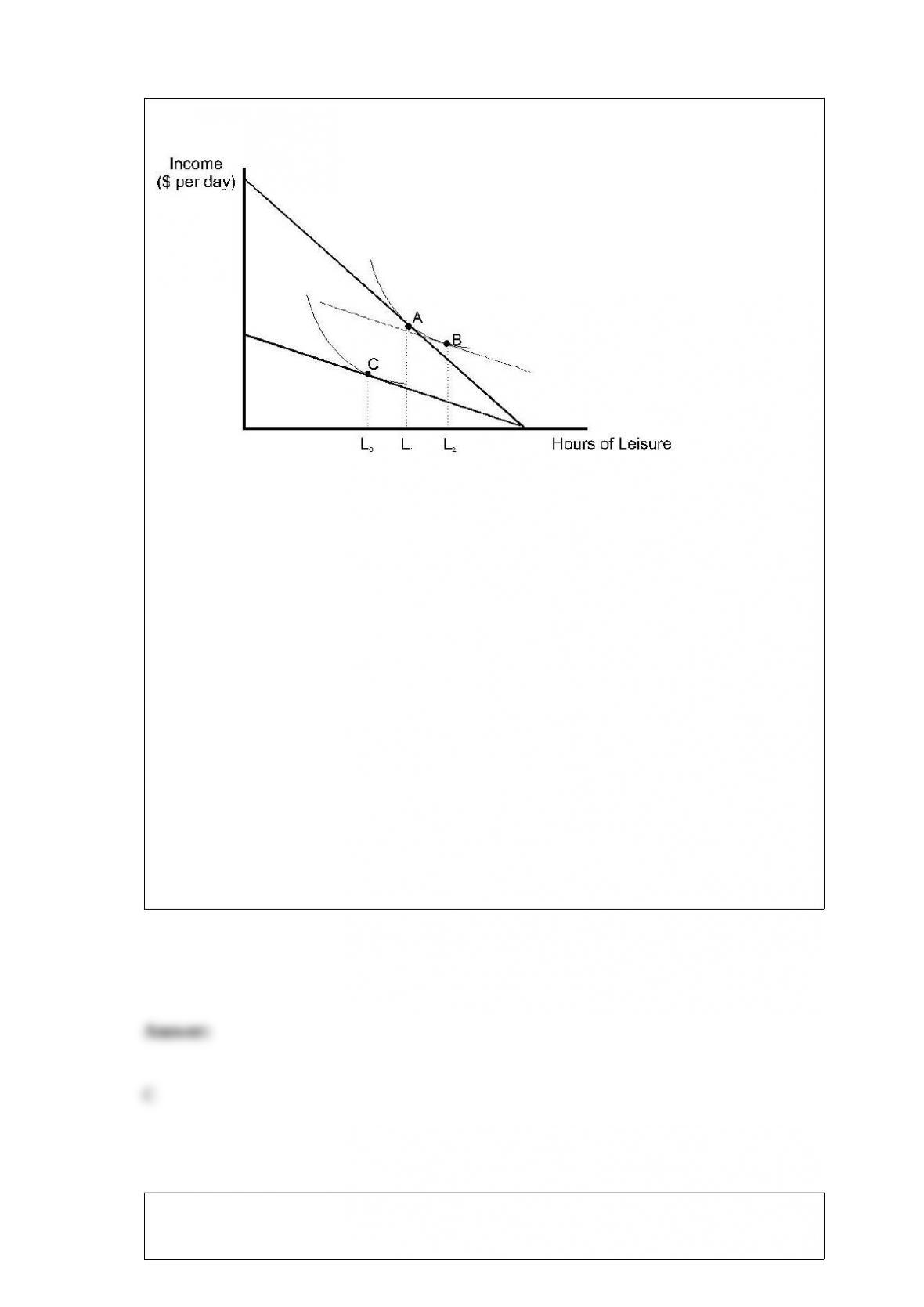
Figure 14.2
A consumer’s original utility maximizing combination of income and leisure is shown
in the diagram above as point A. After a wage decrease, the consumer’s utility
maximizing combination changes to point C.
Refer to Figure 14.2. The substitution effect of the wage decrease on the amount of
hours of leisure is:
A) L1 to L0.
B) L0 to L1.
C) L1 to L2.
D) L2 to L0.
E) none of the above
The “core” inflation rate is typically defined as the change in consumer prices for all
goods included in the CPI basket except energy and food products. Suppose the overall

inflation rate based on the CPI was 4 percent for the past year, and energy and food
prices did not change during the year. Is the core inflation rate for the past year higher
or lower than 4 percent?
A) Higher
B) Lower
C) They are the same
D) We do not have enough information to answer this question
In 1992, the Occupational Safety and Health Authority passed the Bloodborne
Pathogens Standard (BBP), which regulates dental office procedures. This regulation is
designed to minimize the transmission of infectious disease from patient to dental
worker. The effect of this regulation was both to increase the cost of providing dental
care and to ease the fear of going to the dentist as the risk of contracting an infectious
disease.
Under what circumstances will the equilibrium level of output of dental care increase?
A) If supply shifts more than demand.
B) If demand shifts more than supply.
C) If both demand and supply shift by the same magnitude.
D) If supply and demand both decrease.
Suppose the aggregate demand for housing in the U.S. includes a substantial
speculative component. What happens of the expectations of speculators change, and
they believe housing prices will not increase in the future?
A) The aggregate demand curve shifts leftward, and the equilibrium market price
declines.
B) The aggregate demand curve shifts leftward, and the equilibrium market price
increases.
C) The speculative demand curve shifts leftward, but the aggregate demand curve is
unchanged.
D) There is no change in the current demand for housing because speculators’
expectations are based on future events.
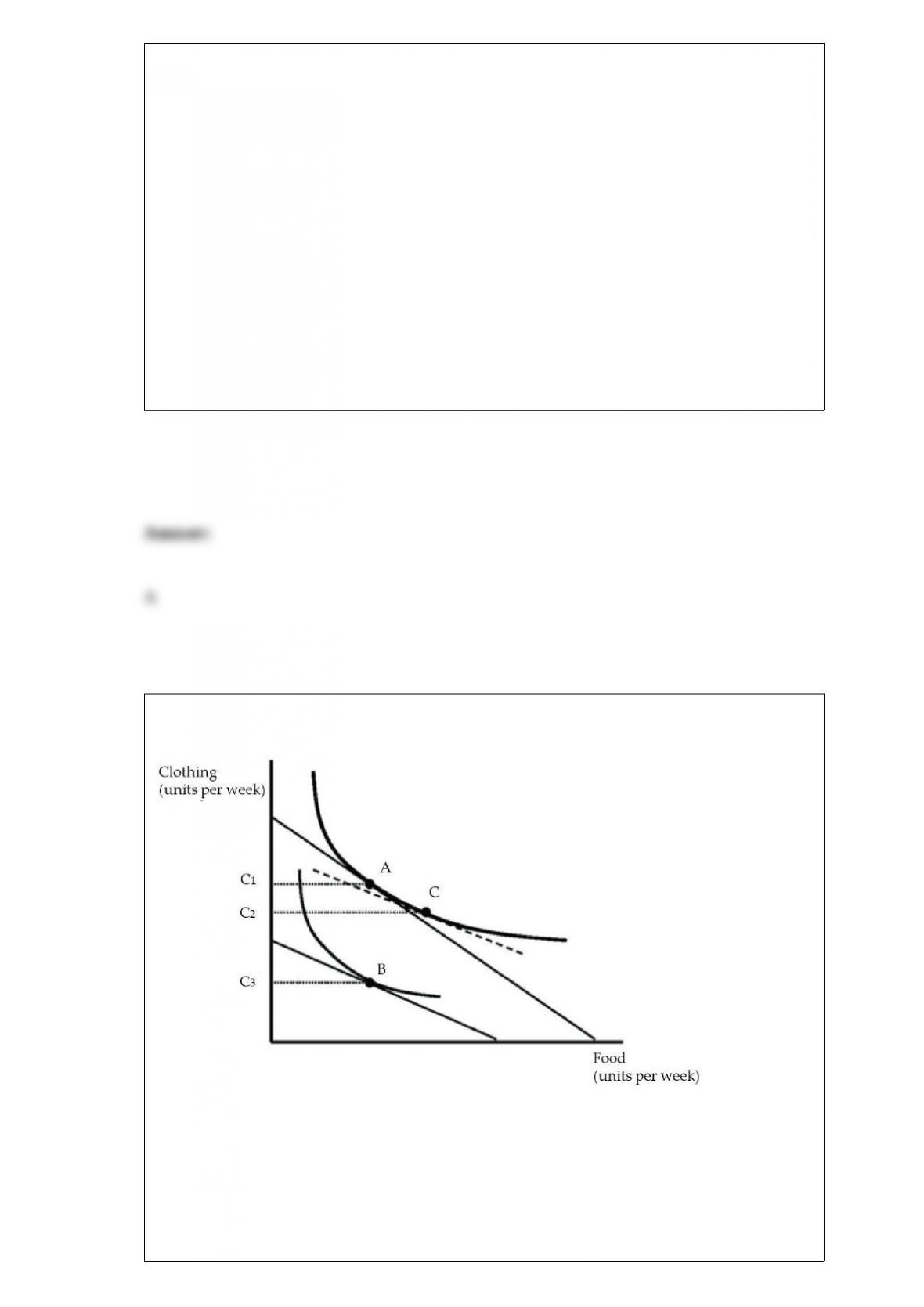
Figure 4.2
A consumer’s original utility maximizing market basket of goods is shown in Figure 4.2
as point A. Following a price change, the consumer’s utility maximizing market basket
is at point B.
Refer to Figure 4.2. The substitution effect on the quantity of clothing purchased is:

A) the change from C3 to C1.
B) the change from C3 to C2.
C) the change from C2 to C1.
D) the change from C1 to C2.
E) none of the above
A national chain of bookstores has initiated a frequent buyer program. If you buy a
frequent buyer card for $10, you are entitled to a 10 percent discount on all purchases
for 1 year. This practice is an example of:
A) peak-load pricing.
B) intertemporal price discrimination.
C) two-part tariff.
D) bundling.
E) Both A and B are correct.
An example of monopoly power in input markets is

A) major league baseball owners in the market for player services.
B) the United Auto Workers union in the market for auto worker services.
C) OPEC in the market for crude oil.
D) all of the above
Having a refundable deposit for recyclable material
A) raises the marginal private cost of disposal.
B) raises the marginal social cost of disposal.
C) lowers the marginal private cost of disposal.
D) lowers the marginal social cost of disposal.
E) does not affect disposal costs.
Use the following statements to answer this question:
I. Markets that have only a few sellers cannot be highly competitive.
II. Markets with many sellers are always perfectly competitive.
A) I and II are true.

B) I is true and II is false.
C) II is true and I is false.
D) I and II are false.
The standard deviation of a two-asset portfolio (with a risky and a non-risky asset) is
equal to
A) the fraction invested in the risky asset times the standard deviation of the non-risky
asset.
B) the fraction invested in the non-risky asset times the standard deviation of the risky
asset.
C) the fraction invested in the risky asset times the standard deviation of that asset.
D) the fraction invested in the non-risky asset times the standard deviation of that asset.
According to the law of diminishing returns
A) the total product of an input will eventually be negative.
B) the total product of an input will eventually decline.
C) the marginal product of an input will eventually be negative.

D) the marginal product of an input will eventually decline.
E) none of the above
When the market price is held above the competitive level, the deadweight loss is
composed of:
A) producer surplus losses associated with units that used to be traded on the market but
are no longer exchanged.
B) consumer surplus losses associated with units that used to be traded on the market
but are no longer exchanged.
C) producer and consumer surplus losses associated with units that used to be traded on
the market but are no longer exchanged.
D) There is no deadweight loss if the government uses a price floor policy to increase
the price.
Scenario 5.8:
Risk-neutral Icarus Airlines must commit now to leasing 1, 2, or 3 new airplanes. It
knows with certainty that on the basis of business travel alone, it will need at least 1
airplane. The marketing division says that there is a 50% chance that tourism will be big
enough for a second plane only. Otherwise, tourism will be big enough for a third plane.

This, plus revenue information, yields the following table:
Planes Tourism Revenue Expected
Leased Light Heavy Profit
2 $90 million $30 million $60 million
3 $10 million $140 million $75 million
Refer to Scenario 5.8. Given that the two outcomes are equally likely, Icarus Airlines’
expected profit under complete information would be
A) $40 million.
B) $90 million.
C) $115 million.
D) $120 million.
E) $125 million.
Which of the following is a positive statement?
A) Intermediate microeconomics should be required of all economics majors in order to
build a solid foundation in economic theory.
B) The minimum wage should not be increased because this action would increase
unemployment.
C) Smoking should be restricted on all airline flights.
D) All automobile passengers should be required to wear seatbelts in order to protect
them against injury.
E) none of the above

Which of the following is NOT an application of supply and demand analysis?
A) Understanding changing world economic conditions and their effects on prices
B) Evaluating the effects of government price controls on the agricultural industry
C) Determining how taxes affect aggregate consumption spending patterns
D) all of the above
E) none of the above
When a monopolist engages in perfect price discrimination,
A) the marginal revenue curve lies below the demand curve.
B) the demand curve and the marginal revenue curve are identical.
C) marginal cost becomes zero.
D) the marginal revenue curve becomes horizontal.

The price of good A goes up. As a result, the demand for good B shifts to the left. From
this we can infer that:
A) good A is used to produce good B.
B) good B is used to produce good A.
C) goods A and B are substitutes.
D) goods A and B are complements.
E) none of the above
The monopolist that maximizes profit
A) imposes a cost on society because the selling price is above marginal cost.
B) imposes a cost on society because the selling price is equal to marginal cost.
C) does not impose a cost on society because the selling price is above marginal cost.
D) does not impose a cost on society because price is equal to marginal cost.
Price elasticity of demand measures the
A) slope of the demand curve.

B) sensitivity of quantity demanded to changes in the price of substitute goods.
C) sensitivity of price to changes in the quantity demanded of substitute goods.
D) sensitivity of quantity demanded to changes in price.
Which is a stock variable?
A) Labor
B) Profit
C) Income
D) Capital
E) Price
An increase in income, holding prices constant, can be represented as:
A) a change in the slope of the budget line.
B) a parallel outward shift in the budget line.
C) an outward shift in the budget line with its slope becoming flatter.
D) a parallel inward shift in the budget line.

Use the following statements to answer this question:
I. A player must have at least one dominant strategy in a game.
II. If neither player in a game has a dominant strategy in a game, then there is no
equilibrium outcome for the game.
A) I and II are true.
B) I is true and II is false.
C) II is true and I is false.
D) I and II are false.
Consider the following diagram where a perfectly competitive firm faces a price of $40.
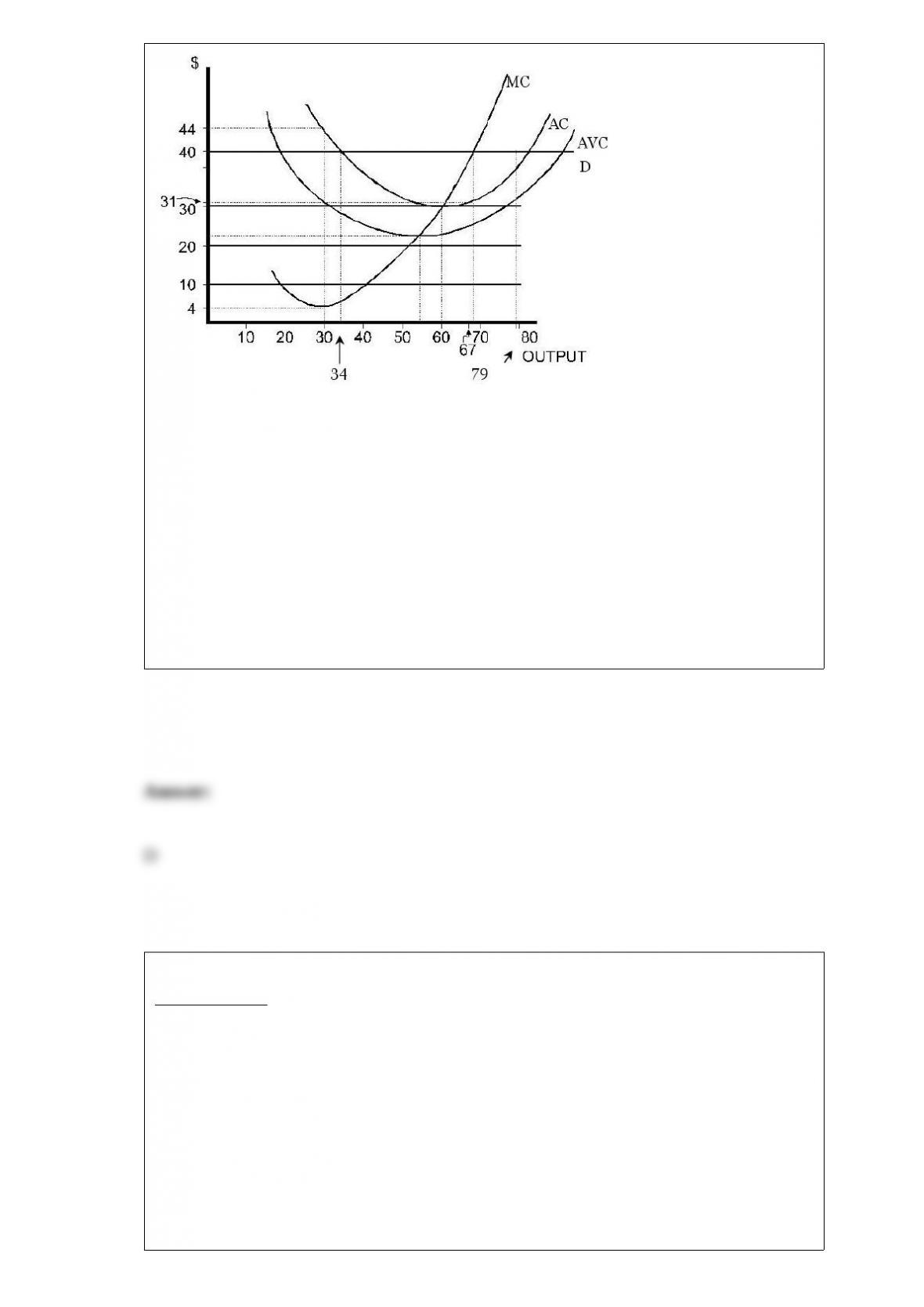
At the profit-maximizing level of output, total revenue is
A) $1200.
B) $2160.
C) $2400.
D) $2680.
E) $3160.
Scenario 10.2:
A monopolist faces the following demand curve, marginal revenue curve, total cost
curve and marginal cost curve for its product:
Q = 200 – 2P
MR = 100 – Q
TC = 5Q

MC = 5
Refer to Scenario 10.2. What level of output maximizes total revenue?
A) 0
B) 90
C) 95
D) 100
E) none of the above