1)
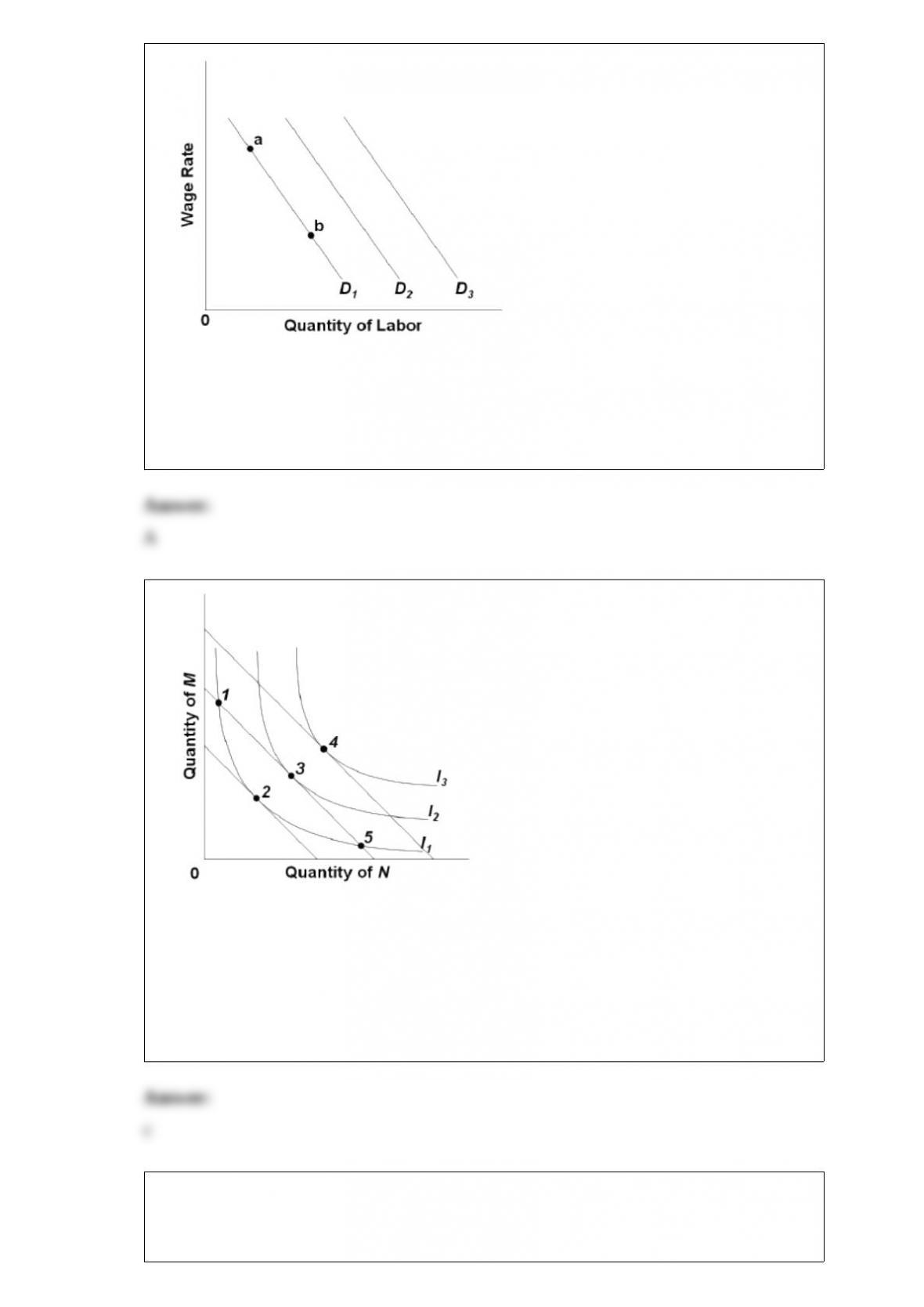
Refer to the above graph. An increase in labor demand is shown by the:
A.shift from labor demand curve D1 to D2.
B.shift from labor demand curve D3 to D2.
C.move from a to b along labor demand curve D1.
D.move from b to a along labor demand curve D1.
2)
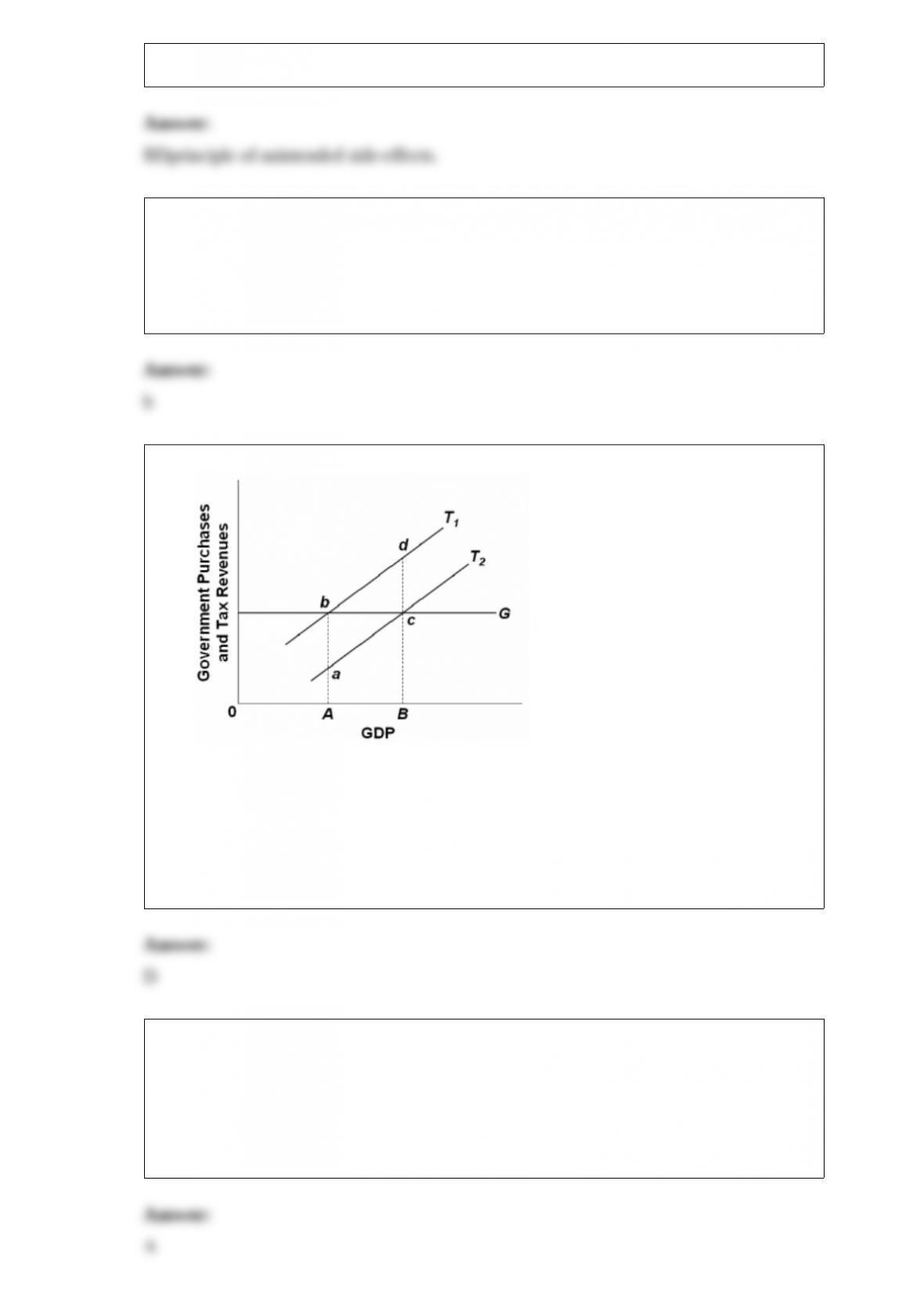
refer to the above diagram in which the downsloping linear lines are budget lines and
i1, i2, and i3 comprise an indifference map. the combinations of products m and n
indicated by points 1, 2, and 5 are such that:
a.point 2 yields more utility than either 1 or 5
b.points 1 and 5 yield more utility than point 2
c.points 1, 2, and 5 yield equal amounts of utility.
d.the levels of utility associated with these three points cannot be compared.
3) (Last Word) “The Case of ATMs” best illustrates the:
A.law of diminishing marginal utility.
B.the substitutability of resources.
C.idea of derived demand.
4) economic profit in the long run is:
a.possible for both a pure monopoly and a pure competitor.
b.possible for a pure monopoly, but not for a pure competitor.
c.impossible for both a pure monopolist and a pure competitor.
d.only possible when barriers to entry are nonexistent.
5)
Refer to the above diagram. Assume that G and T1 are the relevant curves, the economy
is currently at A, and the full-employment GDP is B. This economy has a(n):
A.standardized budget deficit.
B.actual budget deficit.
C.actual budget surplus.
D.neither a surplus nor deficit in the actual budget.
6) If the Fed were to increase the amount of reserves available through the term auction
facility, we would anticipate:
A.lower interest rates, an expanded GDP, and depreciation of the dollar.
B.lower interest rates, an expanded GDP, and appreciation of the dollar.
C.higher interest rates, a contracted GDP, and depreciation of the dollar.
D.lower interest rates, a contracted GDP, and appreciation of the dollar.
7) Which of the following ideas most directly relates to R&D expenditures?
A.increasing cost industries
B.inverted-U theory
C.a cartel
D.kinked-demand curve
8) In which of the following U.S. occupations is the rate of unionization the highest?
A.protective services
B.sales workers
C.managers
D.transportation workers
9)
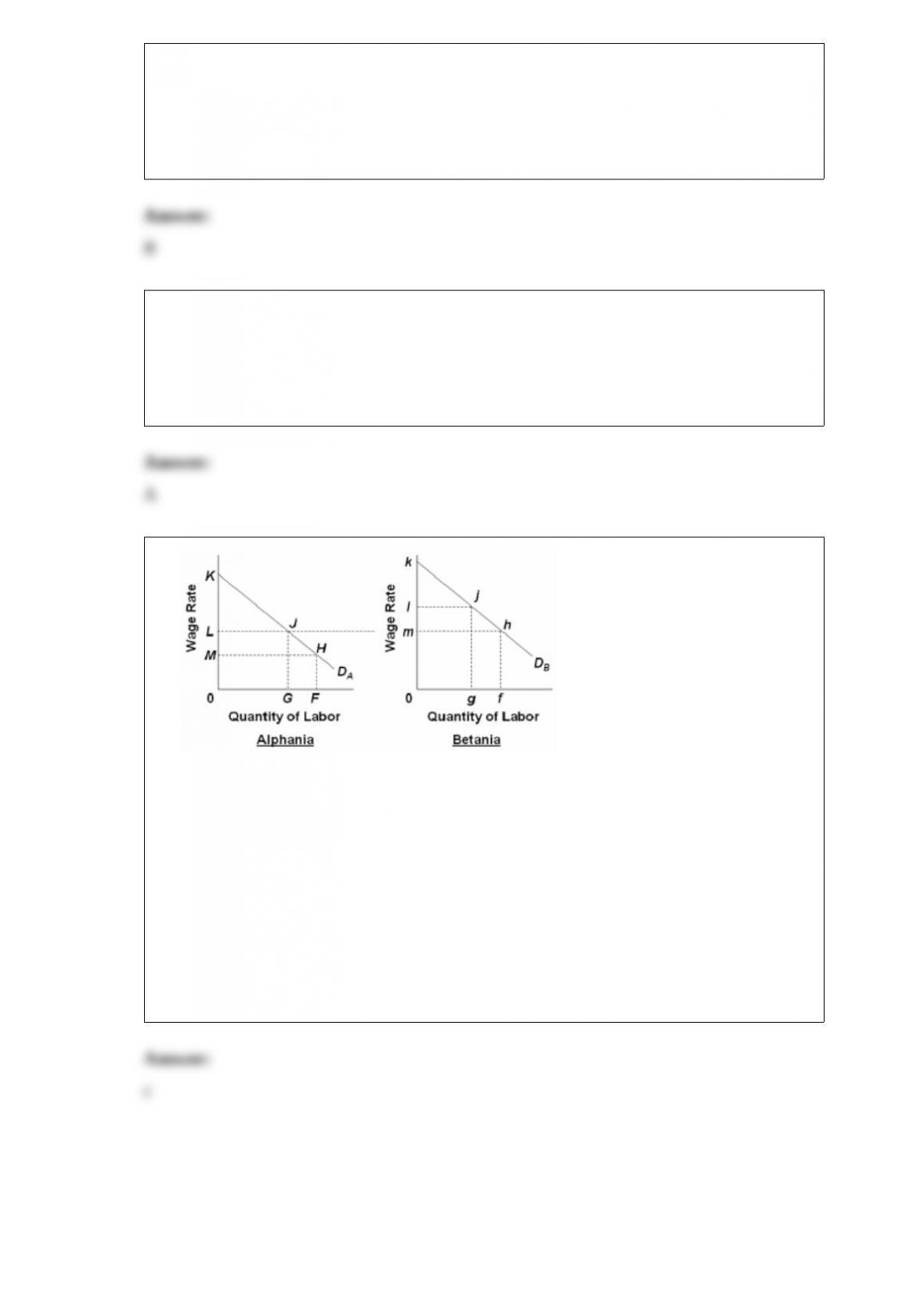
assumptions: (1) the demand for labor in alphania and betania are as shown by da and
db, respectively; (2) alphania’s native labor force is f and that of betania is g; (3) wage l
in alphania is equal to wage m in betania; and (4) full employment exists in both
countries.
refer to the above diagram and assumptions. after migration has ceased:
a.world output will have increased by mljh – mljh.
b.betania’s output will have increased and alphania’s output will have decreased, but
world output will not have changed.
c.world output will have increased by gjhf – gjhf.
d.world output will have decreased by gjhf – gjhf.
10)
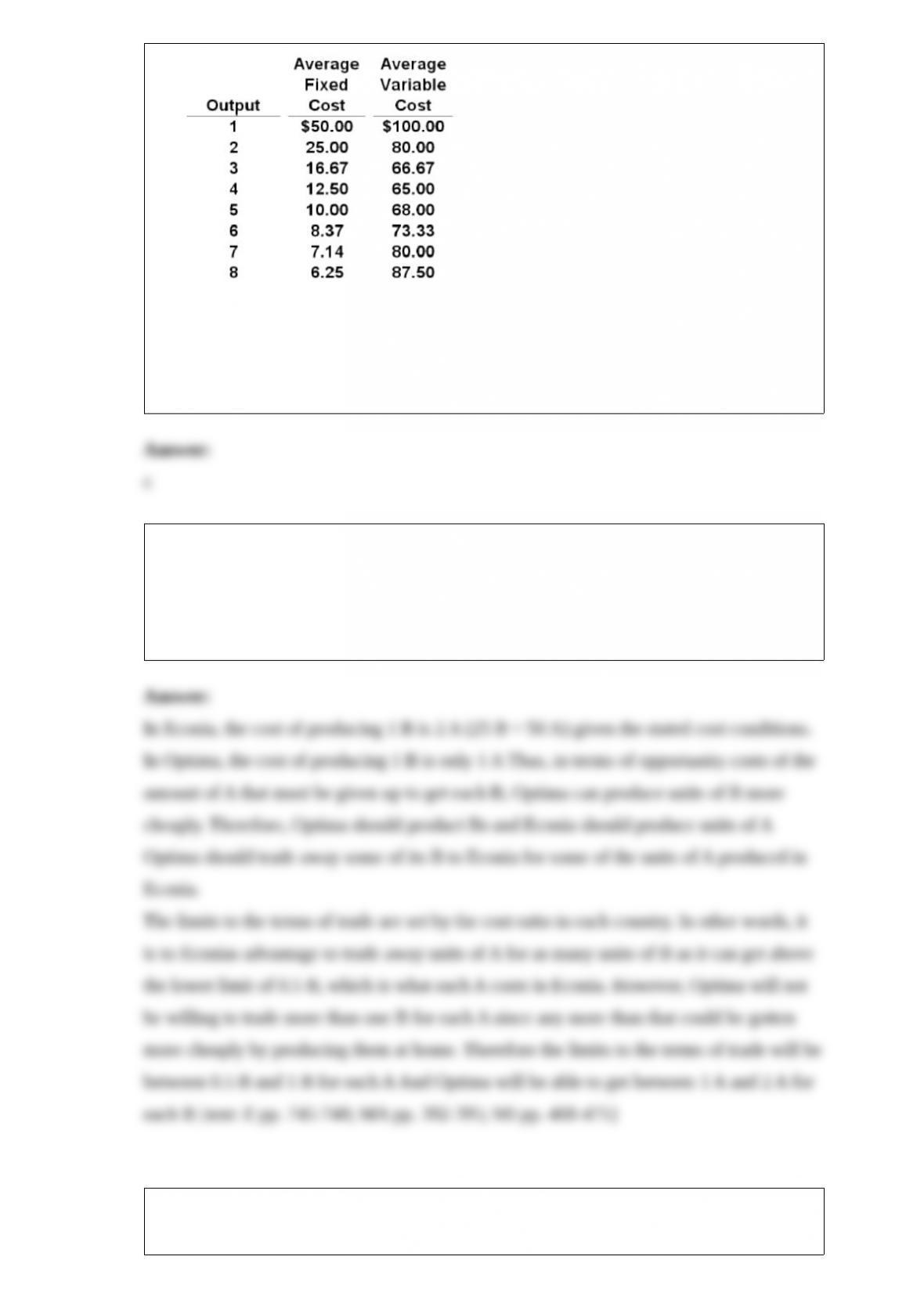
refer to the above data. the total cost of four units of output is:
a.$260.
b.$77.50.
c.$310.
d.$215.
11) Suppose that by devoting all of its resources to the production of A, the nation of
Econia can produce 50 A. By devoting all of its resources to the production of B,
Econia can produce 25 B. The comparable figures for the nation of Optima are 5 A and
5 B. According to the principle of comparative advantage, which nation will specialize
in which product? What are the limits to the terms of trade?
12) Suppose that technological advancements stimulate $20 billion in additional
investment spending. If the MPC = 0.6, how much will the change in investment

increase aggregate demand?
A.$12 billion.
B.$20 billion.
C.$33.3 billion.
D.$50 billion.
13) which of the following is a capital resource?
a.a computer programmer
b.a corporate bond issued by a computer manufacturer
c.silicon (sand) used to make computer chips
d.a piece of software used by a firm
14) it is generally agreed that in the long run the cost of private health insurance
provided by employers is:
a.at the expense of business profits.
b.at the expense of real wages.
c.paid by taxpayers through government.
d.included as taxable income for income tax purposes.
15) If investment decreases by $20 billion and the economy’s MPC is .5, the aggregate
demand curve will shift:
A.leftward by $40 billion at each price level.
B.rightward by $20 billion at each price level.
C.rightward by $40 billion at each price level.
D.leftward by $20 billion at each price level.
16) It may be misleading to label a trade deficit as unfavorable or adverse because:
A.the multiplier does not apply to a trade deficit.
B.a trade deficit increases a nation’s aggregate output and employment.
C.a nation’s consumers benefit from a trade deficit during the period it occurs.
D.a trade deficit precludes inflation.
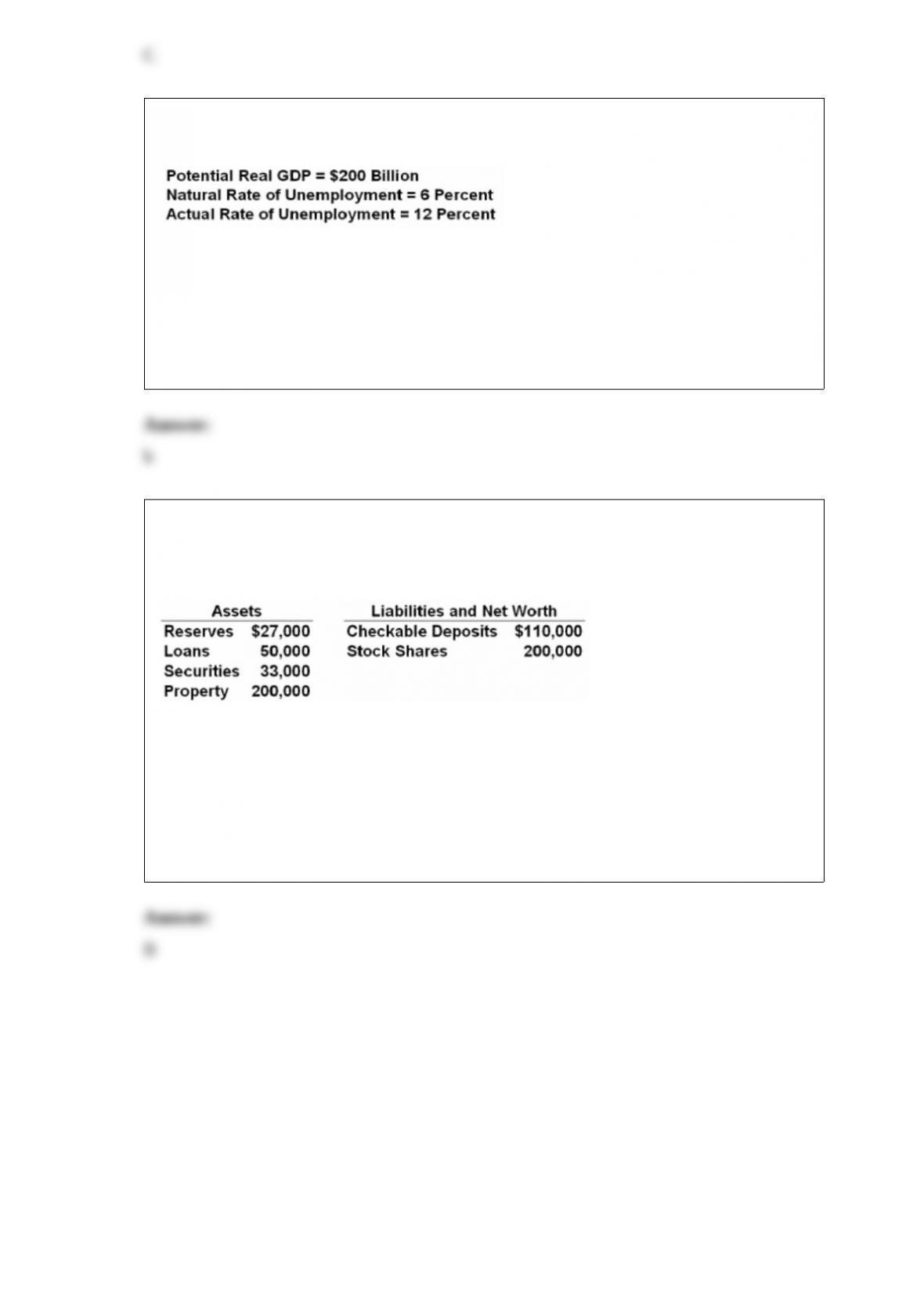
17) answer the next question(s) on the basis of the following information for a specific
year in a hypothetical economy for which okun’s law is applicable:
refer to the above data. the size of the negative gdp gap as a percent of potential gdp for
the above economy is:
a.9 percent.
b.12 percent.
c.15 percent.
d.18 percent.
18) The following balance sheet for the ABC National Bank in answering the next
question(s). Assume the required reserve ratio is 20 percent.
Refer to the above data. Assuming the bank loans out all of its remaining excess
reserves as a checkable deposit, and has a check cleared against it for that amount, its
reserves and checkable deposits will now be:
A.$25,000 and $122,000 respectively.
B.$22,000 and $110,000 respectively.
C.$32,000 and $115,000 respectively.
D.$22,000 and $105,000 respectively.