
Scenario 21-1. Take the following information as given for a small, imaginary
economy:
When income is $10,000, consumption spending is $6,500.
When income is $11,000, consumption spending is $7,300.
Refer to Scenario 21-1. For this economy, an initial increase of $500 in net exports
translates into a
a. $2,000 increase in aggregate demand when the crowding-out effect is taken into
account.
b. $2,500 increase in aggregate demand when the crowding-out effect is taken into
account.
c. $2,000 increase in aggregate demand in the absence of the crowding-out effect.
d. $2,500 increase in aggregate demand in the absence of the crowding-out effect.
Which of the following is likely to have the most price elastic demand?
a. lattés
b. doctor’s visits
c. eggs
d. natural gas

Because it is difficult for economists to use experiments to generate data, they generally
must
a. do without data.
b. substitute assumptions for data when data are unavailable.
c. rely upon hypothetical data that were previously concocted by other economists.
d. use whatever data the world gives them.
In the open economy macroeconomic model, the amount of dollars demanded in the
market for foreign-currency exchange at a given real exchange rate increases if
a. either U.S. imports or exports increase.
b. either U.S. imports or exports decrease.
c. either U.S. imports increase or U.S. exports decrease.
d. either U.S. imports decrease or U.S. exports increase.
Figure 9-3. The domestic country is China.
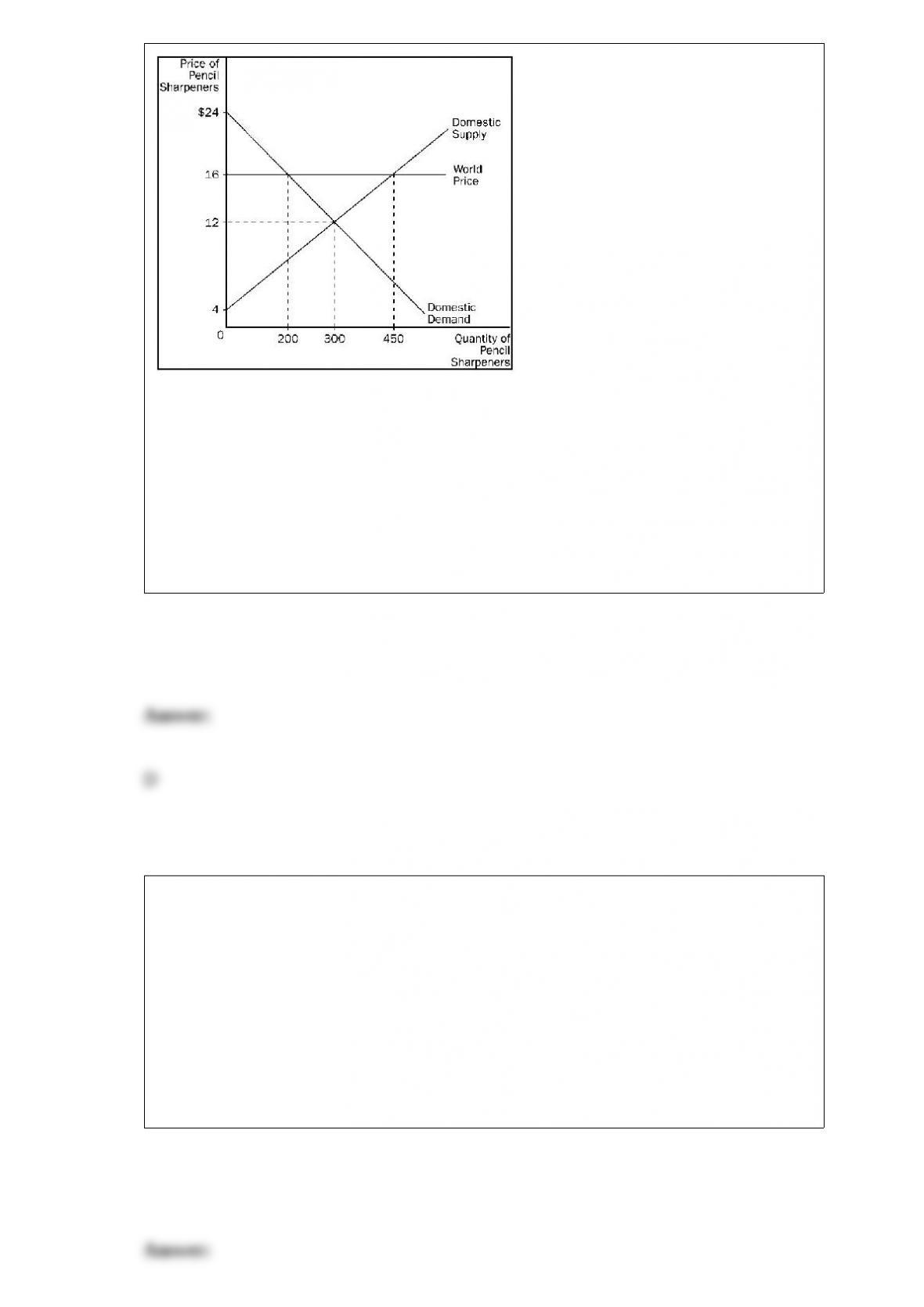
Refer to Figure 9-3. With trade, producer surplus in China is
a. $800.
b. $1,200.
c. $1,800.
d. $2,700.
According to the rule of 70, if the interest rate is 5 percent, how long will it take for the
value of a savings account to double?
a. about 5 years
b. about 3 years
c. about 12 years
d. about 14 years

When a country experiences capital flight its
a. net capital outflow increases and its real exchange rate rises.
b. net capital outflow increases and its real exchange rate falls.
c. net capital outflow decreases and its real exchange rate rises.
d. net capital outflow decreases and its real exchange rate falls.
In the market for oil in the short run, demand
a. and supply are both elastic.
b. and supply are both inelastic.
c. is elastic and supply is inelastic.
d. is inelastic and supply is elastic.
Suppose goods A and B are substitutes for each other. We would expect the cross-price

elasticity between these two goods to be
a. positive.
b. negative.
c. either positive or negative. It depends whether A and B are normal goods or inferior
goods.
d. either positive or negative. It depends whether the current price level is on the elastic
or inelastic portion of the demand curve.
If scientists discover that steamed milk, which is used to make lattés, prevents heart
attacks, what would happen to the equilibrium price and quantity of lattés?
a. Both the equilibrium price and quantity would increase.
b. Both the equilibrium price and quantity would decrease.
c. The equilibrium price would increase, and the equilibrium quantity would decrease.
d. The equilibrium price would decrease, and the equilibrium quantity would increase.
If consumers view cappuccinos and lattés as substitutes, what would happen to the
equilibrium price and quantity of lattés if the price of cappuccinos falls?
a. Both the equilibrium price and quantity would increase.

b. Both the equilibrium price and quantity would decrease.
c. The equilibrium price would increase, and the equilibrium quantity would decrease.
d. The equilibrium price would decrease, and the equilibrium quantity would increase.
Over the long run the Volcker disinflation
a. shifted the short-run and long-run Phillips curves left.
b. shifted the short-run, but not the long-run Phillips curve left.
c. shifted the long-run, but not the short-run Phillips curve left.
d. None of the above is correct.
The production possibilities frontier is used to illustrate some basic economic ideas,
including
a. scarcity.
b. opportunity cost.
c. economic growth.
d. All of the above are correct.

To which of the problems in the construction of the CPI is the creation of the mobile
phone most relevant?
a. substitution bias
b. introduction of new goods
c. unmeasured quality change
d. income bias
In the economy of Ukzten in 2010, consumption was one-half of GDP, government
purchases were $2000 more than investment, investment was one-sixth of GDP, and the
value of imports exceeded the value of exports by $500. What was Ukzten’s GDP in
2010?
a. $3000
b. $4500
c. $9000
d. $15,000

In an open economy, gross domestic product equals $1,950 billion, government
expenditure equals $280 billion, investment equals $500, and net capital outflow equals
$280 billion. What is consumption expenditure?
a. $280 billion
b. $780 billion
c. $890 billion
d. $1,170 billion
Policies that reduce the incentive for households to save include
a. means-testing.
b. College and university financial aid administration.
c. inheritance taxes.
d. All of the above.

Adam and Doug both build birdhouses. Adam works 20 hours a week and produces 12
bird houses. Doug works 30 hours a week and produces 15 bird houses. Which of the
following is correct?
a. Adam’s production and productivity are higher than Doug’s.
b. Adam’s production is higher than Doug’s, but Doug’s productivity is higher than
Adam’s.
c. Doug’s production is higher than Adam’s, but Adam’s productivity is higher than
Doug’s.
d. Doug’s production and productivity are higher than Adam’s.
If a 20% increase in price for a good results in a 15% decrease in quantity demanded,
the price elasticity of demand is
a. 0.75.
b. 1.25.
c. 1.33.
d. 1.60.
If a central bank decreases the money supply in response to an adverse supply shock,
then which of the following quantities moves closer to its pre-shock value as a result?

a. both the price level and output
b. the price level but not output
c. output but not the price level
d. neither output nor the price level
In the Summer of 2008, consumers indicated that they were less optimistic about the
future of the economy. Such a change in sentiment is likely to
a. shift aggregate demand to the right.
b. increase output.
c. increase unemployment.
d. increase prices.
The short-run Phillips curve shows the combinations of
a. unemployment and inflation that arise in the short run as aggregate demand shifts the
economy along the short-run aggregate supply curve.
b. unemployment and inflation that arise in the short run as short-run aggregate supply
shifts the economy along the aggregate demand curve.

c. real GDP and the price level that arise in the short run as short-run aggregate supply
shifts the economy along the aggregate demand curve.
d. None of the above is correct.
The CPI and the GDP deflator
a. generally move together.
b. generally show different patterns of movement.
c. always show identical changes.
d. always show different patterns of movement.
Figure 4-21
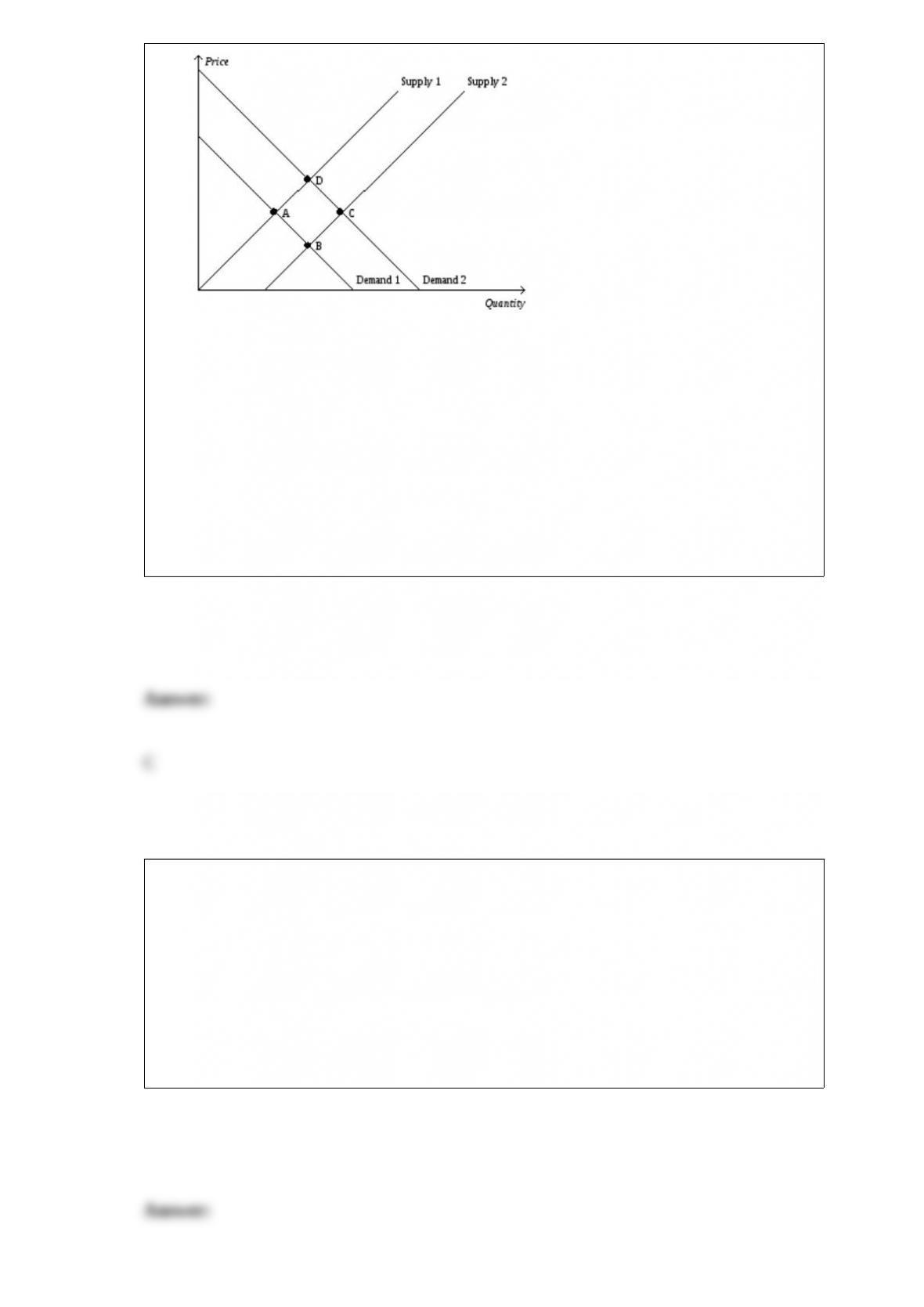
Refer to Figure 4-21. Which of the following movements would illustrate the effect in
the market for kitchen cabinets of an increase in the price of wood?
a. Point A to Point B
b. Point C to Point B
c. Point C to Point D
d. Point A to Point D
A decrease in U.S. interest rates leads to
a. a depreciation of the dollar that leads to greater net exports.
b. a depreciation of the dollar that leads to smaller net exports.
c. an appreciation of the dollar that leads to greater net exports.
d. an appreciation of the dollar that leads to smaller net exports.
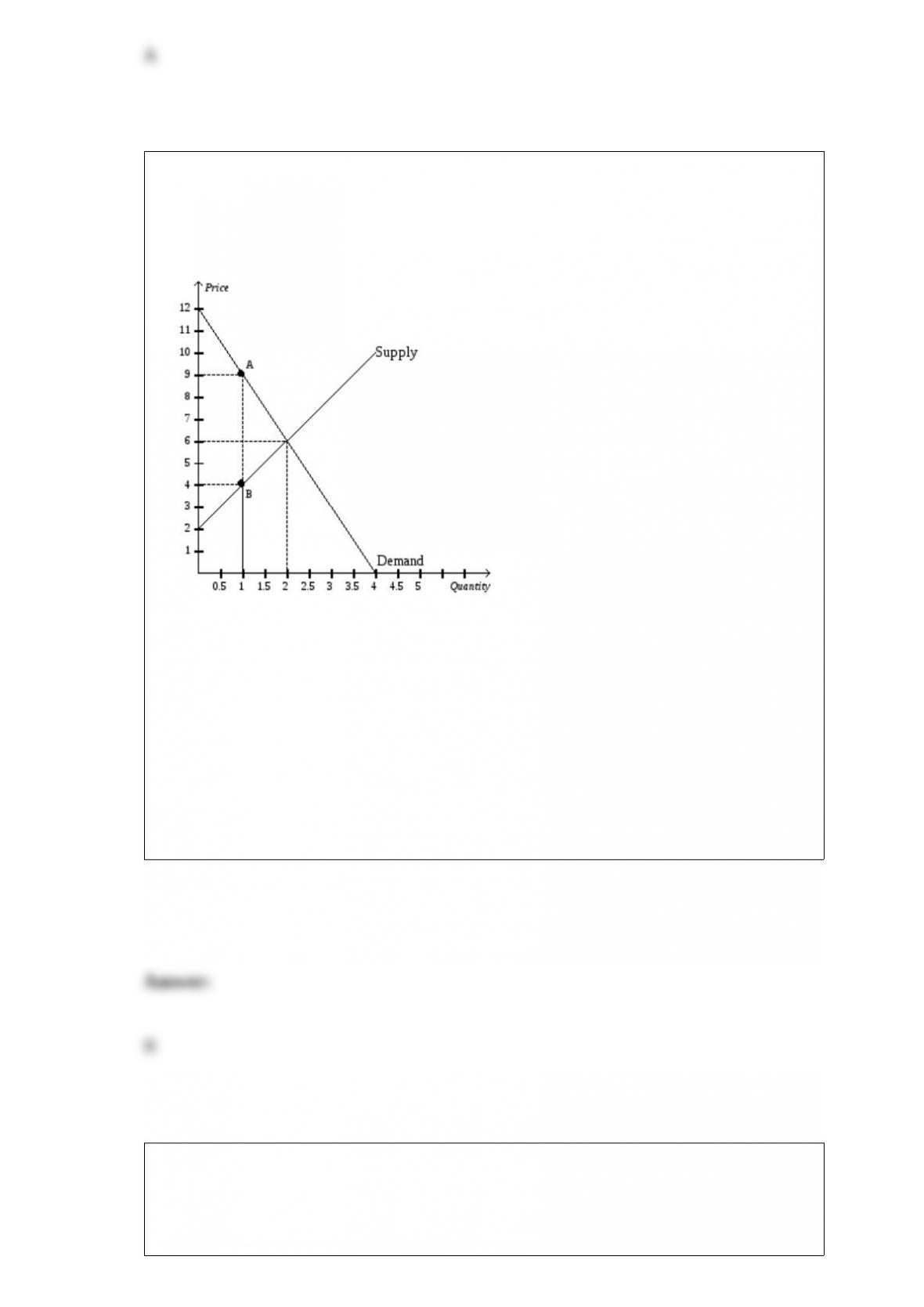
Figure 8-2
The vertical distance between points A and B represents a tax in the market.
Refer to Figure 8-2. The loss of consumer surplus associated with some buyers
dropping out of the market as a result of the tax is
a. $0.
b. $1.50.
c. $3.
d. $4.50.
The value of money rises as the price level
a. rises, because the number of dollars needed to buy a representative basket of goods
rises.

b. rises, because the number of dollars needed to buy a representative basket of goods
falls.
c. falls, because the number of dollars needed to buy a representative basket of goods
rises.
d. falls, because the number of dollars needed to buy a representative basket of goods
falls.
In the long run, fiscal policy influences
a. saving, investment, and growth; in the short run, fiscal policy primarily influences
technology and the production function.
b. saving, investment, and growth; in the short run, fiscal policy primarily influences
the aggregate demand for goods and services.
c. technology and the production function; in the short run, fiscal policy primarily
influences saving, investment, and growth.
d. the aggregate demand for goods and services; in the short run, fiscal policy primarily
influences technology and the production function.
Irregular fluctuations in economic activity are known as the
a. business cycle.
b. broken window fallacy.
c. tradeoff between inflation and unemployment.
d. ten principles of economics.
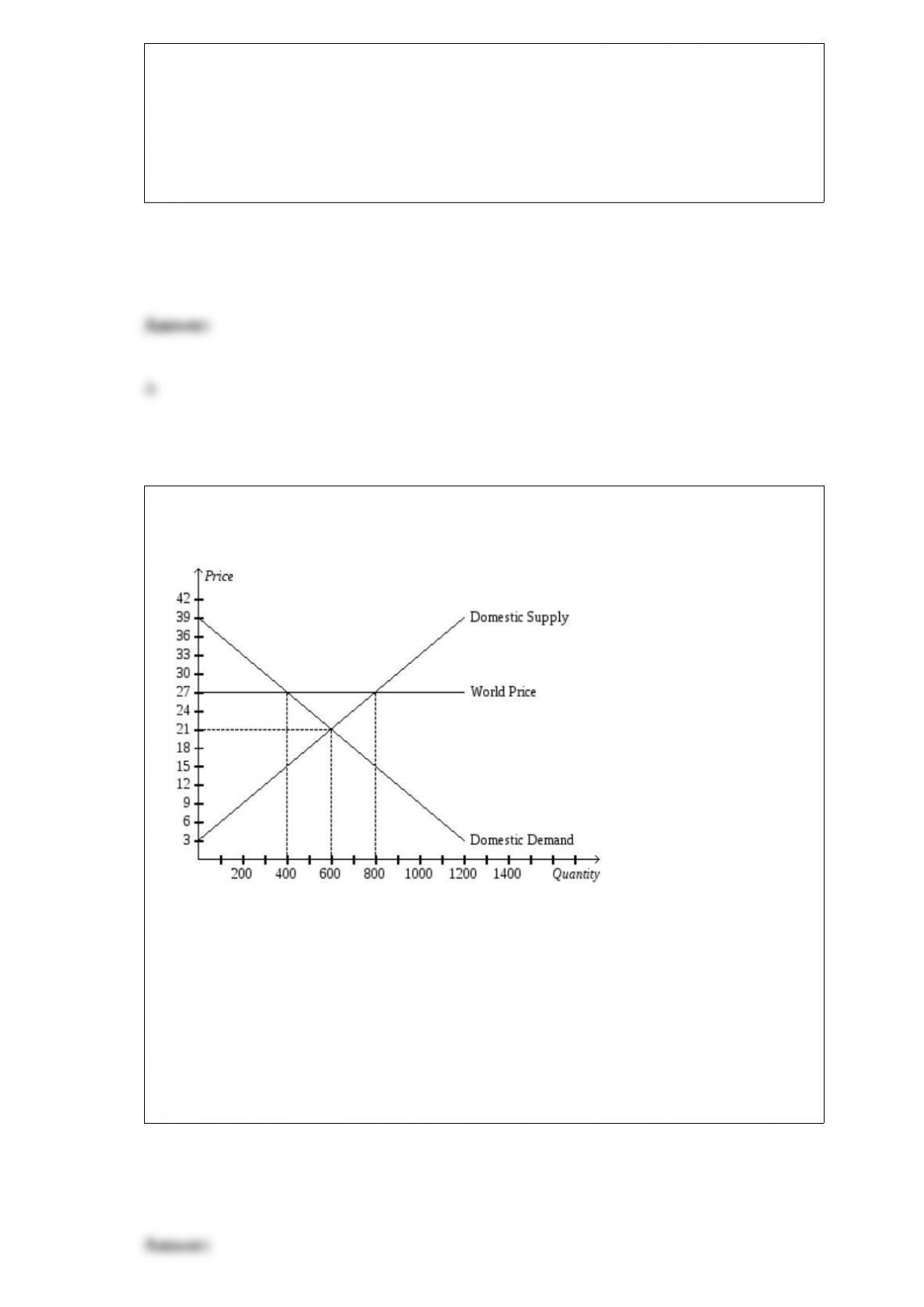
Figure 9-12
Refer to Figure 9-12. Consumer surplus after trade is
a. $1,600.
b. $2,400.
c. $3,200.
d. $3,600.

Data show that at least 20 percent of U.S. manufacturing jobs are destroyed every year.
Changes in inventory are included in the investment component of GDP.
Increasing the number of corporations whose stocks are in your portfolio reduces
market risk.
When the price of a good is high, selling the good is profitable, and so the quantity
supplied is large.

Henry can make a bird house in 3 hours and he can make a bird feeder in 1 hour. The
opportunity cost to Henry of making a bird house is 1/3 bird feeder.
The basic tools of supply and demand are central to microeconomic analysis but are of
little use to macroeconomics.
In general, demand curves for necessities tend to be price elastic.

The unemployment rate equals the percentage of the labor force that is unemployed.
Shoeleather costs and menu costs are both costs of anticipated inflation.
The large trade deficits in the United States in the 1990s were primarily associated with
a rise in domestic investment rather than a rise in the budget deficit.
A movement upward and to the left along a given demand curve is called a decrease in
demand.

GDP adds together many different kinds of products into a single measure of the value
of economic activity by using market prices.
Each week, the Bureau of Labor Statistics computes and reports the consumer price
index.
The population growth rate tends to be higher in developed countries than in developing
countries.
Deciding that A causes B when in fact B causes A is a mistake called omitted variable
bias.
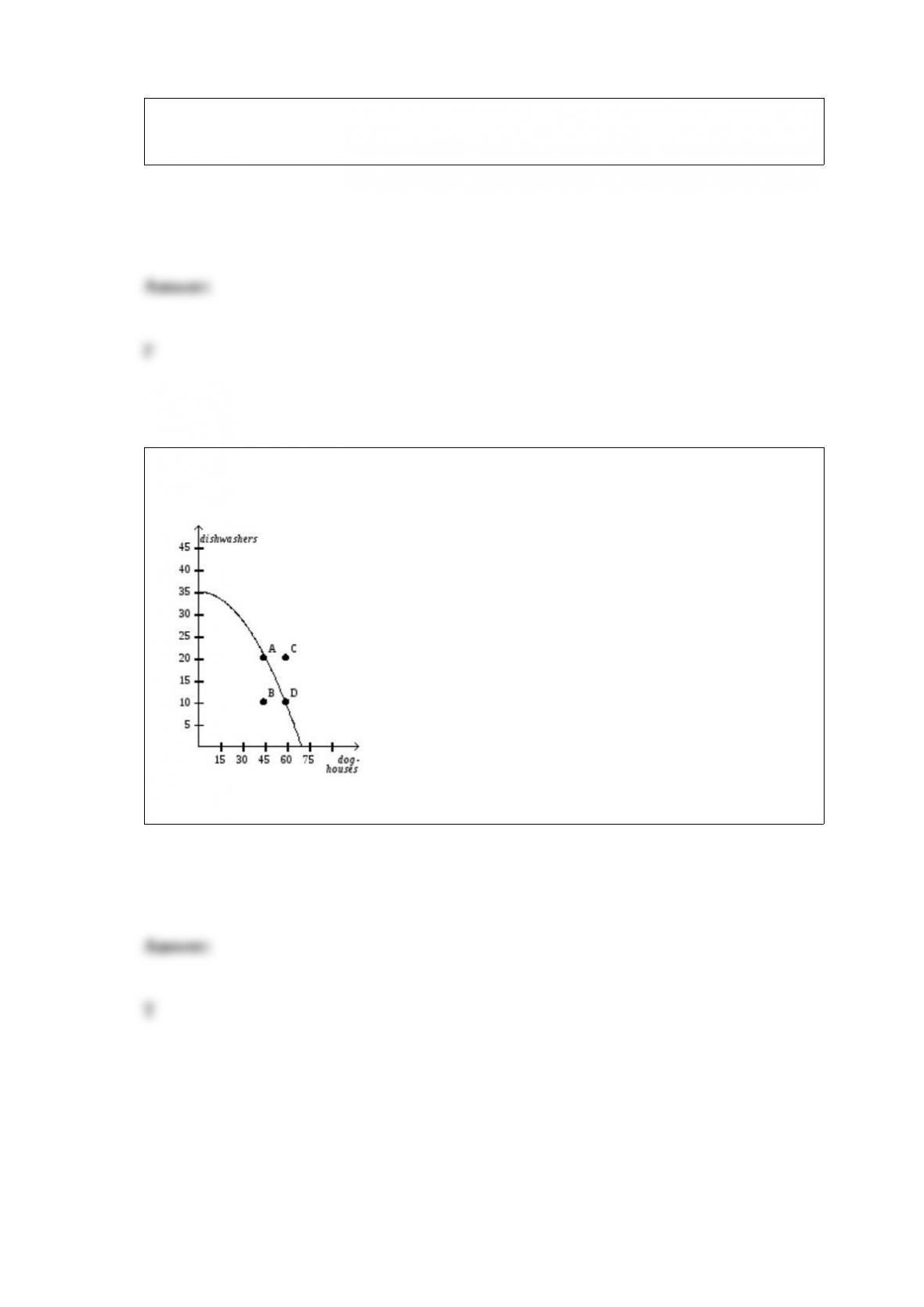
Figure 2-14
Refer to Figure 2-14. Point B represents an inefficient outcome for this economy.